Is Climbing the Duomo in Florence Worth It?

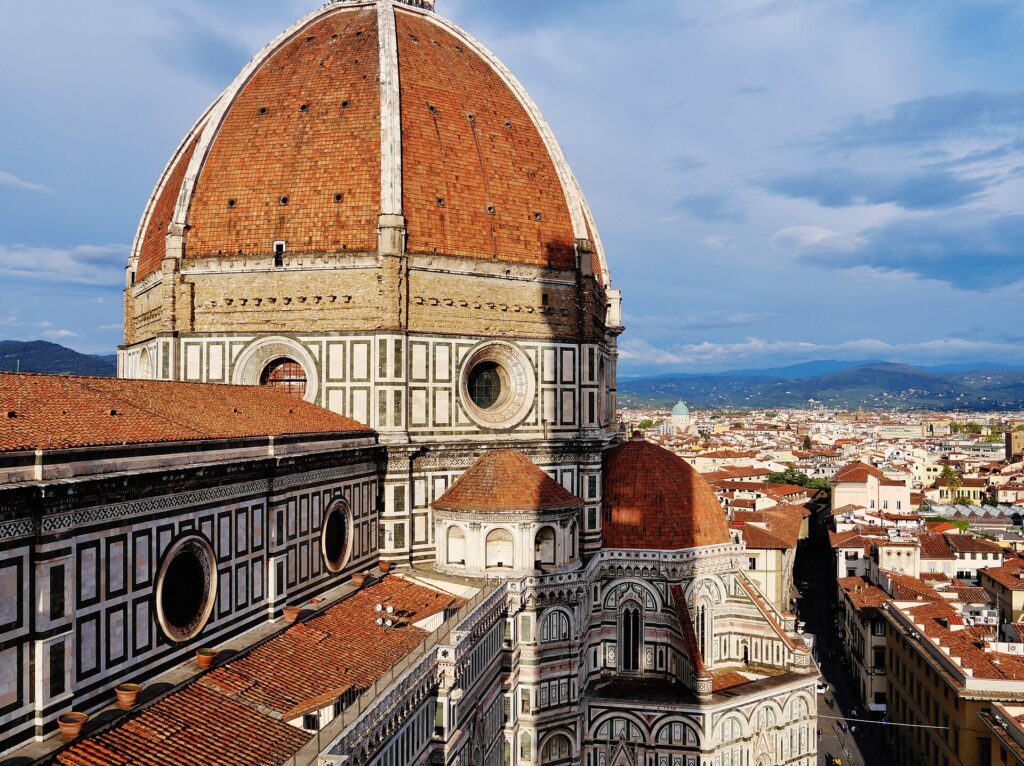
Short answer: yes, climbing the Duomo is worth it for anyone reasonably fit and not claustrophobic. The 463 steps take you past the Last Judgement frescoes up close, through the gap between Brunelleschi’s two shells and out onto a terrace above the whole of Florence. It is less rewarding if you want the Dome itself in your photos, dislike tight stairwells, or can’t commit to a fixed time slot days ahead.
Disclosure: this article contains links to GetYourGuide. If you book through them, People & Media may earn a small commission at no extra cost to you.
Key takeaways
- 463 steps, no lift. The stairs get narrower and steeper towards the top, and the final section is close to a ladder.
- You can’t buy a Dome-only ticket. The climb is only included in the Brunelleschi Pass, which costs €30 for adults at the time of writing and also covers the bell tower, museum, Baptistery and Santa Reparata.
- A time slot is mandatory, the ticket carries your name, and staff check photo ID at the entrance. Slots can’t be changed or refunded.
- Book well ahead from spring to autumn: popular morning and sunset slots go first.
- The best part isn’t only the view. The walkway around the inside of the drum, right below the frescoes, is the moment most people remember.
Why climb the Duomo at all?
Filippo Brunelleschi’s dome over Florence Cathedral (Santa Maria del Fiore) was finished in the 1430s without the wooden centring normally used to support a vault during construction. It is still the largest masonry dome ever built, and the climb goes through the structure itself, so you literally walk inside the engineering puzzle that made his name.
That is what separates it from most “go up a tall thing” attractions. The view at the top is excellent, but the route is the experience: you see the herringbone brickwork, the curve of the inner shell beside you, and the scale of the frescoes painted on the inside of the dome.
What the climb is actually like
Stage 1: up to the drum
You enter through the Porta della Mandorla on the north side of the cathedral and start with stone spiral staircases. This part is steady and not too narrow, and there are small windows and landings where you can pause.
Stage 2: the balcony inside the dome
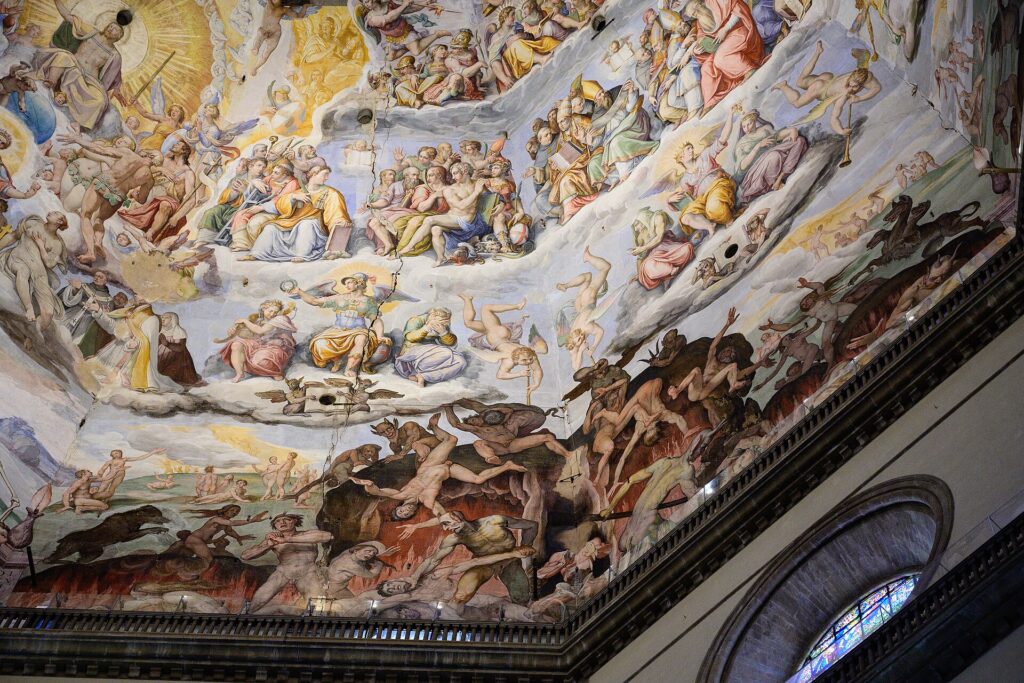
You then come out onto a walkway around the base of the dome, high above the cathedral floor. Here you are face to face with Giorgio Vasari and Federico Zuccari’s Last Judgement, a vast fresco cycle that looks tiny from below. It is protected by glass and railings, so vertigo sufferers usually cope, but it is a long way down.
Stage 3: between the two shells
This is where it gets tight. Brunelleschi built the dome as an inner and outer shell, and the stairs run in the gap between them. Passages are narrow, ceilings are low, and people going up and down have to squeeze past each other in places. The final stretch to the lantern is steep and curved to follow the dome.
Stage 4: the terrace at the lantern
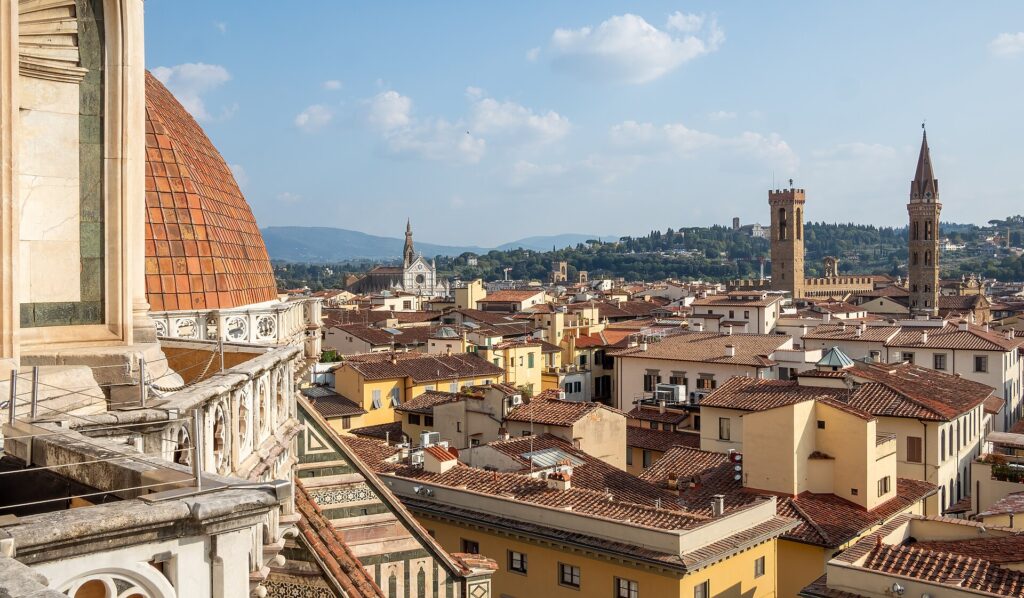
At the top you step out onto a narrow terrace around the base of the lantern. The views take in the red roofs, Palazzo Vecchio, Santa Croce, the hills of Fiesole and, right next to you, Giotto’s bell tower. The terrace is busy and there is a railing, so expect to wait a moment for a front-row spot.
How much does it cost to climb the Dome?
The Opera di Santa Maria del Fiore sells passes rather than single tickets. According to the official ticket site (tickets.duomo.firenze.it) at the time of writing:
| Pass | Includes | Adult | Age 7–14 |
|---|---|---|---|
| Brunelleschi Pass | Dome climb, Giotto’s Bell Tower, Opera del Duomo Museum, Baptistery, Santa Reparata | €30 | €12 |
| Giotto Pass | Bell Tower, Museum, Baptistery, Santa Reparata (no Dome) | €20 | €7 |
| Ghiberti Pass | Museum, Baptistery, Santa Reparata | €15 | €5 |
Children under 7 go free. Passes are valid for three days from the first visit, with one entry per monument, but the Dome climb must be booked for a specific date and time when you buy. Names can’t be changed after purchase and no refunds are given. The main cathedral itself is free to enter (Monday to Saturday), so you don’t need a pass just to see the interior.
Is €30 good value? Yes, if you use more of it than just the Dome. The Opera del Duomo Museum, with Ghiberti’s original Gates of Paradise and Michelangelo’s late Pietà, is one of the most underrated museums in Florence. If you only climb and leave, it feels expensive for an hour.
Dome or Giotto’s Bell Tower?
This is the question most visitors really face. The bell tower next door has 414 steps, and the Giotto Pass is €10 cheaper.
- Choose the Dome for the inside of the structure and the close-up frescoes. It is the more unique experience.
- Choose the bell tower if you want the Dome in your photos. From the top of the campanile, Brunelleschi’s dome fills the frame, which is the view many people come for.
- Do both with the Brunelleschi Pass if you have the legs. Many people climb one on the first day and the other the next, using the three-day validity.
The bell tower is also under restoration at the time of writing, although the top terrace remains open, according to the official opening hours page.
Book your own pass or join a tour?
The official site is the cheapest route, but Dome slots can sell out days in advance, especially for mornings and the last slots before sunset. Tour operators sometimes still have places when the official calendar shows a slot as sold out, and a guided tour adds context in the cathedral before or after your climb.
Book directly if you know your dates well in advance and only want the climb and the monuments.
Book through GetYourGuide if official slots are gone, you want free cancellation where the product offers it (official passes can’t be refunded), or you’d like a guide to explain the cathedral and Brunelleschi’s methods:
- Dome climb ticket with Duomo complex pass: timed climb plus access to the other monuments.
- Guided Duomo tour with Dome climb: learn the story first, then climb.
Whichever you choose, check that your name on the booking matches your ID, because the staff at the Dome entrance check both.
How long does the climb take?
- About 45 minutes is the official recommended visit time for the Dome, which matches most people’s experience.
- Allow an hour or more in summer, when you may wait on the stairs to let people pass or queue at the entrance.
- Half a day if you add the museum, the Baptistery and Santa Reparata on the same day.
Tips for climbing Brunelleschi’s Dome
- Arrive about 10 minutes before your slot at the Porta della Mandorla. Only a short delay (around five minutes) is tolerated before you lose your slot.
- Bring a passport or ID card. The ticket is in your name and is checked against your document.
- Go early. The first slots of the day are cooler and less crowded on the stairs. Note that on Sundays and public holidays the Dome only opens around midday.
- Travel light. A large backpack is a nuisance in the narrow sections. Keep a small bottle of water, as it gets warm inside the shells in summer.
- Wear proper shoes. The steps are worn and uneven in places.
- Check the closures. The Dome occasionally closes for maintenance (for example, the official site lists a closure from 16 to 20 November 2026) and religious celebrations can change hours.
- Visit the free cathedral first, so you can look up at the frescoes you’ll later see from the balcony.
When climbing the Duomo is not worth it
- You’re claustrophobic or have heart, knee or vertigo issues. There’s no lift, and once you’re between the shells there’s no quick way out. The official site warns people with heart problems, vertigo or claustrophobia against the climbs.
- You’re travelling with small children. They go free under 7, but the stairs are hard work for little legs and awkward if you need to carry anyone.
- All you want is a photo of Florence with the Dome. Walk or take a bus up to Piazzale Michelangelo for free instead, or climb the bell tower.
- You can’t plan ahead. With a named, non-refundable slot, spontaneous travellers often end up paying reseller prices or missing out.
The verdict
Climbing Brunelleschi’s Dome is one of the few Florence experiences that combine a real physical challenge, genuine architectural history and a superb view. If you’re fit enough for 463 steps and comfortable in tight spaces, do it, and use the rest of the pass to see the museum. Book early, or if official slots have gone, compare cathedral tours with a Dome climb ticket.
📍 Planning a trip? See our guide: Things to Do in Florence
More honest “is it worth it?” guides
Frequently asked questions
How many steps are there to the top of the Duomo in Florence?
There are 463 steps to the top of Brunelleschi’s Dome, with no lift. Giotto’s Bell Tower next door has 414 steps.
Can you climb the Duomo without a ticket?
No. The Dome climb is only included in the Brunelleschi Pass and requires a booked time slot. The cathedral interior, however, is free to enter from Monday to Saturday.
Is the Duomo climb scary?
The height rarely frightens people, because the internal balcony is enclosed and the top terrace has railings. The narrow passages between the two shells are what bothers claustrophobic visitors.
Is it better to climb the Dome or the bell tower?
The Dome offers the more unique experience inside the structure; the bell tower gives you the better view because the Dome is in it. If you can only choose one and care about photos, pick the bell tower.
How far in advance should I book the Duomo climb?
From spring to autumn, book as soon as your dates are fixed, ideally at least a week or two ahead. Morning and late-afternoon slots sell out first.
Is there a dress code for climbing the Duomo?
The official dress code (no flip-flops, bare shoulders or legs uncovered above the knee) applies to the cathedral and the Baptistery. Covering shoulders and knees is sensible anyway if you plan to see the cathedral on the same day.
Featured image: Photo: Zairon, CC BY 4.0, via Wikimedia Commons



Responses