Is Pompeii Worth It?

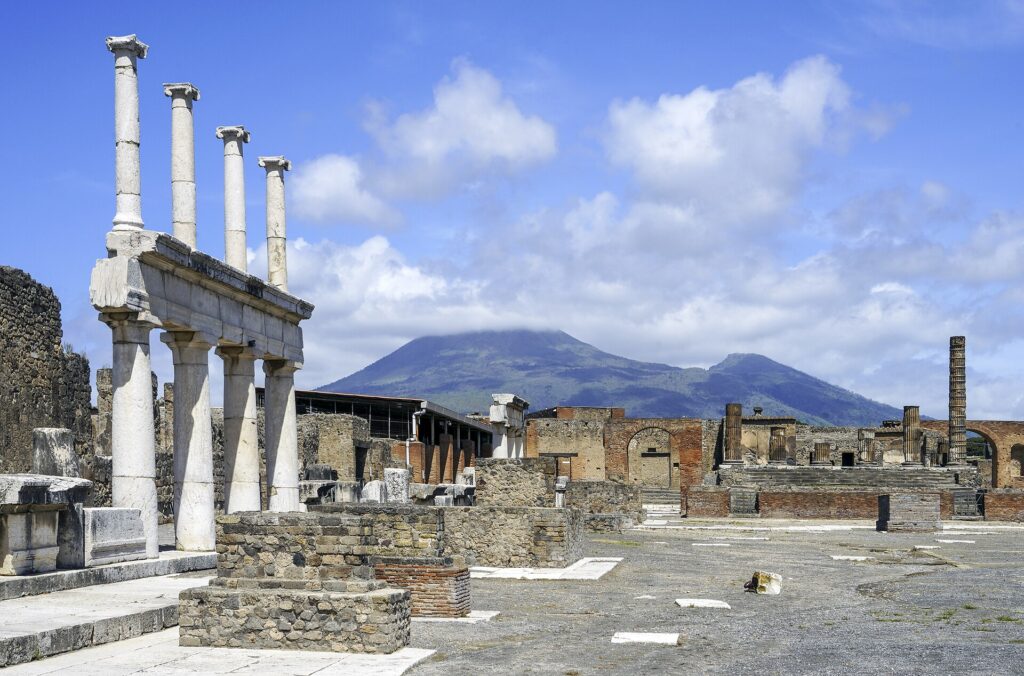
Short answer: yes, Pompeii is worth it, and it’s one of the few famous sights in Italy that is even bigger and more absorbing than people expect. The catch is exactly that size. Pompeii is a whole Roman city, largely without shade, and visitors who turn up at noon in August without a plan often leave hot, tired and unsure what they’ve actually seen. Get the ticket, the timing and the route right, and it’s an unforgettable day trip from Naples or Sorrento.
Disclosure: this article contains links to GetYourGuide. If you book through them, People & Media may earn a small commission at no extra cost to you.
Key takeaways
- Worth it for almost everyone visiting the Bay of Naples. Nowhere else lets you walk through the streets, houses, bakeries and theatres of an ordinary Roman city.
- It’s huge. You won’t see everything in one visit, so pick your highlights in advance.
- Tickets are named and entries are capped. The park limits daily visitors, and in high season there are separate caps for mornings and afternoons.
- Choose between two main tickets: Pompeii Express (the ancient city only) or Pompeii+ (which adds the Villa of the Mysteries and other suburban sites).
- No re-entry. Once you leave, your ticket is used, so bring water and snacks and plan your exit.
Is Pompeii worth it? Our honest take
In AD 79, the eruption of Mount Vesuvius buried Pompeii under metres of ash and pumice. What makes the site extraordinary today isn’t one great monument, but the sheer everyday detail: ruts worn into the paving stones by carts, stepping stones for crossing the street, graffiti on the walls, bar counters with built-in jars, frescoed dining rooms. You’re not looking at a temple behind a rope; you’re walking down a Roman high street.
That said, a few things regularly disappoint visitors:
- The heat and lack of shade. From late spring to early autumn, the midday sun on the stone streets is brutal.
- Closed houses. Pompeii has thousands of rooms, but only a selection of buildings is open at any time, and that rotates due to restoration. The house you read about may be shut.
- Fewer body casts than expected. The famous plaster casts of victims are moving, but there are far fewer on display than photos suggest, and they’re spread around the site.
- Poor signage. It’s easy to get lost, and most houses have only a small sign. Without a map, an app or a guide, many streets look alike after an hour.
Our verdict: worth it, as long as you treat it as a proper outing rather than a quick stop, and go early in the day.
The highlights you shouldn’t miss
The Forum and the Temple of Apollo
The civic heart of the city, with the Temple of Apollo on its western side and Vesuvius looming at the end of the square. It’s the best place to understand the scale of what happened, and a natural starting point if you enter at Porta Marina.
The Lupanar and the Stabian Baths
Pompeii’s ancient brothel is small, busy and famous for its explicit wall paintings. The Stabian Baths nearby are less crowded and give a much fuller idea of Roman daily life, with changing rooms, hot and cold rooms and stucco ceilings.
The House of the Vettii and other grand homes
The homes of Pompeii’s wealthy merchants have some of the finest frescoes on site. The House of the Vettii reopened after a long restoration and is one of the richest-decorated houses you can enter. Check what’s open on the day: the park publishes a list of visitable buildings on its official website.
The Amphitheatre and the Garden of the Fugitives
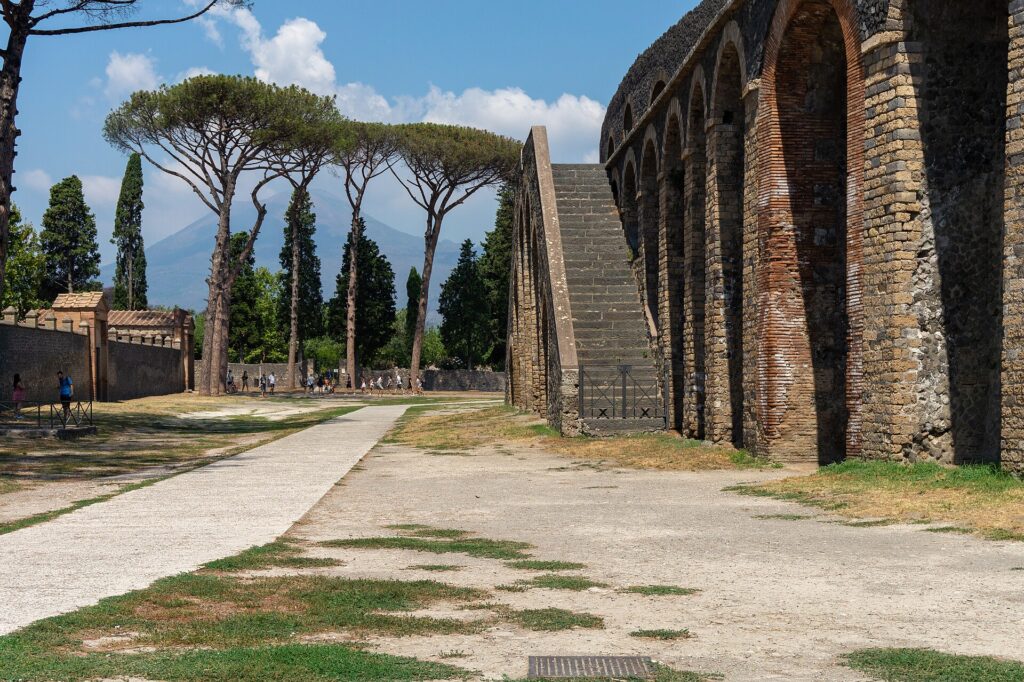
At the eastern end of the city is one of the oldest surviving Roman amphitheatres, far quieter than the Colosseum and nearly empty in the afternoon. Nearby, the Garden of the Fugitives holds a group of body casts of people who died trying to flee. It’s a sobering stop, and one many visitors remember most.
Villa of the Mysteries (Pompeii+ only)
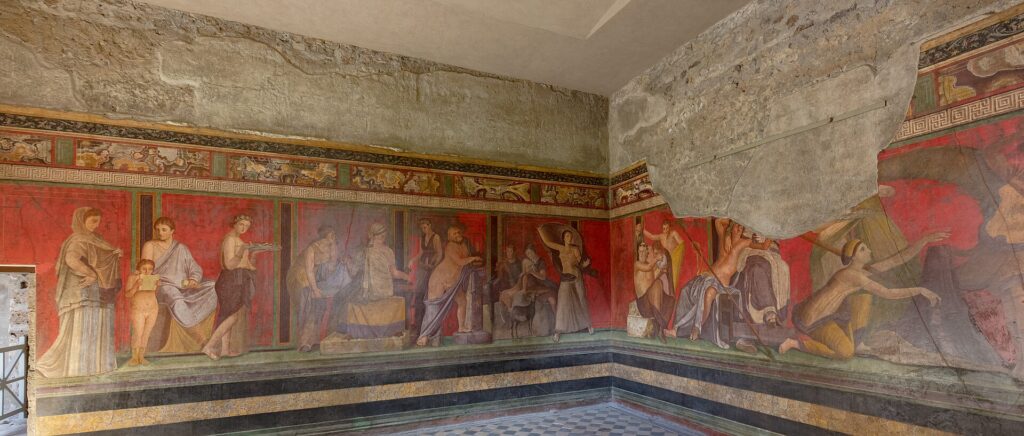
Just outside the city walls, reached via Porta Ercolano and the Street of Tombs, this villa has a room covered in a large cycle of red-ground frescoes that’s among the best-preserved paintings from the Roman world. It’s a detour, but if you like art, it’s worth the walk and the extra cost.
How much does Pompeii cost?
These are the official prices from the Archaeological Park of Pompeii (pompeiisites.org), in force since 12 January 2026 at the time of writing. Online tickets are sold through the park’s official ticketing partner, which the website links to.
| Ticket | What’s included | Full price | Reduced |
|---|---|---|---|
| Pompeii Express | The ancient city of Pompeii only; one entry | €20 | €2 |
| Pompeii+ | Ancient city plus the suburban villas (Villa of the Mysteries, Villa of Diomedes), Villa Regina and Antiquarium at Boscoreale, and the shuttle bus | €25 | €2 |
| 3-day ticket | Pompeii+ plus Oplontis, the Stabiae villas and museum, Boscoreale and the shuttle bus; one entry per site | €30 | €2 |
| MyPompeii card | All park sites for a year | €45 | €10 |
The €2 reduced rate applies to EU citizens aged 18 to 24, and visitors under 18 enter free. Entry is also free for everyone on the first Sunday of the month, which makes those days very busy. If you bought Pompeii Express and change your mind on the day, you can add the suburban villas route for €8 (card payment only) at the Porta Ercolano entrance to that route.
Booking rules to know: tickets are issued in your name, and the park caps entries at 20,000 a day. From mid-March to mid-October there are extra time bands: a maximum of 15,000 entries between 09:00 and 13:00, and 5,000 between 13:00 and 17:30. In practice, that means you should book ahead for a summer morning.
Opening hours at the time of writing: from 16 March to 14 October, 09:00 to 19:00 with last entry at 17:30; from 15 October to 15 March, 09:00 to 17:00 with last entry at 15:30. The site is closed on 25 December and 1 January.
Is it worth the money? Very much so. €20 for a full day in a Roman city is excellent value. Pompeii+ is worth the extra €5 if you’re interested in art and have the stamina to walk out to the Villa of the Mysteries.
Guided tour, audio guide or on your own?
Pompeii rewards context more than most sites. A good guide shows you the details you’d walk straight past: the phallic good-luck symbols, the election slogans painted on walls, the layout of a Roman takeaway. They also know which houses are open and how to route around the tour-group bottlenecks.
Go on your own if you’ve done some reading, you’re happy navigating with the official map, and you want to wander freely, perhaps spending the whole day there.
Book a guided tour if you have limited time, you want the stories, or you’d rather not deal with trains and tickets. Many tours from Naples include transport, which avoids the often crowded local train.
- Pompeii guided day trip from Naples with fast-track entry: transport, ticket and guide sorted in one booking.
- Pompeii entry ticket with audio guide: a middle ground if you want to explore at your own pace but with commentary.
- Pompeii and Amalfi Coast full-day trip from Naples: two highlights in one long day, with less time at each.
Getting there from Naples or Sorrento
The official park website lists these options:
- Circumvesuviana train, Napoli–Sorrento line, stop Pompei Scavi – Villa dei Misteri. This is the most common route and brings you close to the Porta Marina and Piazza Esedra entrances. It works from both Naples and Sorrento.
- Circumvesuviana, Napoli–Poggiomarino line, stop Pompei Santuario, for the Piazza Anfiteatro entrance.
- Trenitalia Napoli–Salerno line, stop Pompei, which is in the modern town, further from the ruins.
The Circumvesuviana is cheap but can be crowded, hot and occasionally unreliable, so allow some slack in your schedule, especially if you have a train or ferry to catch later. The official ticket offices are only at the three site entrances: Porta Marina, Piazza Esedra and Piazza Anfiteatro.
How long do you need at Pompeii?
- 2 to 3 hours: the Forum, baths, Lupanar, a couple of grand houses and the theatres. This is what most guided tours cover.
- 4 to 5 hours: add the amphitheatre, the Garden of the Fugitives and a relaxed pace.
- A full day: include the Villa of the Mysteries and the quieter streets on the eastern side.
Tips that make a real difference
- Be there at 09:00. It’s cooler, and the big tour groups arriving from cruise ships and coaches haven’t filled the main streets yet.
- Wear proper shoes. The Roman paving is uneven, with high kerbs and deep ruts. Flip-flops are a bad idea.
- Carry water, a hat and sunscreen. You can refill bottles at fountains around the site, but there’s little shade.
- Download the map before you go and check the list of visitable buildings on pompeiisites.org.
- Enter at one end and leave at the other. For example, start at Porta Marina and finish at Piazza Anfiteatro, so you don’t have to walk back across the whole site.
- Avoid the first Sunday of the month unless saving the entry fee matters more than space to move.
When isn’t Pompeii worth it?
- You only have a few hours and hate heat. A rushed midday visit in July can feel like a long walk through hot rubble.
- You have limited mobility. Much of the site is uneven, though the park does offer a dedicated “Pompeii for All” route from the Piazza Anfiteatro entrance.
- You want to see well-preserved interiors without the crowds. Then Herculaneum, further up the coast towards Naples, is the better choice. It’s much smaller and easier to see in two or three hours, with some wooden structures and upper floors preserved.
Our conclusion: is Pompeii worth it?
Absolutely. Pompeii is one of the most remarkable places you can visit in Europe, and at €20 it’s a bargain for what you see. It pays to plan: book a named ticket for the morning, pick your highlights, and prepare for sun and cobbles. If you’d like the transport and the storytelling taken care of, compare guided Pompeii tours and day trips.
📍 Planning a trip? See our guide: Things to Do in Naples
More honest “is it worth it?” guides
Frequently asked questions
Is Pompeii or Herculaneum better?
Pompeii is larger and gives you the sense of a whole city, with its forum, amphitheatre and streets. Herculaneum is smaller, less crowded and better preserved in places. With only a few hours, Herculaneum is easier; for the full experience, choose Pompeii.
Do you need to book Pompeii tickets in advance?
It’s strongly recommended. Tickets are named, daily entries are capped, and in high season there are separate limits for morning and afternoon entry. Pre-booked tickets let you go straight to the turnstiles.
Is the Villa of the Mysteries included in the Pompeii ticket?
Only in the Pompeii+ ticket (€25) and the 3-day ticket. With a Pompeii Express ticket, you can add the suburban villas route for €8 at the Porta Ercolano entrance to that route.
Can you visit Pompeii without a guide?
Yes. Many visitors explore with the official map or an audio guide. A guide adds a lot of context, though, and helps you use your time efficiently on a site this large.
What is the best time of day to visit Pompeii?
Early morning, as soon as it opens at 09:00. It’s cooler and quieter. The late afternoon is also pleasant, but check the last entry time for the season.
Is Pompeii free for children?
Yes. According to the official park website, visitors under 18 enter free of charge.
Featured image: Photo: Commonists, CC BY-SA 4.0, via Wikimedia Commons


Responses