Is an Amalfi Coast Day Trip Worth It?

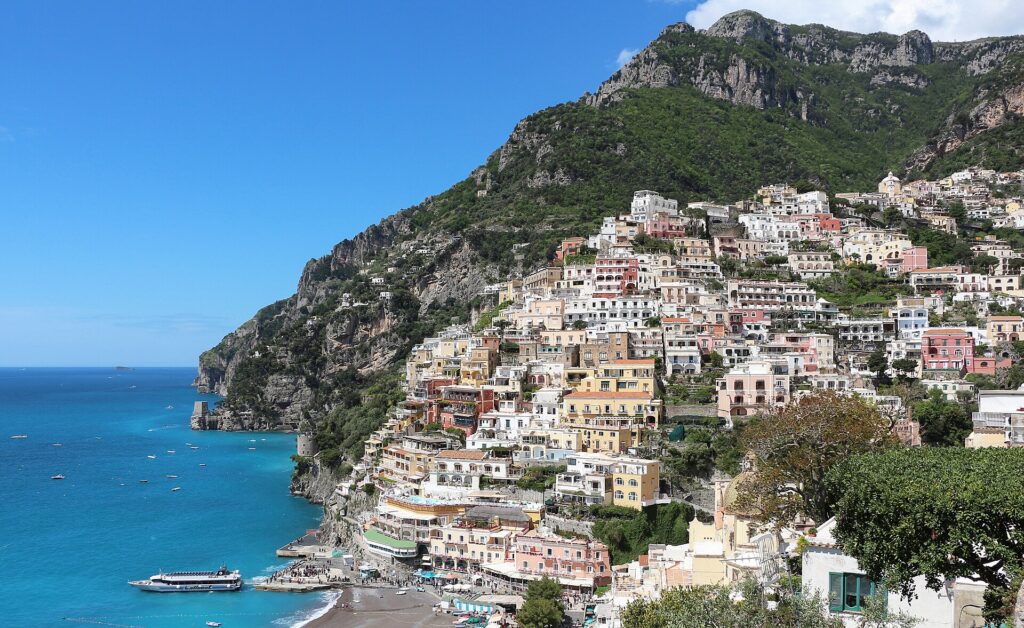
Short answer: an Amalfi Coast day trip is worth it if you keep it to two or three towns and choose your transport carefully; try to cram in everything and you’ll mostly remember traffic. The coastline between Positano and Amalfi really is as dramatic as the photos. But the road is narrow, summer crowds are heavy, and a day goes quickly. From Sorrento it’s an easy win. From Naples it’s a long but rewarding day. From Rome, we’d think twice.
Disclosure: this article contains links to GetYourGuide. If you book through them, People & Media may earn a small commission at no extra cost to you.
Key takeaways
- Worth it from Sorrento or Naples, especially between April and October when ferries and boat tours run most frequently.
- Two or three towns is the realistic maximum for one day. Positano and Amalfi are the classic pair; Ravello is the best third stop.
- How you travel shapes the day. Ferries and boat tours are the most relaxing; public buses are cheap but can be packed in summer.
- Driving yourself is hard work: parking is scarce, and on many days an odd/even number-plate restriction applies on the coast road.
- Weather matters. Rough sea can cancel boats, and haze or rain takes the edge off the views.
The honest verdict on a day trip
The Amalfi Coast isn’t a single sight but a 40-odd kilometre stretch of cliffs, lemon terraces and villages tumbling down to the sea, linked by one winding road, the SS163 “Amalfitana”. It deserves several days. The question is whether a single day gives you enough of it, and for most people the answer is yes, provided you accept what a day trip is.
What lives up to the hype: the first view of Positano stacked up the hillside, the stretch of coast seen from the water, Amalfi’s cathedral steps, and the gardens and terraces of Ravello high above the sea.
What disappoints:
- Time lost in transit. The road is narrow and slow. In summer, buses fill up and you may have to wait for the next one, which can eat into the time you have in each town.
- Crowds in Positano and Amalfi. In high season, the main lanes feel more like a shopping street than a fishing village between late morning and late afternoon.
- Car sickness. Hundreds of bends in a bus or minivan don’t suit everyone. If you’re prone to it, go by sea.
- Prices. Food, drinks and sunbeds in Positano are among the most expensive in southern Italy.
Which towns to see in one day
Positano
The picture-postcard one: pastel houses stacked up a steep ravine, a church with a majolica-tiled dome, and a grey-sand beach at the bottom. It’s best seen from a distance, either from the road above or from a boat. Be aware that the town is essentially one long staircase: walking down is lovely, walking back up in the heat is not.
Amalfi
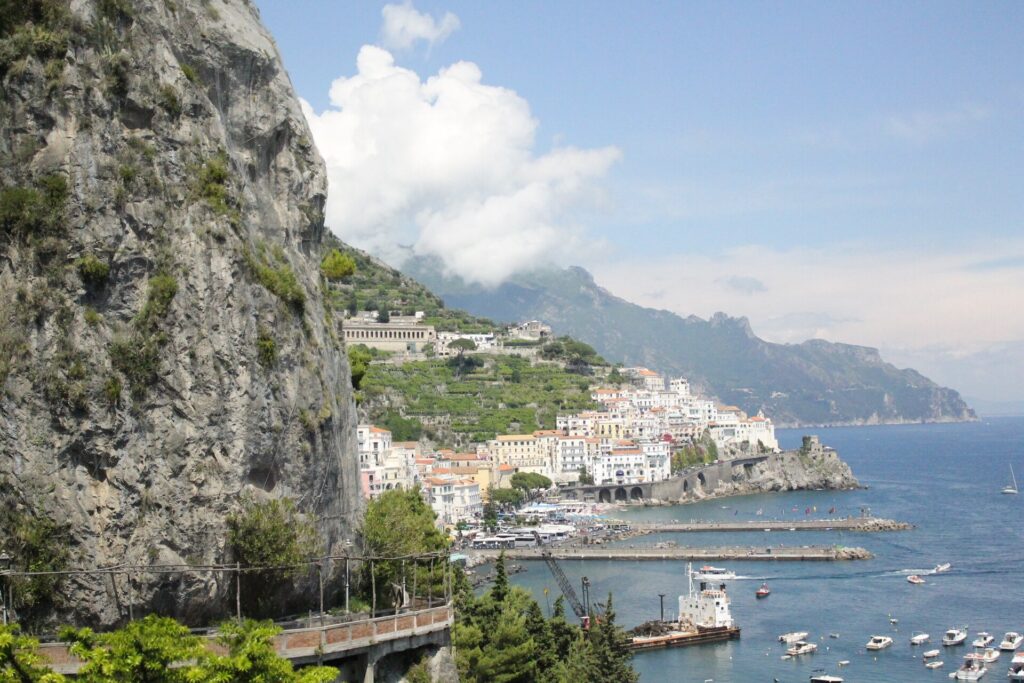
The historic heart of the coast and its transport hub, where buses and ferries meet. The highlight is the Cathedral of Sant’Andrea, with its striped façade at the top of a broad flight of steps, plus the Cloister of Paradise next door. The town has more of a lived-in feel than Positano once you leave the main square, and it’s the natural base for lunch.
Ravello
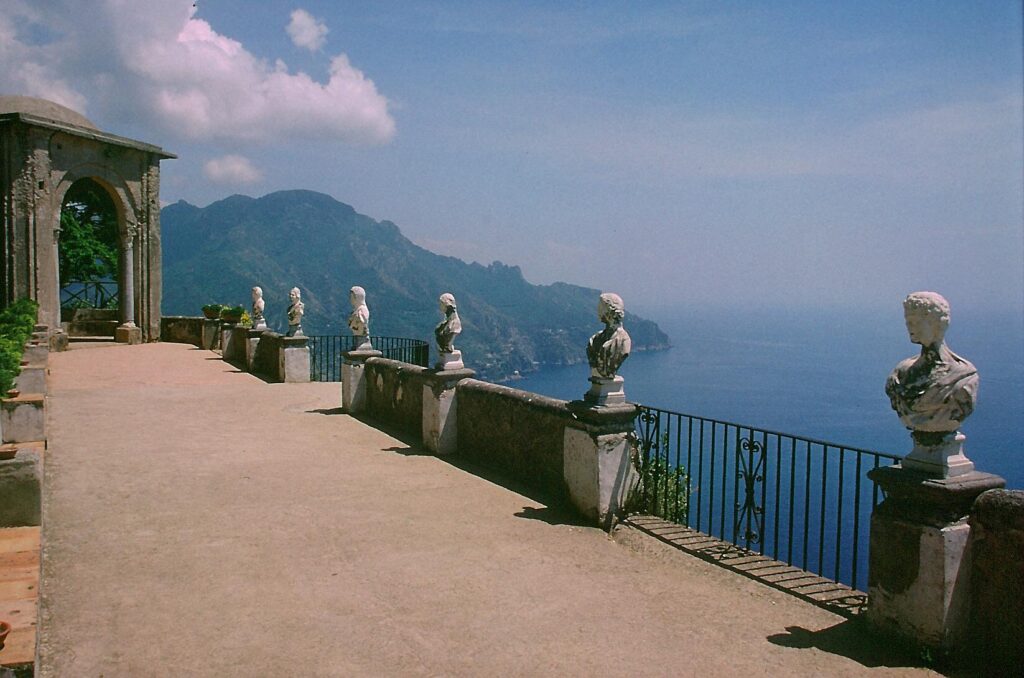
Up in the hills above Amalfi, Ravello is quieter and more elegant. It’s known for the gardens of Villa Rufolo and Villa Cimbrone, whose terraces look straight down onto the coastline; both charge an entrance fee. If you prefer views and calm over beaches and boutiques, swap Positano for Ravello.
Worth a stop if you have time
Atrani, a few minutes’ walk from Amalfi, is a tiny village with a small square and hardly any shops. Praiano and Furore, with its fjord under a road bridge, are better seen from a boat than by bus on a short day.
How to get there: bus, ferry, tour or car?
This is the decision that makes or breaks your day. Here’s how the main options compare in practice:
| Option | Best for | Downsides |
|---|---|---|
| SITA public bus (from Sorrento or Salerno) | Tight budgets, flexible travellers | Crowded in summer, can be slow, full buses may pass by; buy tickets in advance at a tobacconist or newsagent |
| Public ferry (e.g. from Salerno, or Positano–Amalfi) | Views without the bends, independent travel | Timetables change by season; sailings can be cancelled in rough seas |
| Boat tour from Sorrento | First-timers who want the coast from the sea, with swim stops | Fixed, shorter time in each town; weather dependent |
| Small-group minivan tour (from Naples or Sorrento) | Visitors who want pick-up, photo stops and no planning | Same road traffic as everyone else; fixed schedule |
| Self-drive | Travellers staying on the coast for several days | Very limited, expensive parking, stressful road, number-plate restrictions |
The number-plate rule if you’re driving
According to the ANAS ordinance as published by the Comune di Praiano, alternate number-plate circulation applies on the SS163 between Vietri sul Mare and Positano on set dates in 2026, between 10:00 and 18:00. On even-numbered dates, cars whose plate ends in an even number can’t use the road; on odd dates, those ending in an odd number. In 2026 it applies every day in August and September, on selected dates (mostly Sundays and holiday weekends) in May, June, July and October, and during the Easter and late-April holiday periods. Residents, taxis and licensed private hire drivers (NCC) are exempt, as are hotel guests on their check-in and check-out days only. Check the local council websites for the exact dates before you set out.
Sample day trips that actually work
From Sorrento
- Take an early SITA bus or a boat to Positano and walk down through the town.
- Continue by ferry from Positano to Amalfi (when running) for the view from the water, and have lunch.
- Take the local bus up to Ravello for the gardens, then return to Amalfi and back to Sorrento by bus or boat.
Or keep it simple with a full-day boat tour that stops in Positano and Amalfi.
From Naples
You’ll need to add travel time at both ends. Independent travellers usually take the train to Salerno and a ferry along the coast to Amalfi, or the Circumvesuviana to Sorrento and continue by bus or boat. Realistically, two towns is the limit. This is the day trip where a tour with transport from Naples makes the most sense.
Tour or independent?
Go independently if you’re staying in Sorrento or Salerno, you’re comfortable with Italian bus stops and ferry piers, and you want to linger where you like.
Book a tour if you’re coming from Naples, you only have one shot at the coast, or you’d rather spend the day looking at the sea than at timetables.
- Full-day boat trip to Amalfi and Positano from Sorrento: the coast from the water, with free time in both towns.
- Small-group Amalfi Coast tour from Naples: Positano, Amalfi and Ravello: door-to-door, with all three classic towns.
- All Amalfi Coast boat tours: compare group sizes, departure points and swim stops.
Practical tips
- Start early. The coast road and the towns are much calmer before about 10:00.
- Sit on the right side of the bus heading from Sorrento towards Positano and Amalfi for the sea views, and the left side coming back.
- Buy bus tickets before boarding at a tabaccheria, bar or newsagent, and validate them on board.
- Check the sea forecast if your day relies on ferries or a boat tour, and have a bus plan B.
- Bring cash and good shoes. The towns are steep, and plenty of small places prefer cash.
- Book lunch in Positano ahead in summer, or eat in Amalfi or Ravello where there’s more choice.
- Don’t plan the last bus or ferry as your only way home. Leave margin for queues and delays.
When is it not worth it?
- As a day trip from Rome. Many hours on the road for a few hours on the coast. If you can, stay at least one night in Sorrento, Amalfi or Salerno instead.
- On an August weekend if you dislike crowds and queues.
- In the depths of winter, when boat trips are limited, many hotels and restaurants close, and the towns feel very quiet.
- If you mainly want a beach day. The beaches are small, pebbly or grey sand, and crowded. The coast is about views, villages and the sea, not long sandy beaches.
A good alternative if a coast day sounds too hectic: a boat trip around the Sorrento Peninsula to the Bay of Ieranto, or a day on Capri, which is reached directly by ferry from Sorrento and Naples.
Our conclusion: is an Amalfi Coast day trip worth it?
Yes, if you keep it focused. Pick Positano and Amalfi, or Amalfi and Ravello, travel by sea where you can, and start early. You won’t “do” the Amalfi Coast in a day, but you’ll see why people come back for a week. If you’d rather leave the logistics to someone else, compare Amalfi Coast day trips and boat tours.
📍 Planning a trip? See our guide: Things to Do in Naples
More honest “is it worth it?” guides
Frequently asked questions
Can you see the Amalfi Coast in one day?
You can see its highlights: typically two or three towns, such as Positano, Amalfi and Ravello, plus the coastline from the road or the water. To really explore, including hikes like the Path of the Gods, you need more time.
Is it better to visit the Amalfi Coast by boat or by bus?
By boat, if the weather allows. It’s more comfortable, avoids the winding road and gives the best views of the towns. Buses are cheaper and run year-round, but are often crowded in summer.
Positano or Amalfi: which is better for a day trip?
Positano has the more famous view; Amalfi has more history, better transport connections and more choice for lunch. If you can only pick one, Amalfi is easier logistically, but most day trips combine both.
Is Ravello worth visiting on a day trip?
Yes, if you like gardens and views more than beaches and shops. It’s a short bus ride up from Amalfi and noticeably calmer than the coastal towns.
Can you drive the Amalfi Coast?
You can, but it’s not relaxing. The road is narrow and busy, parking is scarce and expensive, and alternate number-plate rules apply on the SS163 on many days between spring and October, from 10:00 to 18:00.
What is the best month for an Amalfi Coast day trip?
May, June and late September to early October generally offer warm weather, running ferries and fewer crowds than July and August.
Featured image: Photo: Bernard Gagnon, CC BY 4.0, via Wikimedia Commons

Responses