Madrid doesn’t have one headline monument; it has three of Europe’s great art museums within a 15-minute walk of each other, a royal palace, a huge park and a tapas culture that keeps the streets busy until well after midnight. Toledo and Segovia are close enough for a day trip each. Here’s what’s worth your time, which museums have free hours, and where a ticket or tour genuinely helps.
Disclosure: this page contains links to GetYourGuide. If you book through them, People & Media may earn a small commission at no extra cost to you.
Our honest attraction reviews
We’ve reviewed Madrid’s two biggest paid sights in depth, including prices, free hours and who should skip them.
13 best things to do in Madrid
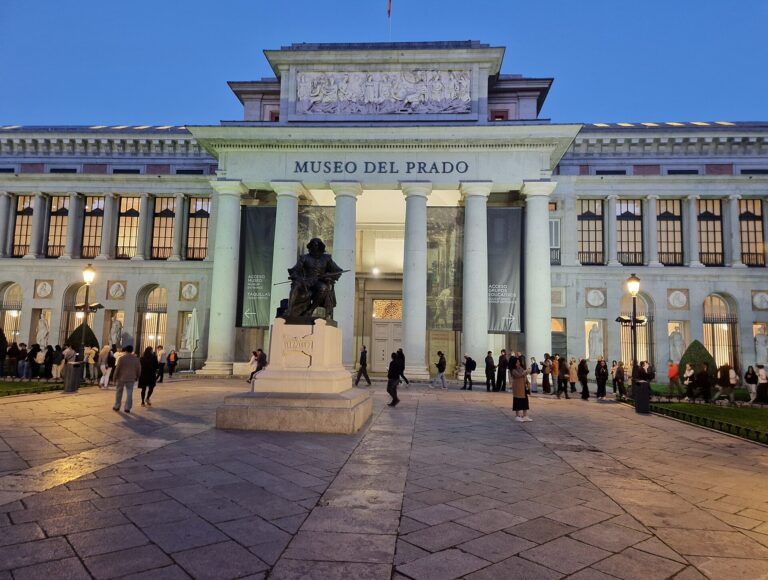
1. Prado Museum
The Prado is the main reason many people come to Madrid: Velázquez’s Las Meninas, Goya’s Black Paintings and Bosch’s Garden of Earthly Delights all hang here. It’s vast, and almost everything predates 1900, so it rewards visitors who come with a short list rather than a plan to see everything.
- Time needed: 2 to 3 hours is the sweet spot.
- Cost: general admission was €15 at the time of writing. Under-18s and students aged 18 to 25 enter free, and the last two hours of each day are free for the permanent collection, subject to capacity.
- Tip: photography isn’t allowed in the galleries. Use the free hours for a second, targeted visit rather than your first.
Read our full review: Is the Prado Museum worth it?
2. Royal Palace of Madrid
The official residence of the Spanish royal family (used for state ceremonies rather than daily life) has some of the most lavish state rooms in Europe, including the Throne Room with Tiepolo’s ceiling fresco and the rococo Gasparini Room. The Royal Armoury across the courtyard is often the surprise favourite.
- Time needed: about 45 minutes for the halls, closer to 1.5 hours with the Armoury.
- Cost: standard admission was €18 at the time of writing. There are free late-afternoon hours from Monday to Thursday, but only for EU citizens and residents and Latin American citizens.
- Tip: the Changing of the Guard outside the palace is free. The weekly guard change takes place on Wednesdays and Saturdays at the Puerta del Príncipe.
Read our full review: Is the Royal Palace of Madrid worth it?
3. Retiro Park
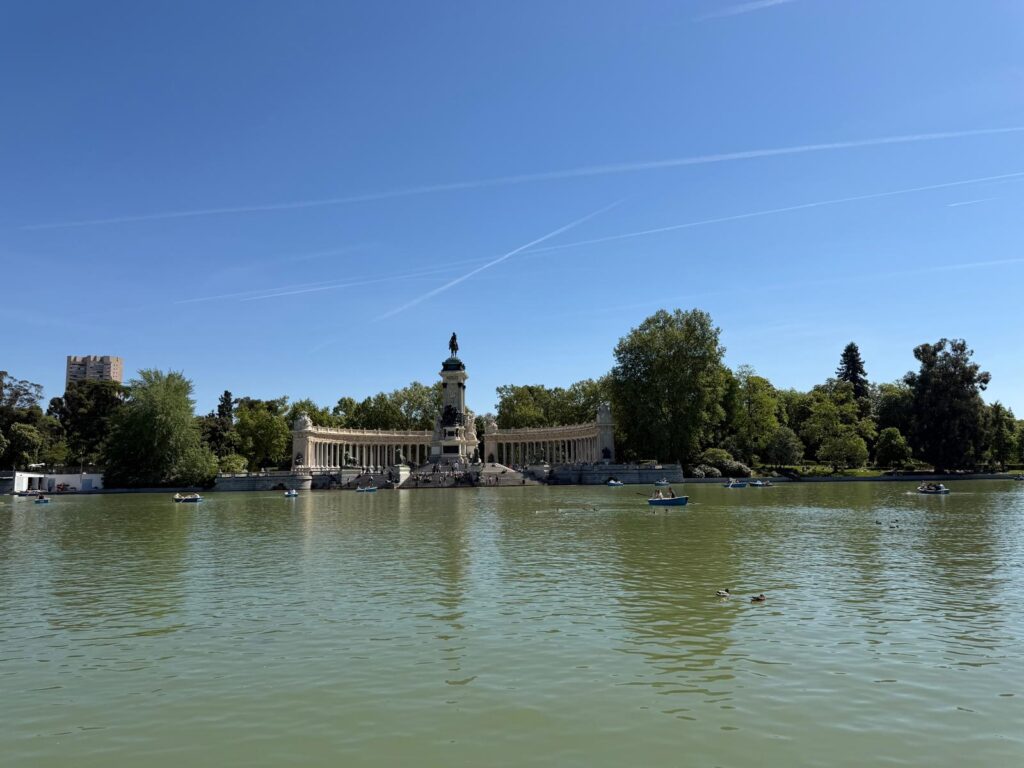
Madrid’s 125-hectare green heart is part of a UNESCO World Heritage Site together with the Paseo del Prado. Rent a rowing boat on the big lake below the Monument to Alfonso XII, look for the Fallen Angel statue and walk through the rose garden. On weekends the park fills with families, joggers and street musicians.
- Time needed: 1 to 3 hours.
- Cost: free; the rowing boats are paid.
- Tip: the glass Palacio de Cristal was temporarily closed for improvements at the time of writing, according to the Reina Sofía museum that runs it. The park itself can close during severe weather warnings.
4. Reina Sofía Museum
Spain’s national museum of modern and contemporary art is home to Picasso’s Guernica, which surprises many visitors who expect it at the Prado. The collection also has major works by Dalí and Miró, so it’s a good counterweight to the Prado’s old masters.
- Time needed: 1.5 to 2 hours.
- Cost: €12 on the official website at the time of writing. Entry is free on Monday and Wednesday to Saturday from 19:00 to 21:00, and on Sunday from 12:30 to 14:30, but you still need a ticket.
- Tip: the museum is closed on Tuesdays. If you want Guernica explained, a small-group Reina Sofía tour puts it in context.
5. Thyssen-Bornemisza Museum
The third corner of Madrid’s “Golden Triangle of Art” fills the gaps the other two leave: Impressionists, German Expressionists, American painting and a strong run of early Italian and Dutch works. It’s easier to digest than the Prado, and rarely as crowded.
- Time needed: about 2 hours.
- Cost: €14 for the collections and temporary exhibitions at the time of writing; the museum lists free entry on Mondays.
- Tip: if you plan all three museums, the Paseo del Arte pass (€32.80 at the time of writing) gives one visit to each.
6. Plaza Mayor and Habsburg Madrid
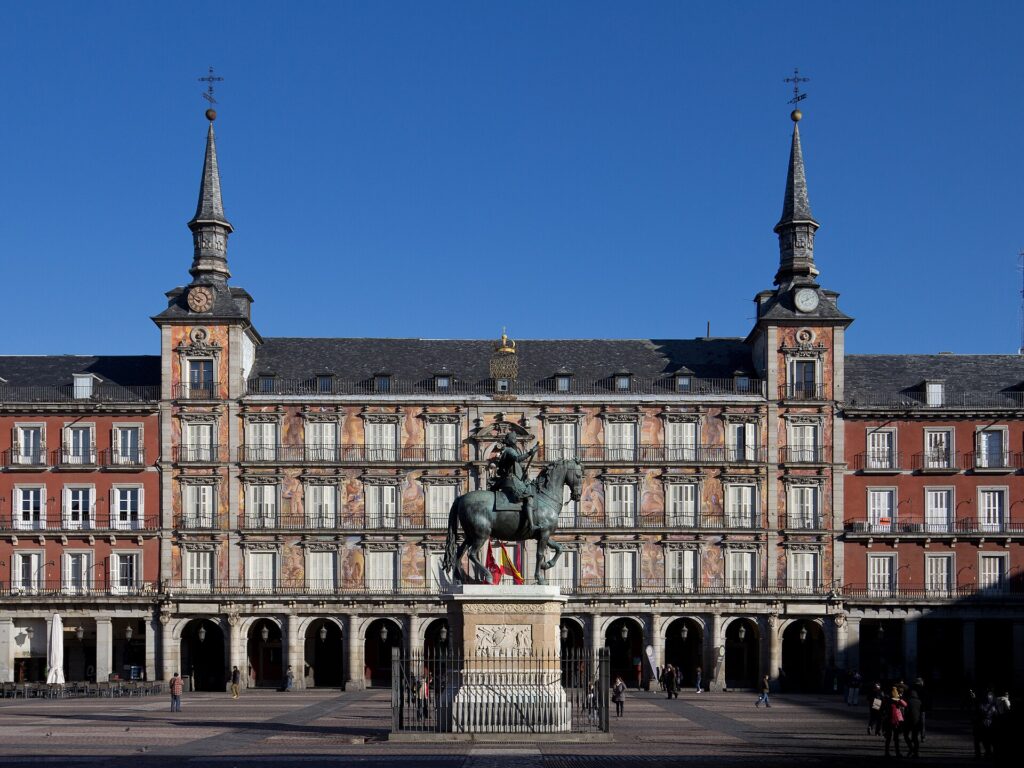
The arcaded Plaza Mayor is the grand set piece of the old town, surrounded by the lanes of “Madrid de los Austrias”, the city built under the Habsburg kings. Walk from here to the Plaza de la Villa and down to the Almudena Cathedral next to the Royal Palace.
- Time needed: 1 to 2 hours.
- Cost: free.
- Tip: admire the square, but eat and drink in the side streets, where prices are lower than on the terraces.
7. Mercado de San Miguel and tapas in La Latina
The iron-and-glass Mercado de San Miguel, just off Plaza Mayor, is a gourmet food hall: polished and touristy, but fun for a first round. For a more local evening, walk south to La Latina and Cava Baja, where old taverns serve tapas, vermouth and wine.
- Time needed: an evening.
- Cost: pay as you go; the market is noticeably pricier than a neighbourhood bar.
- Tip: Madrid dines late, so start around 20:30 or 21:00. A tapas and wine tour is a good first-night introduction.
8. Temple of Debod at sunset
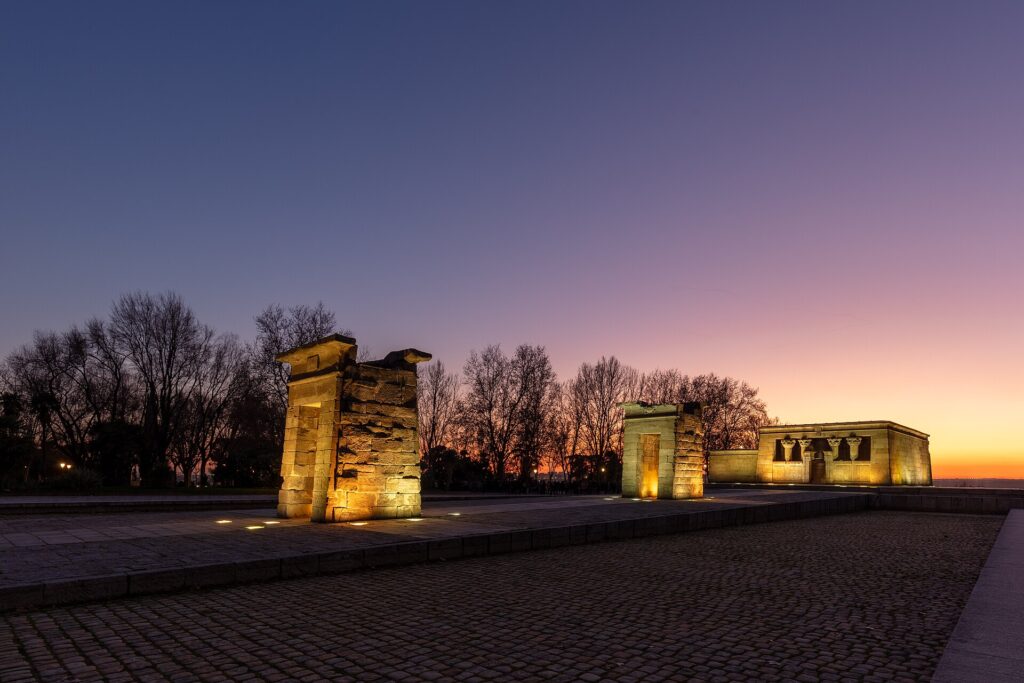
A genuine ancient Egyptian temple, given to Spain after the construction of the Aswan Dam and rebuilt stone by stone in a park near the Royal Palace. It opened to the public in 1972. At sunset, with its reflection in the water and the sky turning orange behind it, it’s one of the best free views in the city.
- Time needed: 30 minutes to an hour.
- Cost: free.
- Tip: the interior is closed on Mondays, admits a maximum of 30 people at a time and visits are limited to 30 minutes, so expect a queue. The outside and the sunset view need no ticket at all.
9. Gran Vía and the rooftop views
Madrid’s early 20th-century showpiece boulevard is lined with grand buildings, theatres and shops, with the domed Metrópolis building at its eastern end. Several rooftops nearby, including the one at the Círculo de Bellas Artes, look straight down this view.
- Time needed: 1 to 2 hours.
- Cost: the street is free; most rooftop terraces charge entry or expect you to buy a drink.
- Tip: go up an hour before sunset, when the light hits the Metrópolis dome.
10. El Rastro flea market
Madrid’s famous open-air market takes over the streets around Ribera de Curtidores in La Latina on Sunday mornings. It’s a mix of antiques, vintage clothes, bric-a-brac and souvenirs, and the real point is the atmosphere, followed by a vermouth in a nearby bar.
- Time needed: 1 to 2 hours.
- Cost: free to browse.
- Tip: go early, before it gets packed, and keep valuables in a front pocket.
11. A flamenco show
Flamenco comes from Andalusia, but Madrid has some of Spain’s best tablaos, where professional dancers, singers and guitarists perform in a small room. It’s a strong option if you’re not heading south on this trip.
- Time needed: about an hour, longer with dinner.
- Cost: paid.
- Tip: a drinks-only ticket is usually better value than a dinner package; eat tapas elsewhere before or after.
12. Santiago Bernabéu Stadium
Real Madrid’s home ground in the Chamartín district has been rebuilt with a retractable roof and a new exterior skin. For football fans, the club’s stadium tour and trophy museum are a pilgrimage; for everyone else, it’s easy to skip.
- Time needed: about 1.5 hours.
- Cost: paid.
- Tip: tour availability changes on match days and around events, so check the club’s official website before you go.
13. Toledo and Segovia (day trips)
Toledo, the hilltop “city of three cultures” where Christians, Muslims and Jews lived side by side for centuries, is the classic day trip from Madrid, with its cathedral, synagogues and views from across the Tagus gorge. Segovia, with its Roman aqueduct and fairy-tale Alcázar, is the other favourite. Both are reachable by fast train from Madrid.
- Time needed: a full day for one city; both in one day is rushed.
- Cost: the towns are free to walk around; train tickets and monuments are paid.
- Tip: if you’d like a guide to explain Toledo’s layers of history, a guided Toledo day trip with cathedral admission is the easy option; there’s also a combined Segovia and Toledo tour if you only have one day.
- Hour-by-hour itinerary for 3 days
- Google Maps list with every stop
- What to book in advance (and when)
- Works offline on your phone
Practical tips for visiting Madrid
Best time to visit
April to June and late September to October bring warm days and pleasant evenings on the terraces. July and August are very hot, and many locals leave town in August. Winters are cold and dry but often sunny, which makes it a good season for museum-heavy trips.
How many days do you need?
- 2 days: Prado and Retiro on day one; Royal Palace, Plaza Mayor, the Temple of Debod at sunset and tapas in La Latina on day two.
- 3 days: add the Reina Sofía or the Thyssen, and Gran Vía.
- 4 to 5 days: add a day trip to Toledo or Segovia and a flamenco evening.
Getting around
The historic centre, the Paseo del Prado and Retiro are all walkable. For longer distances the metro is fast and extensive: Ópera for the Royal Palace, Sol for Plaza Mayor, and Atocha or Banco de España for the museums. The regional transport authority sells a tourist travel pass for unlimited travel over several days, but if you mostly walk, single tickets or a rechargeable transport card are usually enough.
Where to stay
- Centro (Sol, Ópera, Huertas): walking distance to almost everything. Best for a first visit.
- La Latina: atmospheric, full of tapas bars, busy on Sundays.
- Malasaña and Chueca: lively, younger, with lots of bars and cafés; can be noisy.
- Salamanca and Retiro: quieter, elegant and close to the park and museums.
Frequently asked questions
What is the number one thing to do in Madrid?
For most visitors it’s the Prado, followed by a walk in Retiro Park next door. If art isn’t your thing, the Royal Palace and an evening of tapas in La Latina give you a better feel for the city.
Which Madrid museums are free?
All three big art museums have free periods: the Prado in the last two hours of each day, the Reina Sofía on most evenings and Sunday lunchtime, and the Thyssen on Mondays, at the time of writing. Expect queues, and check the official websites, as rules can change.
Is 2 days enough for Madrid?
Two days covers the Prado, Retiro, the Royal Palace and the old town at a brisk pace. Three to four days lets you add a second museum and a day trip to Toledo or Segovia.
Is Guernica in the Prado?
No. Picasso’s Guernica hangs in the Reina Sofía Museum, about a ten-minute walk south of the Prado.
Is Toledo or Segovia the better day trip from Madrid?
Toledo if you want history, churches and a dramatic setting; Segovia if you want the Roman aqueduct, the Alcázar and a more relaxed town. With a single free day, pick one and do it properly.
Featured image: Photo: Nan Palmero from San Antonio, TX, USA, CC BY 2.0, via Wikimedia Commons