Kraków came through the Second World War with its medieval centre largely intact, and it shows: the Old Town, Wawel Hill and the former Jewish district of Kazimierz are all within walking distance of each other. It’s also the base for two very different day trips, the underground chapels of the Wieliczka Salt Mine and the Auschwitz-Birkenau Memorial, so plan more time here than you might think.
Disclosure: this page contains links to GetYourGuide. If you book through them, People & Media may earn a small commission at no extra cost to you.
Our honest attraction reviews
Wondering whether a ticket or day trip is worth it? Our in-depth reviews tell you what’s great, what’s overrated and how to plan your visit.
14 best things to do in Krakow
1. Take in the Main Market Square
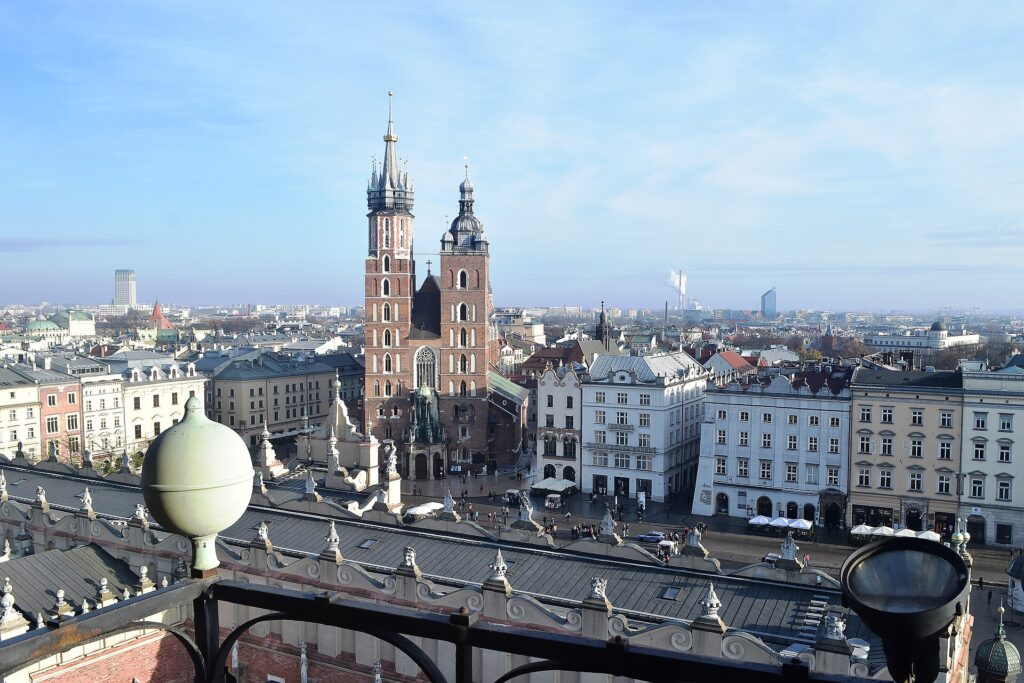
Rynek Główny is one of the largest medieval town squares in Europe, and it still works as the city’s living room. In the middle stands the Renaissance Cloth Hall (Sukiennice), with souvenir stalls on the ground floor and a gallery of 19th-century Polish art upstairs. Around the edge you’ll find the Town Hall Tower, cafés with terraces and horse-drawn carriages.
Time needed: 1 hour, but you’ll pass through many times. Cost: free. Tip: the café terraces on the square are expensive for what you get. Have your coffee in a side street and come back to the square in the early morning or late evening, when it’s at its most beautiful.
2. Hear the trumpet call at St. Mary’s Basilica
The two unequal brick towers of St. Mary’s dominate the square. Every hour a trumpeter plays the hejnał from the taller tower, breaking off mid-melody in memory of a medieval watchman said to have been shot while sounding the alarm. Inside, the star-painted vault and the huge carved wooden altarpiece by Veit Stoss are among Poland’s great treasures.
Time needed: 30 to 45 minutes. Cost: paid entry for tourists; the tower climb is a separate ticket. Tip: the basilica is open to sightseeing visitors from 11:30 to 18:00, outside those hours it’s for worship only. Try to be in the square on the hour to hear the trumpet call from below.
3. Explore Wawel Royal Castle and Cathedral
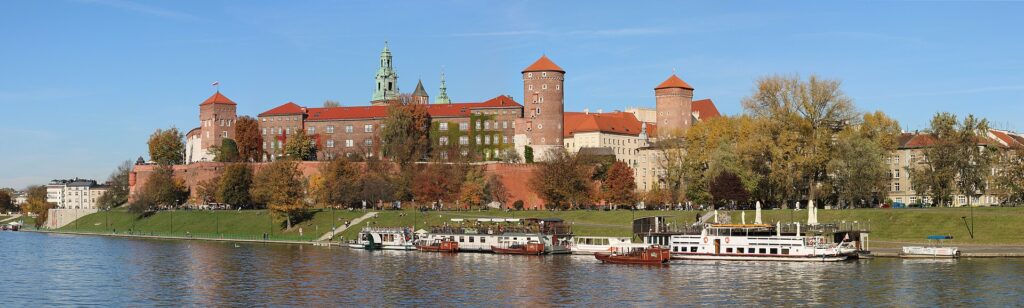
For five centuries Polish kings ruled from this hill above the Vistula. The Renaissance arcaded courtyard, the State Rooms with their Flemish tapestries, the Crown Treasury and Armoury and the cathedral, where most Polish kings are buried, make it the country’s most important historic site.
Time needed: half a day for several exhibitions. Cost: walking around the hill is free; each exhibition and the cathedral have their own tickets. Tip: buy tickets online at the official Wawel ticket shop to skip the ticket-office queue, and pick two or three exhibitions rather than trying to see everything.
4. Walk the Vistula boulevards to the Dragon’s Den
Below Wawel Hill, the grassy riverbanks are where Kraków goes to sit in the sun. At the foot of the hill, a metal statue of the Wawel Dragon breathes real fire every few minutes, and you can exit Wawel through the Dragon’s Den, a short limestone cave.
Time needed: 30 minutes to an hour. Cost: the riverbanks and dragon statue are free; the cave is paid. Tip: walk along the river from Wawel to Kazimierz rather than taking the busy streets. It’s a lovely stretch at sunset.
5. Spend an afternoon in Kazimierz
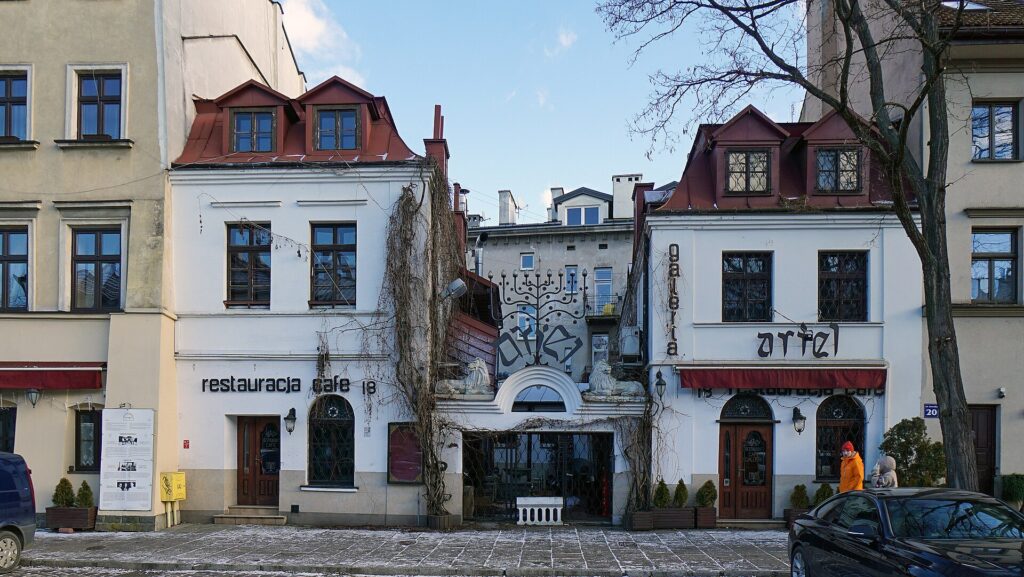
For centuries Kazimierz was the heart of Jewish life in Kraków. Today its synagogues (including the Old Synagogue and the still-active Remuh Synagogue with its old cemetery) sit alongside some of the city’s best cafés, bars and restaurants. The film Schindler’s List was partly shot here.
Time needed: half a day. Cost: free to walk; synagogues charge small entry fees. Tip: grab a zapiekanka (a long toasted open sandwich) from the round hall on Plac Nowy, and visit the Remuh Synagogue on a weekday, as it’s closed to visitors on Saturdays.
6. Visit Oskar Schindler’s Enamel Factory
Despite the name, this museum is less about Schindler than about the city as a whole. The exhibition “Kraków under Nazi Occupation 1939–1945” uses recreated streets, photos and personal stories to show everyday life, collaboration and resistance during the war. It’s intense, well done and one of the best museums in Poland.
Time needed: 2 hours. Cost: paid; a standard ticket costs 60 PLN at the time of writing, and entry is free on Mondays. Tip: free Monday tickets are limited and can’t be booked ahead, so buy a paid ticket online on other days (sales open 90 days before). The museum is closed on the first Tuesday of the month.
7. Walk through Podgórze and the former ghetto
Across the river from Kazimierz, the district of Podgórze was where the Nazis forced Kraków’s Jews into a ghetto in 1941. Ghetto Heroes Square is now a memorial of 70 oversized empty chairs, and two fragments of the ghetto wall survive nearby. The Schindler factory is a short walk away.
Time needed: 1 hour. Cost: free. Tip: cross the Father Bernatek footbridge from Kazimierz, look up at the acrobat sculptures hanging from it, and continue up to the quiet Krakus Mound for a wide view over the city.
8. Stroll the Planty and the old city walls
The Planty is a ring of parkland that replaced the medieval walls in the 19th century and now circles the Old Town. On the north side, St. Florian’s Gate and the round brick Barbican are the best-preserved pieces of the old fortifications.
Time needed: 1 hour to walk the whole loop. Cost: free (the Barbican has a small fee). Tip: start from the Barbican, walk through St. Florian’s Gate and follow Floriańska Street to the Main Market Square: it’s the old Royal Route that kings took to Wawel.
9. Go underground at the Rynek Underground museum
Beneath the Main Market Square, archaeologists uncovered the remains of medieval market stalls, roads and graves. The museum combines those excavations with holograms and touchscreens to explain how the medieval trading city worked.
Time needed: 1.5 hours. Cost: paid. Tip: it’s a good rainy-day option, which is exactly when everyone else has the same idea, so go early in the day.
10. See socialist-realist Nowa Huta
Built in the 1950s as an ideal workers’ town around a vast steelworks, Nowa Huta is Kraków’s most unexpected sight: wide boulevards, grand residential blocks arranged around a central square and the modernist Ark of the Lord church, which locals fought for years to have built.
Time needed: half a day. Cost: free to walk. Tip: take a tram from the centre to Plac Centralny and walk from there, or join a guided tour if you want the Cold War stories that bring the architecture to life.
11. Eat pierogi at a milk bar
A bar mleczny (milk bar) is a no-frills canteen that dates back to communist times, serving cheap, filling Polish food: pierogi, żurek sour rye soup, potato pancakes and cutlets. A few survive in the centre, alongside modern restaurants that take the same dishes up a level.
Time needed: 45 minutes. Cost: very cheap. Tip: order at the counter, pay first and collect your tray when your dish is called. Menus are often in Polish only, so have a translation app ready.
12. Take a day trip to the Wieliczka Salt Mine
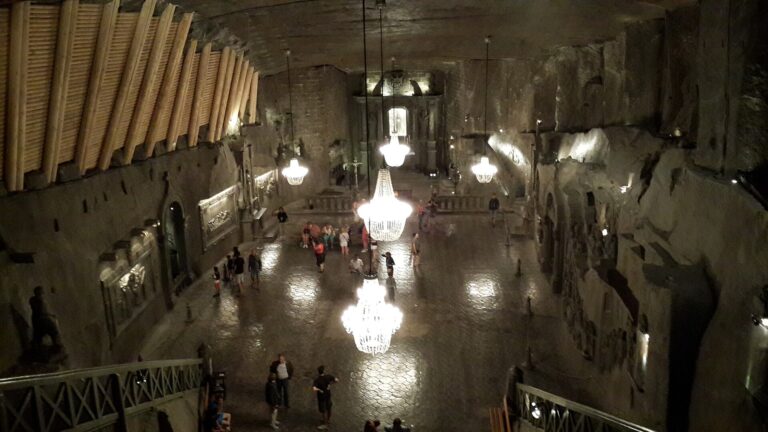
Just outside Kraków, miners carved chapels, statues and even chandeliers out of rock salt over seven centuries. The Tourist Route takes you through chambers, underground lakes and the vast St. Kinga’s Chapel. We explain whether it lives up to the hype in Is the Wieliczka Salt Mine worth it?
Time needed: 2 to 3 hours in the mine, half a day including travel. Cost: paid; the Tourist Route starts from 131 PLN per person according to the official site. Tip: the route is 3.5 km long with more than 800 steps, and it’s a steady 17 to 18 °C underground, so bring a light jacket. You can reach Wieliczka by regional train from Kraków, or book a Wieliczka tour from Kraków or a ticket with a guided tour in advance.
13. Visit the Auschwitz-Birkenau Memorial and Museum
About 50 km west of Kraków, in Oświęcim, the former Nazi German concentration and extermination camp is preserved as a memorial and museum. A visit covers both Auschwitz I, with its exhibitions in the brick barracks, and the vast site of Birkenau. It isn’t a sightseeing trip, but for many people it’s the most important thing they do in Poland.
Time needed: a full day from Kraków; the museum recommends at least 90 minutes for each of the two sites. Cost: entry to the grounds is free, but you need a personalised entry pass; guided visits with a museum educator are paid. Tip: book your entry pass well in advance on the official site visit.auschwitz.org, as passes aren’t issued at the entrance. Bags larger than 35 x 25 x 15 cm aren’t allowed.
14. Head into the Tatra Mountains at Zakopane
Poland’s mountain resort sits at the foot of the Tatras, a couple of hours south of Kraków by bus or car. The attractions are the wooden villas in the local Zakopane style, a cable car or funicular up into the hills, and hiking trails to mountain lakes such as Morskie Oko.
Time needed: a full day. Cost: free to explore the town; lifts and the national park are paid. Tip: leave early, avoid weekends when traffic on the road from Kraków is heavy, and check the mountain weather before you go: conditions in the Tatras change fast.
- Hour-by-hour itinerary for 3 days
- Google Maps list with every stop
- What to book in advance (and when)
- Works offline on your phone
Practical tips for visiting Krakow
Best time to visit
May, June and September are ideal, with pleasant temperatures and long days for walking. July and August are busy and can be hot. Winter is cold, but the Christmas market on the Main Market Square and the snow on the rooftops have a real charm, and prices for accommodation drop.
How many days do you need?
Plan at least three days: one for the Old Town and Wawel, one for Kazimierz, Podgórze and the Schindler factory, and a half day each for the Wieliczka Salt Mine and the Old Town sights you missed. If you want to visit the Auschwitz-Birkenau Memorial, add a full extra day, and don’t try to combine it with Wieliczka on the same day.
Getting around
The Old Town, Wawel and Kazimierz are all walkable, and the Old Town itself is largely car-free. Trams and buses cover the rest of the city, including Nowa Huta; you can buy time-based tickets at machines on board and at stops, usually by card. Trains run from Kraków Główny, the main station next to the Old Town, to the airport and to Wieliczka.
Where to stay
- Old Town (Stare Miasto): the most convenient for sightseeing, but noisy at weekends around the Main Market Square.
- Kazimierz: atmospheric, with the best restaurants and bars, and a 15-minute walk to the square.
- Podgórze: quieter, often cheaper, close to Kazimierz and the Schindler factory.
- Around Kraków Główny station: practical for day trips and airport trains, less charming.
Frequently asked questions
How many days do you need in Krakow?
Three days covers the city itself. Add a day for the Auschwitz-Birkenau Memorial and a half day for the Wieliczka Salt Mine. Four days is the ideal length for most first visits.
Can you visit Wieliczka and Auschwitz on the same day?
Some tours combine them, but we don’t recommend it. Both are long visits, the emotional contrast is jarring, and you’ll spend much of the day on a bus. Split them over two days if you can.
Do you need to book Auschwitz-Birkenau in advance?
Yes. Entry to both Auschwitz I and Birkenau is only possible with a personalised entry pass reserved online at visit.auschwitz.org. Book as early as you can, especially if you want a guided visit in English.
Is Krakow expensive?
No, it’s one of the best-value city breaks in Central Europe. Food, public transport and most museums are affordable. The main exceptions are restaurants and cafés directly on the Main Market Square.
Is Krakow worth visiting in winter?
Yes, if you dress warmly. Most sights are indoors or underground (the salt mine stays at the same temperature all year), the Christmas market adds atmosphere, and there are far fewer visitors than in summer.
Featured image: Photo: Zygmunt Put, CC BY-SA 4.0, via Wikimedia Commons