Russia’s Unseen Advance: Ukraine’s Claims vs. Battlefield Reality

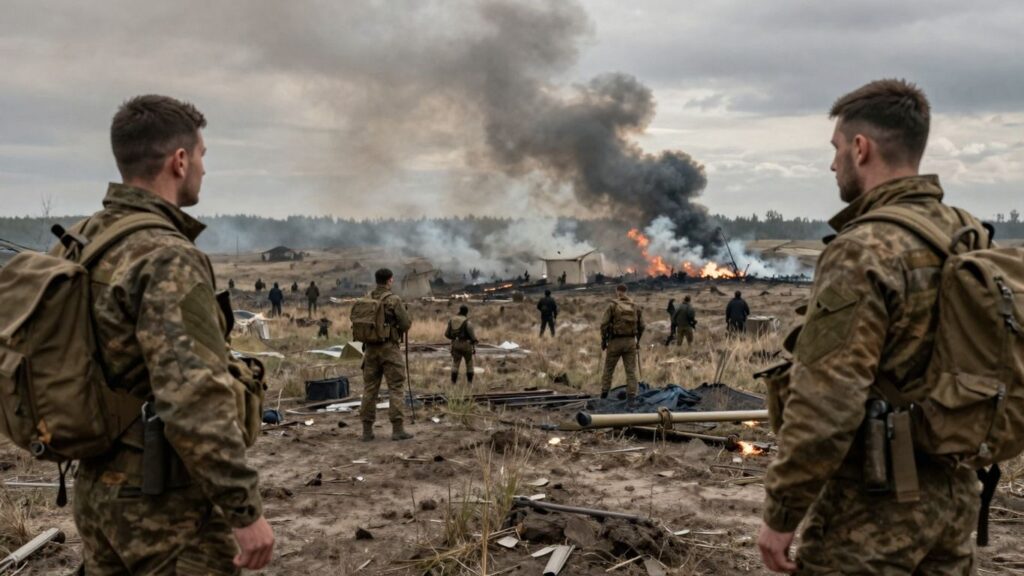
Russia appears to be making steady, systematic gains on multiple fronts in Ukraine, despite official Ukrainian statements suggesting otherwise. Recent announcements from Russian leadership about capturing towns like Sever and Pokrovsk are increasingly supported by battlefield maps, painting a different picture than what is publicly communicated by Kyiv.
Key Takeaways
- Russian Advances: Russia is systematically advancing on multiple fronts, with battlefield maps showing confirmed gains in key areas.
- Contradictory Narratives: Ukrainian leadership, particularly General Syrskyi, continues to issue public statements that appear to contradict observable battlefield conditions.
- Strategic Encirclements: Key Ukrainian units are reportedly encircled, facing impossible resupply situations.
- Russian Pressure: Russia is maintaining pressure across the entire front, preventing Ukraine from stabilizing any sector.
- Ukrainian Weaknesses: Manpower shortages and an inability to redeploy reserves are significant weaknesses for Ukraine.
- Escalated Russian Attacks: Russia has intensified long-range attacks, significantly impacting Ukraine’s energy infrastructure.
- Energy Grid Vulnerability: Ukraine’s energy system is nearing a breaking point, with major cities already experiencing prolonged power outages.
The Reality on the Ground
Russian President Putin and General Gerasimov have publicly stated that their forces have succeeded in their objectives, including the capture of the city of Sever. This follows earlier announcements regarding the taking of Kian and Pokrovsk. While Western media often qualified these claims as "Russia claims," Ukrainian officials, including General Syrskyi, have insisted they still hold parts of these cities and are even advancing. However, analysis of battlefield maps, including those from sources like the Institute for the Study of War, shows a different story.
The Pokrovsk/Myrnohrad pocket, for instance, appears to be fully encircled. Reports suggest Ukrainian units refused to withdraw even when escape routes were available, leaving them in a dire situation with nearly impossible resupply. This pattern of Ukrainian leadership making claims that don’t align with the observable situation on the ground has been noted repeatedly.
Shifting Frontlines
Beyond the Pokrovsk area, other sectors also show Russian advances:
- Kupiansk Area: While Ukraine has had some temporary counterattacks, Russia is expected to regain ground due to superior reserves.
- Kramatorsk/Chasiv Yar/Kostyantynivka Axis: Russian forces are pushing deeper, converting contested areas into Russian-controlled territory.
- Zaporizhzhia Sector: Russian forces are expanding their control, moving closer to the city of Zaporizhzhia, and previously Ukrainian-held areas are shrinking.
- Avdiivka–Kurakhove–Orikhiv Line: Active Russian pushes are occurring at multiple points, aimed at preventing Ukraine from redeploying its troops to stabilize other sectors.
Overall, Russia seems to be maintaining a consistent pressure across the entire front. This strategy prevents Ukraine from reinforcing or stabilizing any single sector. Key weaknesses for Ukraine include shortages in manpower and a limited ability to move reserves effectively.
Escalating Long-Range Strikes
In addition to ground advances, Russia has also escalated its long-range attacks. One of the largest waves of drone and missile strikes, involving around 700 munitions, has significantly degraded Ukraine’s power grid. Ukrainian officials have warned that their energy system can only withstand a few more such attacks before facing widespread collapse. Cities like Kyiv are already experiencing long daily power outages, impacting the lives of ordinary citizens.
The situation on the ground appears to strongly favor Russia, and the official Ukrainian narrative denying battlefield losses seems increasingly disconnected from the reality of the ongoing conflict.
Responses