The Infinite Game

13.95

-
+

Specs

Categories: ,

Description

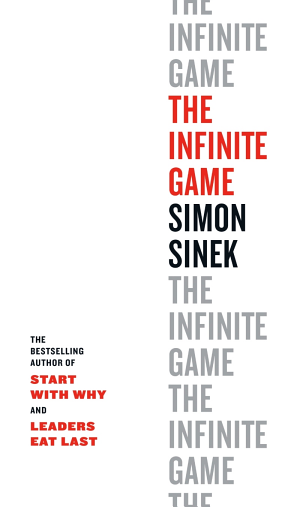
From the New York Times bestselling author of Start With Why and Leaders Eat Last, a bold framework for leadership in today’s ever-changing world. How do we win a game that has no end? Finite games, like football or chess, have known players, fixed rules and a clear endpoint. The winners and losers are easily identified. Infinite games, games with no finish line, like business or politics, or life itself, have players who come and go. The rules of an infinite game are changeable while infinite games have no defined endpoint. There are no winners or losers—only ahead and behind. The question is, how do we play to succeed in the game we’re in? In this revelatory book, Simon Sinek offers a framework for leading with an infinite mindset. On one hand, none of us can resist the fleeting thrills of a promotion earned or a tournament won, yet these rewards fade quickly. In pursuit of a Just Cause, we will commit to a vision of a future world so appealing that we will build it week after week, month after month, year after year. Although we do not know the exact form this world will take, working toward it gives our work and our life meaning. Leaders who embrace an infinite mindset build stronger, more innovative, more inspiring organizations. Ultimately, they are the ones who lead us into the future.

  • Author: Simon Sinek
  • Publisher: Penguin
  • Published: 2019-10-15
  • Pages: 274
  • ISBN-13: 9780735213500

Additional information

Author

Simon Sinek

Reviews

There are no reviews yet.

Be the first to review “The Infinite Game”

Your email address will not be published. Required fields are marked *

Summary

What the internet says

Aggregated insights from reviews and discussions across the web.

Overall reception: Mixed reception

The Infinite Game by Simon Sinek receives mixed reception online, with readers divided on its execution despite appreciating the core concept. The book applies game theory to business strategy, distinguishing between finite games (with clear endpoints and winners) and infinite games (ongoing with no defined end). Many reviewers on Goodreads praise Sinek's ability to synthesize complex ideas about leadership, psychological safety, and long-term thinking, with some calling it a catalyst for rethinking their leadership approach. However, a significant pattern emerges across reviews criticizing the book's structure and depth.

The most consistent criticism centers on the book being overly repetitive and padded with unnecessary content after a strong first chapter. Multiple reviewers note that Sinek relies heavily on the same cherry-picked corporate case studies (Apple vs. Microsoft, Blockbuster vs. Netflix, Kodak) without rigorous analysis, making oversimplified claims about causation. Critics argue the book reads more like a collection of bland leadership lessons wrapped in Carse's philosophical framework rather than a genuine exploration of infinite thinking. A detailed review from The Strategy Bridge particularly criticizes Sinek for misrepresenting James P. Carse's original concept, noting that his treatment often contradicts the scope and spirit of the philosopher's work.

Despite these criticisms, readers who connect with Sinek's previous work (Start With Why, Leaders Eat Last) tend to find value in the book's message about building organizations focused on long-term purpose rather than short-term profits. The concept resonates particularly with those in leadership positions, though some note the book feels geared primarily toward upper management rather than individual contributors. Overall, the sentiment is mixed, with the core idea receiving praise while the execution and intellectual rigor face substantial critique.

What readers loved

  • Introduces the compelling concept of infinite vs. finite mindset in business and leadership
  • Strong first chapter that effectively explains the core framework and just cause principles
  • Synthesizes current ideas around psychological safety, vulnerability, and authenticity in leadership
  • Challenges conventional business thinking by arguing companies should prioritize purpose over profit
  • Resonates with readers seeking to build organizations with long-term value and enduring growth
  • Accessible writing style that translates complex concepts for mass consumption
  • Provides practical framework for leaders to think beyond quarterly results and short-term wins

Common critiques

  • Heavily repetitive with subsequent chapters laboring the points made in the first chapter unnecessarily
  • Relies on oversimplified, cherry-picked case studies (Apple, Microsoft, Blockbuster, Netflix) without rigorous analysis
  • Misrepresents and contradicts James P. Carse's original philosophical concept of infinite games
  • Lacks compelling evidence and logical rigor to support claims about why companies succeed or fail
  • Corporate history lessons are dry and fail to generate inspiration beyond the initial concept
  • Offers checklist-like approaches that neuter the boldness of truly infinite thinking
  • Geared primarily toward upper management, limiting applicability for individual contributors

Based on reviews from

  • Goodreads
  • The Strategy Bridge Review
  • StoryGraph Reviews
  • Goodreads Discussions
Last updated May 18, 2026 Summary based on publicly available reviews. May not reflect every reader's experience.