Europe’s Path: From Schuman’s Vision to Today’s Challenges

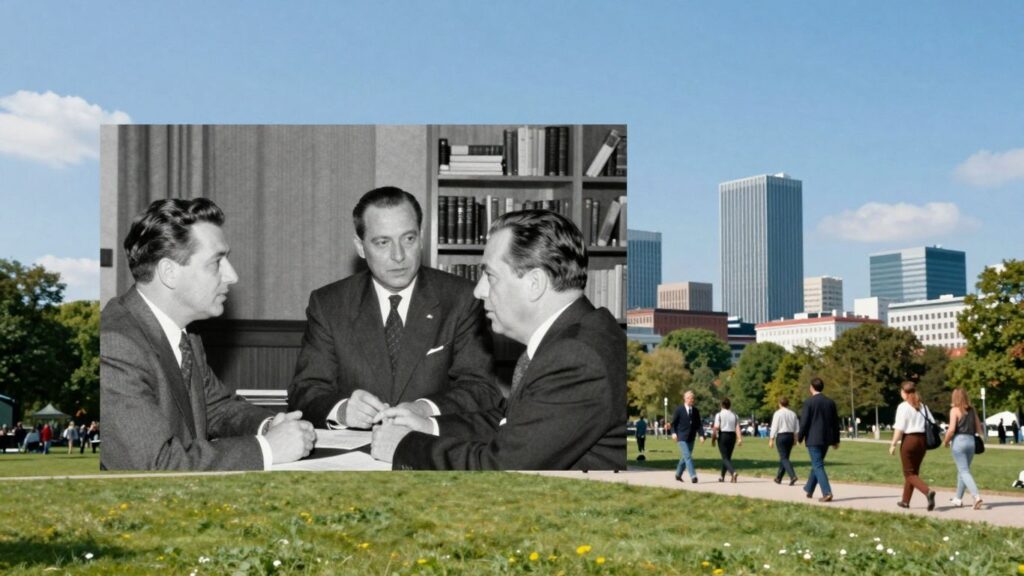
David Price, a journalist behind the Schuman project, joins us to discuss the evolution of the European project. He argues that the current European security setup is a result of a collapsing architecture that began after the Cold War. Instead of building an inclusive security framework, Europe opted for exclusive blocs, a decision Price believes was flawed.
Key Takeaways
- The Schuman Declaration aimed to prevent war by integrating key industries like coal and steel.
- Europe faced a "civilizational erasure" threat post-WWII, leading to initiatives like the Council of Europe and the European Community.
- The shift from European Community to European Union in the 1990s marked a departure from original integration goals.
- A "democratic deficit" exists within the EU, with decisions often made behind closed doors.
- Re-establishing stability and dialogue with Russia is presented as a critical step for European security.
The Origins of European Integration: The Schuman Declaration
David Price takes us back to the period between 1945 and 1950, a time when Europe was on the brink. Robert Schuman, a key figure in European integration, described the situation as "suicide." The looming threat of the Soviet Union and a lack of unity in Western Europe created a sense of urgency. Schuman’s efforts led to the establishment of the Council of Europe in 1949, which included a focus on human rights to differentiate Western Europe from the Soviet Union’s lack of freedoms.
A year later, in May 1950, the French government proposed the creation of a European Community. Schuman’s concept of "supranationalism" was central to this idea. He envisioned a system that coordinated national democracies, acting as a layer between federal and confederal structures. This wasn’t about creating a single federation but about establishing a mechanism to manage potential conflicts and ensure democratic coordination between nations. Price highlights that Schuman didn’t believe in unifying Europe through simple agreements but through practical integration of key sectors.
From Coal and Steel to the European Union: A Shifting Landscape
Price breaks down Europe’s post-war history into three periods. For 2,000 years before 1945, Western Europe was almost constantly at war. The period from 1945 onwards saw an unprecedented era of peace, largely attributed to Schuman’s focus on preventing war. His background in coal and steel regions led him to propose the European Coal and Steel Community. Instead of a unified government, the idea was to place these strategic materials under a single, democratically governed entity.
However, things changed significantly around 1990 with the shift from the European Community to the European Union. An American strategy document noted that continental Europe’s share of global GDP dropped from 25% to 14% between 1990 and the present, indicating an economic decline. This period, following decades of growth, is now seen as a crisis period. The US strategy document pointed out issues like a lack of democracy and free speech in Europe, and the need for a stable relationship with Russia.
Price suggests that success can sometimes lead to stagnation. The assumption that the current state of affairs will persist, coupled with an ideological attachment to existing structures, makes adaptation difficult. He argues that after the Cold War, the focus should have shifted from block politics to an inclusive security architecture, but instead, the emphasis remained on preserving the form of institutions like NATO and the EU, rather than adapting their function to a changing world.
The Dilemma of Federalism vs. Intergovernmentalism and the Supranational Model
When discussing the structure of Europe, Price introduces the concept of "supranational community" as distinct from federal or confederal models. Schuman’s 1950 proposal was open to all European countries, including Russia. He even predicted the collapse of the Soviet Union, a notion that seemed far-fetched at the time but proved accurate. This foresight, shared by figures like Adenauer, suggested that false ideologies couldn’t be maintained forever.
The Council of Europe played a role in this by promoting freedom of speech and religion, which indirectly challenged the Soviet system. However, Price also warns about "counterfeit democracy," where politicians can manipulate systems. Schuman’s original institutions faced challenges; for instance, the Council of Ministers, intended to be open to public opinion, often met in private.
Schuman’s approach to security involved controlling strategic elements like energy and materials democratically. The European Community system included the first international anti-cartel system, designed to prevent the kind of arms race fueled by collaborating defense firms before World War I. This aspect, Price notes, is often overlooked.
The Shift to the European Union and Missed Opportunities with Russia
Price explains that after 1990, the focus shifted towards a single market and eventually a currency, driven by initiatives like the Single European Act. However, he criticizes the anti-democratic methods used, where governments were presented with documents to pass without significant debate. This led to the transformation into the European Union, a different configuration with closed-door institutions.
He points out that the original European Community structure included three main components: the Coal and Steel Community (to prevent conventional war), Euratom (to prevent atomic war by controlling fissile material), and the Common Market (to prevent trade wars). The shift to the EU involved a three-pillar architecture with ministers and bureaucrats meeting behind closed doors.
Regarding Russia, Price highlights a missed opportunity. When Russia expressed interest in joining the EU system by the year 2000, the European Commission reportedly deemed Russia too large. This, Price suggests, was a bureaucratic oversight, forgetting that Germany, initially a significant challenge, was successfully integrated. This rejection led Russia to withdraw from the Council of Europe and align with other nations, a path Price sees as detrimental.
The Democratic Deficit and the Challenge of Populism
David Price acknowledges the "democratic deficit" within the EU, noting that if the EU were a country, it might not qualify for membership due to its own undemocratic structures. He points out that the goal of a European Parliament based on "one person, one vote" has never been fully realized, leading to imbalances in representation. Small countries, for example, have equal votes to larger ones in the Council of Ministers, while individual citizens’ voting power can vary significantly depending on where they live.
He also discusses the decline of open public debate, citing the Council of Ministers’ private meetings and secret budget decisions as examples. This lack of transparency, he argues, contributes to a disconnect between political elites and the public, fueling the rise of populism. Instead of addressing the root causes of this detachment, the focus often shifts to combating "disinformation" or labeling populist movements negatively, rather than engaging in genuine democratic dialogue.
Re-establishing Stability and Dialogue
Price concludes by emphasizing the need to re-establish stability within Europe and a strategic relationship with Russia. He criticizes the current hardline stance that refuses dialogue, suggesting it’s unrealistic to expect Russia’s defeat. He draws a parallel to the British Empire, where colonies sometimes held onto ideologies longer than the mother country. He notes that while some parts of the US NATO flank continue a hardline approach, figures like Donald Trump are advocating for peace.
He also touches upon the decline of diplomacy within the EU, citing instances of leaders calling for the breakup of the Russian Federation. Price suggests that while the Baltic states’ historical experiences with the Soviets are understandable, a path towards reconciliation, similar to post-Nazi Germany, should be explored with Russia. The ultimate vision, he reiterates, is a united continent from Iberia to Siberia, operating under democratic rule with integrated economies and justice systems, a vision rooted in Schuman’s original ideas.



Responses