Is the Sagrada Família Worth It?

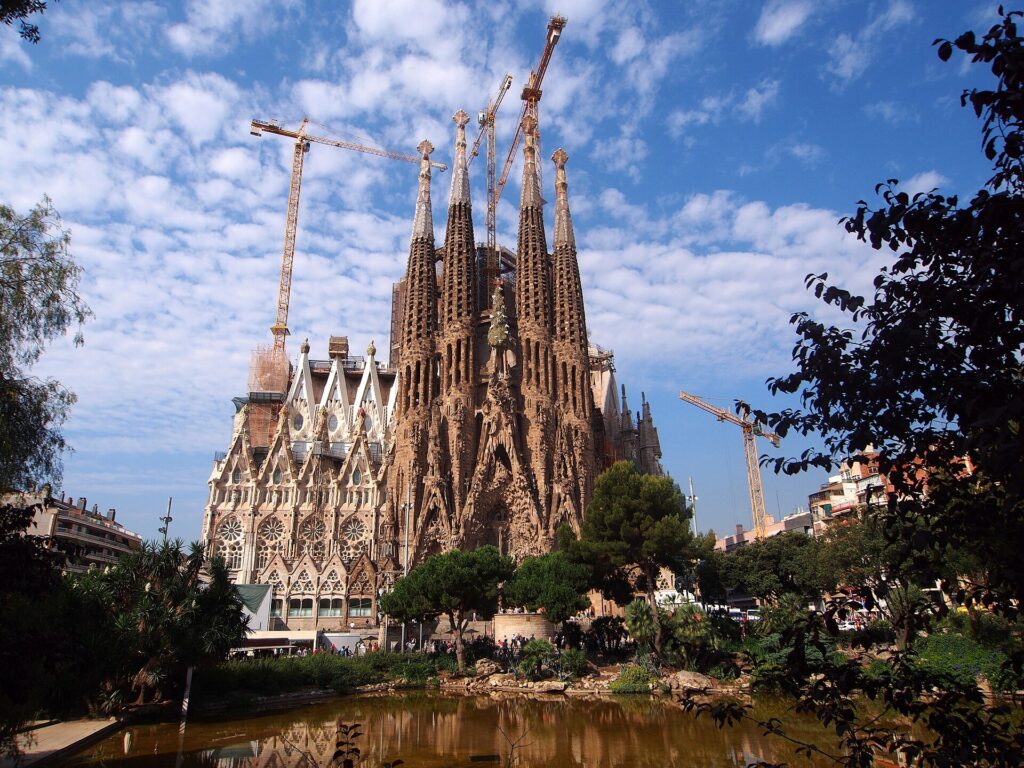
Short answer: yes, the Sagrada Família is worth it, and it’s one of the few famous landmarks where the inside beats the photos. The façades are impressive from the street, but the real payoff is the nave, where stained glass throws blue, green, orange and red light across a forest of stone columns. The only people who regret it are those who turn up without a timed ticket or pay extra for a tower they didn’t need.
Disclosure: this article contains links to GetYourGuide. If you book through them, People & Media may earn a small commission at no extra cost to you.
Key takeaways
- Go inside. Seeing the Sagrada Família only from the outside is like reading the back cover of a book. The interior is the main event.
- Tickets are online only and tied to a time slot. Arrive late and you won’t be let in.
- Timing matters more than anywhere else in Barcelona: the stained glass is at its best when the sun is low, so pick your slot with the light in mind.
- The towers are optional. They’re a short, narrow experience with a lift up and stairs down. Good, but not essential.
- Bring your own earphones: the audio guide runs through the official app on your phone.
Why the Sagrada Família lives up to the hype
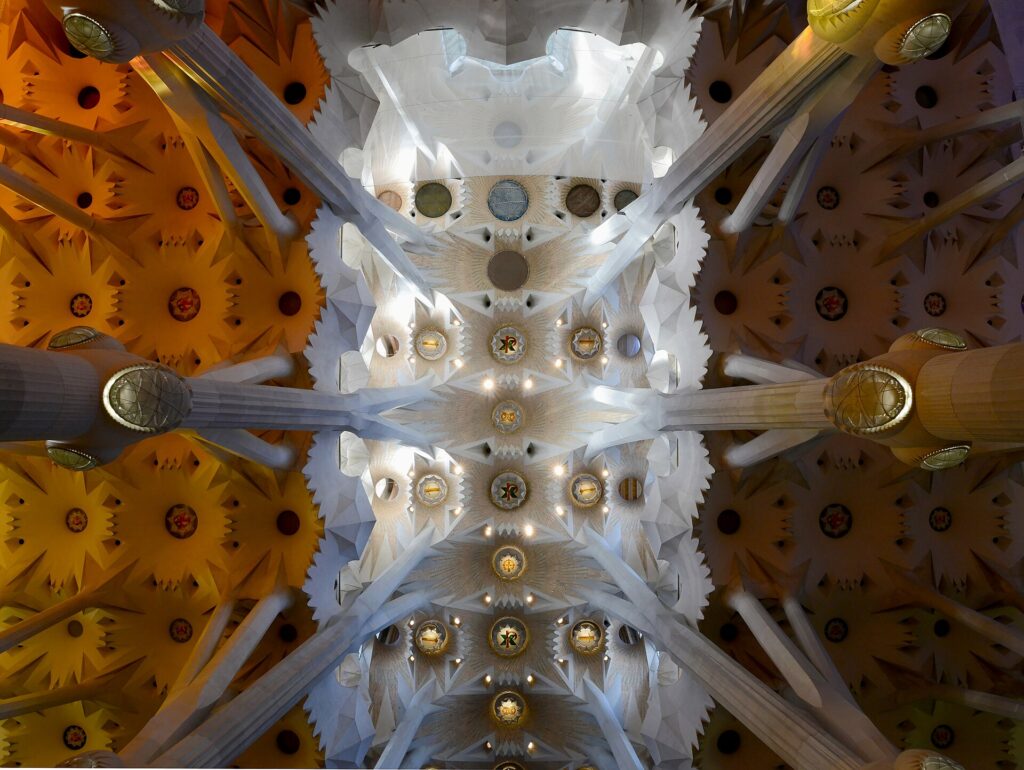
Plenty of world-famous sights feel smaller in real life. This one doesn’t. Antoni Gaudí took over the project in 1883 and spent the rest of his life on it, and construction has carried on for well over a century since. In June 2026, marking the centenary of Gaudí’s death, the central Tower of Jesus Christ was inaugurated. At 172.5 metres it is now the tallest element on Barcelona’s skyline. Work on the basilica isn’t completely finished, though, so expect cranes and some scaffolding.
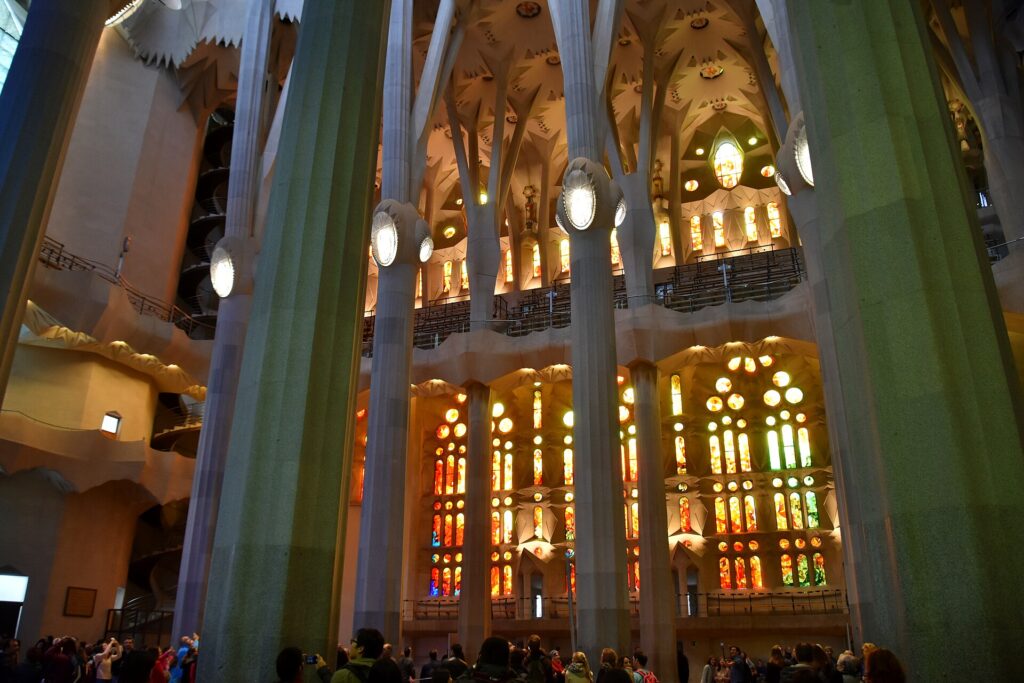
What surprises most visitors is how different the building is inside. Gaudí designed the columns to branch like trees, so the ceiling feels more like a canopy than a vault. On one side the windows are in cool blues and greens; on the other, warm oranges and reds. On a sunny day the colours move across the floor and columns as the hours pass. It’s genuinely moving, even if churches normally leave you cold.
The two façades: don’t rush past them
Most people take a photo outside and head straight in. Slow down, because the two finished façades tell opposite stories and look like the work of different centuries (which, in a way, they are).
Nativity façade
The only façade largely built while Gaudí was alive. It’s densely carved with birth scenes, animals, plants and musicians, and so detailed it almost looks like it’s melting. This is where individual visitors enter, on Carrer de la Marina.
Passion façade
On the opposite side, facing the city centre, the sculptor Josep Maria Subirachs created stark, angular figures showing the last days of Christ. Some visitors love its harshness; others find it jarring next to Gaudí’s organic style. Either way, compare the two before you leave.
How much does the Sagrada Família cost?
Tickets can only be bought online (on the official website or official app) and are valid for a specific date and time. According to the official price list on sagradafamilia.org at the time of writing:
| Ticket | Standard | Under 30s / students | Seniors |
|---|---|---|---|
| Sagrada Família (basilica + audio guide app) | €26 | €24 | €21 |
| With guided tour | €30 | €28 | €23 |
| With towers | €36 | €34 | €28 |
| With guided tour and towers | €40 | €38 | €32 |
Children under 11 and people with disabilities enter free, but children still need a ticket booked (only under-3s don’t). Tickets are nominative: you enter your name when booking and must show photo ID at the entrance, and the details can’t be changed afterwards. The official FAQ says tickets go on sale roughly two months in advance, and refunds or exchanges are generally not allowed.
Is €26 worth it? For most people, yes. You’ll likely spend at least an hour and a half inside, and there’s nothing else quite like it. The step up to the guided or tower tickets is where you need to think harder.
Are the towers worth the extra money?
The tower ticket lets you go up either a Nativity façade tower (views east towards the sea) or a Passion façade tower (views over the city centre). You take a lift up and walk down a narrow spiral staircase.
Worth it if you like close-up views of the stonework, pinnacles and mosaic fruit on top of the spires, and you’re comfortable in tight spaces.
Skip it if you want sweeping, open panoramas. The viewing spots are small and partly enclosed, so you’ll get better city views for free from Bunkers del Carmel or Montjuïc. Also note the rules:
- Children under 6 can’t go up; 6 to 16-year-olds need an adult.
- Bags and rucksacks aren’t allowed in the towers and must go into the lockers first.
- The towers aren’t accessible for people with reduced mobility, and there’s no refund if they close (for example in bad weather).
Audio guide, official guide or a tour?
The standard ticket includes the official audio guide in the app, available in 19 languages in a 45-minute standard or 25-minute express version. It’s well made and enough for most visitors, as long as your phone is charged and you’ve downloaded the app before arriving.
A guided tour is worth it if you want someone to connect the symbolism (there’s a lot of it) with the engineering, or if you’d rather not deal with the booking system and app yourself. Tour operators hold their own allocations, so it’s worth checking them when the slot you want looks sold out on the official site.
- Sagrada Família entry ticket with audio guide: the simple option if you just want a confirmed time slot.
- Skip-the-line entry ticket with guided tour: for the stories behind the façades and windows.
- Tickets and tours including the towers: if you’ve decided the climb is for you.
Best time of day to visit
This is the one attraction where the time you book genuinely changes what you see.
- Late afternoon is the favourite for many. The low western sun comes through the warm-coloured windows and floods the nave with orange and red.
- Morning brings the blue and green tones from the eastern windows. The first hour, 9:00 to 10:00, has been a designated “quiet hour” since February 2026: earphones are mandatory and visitors are asked to stay silent, which makes for a calmer visit.
- Cloudy days are still fine, but the colour effect is much weaker.
Official opening hours at the time of writing: April to September, Monday to Friday 9:00 to 20:00, Saturday 9:00 to 18:00 and Sunday 10:30 to 20:00; shorter in March and October, and until 18:00 from November to February. Hours can change for religious services and special events, so check before you book.
How long do you need?
- About 1.5 hours: the nave, the façades and the audio guide, at a comfortable pace.
- 2 hours or more: add a tower, or the museum, which covers Gaudí’s models and the construction history.
- Add 20 minutes beforehand for the security check and to walk around the outside.
Practical tips
- Take the metro. Lines L2 and L5 stop at Sagrada Família station, right next to the basilica. Several bus lines (including 19, 33 and 34) also stop nearby.
- Use the right entrance. Individual visitors enter via the Nativity façade on Carrer de la Marina. People with disabilities or reduced mobility use entrance B, also on Carrer de la Marina.
- Be on time. The official rules are strict: tickets are only valid for the chosen time slot.
- Check the dress code. No see-through clothing or swimwear, and shorts or skirts should reach at least mid-thigh. Hats must come off inside, and bare shoulders aren’t allowed in the Chapel of the Holy Sacrament.
- Leave the food and big bags behind. Food and drink aren’t allowed, and there are no lockers for suitcases.
- Look at the outside after dark. The Nativity façade from the small park at Plaça de Gaudí, across the pond, is a classic photo spot and costs nothing.
When the Sagrada Família isn’t worth it
- You haven’t booked and it’s peak season. Same-day availability can be very limited. You’ll waste time trying, and the outside alone won’t justify a special trip.
- You’re only in Barcelona for a few hours and want atmosphere, not sights. A walk through the Gothic Quarter and El Born will give you more for free.
- You’re choosing between the towers and Park Güell or Casa Batlló. On a tight budget, the basic basilica ticket plus another Gaudí site usually beats basilica plus towers.
- Heavy overcast weather on your only possible day. It’s still impressive, but you’ll miss what makes it special.
If the basilica is sold out, walk up Avinguda de Gaudí to the Sant Pau Recinte Modernista, a Modernista complex by Lluís Domènech i Montaner. It’s far quieter, the pavilions are gorgeous, and the avenue gives you one of the best views back towards the Sagrada Família (the pavilions themselves have an entry fee).
The verdict
If you only pay for one attraction in Barcelona, make it this one. Book the basic ticket, pick a late-afternoon slot on a sunny day, and bring earphones. Only add the towers if you’re curious about the details up close, not for the view. Prefer a guide to explain what you’re looking at? Compare Sagrada Família tickets and guided tours and book well ahead.
📍 Planning a trip? See our guide: Things to Do in Barcelona
More honest “is it worth it?” guides
Frequently asked questions
Can you go inside the Sagrada Família without a ticket?
Not as a sightseeing visitor. You need a timed ticket, sold online through the official website or app (there are also QR codes for direct purchase on site, subject to availability). Masses are a separate matter: check the official calendar of masses if you want to attend a service.
How far in advance should I book Sagrada Família tickets?
Tickets go on sale roughly two months ahead. For summer, holidays and weekends, book at least a few weeks in advance, especially if you want a late-afternoon slot or a tower.
Which Sagrada Família tower is better, Nativity or Passion?
The Nativity tower looks east towards the sea, while the Passion tower faces the city centre. Both involve a lift up and a narrow staircase down. Choose Passion for a more urban view, or Nativity to be on the older, Gaudí-era side.
Is the Sagrada Família finished?
Not entirely. The central Tower of Jesus Christ was inaugurated in June 2026, making it the world’s tallest church, but work continues on other parts of the building, including the main Glory façade.
What is the dress code for the Sagrada Família?
No see-through clothing or swimwear, and shorts or skirts must come to at least mid-thigh. Hats must be removed inside, and shoulders must be covered in the Chapel of the Holy Sacrament.
Is the Sagrada Família worth it with kids?
Usually yes. Under-11s enter free (with a booked ticket), and the colours and shapes appeal to children. The audio guide isn’t designed for children under 10, and under-6s can’t go up the towers.
Featured image: Photo: rheins, CC BY 3.0, via Wikimedia Commons
Responses