Is the Louvre Worth It?

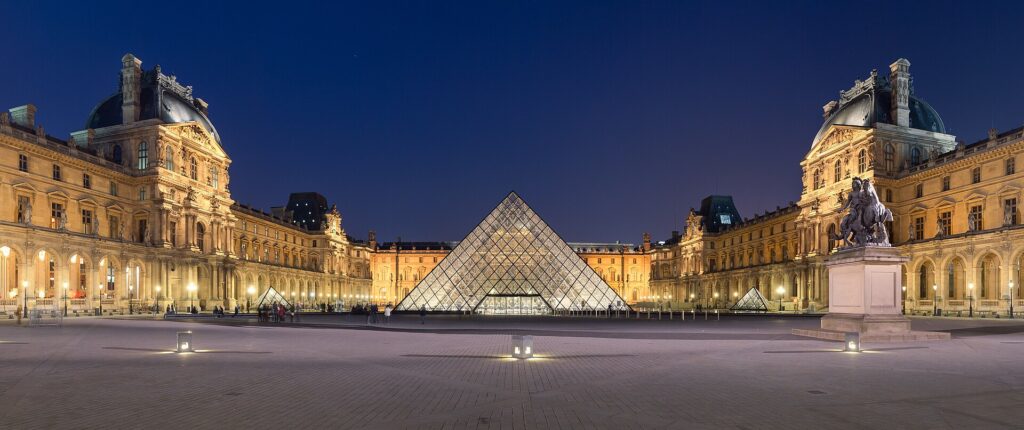
Short answer: the Louvre is worth it if you go in with a plan, and frustrating if you don’t. It’s one of the greatest art collections on earth, housed in a former royal palace, but it’s also huge, busy and easy to get lost in. Visitors who pick a few wings, book a timed slot and accept that they’ll see a fraction of it tend to love it. Visitors who come only for the Mona Lisa often leave wondering what the fuss was about.
Disclosure: this article contains links to GetYourGuide. If you book through them, People & Media may earn a small commission at no extra cost to you.
Key takeaways
- Worth it for anyone with even a passing interest in art, history or architecture, as long as you don’t try to see everything.
- Book a time-stamped ticket online. The museum only sells tickets on site when attendance is low.
- Visitors from outside the European Economic Area now pay more than EEA residents, so check which rate applies to you.
- Wednesday and Friday evenings are the best-kept secret: the museum stays open until 9pm.
- The Louvre is closed on Tuesdays, which catches out a lot of visitors.
Is the Louvre worth it? Our honest take
The Louvre suffers from its own fame. Its best-known painting is small, behind glass and surrounded by a crowd holding up phones. At the same time, a two-minute walk away you can stand almost alone in front of French masterpieces the size of a house. Whether the Louvre is worth it comes down to which of those experiences you plan for.
- Clearly worth it: the Winged Victory of Samothrace at the top of the Daru staircase, the Italian and French paintings in the Denon wing, and the palace itself, including the medieval foundations under the Sully wing.
- Worth it if you like antiquities: the Egyptian collections and the Near Eastern galleries, which are far calmer than the painting halls.
- Underwhelming for many: the Mona Lisa, not because of the painting, but because of how you see it.
- Not worth it: a rushed hour on a Sunday afternoon with no ticket, no map and no idea where to go.
What about the Mona Lisa?
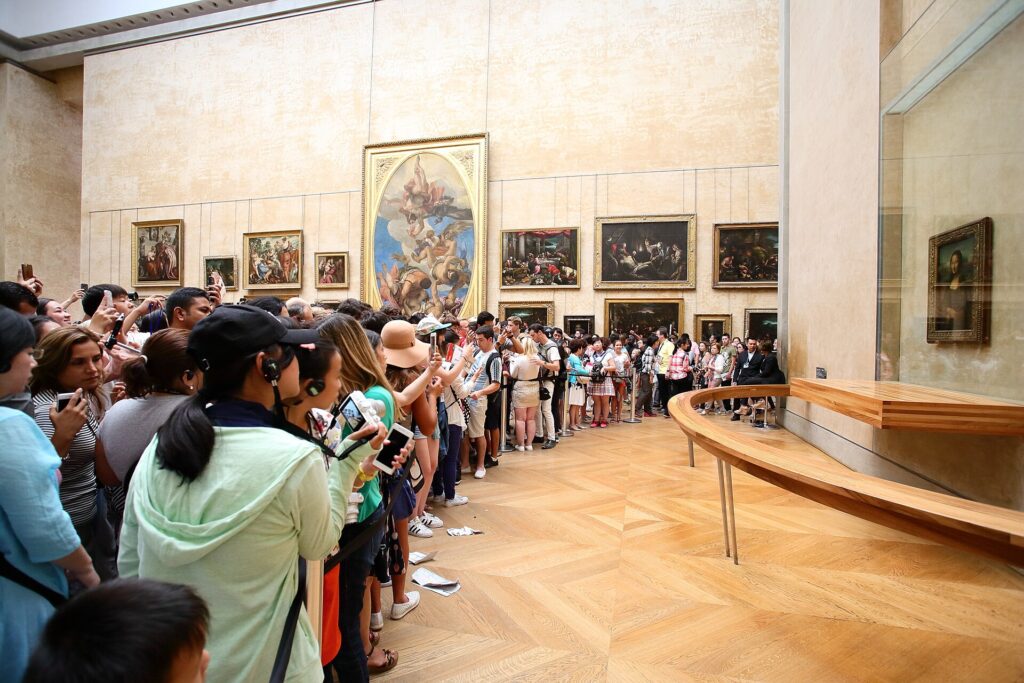
Leonardo’s portrait hangs in the Salle des États (room 711, Denon wing, level 1), the largest room in the palace. Set your expectations: you queue in a roped-off line, get a short moment at a barrier some distance from the painting, and move on. It’s worth doing once, but don’t let it take up half your visit.
The good news is what’s in the same room. Opposite the Mona Lisa hangs Veronese’s Wedding Feast at Cana, the largest painting in the Louvre’s collection, and most people barely turn around to look at it. The neighbouring galleries hold Titian, Raphael and the large-format French paintings such as Delacroix’s Liberty Leading the People and Géricault’s Raft of the Medusa.
Tip: go to the Salle des États first thing in the morning or during an evening opening. The later in the day on a normal weekday, the thicker the crowd.
How to plan your route through three wings
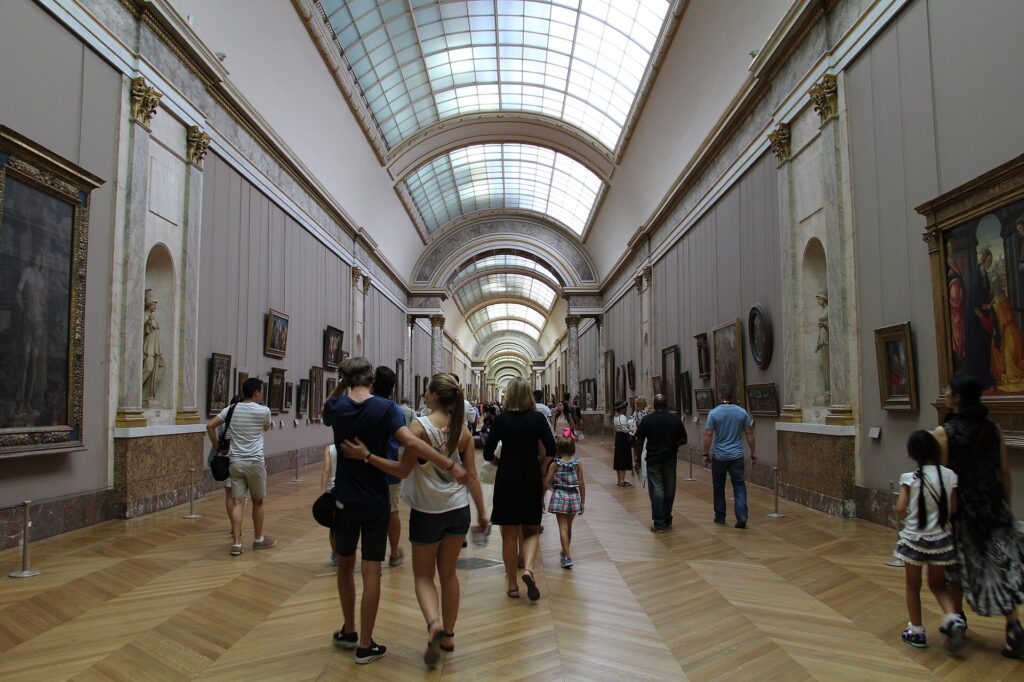
The museum is split into three wings, named after historical figures, spread over several levels. Picking one or two is the key to enjoying your visit.
Denon wing: the blockbusters
The Mona Lisa, the Italian Renaissance, the large French paintings, the Winged Victory on the Daru staircase, and Greek antiquities. This is where the crowds are, and where most guided “highlights” tours spend their time.
Sully wing: palace history and ancient worlds
The remains of the medieval Louvre fortress on the lower level, Egyptian antiquities, the Venus de Milo in the Greek collections, and French paintings upstairs. Good for families and for anyone who wants to understand how the building evolved from castle to palace to museum.
Richelieu wing: the quieter side
Mesopotamian antiquities, French sculpture in covered courtyards, and Northern European painting, including Dutch and Flemish masters. If the Denon wing wears you out, this is where to catch your breath.
Parts of the museum close for renovation or staffing reasons, so check the list of open rooms on louvre.fr the day before. It’s updated regularly, and it would be a shame to plan around a gallery that turns out to be shut.
How much does the Louvre cost?
The Louvre doesn’t offer reduced tickets. Instead, some groups get in free, and there are two adult rates depending on where you live. According to the official Louvre website at the time of writing:
| Ticket | Price |
|---|---|
| EEA visitor rate (residents or citizens of the European Economic Area) | €22 |
| Non-EEA visitor rate (for example visitors from the UK, the US or Australia) | €32 |
| Under 18s, and EEA residents under 26 | Free (book a free time slot) |
| Museum guided tour or workshop (on top of admission) | €12 (€9 reduced) |
| Audio guide | €6 |
Your ticket also includes the permanent collections, temporary exhibitions (exhibitions in the Hall Napoléon need a specific time slot) and entry to the Musée National Eugène-Delacroix on the same or next day. The museum says admission is free for everyone on the first Friday evening of the month after 6pm (except July and August) and on 14 July.
Two things to know: tickets are valid only for the date and time slot you choose and can’t be changed or refunded, and any exit is final. Official tickets are sold at ticket.louvre.fr. The museum warns about mirror sites and street sellers offering tickets that supposedly “jump the queue”.
Guided tour or on your own?
The Louvre is one of the few museums where a guide genuinely changes the experience. It isn’t that the labels are poor; it’s that the building is a maze, and a good guide knows the shortest route between the big names and the stories that make them worth seeing.
Go on your own if you have a clear list, you’re comfortable with maps, and you want to linger in less famous galleries. Download or pick up the free museum map (available in nine languages at the information desks) and consider the official audio guide.
Book a guided tour if it’s your first visit, you have one or two hours, or you’re travelling with people who’ll lose interest after the third room of paintings. Note that you still need a time slot, so check whether the tour includes your admission ticket or not.
A few options to compare on GetYourGuide:
- Louvre tour: Mona Lisa and the iconic masterpieces: a highlights tour focused on the Denon and Sully blockbusters.
- Louvre morning or last-entry tour with ticket: timed for the quieter ends of the day.
- Mona Lisa discovery tour with entry ticket: a shorter option with admission included.
How long do you need at the Louvre?
- 2 hours: the “big three” (Mona Lisa, Venus de Milo, Winged Victory) plus the paintings around them. This is what most highlights tours cover.
- 3 to 4 hours: one wing properly, plus the highlights. The sweet spot for most people.
- A full day: realistic only with a long lunch break, as museum fatigue sets in fast. Since exit is final, eat inside rather than leaving.
Last entry is one hour before closing, and rooms start clearing 30 minutes before closing time, so don’t arrive late expecting a full visit.
Tips for a better Louvre visit
- Use the evening openings. According to the official site, the museum is open 9am to 6pm on Monday, Thursday, Saturday and Sunday, and until 9pm on Wednesday and Friday. Closed on Tuesdays.
- Think about your entrance. The glass Pyramid is the main entrance and has a queue for visitors with a time slot. With a ticket you can also use the Carrousel entrance (from the underground shopping gallery) or the Porte des Lions, which can be quicker when the Pyramid line is long.
- Take the metro to Palais-Royal – Musée du Louvre (lines 1 and 7) or Pyramides (line 14). The Batobus river shuttle also has a Louvre stop.
- Start at the far end. Most people head straight for the Mona Lisa. Do a quieter wing first, or go to the Salle des États right at opening before the crowd builds.
- Expect a security check and keep your bag small.
- Pace yourself. Distances inside are long, and the floors are hard. Wear comfortable shoes and plan at least one break.
- Look up. The painted ceilings and the palace rooms, such as the Napoleon III apartments in the Richelieu wing, are as impressive as many of the paintings.
When the Louvre isn’t worth it
- You don’t really like museums. Walk through the Cour Napoléon to see the Pyramid, stroll the free Tuileries Garden, and spend your money elsewhere.
- You love Impressionism. The Louvre’s paintings mostly stop in the mid-19th century. The Musée d’Orsay, across the river, is the place for Monet, Renoir and Van Gogh, and the Musée de l’Orangerie has Monet’s Water Lilies.
- You’re only going for the Mona Lisa. Paying full price, plus the time, to see one painting from a distance rarely feels worth it.
- It’s a Tuesday. The museum is closed. Rearrange your days rather than finding out at the Pyramid.
Is the Louvre worth it? Our verdict
Yes, with a plan. Book a time slot, pick your wings, check the open rooms list and consider a Wednesday or Friday evening. See the Mona Lisa if you want to, but give the Winged Victory, the Wedding Feast at Cana and the quieter galleries the time they deserve. If you’d rather not navigate it yourself on a first visit, compare guided Louvre tours and let someone else do the route planning.
📍 Planning a trip? See our guide: Things to Do in Paris
More honest “is it worth it?” guides
Frequently asked questions
Do you need to book Louvre tickets in advance?
Yes, in practice. The museum advises all visitors, including those who get in free, to book a time-stamped ticket online. Tickets are only sold on site when attendance is low.
How much is a ticket to the Louvre?
At the time of writing, €22 for residents and citizens of the European Economic Area and €32 for other visitors. Under-18s and EEA residents under 26 go free. Check louvre.fr for current prices.
Is the Mona Lisa worth seeing?
Once, yes, but keep your expectations low. You’ll see it from a barrier with a crowd around you. The Salle des États it hangs in, with Veronese’s huge Wedding Feast at Cana, is often the bigger surprise.
What day is the Louvre closed?
Tuesday. The museum is also closed on 1 January, 1 May and 25 December.
Is the Louvre free on the first Sunday of the month?
Not any more. According to the museum, free entry for everyone now applies on the first Friday of the month after 6pm (except July and August) and on 14 July.
Can you see the Louvre in 2 hours?
You can see the main highlights in two hours, especially with a guide. You won’t see much else, so prioritise one wing.
Featured image: Photo: Benh LIEU SONG (Flickr), CC BY-SA 3.0, via Wikimedia Commons


Responses