Vinod Khosla Net Worth: How the Sun Microsystems Co-Founder Built a 3 Billion VC Empire

Investing · Sun Microsystems · Khosla Ventures
Key Takeaways
- Estimated net worth of approximately $13.4 billion as of January 2026 according to Forbes’ Billionaires List, anchored primarily by his Khosla Ventures cumulative carried-interest distributions, the foundational Sun Microsystems co-founding equity, and substantial early-stage AI and climate-technology investments including OpenAI
- Founder of Khosla Ventures (2004) — the venture capital firm focused on alternative energy, healthcare, AI, and adjacent experimental-technology categories — and substantial investor in OpenAI, Square, Affirm, Instacart, DoorDash, and dozens of other consequential technology companies
- Born 28 January 1955 in Pune, Bombay State, India; emigrated to the United States; earned a BTech from IIT Delhi, MS from Carnegie Mellon University, and MBA from Stanford Graduate School of Business
- Co-founder of Sun Microsystems (1982) alongside Scott McNealy, Andy Bechtolsheim, and Bill Joy — one of the most economically and culturally consequential workstation-and-network-computing companies of the 1980s and 1990s
- Former general partner at Kleiner Perkins (1986–2004), where he led substantial early-stage investments before founding Khosla Ventures; ranked one of the most successful contemporary venture investors with substantial historical track record across networking, software, and alternative energy technologies

Who Is Vinod Khosla?
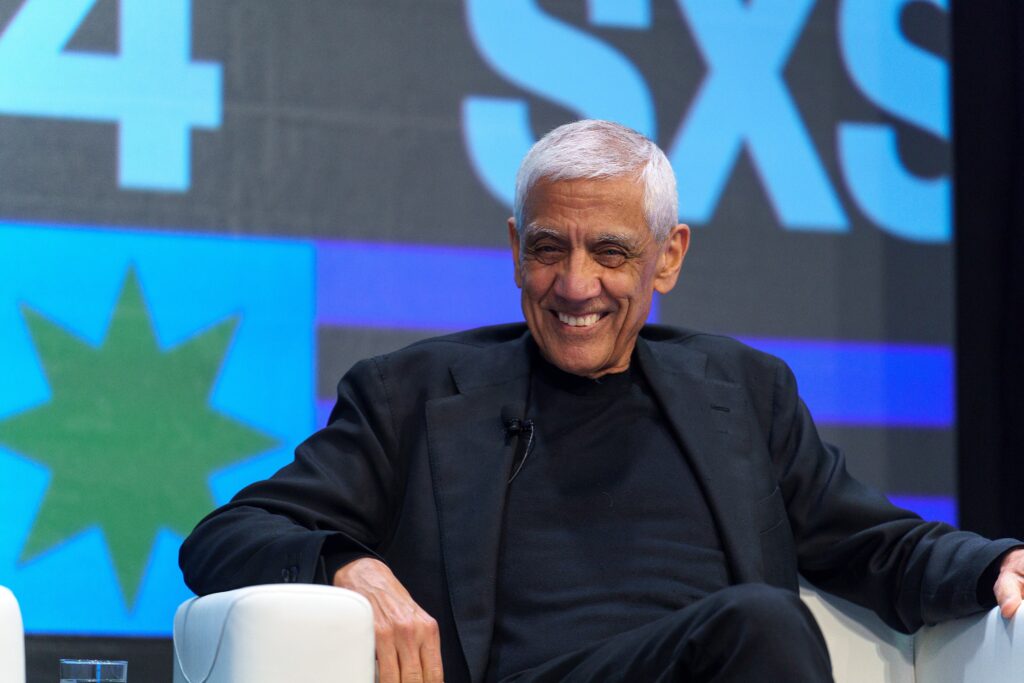
Vinod Khosla is one of the most economically and culturally consequential individual venture investors of the modern technology era. Through his co-founding of Sun Microsystems in 1982 (one of the most economically and culturally consequential workstation-and-network-computing companies of the 1980s and 1990s), his foundational eighteen-year tenure as a general partner at Kleiner Perkins from 1986 to 2004, and his founding of Khosla Ventures in 2004 (the venture capital firm focused on alternative energy, healthcare, AI, and adjacent experimental-technology categories with substantial portfolio positions across OpenAI, Square, Affirm, Instacart, DoorDash, and dozens of other consequential technology companies), he has built one of the more substantively-built contemporary worked examples of how an Indian-born American immigrant can scale into a multi-billion-dollar technology empire across operating businesses, foundational venture capital partnership, and substantive long-tenure investing work. His broader career — Pune-born, American-immigrant-raised, IIT Delhi, Carnegie Mellon, and Stanford GSB-educated entrepreneur turned Sun Microsystems co-founder turned Kleiner Perkins partner turned Khosla Ventures founder — has scaled into one of the most distinctive contemporary careers in the broader venture capital category.
Born on 28 January 1955 in Pune, Bombay State, India, Khosla emigrated to the United States after earning his BTech from the Indian Institute of Technology Delhi. He subsequently earned an MS from Carnegie Mellon University and an MBA from Stanford Graduate School of Business. The combination of substantive Indian engineering background, the disciplined Carnegie Mellon graduate work, and the Stanford GSB business credentials provided the foundational credentials that subsequently underpinned both the Sun Microsystems founding and the broader venture capital career.
What distinguishes Khosla is the combination of substantive operator credentials accumulated through Sun Microsystems, distinctive long-tenure venture capital work across both Kleiner Perkins and Khosla Ventures, and the operational discipline of building Khosla Ventures into a substantial alternative-energy-and-AI-focused investment platform alongside the broader cultural commentary work. Most successful venture investors at his economic tier either remain pure capital allocators or pivot into single-discipline operating roles. Khosla has consistently combined substantive operator credentials, long-tenure venture capital partnership work, distinctive contrarian investment positioning, and the kind of substantive cultural-and-political commentary that few other contemporary venture investors have replicated at comparable depth.
Today, Khosla continues to lead Khosla Ventures across multiple successive fund vintages, contribute substantial commentary across substantive AI and climate technology categories, and operate alongside his marriage to Neeru Khosla and their four children. He has been transparent about both the operating mechanics of running a substantial venture capital firm alongside substantive public commentary and the personal commitments — particularly around his characterization of himself as a “venture assistant” rather than a venture capitalist — that have shaped both the professional work and the broader cultural position.
Career and Rise to Fame
Khosla’s professional career began with substantive engineering work following his early-1980s arrival in the United States with Stanford GSB credentials. The early-career period — during which Khosla worked at Daisy Systems and adjacent companies — provided foundational technology-operating credentials.
The 1982 co-founding of Sun Microsystems alongside Scott McNealy, Andy Bechtolsheim, and Bill Joy was the chapter that defined the early phase of Khosla’s broader career. Sun Microsystems — which subsequently scaled into one of the most economically and culturally consequential workstation-and-network-computing companies of the 1980s and 1990s — provided substantive operator credentials and substantial wealth-creation effects for Khosla as a founding shareholder. Khosla served as Sun’s first chairman and CEO before transitioning out of the operating role.
The 1986 transition to Kleiner Perkins as a general partner was the chapter that defined Khosla’s substantive transition into venture capital. Across his eighteen-year Kleiner Perkins tenure (1986–2004), Khosla built substantive venture capital credentials and led substantial early-stage investments across networking, software, and adjacent technology categories. The 2001 Red Herring article titled “The No. 1 VC on the Planet: Vinod Khosla” formalized his cultural position as one of the most economically successful contemporary venture investors. The article noted that Khosla had created six new jobs for every day he lived in the US and helped create 40 companies producing $150 billion of market value during his first 24 years in the US.
The 2004 founding of Khosla Ventures was the chapter that defined the rest of Khosla’s career as a substantive venture investor. The firm — which Khosla founded as a deliberate alternative to traditional venture capital with substantial focus on alternative energy, healthcare, AI, and adjacent experimental-technology categories — has scaled across multiple successive fund vintages with substantial portfolio positions across hundreds of consequential technology companies.
The notable investment portfolio across Khosla Ventures includes Square, Affirm, Instacart, DoorDash, OpenAI, and dozens of other consequential technology companies. The OpenAI position alone — which Khosla famously took as one of the earliest substantial outside investors — has produced substantial returns as OpenAI has scaled across the contemporary AI environment.
Across the same period, Khosla has scaled substantial alternative-energy-and-climate-technology investing alongside the broader Khosla Ventures work. The combination of substantive engineering credentials and the deliberate climate-technology positioning has produced one of the more substantive contemporary worked examples of how individual venture investors can deploy substantial capital into substantive scientific-and-environmental categories alongside the underlying technology investing.
The 2012 article “Do We Need Doctors Or Algorithms?” — published by Khosla in TechCrunch — articulated his broader thesis on artificial intelligence in medicine. The article became substantively influential across the broader healthcare-AI category and represents one of the more substantive contemporary worked examples of how venture investors can articulate substantive long-form theses alongside their underlying investing work.
How Vinod Khosla Makes Money
Khosla’s wealth flows from four primary categories: cumulative Khosla Ventures management economics and carried-interest distributions across multiple successive fund vintages, the foundational Sun Microsystems equity and subsequent reinvestment proceeds, the cumulative Kleiner Perkins-period carried-interest distributions, and adjacent investment positions including substantial real estate.
Khosla Ventures cumulative carried interest: The largest single component of Khosla’s wealth is the cumulative carried-interest distributions from Khosla Ventures fund vintages across more than two decades. With portfolio investments in OpenAI, Square, Affirm, Instacart, DoorDash, and dozens of other consequential technology companies, the cumulative carried-interest position across multiple Khosla Ventures fund vintages represents the foundational asset base of the broader wealth profile.
Sun Microsystems equity: The foundational Sun Microsystems co-founding equity from 1982 produced substantial wealth-creation effects for Khosla as a founding shareholder. The cumulative reinvestment of the Sun Microsystems-derived wealth across the broader investment portfolio has subsequently produced substantial compounding returns.
Kleiner Perkins economics: Across his eighteen-year Kleiner Perkins tenure from 1986 to 2004, Khosla accumulated substantial cumulative carried-interest distributions across multiple Kleiner Perkins fund vintages. The combination of management fees and carried-interest economics from substantial successful Kleiner Perkins investments produced substantial wealth-creation effects that subsequently funded the founding of Khosla Ventures.
Adjacent investment positions: Across the broader career, Khosla has built substantial private investment positions across technology equities, real estate (including substantial California coastal property holdings), and adjacent asset classes. The cumulative diversification across multiple substantive investment positions represents another meaningful component of the broader wealth profile.
Vinod Khosla’s Net Worth
Estimating Khosla’s net worth involves substantially less methodology disagreement than is typical for private investor profiles, because Forbes’ Billionaires List provides a substantively-validated estimate. Forbes places Khosla’s net worth at approximately $13.4 billion as of January 2026, with the underlying valuation incorporating Khosla Ventures cumulative economics, residual Sun Microsystems-derived investments, and adjacent investment positions.
The lower end of credible recent estimates — around $10 billion — likely reflects a calculation that focuses primarily on after-tax Sun Microsystems-derived investments and conservatively-valued Khosla Ventures economics, without fully accounting for the cumulative carried-interest distributions across multiple fund vintages or the substantial OpenAI position growth.
Mid-range estimates — around $13.4 billion (consistent with Forbes’ figure) — reflect a more balanced calculation that incorporates Khosla Ventures cumulative carried-interest economics, substantial OpenAI and adjacent AI positions, the foundational Sun Microsystems-derived investments, the Kleiner Perkins-period accumulated wealth, and substantial real estate positions. This level is consistent with what billionaire-tier venture investor profiles at his cumulative tenure typically retain.
The upper end — beyond $13.4 billion — reflects estimates that more aggressively incorporate the standalone enterprise value of Khosla Ventures as a multi-fund operating business, the underlying value of any retained substantial OpenAI and adjacent AI positions at substantial future-valuation assumptions, and any meaningful retained income from adjacent ventures. Given the depth of the underlying multi-fund architecture, the upper end is well-supported as a plausible position.
The honest answer is that Khosla’s net worth has been substantively validated through Forbes’ Billionaires List reporting and remains in the substantial multi-billion-dollar range. What can be said with confidence is that his career has produced one of the more substantive contemporary individual venture-investor wealth positions, with cumulative wealth comfortably into the multiple-billions and a structural position that continues to compound across the ongoing Khosla Ventures operations.
Investments and Business Philosophy
Khosla’s investment philosophy is informed by his combination of substantive IIT Delhi, Carnegie Mellon, and Stanford GSB academic credentials, the disciplined Sun Microsystems co-founding experience, and the multi-decade venture capital work that has anchored the broader career across both Kleiner Perkins and Khosla Ventures. He has emphasized publicly the importance of substantive contrarian investing, durable focus on substantive scientific-and-environmental categories (particularly alternative energy, healthcare, and AI), and the long-horizon orientation required to compound a multi-decade venture capital career.
Inside Khosla Ventures, the philosophy emphasizes substantive contrarian investing, durable focus on substantive experimental-technology categories, and the kind of patient long-horizon capital deployment that compounds across multiple market cycles. The combination of substantive operator credentials and the disciplined contrarian-investing approach has produced one of the more substantive contemporary worked examples of how venture investors can deploy substantial capital into substantive scientific-and-environmental categories alongside the underlying technology investing.
The deeper professional philosophy is the case for combining authentic operator credentials with substantive long-tenure venture capital work and the kind of substantive cross-disciplinary thesis-and-commentary work that produces both economic-and-cultural outcomes. Khosla’s career — Pune-born American immigrant turned IIT Delhi, Carnegie Mellon, and Stanford GSB graduate turned Sun Microsystems co-founder turned Kleiner Perkins partner turned Khosla Ventures founder — represents one of the cleaner contemporary worked examples of how patient credentials-and-multi-business building scales into substantial cultural-and-economic position.
Lifestyle and Spending
Khosla’s lifestyle, by his own description and substantial public reporting, has been deliberately substantive relative to billionaires at his cumulative-wealth tier. He has substantial real estate (including substantial California coastal property at Martins Beach that has produced substantial public legal commentary), the broader family commitments through his marriage to Neeru Khosla and their four children, and substantive philanthropic work across multiple categories.
Where he spends meaningfully is on substantive philanthropic disbursements across the Khosla Family Foundation and adjacent causes (particularly focused on substantive scientific-and-environmental work), on substantial real estate, on the operational infrastructure that supports Khosla Ventures, and on the kinds of long-horizon experiences he has explicitly identified as producing satisfaction. The implicit operating philosophy is consistent with the rest of the work: optimize for what compounds across the long arc of substantive investing-and-philanthropic work.
His public commentary on lifestyle has been deliberately substantive and notably scientific-and-philosophical relative to many of his peer venture-investor cohort. He has spoken publicly about specific personal-finance choices, philanthropic commitments, and the broader balance between commercial work and substantive scientific-and-environmental contributions in a way that is consistent with the broader long-tenure venture capital career.
What Can We Learn from Vinod Khosla?
- Operator credentials anchor venture capital. Khosla’s substantive Sun Microsystems co-founding credentials — alongside the deep operator-level technology experience — produced foundational credentials that subsequently anchored the broader Kleiner Perkins and Khosla Ventures career. Most venture investors lack comparable operator credentials.
- Long-tenure venture capital compounds. Khosla’s combined eighteen-year Kleiner Perkins tenure plus more-than-two-decade Khosla Ventures tenure represents substantive worked example of how patient long-tenure venture capital produces durable returns.
- Build alternative venture capital firms. The 2004 founding of Khosla Ventures — as a deliberate alternative to traditional venture capital with substantial focus on alternative energy, healthcare, AI, and adjacent experimental-technology categories — represents substantive worked example of how individual partners can build distinctive venture capital firms.
- Articulate substantive theses. The 2012 “Do We Need Doctors Or Algorithms?” article and the broader thesis-and-commentary work on alternative energy and AI represent substantive worked example of how venture investors can articulate substantive long-form theses alongside their underlying investing work.
- Substantive immigrant entrepreneurship compounds. Khosla’s career arc — from Pune-born immigrant family to substantive multi-business operator and substantial billionaire investor — represents substantive worked example of how patient immigrant-entrepreneurship compounds across multiple decades.
- Combine engineering with finance. The combination of substantive IIT Delhi engineering credentials and the disciplined Stanford GSB MBA credentials produced cross-discipline credentials that subsequently anchored the broader Sun Microsystems and venture capital career.
Frequently Asked Questions
What is Vinod Khosla’s estimated net worth?
Vinod Khosla’s net worth is estimated at approximately $13.4 billion as of January 2026 according to Forbes’ Billionaires List, anchored primarily by his Khosla Ventures cumulative carried-interest distributions across more than two decades, the foundational Sun Microsystems co-founding equity, the cumulative Kleiner Perkins-period accumulated wealth, and substantial early-stage AI and climate-technology investments including OpenAI.
What is Khosla Ventures?
Khosla Ventures is the venture capital firm Vinod Khosla founded in 2004. The firm — which Khosla founded as a deliberate alternative to traditional venture capital with substantial focus on alternative energy, healthcare, AI, and adjacent experimental-technology categories — has scaled across multiple successive fund vintages with substantial portfolio positions across hundreds of consequential technology companies including Square, Affirm, Instacart, DoorDash, and OpenAI.
What is Vinod Khosla’s connection to Sun Microsystems?
Vinod Khosla co-founded Sun Microsystems in 1982 alongside Scott McNealy, Andy Bechtolsheim, and Bill Joy. The company — which subsequently scaled into one of the most economically and culturally consequential workstation-and-network-computing companies of the 1980s and 1990s — provided substantive operator credentials and substantial wealth-creation effects for Khosla as a founding shareholder. Khosla served as Sun’s first chairman and CEO before transitioning out of the operating role into venture capital.
Has Vinod Khosla invested in OpenAI?
Yes. Vinod Khosla famously took a substantial early-investor position in OpenAI as one of the earliest substantial outside investors. The OpenAI position has produced substantial returns as the company has scaled across the contemporary AI environment, formalizing Khosla’s position as one of the more economically successful AI investors of the modern era.
Where is Vinod Khosla from?
Vinod Khosla was born on 28 January 1955 in Pune, Bombay State, India. He emigrated to the United States after earning his BTech from the Indian Institute of Technology Delhi. He subsequently earned an MS from Carnegie Mellon University and an MBA from Stanford Graduate School of Business. He is married to Neeru Khosla and has four children.
The Impact of Long-Tenure Contrarian Venture Capital
The argument that contemporary venture capital benefits from substantive long-tenure contrarian investing — particularly when grounded in foundational operator credentials and combined with substantial focus on substantive scientific-and-environmental categories — has been advanced by relatively few investors at Khosla’s level of consistency and operational depth. The cumulative effect of his work, across Sun Microsystems, Kleiner Perkins, Khosla Ventures, and the substantive cross-disciplinary thesis-and-commentary work, has been to redefine what serious long-tenure contrarian venture capital can produce both economically and culturally at multi-billion-dollar scale.
The downstream effect on the broader venture capital industry is visible. The number of substantial venture investors who have explicitly built parallel substantial focus on alternative energy, healthcare, AI, and adjacent experimental-technology categories alongside their conventional technology investing has continued to grow across recent decades, and many of the most operationally serious contemporary venture investors cite Khosla’s career as part of their early thinking about the relationship between substantive operator credentials, contrarian investing, and durable long-tenure venture capital work.
What makes the impact durable is that the underlying economics of long-tenure contrarian venture capital continue to favor investors who can sustain substantive operator credentials alongside their long-tenure investing work. As technology markets continue to evolve and as the underlying competitive dynamics in venture capital continue to favor substantive contrarian work, the relative position of long-tenure contrarian venture investors tends to compound rather than decay. Khosla’s career — Pune-born American immigrant turned IIT Delhi, Carnegie Mellon, and Stanford GSB graduate turned Sun Microsystems co-founder turned Kleiner Perkins partner turned Khosla Ventures founder — is one of the cleaner contemporary worked examples of how patient credentials-and-multi-business building scales into category-defining position.
Responses