The BRICS Golden Corridor: How Eurasian Trade Realignment Affects Rotterdam and Antwerp

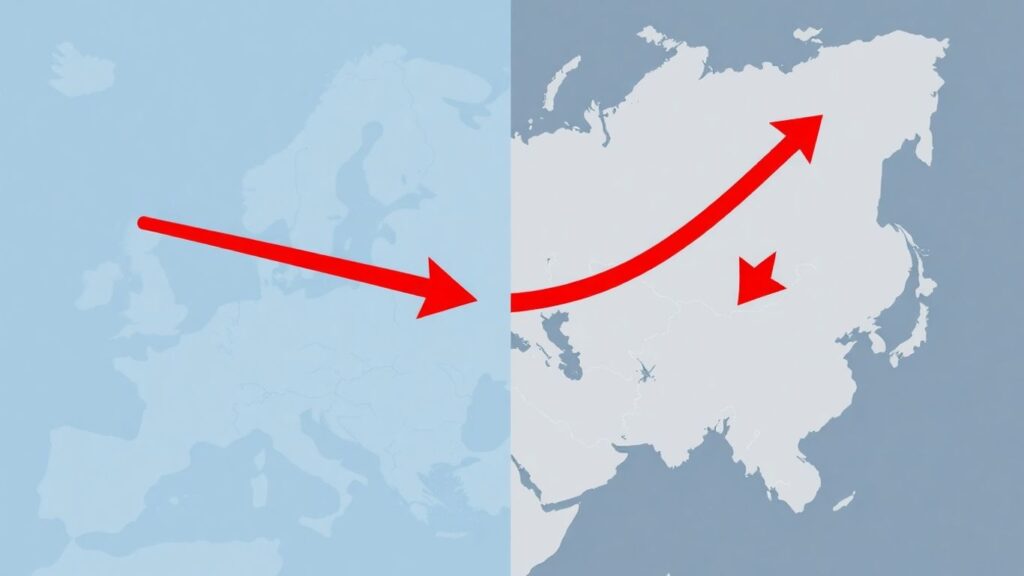
Rotterdam is Europe’s largest port and one of the busiest in the world. Antwerp is its nearest rival. Together they handle a vast share of European goods trade — and both were built on the assumption that the global trading system would remain organised around Atlantic and trans-Pacific shipping routes, with Europe at the western terminus of the most valuable commercial corridors. That assumption is being tested. The emergence of what analysts call the BRICS “Golden Corridor” — overland and maritime routes connecting China, Russia, Central Asia, Iran, and the Gulf — represents a structural alternative to Atlantic-centred trade, and its long-term implications for Northwestern European ports deserve serious attention.
- → The Golden Corridor refers to the emerging network of overland (rail, road) and maritime routes connecting China to Russia, Central Asia, Iran, the Gulf, and Africa — largely bypassing Western-controlled infrastructure and financial systems
- → Russia’s war in Ukraine accelerated Eurasian trade reorientation: Russian commodities that previously flowed west (oil, gas, grain, metals) now increasingly flow east and south
- → Rotterdam and Antwerp are not immediately threatened — but their long-term growth models depend on assumptions about trade patterns that are now in flux
- → The Middle Corridor (through the Caucasus and Central Asia) is the fastest-growing trade route in the world — tripling volumes since 2022
- → The strategic question for the Netherlands: how does a trading nation whose prosperity is built on being Europe’s Atlantic gateway adapt to a world where the Atlantic is no longer the only gateway?
What Is the Golden Corridor?
The term “Golden Corridor” describes the network of infrastructure — railways, roads, pipelines, and port facilities — being developed to connect BRICS economies through Eurasian rather than Atlantic routes. It has several overlapping components. China’s Belt and Road Initiative provides the foundational investment framework, with Chinese financing for ports, railways, and industrial zones from Southeast Asia through Central Asia to Europe and Africa. The International North-South Transport Corridor (INSTC) connects Russia to India via Iran — a 7,200km route that reduces transit time for certain goods by two weeks compared to the Suez Canal route. The Middle Corridor, running through Kazakhstan, Azerbaijan, and Georgia, has seen explosive growth since Western sanctions on Russia pushed shippers to find alternative routes.
These routes do not form a unified system — they are overlapping, partially competitive, and at varying stages of development. But they share a common characteristic: they reduce dependence on the maritime chokepoints (Suez Canal, Strait of Hormuz, Strait of Malacca) and the SWIFT-based financial infrastructure through which the West has historically been able to apply economic pressure. For the full context of China’s Belt and Road strategy, see our Belt and Road Initiative deep dive.
“Rotterdam’s position as Europe’s gateway was built on Atlantic trade. If the centre of gravity of global trade shifts to Asia and Eurasia, the question is not whether Rotterdam remains important — it is whether it remains the most important.”
Impact on Rotterdam and Antwerp: Short vs Long Term
In the short term, the impact on Rotterdam and Antwerp is limited but visible. The loss of Russian container traffic following 2022 sanctions was significant — Rotterdam had been a major hub for Russian imports and exports. Russian oil no longer flows through Dutch refineries at scale. Some commodity flows that previously terminated at European ports now route through Gulf or Asian alternatives. But these losses have been partially offset by increased military and energy logistics (LNG terminal expansion at Rotterdam, increased US LNG imports) and the general growth in European trade with Asia that still flows through Atlantic ports.
The longer-term question is more fundamental. If BRICS trade increasingly flows through Eurasian corridors rather than around Africa or through Suez to European ports, the share of global trade transiting Rotterdam and Antwerp could structurally decline. This does not mean these ports become unimportant — European domestic trade and Atlantic commerce will sustain significant volumes regardless. But the growth trajectory assumed in port investment plans depends on continued European centrality in global trade, and that centrality is being tested by the realignment of Eurasian supply chains. The Dutch government’s recognition of this in its National Ports Strategy 2030 reflects an awareness that adaptation is necessary.
The Netherlands’ Strategic Response
The Netherlands occupies an unusual position in this realignment: it is simultaneously a major beneficiary of the existing Atlantic-centred trading system and a country with historical commercial ties to Asia (the VOC legacy), a sophisticated logistics infrastructure, and a pragmatic trading culture that has always prioritised commercial relationships over ideological alignment. The strategic question is whether the Netherlands can leverage these assets to remain relevant as a logistics hub even as trade patterns shift — or whether its prosperity is structurally tied to an order that is declining.
Rotterdam’s investments in hydrogen infrastructure, the energy transition supply chain, and digital logistics suggest an awareness that the port’s future lies in value-added logistics rather than volume throughput. But these adaptations take decades and require sustained public investment and political vision. The broader economic question — how should a small, open, trade-dependent economy like the Netherlands position itself in a world of competing blocs and fragmented supply chains — connects directly to the themes explored in our Netherlands economic model analysis and our Geopolitics 2026 overview.
The Golden Corridor is not just about physical trade routes — it is also about financial infrastructure. BRICS countries are actively developing alternatives to SWIFT and dollar-denominated trade settlement. Russian-Chinese bilateral trade now settles largely in yuan and rubles. The INSTC is designed to enable Indian-Russian trade outside Western financial systems. For European financial institutions and the euro’s international role, these developments have significant long-term implications. See: De-Dollarisation: Is the Dollar Losing Reserve Status?
The BRICS Golden Corridor does not threaten Rotterdam and Antwerp tomorrow. But it represents a structural shift in the direction of global trade that, over a decade or two, will reshape the competitive position of European logistics hubs. The Netherlands has the institutional quality, the infrastructure, and the commercial culture to adapt — but adaptation requires acknowledging that the old assumptions no longer hold. A country whose prosperity was built on being Europe’s Atlantic gateway needs a strategy for a world where the Atlantic is one of several gateways, not the only one.

Responses