The Seas Are Getting Rough: Is Freedom of Navigation Over?

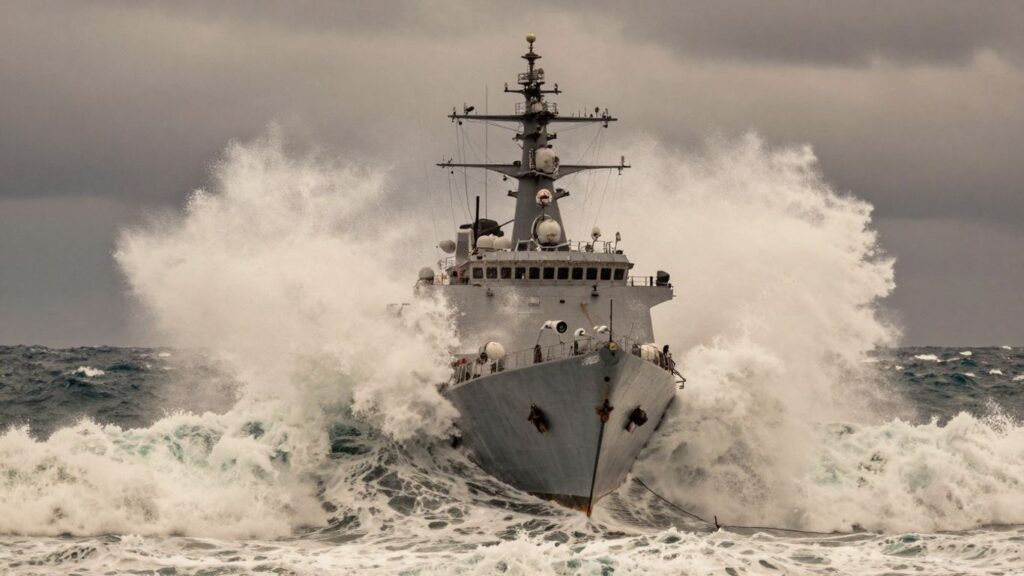
The world is witnessing a concerning breakdown in the established norms of international maritime law, leading to increased tensions and the potential for conflict. This shift is marked by a decline in the predictability and safety of sea lanes, impacting global trade and security.
Key Takeaways
- The decline of a hegemonic power often leads to the unraveling of open international economic systems and can spark wars.
- Freedom of navigation, a cornerstone of global trade, is under threat due to various conflicts and assertive actions by states.
- The United States, while historically a proponent of freedom of navigation, has also been accused of misapplying the concept and violating international law.
- Several nations, including China and Russia, have growing maritime interests and strategies that are reshaping global sea control.
- The erosion of international law and established post-World War II norms is creating a more unpredictable and potentially dangerous maritime environment.
The Shifting Tides of Power
It’s becoming increasingly clear that as a dominant power, like the United States, starts to lose its grip, the open international economic system can begin to fall apart. This isn’t just about trade; it can even lead to wars. When a country is on top, it usually wants to keep the trading system open and peaceful because that benefits them. But when that country starts to decline, it might try to use its former power to stop rivals from rising, even using military force to hold onto what it’s losing.
One area where we can really see this happening is with freedom of navigation. Think about the open sea lanes that ships use for trade. These have been super important for decades, keeping things peaceful and open. But now, it seems like these routes are closing down. We’re seeing conflicts in the Caribbean, blockades around Venezuela, attacks on ships in the Black Sea, and problems popping up in the Arctic and East Asia. There are plenty of examples to show that something is changing.
A Crisis in Maritime Law
Ambassador Chas Freeman points out that we’re seeing a strange mix of things happening. On one hand, the United States seems to be pulling back from its global commitments, but at the same time, it’s starting to assert powers it never used before, especially concerning the law of the sea. On the other hand, there’s also a domestic political situation that’s quite unstable. When powerful groups feel they’re losing their standing, they sometimes turn to strong leaders who blame an enemy for their problems. This is happening in the U.S. right now.
This combination of international and domestic contraction is causing problems. The phrase "freedom of navigation" has been used in ways that don’t quite fit. For instance, the U.S. Navy has conducted operations in the South China Sea, claiming it’s about freedom of navigation. But China, which has the most ships passing through the South China Sea, also has a huge stake in keeping those routes open. The real issue there is more technical, involving claims over islands and waters. China’s claims, drawn on lines like the nine-dash line, are seen by some as improper under the UN Convention on the Law of the Sea. Ironically, the U.S. hasn’t ratified this convention but often relies on its principles.
Violations and Escalation
The situation gets even more complicated when we look at actions in other areas. The law of the sea is being violated in the Caribbean and the Eastern Pacific. Sinking a boat with civilians or military personnel is considered an act of war, unlike intercepting a vessel for inspection. Yet, there have been instances where this has happened, and even survivors have been targeted. These actions are not only acts of war but also acts of piracy.
Seizing oil tankers on questionable grounds, like alleged transport of oil to groups like Hezbollah, also falls into this category. The breakdown of the law of the sea is evident, with little respect for international agreements. Even actions like the Houthi blockade in the Red Sea, which they claimed was in line with the genocide convention, highlight the complex and often conflicting interpretations of international law.
Competing Maritime Strategies
We’re entering a world where the rule of law and a consensus-based international order are disappearing. It feels like we’re going back to an era of piracy and unchecked actions. The United States, China, and Russia all have different strategies for maritime control. The U.S. is trying to maintain its past dominance, which is no longer possible. China, historically not a major naval power, is now globally active and seeking to establish a defensive perimeter. Russia is focused on preventing the Black Sea from becoming a "NATO lake" and has significant interests in the Arctic and Baltic.
The Role of Major Powers
- United States: Trying to hold onto global maritime control, which is becoming increasingly difficult. Historically a proponent of freedom of navigation, but actions have sometimes contradicted this principle.
- China: Expanding its naval capacity and seeking a defensive perimeter in its near seas, with growing interests in the Arctic.
- Russia: Focused on securing its access to warm-water ports, particularly in the Black Sea, and concerned about NATO’s presence in the Arctic and Baltic.
The Future of Sea Lanes
The breakdown of international law is happening across the board. From the South China Sea to the Arctic, and the Black Sea to the Baltic, there’s a growing disregard for established norms. This is particularly concerning because it involves major nuclear powers. The lack of leadership in establishing new rules or enforcing existing ones is a significant problem. While new transport corridors are emerging, like those through the Arctic, there’s no clear initiative to regulate them.
The United States is no longer leading the charge for international law, and China, while economically powerful, seems hesitant to take on a leadership role in global security and rule-making. Europe is divided, and other nations show little inclination to step up. This leaves a vacuum where might often makes right, echoing historical patterns where the strong do what they can and the weak suffer what they must. The golden rule, "Do not do unto others what you would not have them do unto you," seems to have been forgotten, leading us into a more dangerous and unpredictable maritime future.


Responses