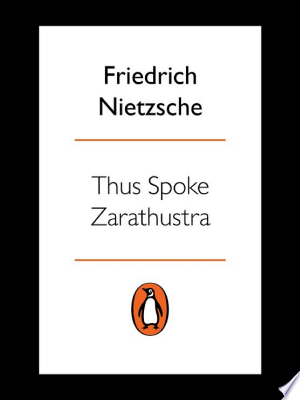
Thus Spoke Zarathustra

9.49

-
+

Specs

Categories: ,

Description

‘Enigmatic, vatic, emphatic, passionate . . . Nietzsche’s works together make a unique statement in the literature of European ideas’ A. C. Grayling Nietzsche was one of the most revolutionary thinkers in Western philosophy, and Thus Spoke Zarathustra remains his most influential work. It describes how the ancient Persian prophet Zarathustra descends from his solitude in the mountains to tell the world that God is dead and that the Superman, the human embodiment of divinity, is his successor. With blazing intensity, Nietzsche argues that the meaning of existence is not to be found in religious pieties or meek submission, but in an all-powerful life force: passionate, chaotic and free. Translated with an introduction by R. J. HOLLINGDALE

  • Author: Friedrich Nietzsche
  • Publisher: Penguin UK
  • Published: 1974-02-28
  • Pages: 437
  • ISBN-13: 9780141904320

Additional information

Author

Friedrich Nietzsche

Reviews

There are no reviews yet.

Be the first to review “Thus Spoke Zarathustra”

Your email address will not be published. Required fields are marked *

Summary

What the internet says

Aggregated insights from reviews and discussions across the web.

Overall reception: Mixed reception

Thus Spoke Zarathustra receives deeply polarized reception online, with readers either finding it transformative or impenetrably difficult. On Goodreads, the book maintains strong ratings but reviews reveal a sharp divide: admirers praise it as a singularly powerful philosophical experience that defies categorization, while critics describe it as 'a messy, self-serious heap of obscure references and ungracious philosophy wrapped in a mountain of bad allegory.' Many readers acknowledge encountering the work as teenagers or young adults, where its existential critique and challenge to conventional values left lasting impressions. The book's unique blend of philosophy, poetry, and Biblical parables creates what one reviewer called 'the longest short book I've ever read,' requiring significant effort to parse Nietzsche's dense metaphors and wordplay even in translation. A recurring theme across discussions is the historical baggage: readers consistently note how Nazi appropriation distorted Nietzsche's ideas, though careful readers recognize his actual opposition to antisemitism and nationalism. The book's concepts—the death of God, eternal recurrence, and the Übermensch—remain culturally influential even among those who struggle with the text itself. Modern readers particularly grapple with the archaic language and gendered terminology, with translation choices like 'Superman' versus 'Overman' sparking ongoing debate about accessibility and fidelity to the original German.

What readers loved

  • Singularly powerful and transformative reading experience that defies genre categorization, blending philosophy, poetry, and narrative
  • Accessible entry point to existential thought without conventional philosophical semantics, making complex ideas available to young students
  • Poetic brilliance and lyrical intensity with lines that carry power on multiple levels, described as 'blazing intensity' and genuinely entertaining
  • Profound exploration of moral relativism, comparative theology, eternal recurrence, and the will to life through ambitious metaphorical leaps
  • Stinging critique of religious pieties and conventional morality that challenges readers to question 'Why should I?' rather than accept 'Thou Shalt'
  • Surprisingly readable compared to conventional philosophy, with forceful jeremiad style that apes Biblical tones effectively
  • Contains moments of genuine brilliance and spectacular, stimulating ideas worth contending with despite difficulty

Common critiques

  • Impenetrably difficult with obscure references, ungracious philosophy, and bad allegory that makes it feel like 'the longest short book'
  • Translation issues compound difficulty—archaic language, wordplay lost in English, and invented words that don't exist in dictionaries
  • Overblown at times with an unconvincing ending where Zarathustra's final revelatory change seems abrupt and the thread of argument is lost
  • Limited value for modern audiences due to 1883 publication date, gendered language ('all with men in mind'), and cultural distance
  • Dangerous historical baggage from Nazi appropriation of concepts like Übermensch and will to power, despite Nietzsche's actual opposition to such ideology

Based on reviews from

  • Goodreads - Main Edition
  • Goodreads - Mike Futcher Review
  • Goodreads - Discussion Topics
  • Goodreads - Modern Translation Edition
Last updated May 18, 2026 Summary based on publicly available reviews. May not reflect every reader's experience.