Description
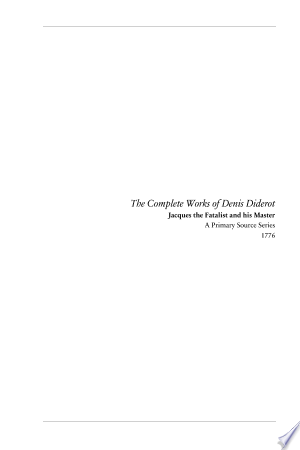
Jacques the Fatalist and His Master, written in bursts from the 1760s to the early 1770s and only published posthumously in 1796, is Diderot at his most structurally unruly and philosophically sly. It is a philosophical and experimental novel, reminiscent of Don Quixote, known for its nonlinear plot, metafictional style, and exploration of free will vs. determinism, as indicated by the title.Though composed decades earlier, the novel was considered too unorthodox to publish in the French intellectual climate of the time, circulating only in manuscript among the author’s confidants. Drawing inspiration from Laurence Sterne’s Tristram Shandy, Diderot abandons narrative continuity in favor of interruption, irony, and direct addresses to the reader—effectively turning the novel into a philosophical hall of mirrors. The book appears to be a travel narrative, following Jacques and his unnamed master on the road, but it’s real motion is not geographic—it’s dialectical, digressive, and perpetually under revision. This modern edition contains a new Epilogue by the translator, a glossary of Philosophical Terms used by Diderot, a chronology of his core life and works, and a summary index of all of Diderot’s works. With a clean, modern translation of Diderot’s Enlightenment-era French, this edition brings Diderot’s thoughts directly into the modern intellectual sphere, tracing the intellectual forces which swept along Diderot and impacted today’s secular world. Johann Wolfgang von Goethe praised the novel, stating that it “penetrates into the darkest depths of human existence and throws a clear light on everything.” The work remains a classic of French literature and continues to be studied and celebrated for its philosophical depth and narrative ingenuity. Jacques the Fatalist and his Master is a testament to Diderot’s creativity and his ability to blend humor, philosophy, and storytelling into a work that challenges readers to think deeply about the nature of freedom, fate, and human existence. This translation offers readers a chance to engage with one of Diderot’s most enduring and thought-provoking works. Jacques’ insistence that “everything is written” clashes with his master’s insistence on agency, yet Diderot avoids resolving this tension, using their journey as a framework to satirize Enlightenment rationality, social hierarchies, and literary conventions. The work’s fragmented form—stories within stories, metafictional asides, and deliberate narrative dead-ends—reflects its thematic preoccupation with chaos, contingency, and the limits of human understanding. The work functions as both a philosophical inquiry and a parody of 18th-century fiction. Jacques’ fatalism serves less as a coherent doctrine than a rhetorical device to expose the absurdity of seeking order in a disordered world. Diderot mocks the period’s obsession with moralizing tales by having characters’ lives derailed by trivial accidents, bureaucratic absurdities, and unresolved subplots. While the novel critiques rigid systems of thought (religious, philosophical, literary), its primary innovation lies in form: the narrator’s playful intrusions and refusal to provide closure challenge readers to confront their own expectations of coherence. Historically overshadowed by Diderot’s more overtly political works, it gained later recognition for its proto-postmodern experimentation, though its uneven pacing and deliberate opacity limit its accessibility.
- Author: Denis Diderot
- Publisher: Marchen Press
- Published: 2024-05-09
- Pages: 366
- ISBN-13: 9783989887473
Reviews
There are no reviews yet.