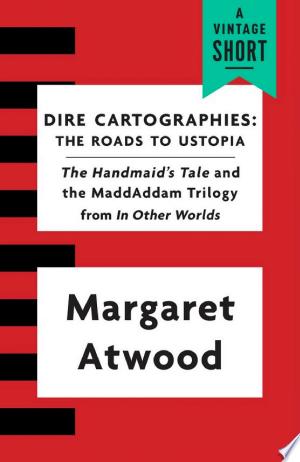
Dire Cartographies: The Roads to Ustopia and The Handmaid’s Tale

0.97

-
+

Specs

Categories: ,

Description

In honor of the thirtieth anniversary of The Handmaid’s Tale: Margaret Atwood describes how she came to write her utopian, dystopian works. The word “utopia” comes from Thomas More’s book of the same name—meaning “no place” or “good place,” or both. In “Dire Cartographies,” from the essay collection In Other Worlds, Atwood coins the term “ustopia,” which combines utopia and dystopia, the imagined perfect society and its opposite. Each contains latent versions of the other. Following her intellectual journey and growing familiarity with ustopias fictional and real, from Atlantis to Avatar and Beowulf to Berlin in 1984 (and 1984), Atwood explains how years after abandoning a PhD thesis with chapters on good and bad societies, she produced novel-length dystopias and ustopias of her own. “My rules for The Handmaid’s Tale were simple,” Atwood writes. “I would not put into this book anything that humankind had not already done, somewhere, sometime, or for which it did not already have the tools.” With great wit and erudition, Atwood reveals the history behind her beloved creations.

  • Author: Margaret Atwood
  • Publisher: Anchor
  • Published: 2015-09-08
  • Pages: 43
  • ISBN-13: 9781101972007

Additional information

Author

Margaret Atwood

Reviews

There are no reviews yet.

Be the first to review “Dire Cartographies: The Roads to Ustopia and The Handmaid’s Tale”

Your email address will not be published. Required fields are marked *

Summary

What the internet says

Aggregated insights from reviews and discussions across the web.

Overall reception: Mostly positive

Margaret Atwood's essay 'Dire Cartographies: The Roads to Ustopia and The Handmaid's Tale' receives generally positive reception from readers, with most praising its intellectual depth and insight into dystopian literature. Reviewers on Goodreads consistently highlight the essay's introduction of the term 'ustopia' (combining utopia and dystopia) as a valuable conceptual framework for understanding how ideal and nightmarish societies contain elements of each other. The first half, which traces a timeline of utopian narratives through history, is particularly well-received for its sharp analysis and erudition. However, several readers note a significant shift in quality when the essay transitions to Atwood's autobiographical reflections on her academic career and the genesis of The Handmaid's Tale.

The essay is praised for Atwood's characteristic wit, accessible voice, and ability to illuminate complex societal themes. Readers appreciate learning about Atwood's creative process and the rules she set for writing The Handmaid's Tale—specifically, that she would only include things humanity had already done or had the tools to do. The discussion of how dystopias often contain hidden utopias, and vice versa, resonates strongly with readers interested in speculative fiction. Some reviewers note the essay feels like two pieces merged together, with the second autobiographical portion being weaker and more meandering than the focused, analytical first half. Despite this structural critique, most readers find value in Atwood's non-fiction voice and recommend the essay for fans of dystopian literature and those interested in the relationship between literature, cartography, and social commentary.

What readers loved

  • Introduces the valuable concept of 'ustopia' that combines utopian and dystopian elements, providing a new framework for understanding speculative fiction
  • First half offers a fascinating and insightful timeline of utopian narratives throughout history with sharp, efficient analysis
  • Atwood's voice is described as alive, inviting, witty, and erudite, making complex ideas accessible
  • Provides behind-the-scenes insight into the creation of The Handmaid's Tale and Atwood's writing philosophy
  • Explores important themes about the relationship between literature and cartography, and how map and story intersect
  • Demonstrates how dystopias and utopias often bleed into and contain each other, with relevant contemporary examples
  • Reveals Atwood's academic background and how research questions translated into fictional work

Common critiques

  • Second half becomes introspective and autobiographical, meandering without the efficiency of the first section
  • Feels like two separate essays merged together, with significantly different quality levels between halves
  • Some readers felt the autobiographical portion was predictable and unnecessary, like 'padding out the length'
  • The essay is quite short, leaving some readers wanting more depth or expansion on key concepts

Based on reviews from

  • Goodreads - Dire Cartographies
  • Goodreads - Dystopia Land Discussion
Last updated May 18, 2026 Summary based on publicly available reviews. May not reflect every reader's experience.