Offensive Realism: Why Great Powers Never Stop Competing

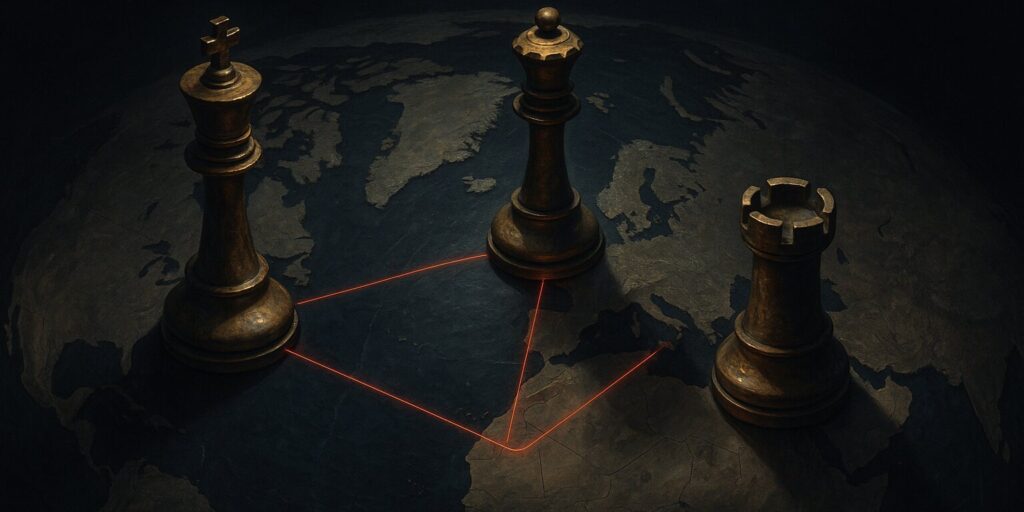
Great powers do not compete because their leaders are greedy or reckless. They compete because the structure of the international system leaves them little choice. That is the uncomfortable core of offensive realism, and it explains more about today’s world than most commentators would like to admit.
From Washington’s containment of China to Russia’s war in Ukraine, the logic of offensive realism keeps resurfacing. Its most famous proponent, John Mearsheimer of the University of Chicago, has been called a cynic, a prophet and an apologist, sometimes in the same week. Whatever you think of him, his theory is worth understanding, because the people who run great powers often behave exactly as it predicts.
What offensive realism is
Offensive realism holds that great powers are always looking for opportunities to gain power at the expense of their rivals. Their ultimate goal is hegemony, because being the strongest is the best guarantee of survival. Security, in this view, is never something a state can have enough of.
The theory was set out most fully by Mearsheimer in The Tragedy of Great Power Politics (2001). It belongs to the structural realist tradition, which explains state behaviour through the shape of the international system rather than through ideology, culture or the personalities of leaders.
The “tragedy” in the title is deliberate. Mearsheimer does not argue that states are evil. He argues that well-meaning states, acting rationally in a dangerous world, still end up locked in a competition that nobody can opt out of.
The five bedrock assumptions
The whole theory rests on five assumptions about the world. None of them is controversial on its own. Put together, they produce a grim conclusion.
- Anarchy. There is no world government, no authority above states that can protect them or enforce rules. When a state is in trouble, there is no one to call.
- Offensive capability. Every great power has some military capacity to hurt its neighbours. Capabilities can change, but they never disappear.
- Uncertain intentions. States can never be sure what other states intend, today or in ten years. A friendly government can be replaced by a hostile one.
- Survival is the primary goal. Above prosperity, ideology or prestige, states want to keep their territory and their autonomy.
- Rationality. States think strategically about how to survive in this environment.
The conclusion follows. If you cannot know what others intend, cannot call for help, and know others can hurt you, the rational move is to become as powerful as possible. Mearsheimer sums up the resulting mood among great powers in three words: fear, self-help and power maximisation.
Why regional hegemony is the real prize
If every state wants to dominate, why has no country ever ruled the whole world? Mearsheimer’s answer is geography, and specifically what he calls “the stopping power of water”. Projecting land power across oceans is so difficult that global hegemony is practically impossible.
The realistic goal is therefore regional hegemony: dominating your own neighbourhood. The United States is the only modern great power to have achieved it, by becoming the unchallenged power of the Western Hemisphere in the 19th century. The Monroe Doctrine was, in this reading, a textbook offensive realist policy.
A regional hegemon then has a second objective: making sure no other great power achieves the same in its own region. A peer in Europe or Asia would be free to meddle in the Western Hemisphere. That is why the United States fought Imperial Germany, Nazi Germany, Imperial Japan and the Soviet Union, and why Mearsheimer expects it to resist China.
The preferred method is offshore balancing. The hegemon stays out of distant regions and lets local powers check the rising state. It intervenes directly only when the locals cannot do the job alone. Zbigniew Brzezinski’s The Grand Chessboard applies the same logic to Eurasia.
The strategic toolkit
Offensive realism does not say states attack whenever they can. Wars are costly and often fail. Instead, great powers choose from a menu of strategies depending on the balance of power.
| Strategy | What it means | Classic example |
|---|---|---|
| War | Gain power by conquest | Germany in 1939 |
| Blackmail | Coerce a rival with the threat of force | Germany over the Sudetenland, 1938 |
| Balancing | Check a rival directly, by arming or forming alliances | NATO against the Soviet Union |
| Buck-passing | Get another state to bear the cost of checking a rival | Britain and France pushing the burden onto each other in the 1930s |
| Bait and bleed | Provoke two rivals into a long war with each other | Rarely successful in practice |
| Bloodletting | Prolong a war a rival is already fighting | US support for the mujahideen in Afghanistan |
According to Mearsheimer, buck-passing is the favourite option. It is cheap, and it lets someone else pay the price of confronting the threat. Balancing tends to happen only when the rival is so strong that no one else can stop it.
Offensive versus defensive realism
Offensive realism is best understood against its sibling, defensive realism, associated with Kenneth Waltz’s Theory of International Politics (1979). Both start from anarchy. They disagree about how much power a state should want.
Waltz argued that states seek an appropriate amount of power, enough to be secure. Grabbing more is self-defeating, because it frightens neighbours into balancing against you. Napoleon, Wilhelmine Germany and Hitler all overreached and were crushed by coalitions.
Mearsheimer accepts that balancing happens but draws the opposite conclusion. Because you can never be sure how much power is enough, the only safe amount is the most you can get. Where Waltz sees status-quo powers seeking security, Mearsheimer sees revisionist powers waiting for an opening.
The practical difference is large. A defensive realist expects a rising power to settle down once it feels secure. An offensive realist expects it to keep pushing until it dominates its region or is stopped.
The theory applied: China, Ukraine and NATO
China cannot rise peacefully
Mearsheimer’s best-known prediction is that China’s rise will not be peaceful. If China keeps growing economically, it will try to dominate Asia the way the United States dominates the Western Hemisphere. It will want to push the US Navy beyond the first island chain, settle Taiwan on its terms and set the rules in the South China Sea.
The United States, in turn, will do what it has always done against a would-be regional hegemon: contain it. Mearsheimer has long argued that engagement, the bet that trade and growth would make China a “responsible stakeholder”, was a strategic mistake. Export controls on advanced chips, the AUKUS pact and tighter alliances with Japan, the Philippines and India all fit the containment pattern he described.
Ukraine and the cost of ignoring geography
Mearsheimer’s most controversial application concerns Ukraine. In a 2014 Foreign Affairs essay, he argued that NATO and EU expansion toward Russia’s border had provoked the crisis, and that the West bore much of the responsibility. He has repeated the argument since Russia’s full-scale invasion in 2022.
Here the theory is used less to justify Russia than to predict it. A great power, he argues, will treat a rival military alliance on its border as an existential threat, just as Washington did with Soviet missiles in Cuba in 1962. Critics reply that this denies Ukraine its own agency and reads Russian imperial ambition as mere fear.
The critiques
Offensive realism is powerful partly because it is simple. That simplicity is also its main weakness.
- It ignores domestic politics. Liberals and constructivists argue that democracies, ideologies and national identities shape foreign policy. Germany and Japan after 1945 had the capacity to pursue power but chose not to, for reasons the theory struggles to explain.
- It underrates institutions and trade. Economic interdependence, international law and alliances like the EU have kept the peace among old rivals in Western Europe for eighty years.
- It removes agency from smaller states. Treating Ukraine, Poland or Taiwan as objects of great-power competition ignores that they make their own choices, including the choice to seek Western protection.
- Its record is mixed. Mearsheimer predicted instability in Europe after the Cold War that took decades to materialise, and in 1993 he argued that Ukraine should keep its nuclear arsenal as a deterrent against Russia, a call his supporters now cite in his favour.
- It can become self-fulfilling. If policymakers assume every rival seeks domination, they may act in ways that make hostility inevitable.
Defenders reply that a theory is not supposed to explain everything. It is supposed to explain the big, recurring patterns, and on that score great-power rivalry has been remarkably consistent.
What it means for markets and investors
For investors, offensive realism offers a useful baseline: assume great-power rivalry is structural, not a passing phase that the next summit will fix. That assumption has already been more reliable than the post-Cold War bet on ever-deeper globalisation.
Several market themes follow directly from the theory:
- Fragmenting supply chains. If the US and China see each other as long-term rivals, reshoring, friend-shoring and export controls on strategic technology are here to stay. Semiconductors, critical minerals and rare earths become security assets, not just commodities.
- Higher defence spending. Balancing is expensive. European rearmament after 2022 and rising budgets in Asia point to a multi-year cycle for defence and dual-use industries.
- Reserve currencies and the dollar. Rivals of a hegemon have an incentive to reduce exposure to its financial system, which helps explain central bank gold buying and efforts to build payment rails outside the dollar.
- Chokepoint risk. Taiwan, the Strait of Hormuz and the South China Sea are where regional ambitions collide with global trade. A theory that predicts competition there is a theory worth pricing in.
None of this tells you the timing of a crisis. But it does suggest that portfolios built for a world of benign globalisation are built for a world that offensive realists never believed in. For the wider picture, see the forces reshaping the world order in 2026.
Conclusion: a theory for a harder world
In the 1990s, offensive realism looked like a relic. The Cold War was over, markets were opening and many believed the age of great-power rivalry had ended for good. Three decades later, the world looks a lot more like Mearsheimer’s than like the one his critics expected.
That does not make the theory right about everything. It struggles with domestic politics, with the choices of smaller states and with the moral questions it deliberately sets aside. But as a lens for understanding why powerful states behave as they do, it remains hard to beat.
The lesson is not that conflict is inevitable. It is that wishful thinking about rivals is a poor strategy, for governments and investors alike.
Further reading
- John J. Mearsheimer, The Tragedy of Great Power Politics (2001, updated 2014)
- Kenneth N. Waltz, Theory of International Politics (1979)
- John J. Mearsheimer, “Why the Ukraine Crisis Is the West’s Fault”, Foreign Affairs (2014)
- John J. Mearsheimer, “The Case for a Ukrainian Nuclear Deterrent”, Foreign Affairs (1993)
This article contains affiliate links. If you buy through them, People & Media may earn a small commission at no extra cost to you.




Responses