 Member
 People & Media
MemberForum Replies Created
-

Key Takeaways
- Estimated net worth of $5–$12 million as of 2026
- Among the most-watched female streamers on Twitch (and now YouTube) since 2017
- Co-founder of OfflineTV (OTV) — major creator collective with members including Disguised Toast, Scarra, LilyPichu, Michael Reeves
- 2021 Twitch leak revealed $1.6M in subscription/bits earnings across the 26-month window
- Co-founded RTS (representation/talent agency) with UTA backing in 2022
- Migrated from Twitch exclusive to multi-platform (YouTube, Twitch) in early 2023
Imane “Pokimane” Anys — Moroccan-Canadian streamer, one of the longest-running and most influential female creators on Twitch, co-founder of the OfflineTV creator collective (which has produced some of the most-watched gaming variety content on the internet for nearly a decade), co-founder of the RTS talent agency (backed by UTA), and a meaningful crossover figure between gaming streaming and mainstream entertainment — has built one of the more diversified businesses among gaming streamers. Combining Twitch and YouTube ad and subscription revenue, brand partnerships across gaming, beauty, fashion, and tech categories, equity in OfflineTV and RTS, and merchandise revenue, Pokimane’s net worth is estimated at $5 million to $12 million as of 2026.
Pokimane’s case is notable because she has been at the top of female-streamer rankings for an unusually long time — 7+ years of sustained top-tier audience — in a creator industry where most individual creators peak and decline within 2-3 years. Her business is also more deliberately diversified than most pure-streamer peers, with the RTS talent agency and OfflineTV stakes adding equity-like wealth on top of personal-brand income.

Photo by Simone Cisale (Pexels) Net worth at a glance
Metric Estimate Estimated net worth (2026) $5M – $12M Twitch handle Pokimane Twitch followers 9M+ YouTube subscribers 6M+ (combined channels) 2021 Twitch leak (Aug 2019 – Sept 2021) $1.6M from subs and bits alone Co-founded OfflineTV (OTV, 2017), RTS talent agency (2022) Education McMaster University (chemical engineering, dropped out) Hometown Born in Morocco, raised in Canada, currently based in Los Angeles Note: this article is independent editorial research. We are not affiliated with Pokimane, OfflineTV, RTS, Twitch, or YouTube. Net worth ranges are best-effort estimates derived from the leaked Twitch payout data, public Twitch and YouTube subscriber tracking, typical brand-deal economics, and reasonable equity-stake assumptions; only Imane and her accountant know the exact figure.
How Pokimane built her net worth
Pokimane’s wealth is the product of being early to Twitch as a serious career platform, scaling within it, and then deliberately diversifying her income across collective ownership (OTV), agency operations (RTS), and platform diversification (YouTube alongside Twitch). The arc has four phases.
Phase 1: Early Twitch and McMaster (2013–2017)
Born in Morocco in May 1996 and raised in Canada from a young age, Pokimane began streaming on Twitch in 2013 as a teenager. She enrolled at McMaster University in Hamilton, Ontario to study chemical engineering, but the streaming and YouTube careers grew faster than the academic track. She left McMaster to pursue content creation full-time around 2016-2017.
Phase 2: OfflineTV and Twitch growth (2017–2020)
In 2017, Pokimane co-founded OfflineTV (OTV) with William “Scarra” Li, Lily “LilyPichu” Ki, Yvonne “Yvonnie” Ng, and others. The collective lived together in a Los Angeles content house and produced collaborative gaming and variety content that scaled all of the members’ individual channels. OTV became one of the most-watched creator collectives on Twitch and YouTube in the late 2010s.
Pokimane’s individual Twitch following grew from a few hundred thousand to multiple millions during this period. Her primary content was Just Chatting, Valorant, Fortnite, League of Legends, and various variety streams.
Phase 3: Twitch leak and platform negotiations (2020–2022)
The 2021 Twitch payout leak revealed that Pokimane earned $1,558,049 in subscription and bits revenue across the 26-month window from August 2019 through September 2021 — roughly $60,000/month from those two revenue lines alone, excluding ads, donations, brand deals, and any platform contract payments. The leak placed her among the highest-earning female creators on Twitch and confirmed that her business operated at meaningful scale.
In 2022, Pokimane and OTV partners co-founded RTS — a talent representation agency for digital creators, backed by UTA (the major Hollywood talent agency). The agency provided equity-like exposure to the broader creator economy beyond her own streaming income.
Phase 4: Multi-platform pivot and beyond (2023–present)
In January 2023, Pokimane ended her Twitch exclusivity and signed a non-exclusive deal that allowed her to stream on YouTube. The platform diversification reduced her dependency on Twitch and let her capture additional ad revenue from a YouTube audience that had been growing in parallel.
By 2024-2026, her business operates across multiple platforms with more emphasis on long-form YouTube content, podcast appearances, and brand partnerships beyond pure live streaming. The combined revenue across Twitch, YouTube, brand deals, OTV equity, and RTS plausibly generates $2M-$5M per year in current income.
Career timeline
Year Milestone 1996 (May) Born in Morocco; raised in Canada 2013 Begins streaming on Twitch as a teenager ~2014 Enrolls at McMaster University, chemical engineering ~2016-2017 Leaves McMaster to pursue content creation full-time 2017 Co-founds OfflineTV (OTV) collective in Los Angeles 2018-2019 Twitch following scales rapidly into the multi-million range 2020 Becomes one of the most-watched female streamers on Twitch 2021 (Oct) Twitch leak reveals $1.56M in sub/bits earnings across 26-month window 2022 Co-founds RTS talent agency with OTV partners and UTA backing 2023 (Jan) Ends Twitch exclusivity; signs non-exclusive deal allowing YouTube streaming 2024-2026 Continues multi-platform streaming, OTV operations, and brand partnerships Net worth estimate breakdown
Twitch and YouTube ad/sub revenue
Combined Twitch sub revenue and YouTube ad revenue at her current audience size plausibly $1M-$3M per year, growing as YouTube audience compounds.
Brand partnerships
Major brand deals across gaming (Riot Games, EA), beauty, fashion (HyperX, JBL, Skims, multiple beauty brands), and lifestyle categories plausibly contribute $1M-$3M per year.
OfflineTV equity
OTV is a privately held collective with both content production revenue and brand-management operations. Pokimane’s equity stake plausibly $1M-$3M in enterprise value share.
RTS talent agency
The RTS agency, with UTA backing, has been a meaningful career investment but is a longer-horizon equity asset rather than a current cash-flow driver. Plausibly $500K-$2M in equity value.
Real estate and personal assets
Pokimane is based in Los Angeles. Real estate equity plausibly $1M-$2M.
Investments and savings
After roughly seven years of meaningful streaming income, accumulated investments plausibly $1.5M-$3M. She has been notably disciplined about her finances and has discussed personal money management in interviews.
Adding the buckets and applying realistic discounts for taxes (federal plus California top brackets), team and production costs, and OTV operating obligations produces the $5M-$12M range.
Common misconceptions
“She’s worth $50 million from Twitch”
Some celebrity-net-worth aggregator sites quote Pokimane at figures north of $20M-$50M. The Twitch leak data and reasonable assumptions about the rest of her revenue lines do not support those figures. Realistic estimates land in the $5M-$12M range. Female streamers generally have lower brand-deal ceilings than the very top male creators because of category limitations on the brands that pursue female creator partnerships.
“She must own most of OfflineTV”
OTV equity is split among multiple co-founder members. Pokimane is one of the most visible founders but does not own a controlling stake; the structure is collaborative rather than founder-led.
“She got rich from her boyfriend / business partner”
Pokimane’s wealth is built on her own streaming, brand, and equity ventures. Various rumors and parasocial speculation about her personal life have circulated for years but have no bearing on the financial picture.
“She’s stopped streaming”
Her streaming cadence has been more variable since 2023 with the multi-platform shift, but she continues to stream regularly across Twitch and YouTube. The reduced live cadence has been balanced by more long-form video content and podcast guest appearances.
Comparison to other top streamers and creators
Creator Estimated Net Worth Profile Pokimane $5M – $12M Twitch/YouTube, OTV co-founder, RTS Valkyrae (Rachell Hofstetter) $10M – $20M YouTube exclusive deal, 100 Thieves co-owner Amouranth (Kaitlyn Siragusa) $15M – $30M Twitch/Kick streamer, business investments Kai Cenat $25M – $50M Twitch #1, AMP collective Disguised Toast (Jeremy Wang) $5M – $10M OTV co-founder, Disguised esports org owner LilyPichu (Lily Ki) $3M – $7M OTV co-founder, music and streaming Pokimane sits in the upper-middle tier of female streamers and is comparable to several of her OfflineTV co-founders. She trails Valkyrae primarily because Valkyrae’s 100 Thieves co-ownership stake provides equity in a much larger esports/lifestyle business.
Related Profiles
Profiles in the same space — streamers & YouTube creators — that readers of this page often explore next:
Frequently asked questions
What is Pokimane’s net worth in 2026?
Combining Twitch and YouTube ad/sub revenue, brand partnerships across gaming and lifestyle categories, OfflineTV equity, RTS agency equity, and accumulated investments, Pokimane’s net worth is estimated at $5 million to $12 million.
How much did Pokimane earn from Twitch in the 2021 leak?
The leak revealed $1,558,049 in subscription and bits revenue across the 26-month window from August 2019 through September 2021 — approximately $60,000/month from those two revenue streams alone, excluding ads, donations, brand deals, and platform contract payments.
What is OfflineTV?
OfflineTV (OTV) is the creator collective Pokimane co-founded in 2017 with William “Scarra” Li, Lily “LilyPichu” Ki, Yvonne “Yvonnie” Ng, and others. The collective lives and creates content together in Los Angeles and has been one of the most-watched gaming variety content groups on Twitch and YouTube for nearly a decade.
What is RTS?
RTS is the talent representation agency Pokimane and OTV partners co-founded in 2022, backed by UTA (United Talent Agency, one of Hollywood’s major agencies). RTS represents digital creators across gaming, lifestyle, and entertainment categories.
Where is Pokimane from?
She was born in Morocco in May 1996 and raised in Canada from a young age. She is now based in Los Angeles, California.
Did Pokimane go to college?
She enrolled at McMaster University in Hamilton, Ontario to study chemical engineering but left to pursue content creation full-time as the streaming career grew.
What does Pokimane stream?
Her primary content has included Just Chatting, Valorant, Fortnite, League of Legends, Among Us, Genshin Impact, and various other gaming and variety formats. The mix has shifted over time as different games have become culturally relevant.
Did Pokimane leave Twitch?
She ended her Twitch exclusivity in January 2023 in favor of a non-exclusive deal that allowed her to stream on YouTube as well. She continues to stream on both platforms.
How long has Pokimane been streaming?
Since 2013, when she began on Twitch as a teenager. The full arc is approximately 13 years, making her one of the longest continuously-active female streamers on the platform.
Is Pokimane married?
She has been generally private about her personal relationship status. She has been the subject of parasocial speculation throughout her career but has chosen to keep specific personal-life details out of her content.
Did Pokimane have a controversy with a Hasan Piker hot tub stream?
Various controversies and online drama incidents have been part of her career — typical for a long-running female streamer in a parasocially intense audience environment. None have meaningfully affected her business trajectory or audience size over the long arc.
What is Pokimane’s content style?
The bulk of her content is conversational and game-driven, with a deliberately light, friendly on-camera persona. She has avoided the more confrontational political or culture-war content that some of her contemporaries pursue, which has both kept her brand more universally accessible and capped her growth in the most engaged but smallest audience segments.
How does Pokimane compare financially to male top streamers?
Female top streamers generally have lower brand-deal ceilings than the very top male creators in equivalent audience tiers, primarily because of category limitations on which brand sponsors actively pursue female creator partnerships. The gap is structural across the industry rather than specific to Pokimane.
What is Pokimane’s relationship with UTA?
UTA (United Talent Agency, one of Hollywood’s major agencies) backed the launch of RTS, the talent representation agency Pokimane co-founded with OTV partners in 2022. The partnership gives Pokimane and her co-founders meaningful Hollywood-level industry connections beyond the gaming streaming world.
Has Pokimane done podcast appearances?
Yes. She has been a frequent guest on major creator and lifestyle podcasts and was a co-host of Trash Taste-adjacent shows and other gaming podcasts at various points. The podcast appearances have helped diversify her audience beyond pure live streaming.
Is Pokimane involved in esports?
She has not co-owned an esports organization in the way Valkyrae has with 100 Thieves, but she has been a brand partner with Riot Games, EA, and other major game publishers across multiple titles. The relationship is more brand-ambassador than equity-holder.
How big is the OfflineTV YouTube channel?
The OTV YouTube channel and the related individual member channels collectively reach tens of millions of subscribers and produce regular collaborative content that is among the most-watched gaming variety content on the platform. The collective format multiplies each member’s individual reach.
Did Pokimane move to Kick or any other platform?
No. Despite the high-profile platform shifts of contemporaries like xQc moving to Kick, Pokimane chose to retain a Twitch presence while adding YouTube streaming via the 2023 non-exclusive deal. The strategy is multi-platform rather than platform-switching.
Sources & references
- Wikipedia — Pokimane
- Twitch — Pokimane channel statistics and history
- OfflineTV — official collective site (founded 2017)
- RTS — official talent agency site (founded 2022, UTA-backed)
- Twitch payout leak (October 2021) — coverage in The Verge, Polygon, and Variety
- Twitch Tracker / SullyGnome — public subscriber and viewer analytics
Last updated: April 2026. Net worth estimates are based on publicly leaked Twitch payout data, current platform metrics, typical brand-deal economics, and reasonable equity-stake assumptions. Figures will be revised when new disclosures occur.
-
# The AI Energy Revolution: How Small Modular Reactors Are Reshaping Global Power Dynamics in 2026
Energy · Geopolitics · TechnologyIn the rapidly evolving landscape of global energy infrastructure, a quiet revolution is transforming how nations and technology giants approach power generation. The emergence of Small Modular Reactors (SMRs) is not just an technological innovation—it represents a fundamental reshaping of geopolitical and economic power structures, driven by an unexpected catalyst: the insatiable energy demands of artificial intelligence.
Key Takeaways- → Small Modular Reactors (SMRs) are creating a new paradigm in energy infrastructure, driven by AI’s massive power requirements
- → Technology giants like Google, Microsoft, and Meta are directly investing in nuclear energy infrastructure for the first time
- → European Union’s Critical Raw Materials Act is strategically repositioning nuclear energy as a critical infrastructure component
- → Geopolitical tensions are driving a fundamental restructuring of uranium supply chains, with Western nations seeking independence from Russian and Chinese processing
- → Advanced extraction technologies like In-Situ Recovery (ISR) are reducing environmental impact and accelerating nuclear fuel production
## The Emerging AI-Nuclear ComplexThe convergence of artificial intelligence and nuclear energy represents one of the most significant technological and geopolitical developments of 2026. As AI systems become increasingly sophisticated and energy-intensive, traditional power generation models are proving inadequate. The $1 Trillion AI Investment Boom has highlighted the massive computational infrastructure required to power next-generation machine learning models, creating an unprecedented demand for stable, baseload power.Tech giants like Google, Microsoft, and Meta are no longer passive consumers of electricity—they are becoming direct investors and developers of nuclear infrastructure. This shift marks a profound transformation in how energy is conceptualized and delivered. Unlike traditional utility models, these technology companies approach nuclear power with a long-term, infrastructure-oriented perspective that prioritizes reliability and scalability over short-term cost considerations.## Historical Context: From Cold War to Climate CrisisThe nuclear energy landscape in 2026 is dramatically different from previous decades. Russia’s geopolitical pivot and Europe’s nuclear reckoning have fundamentally altered global energy dynamics. The traditional narrative of nuclear energy as a geopolitical liability has been replaced by recognition of its critical role in decarbonization and technological infrastructure.The geopolitical tensions surrounding uranium supply chains mirror broader global realignments. The 250-Year Empire Cycle analysis reveals how nations are repositioning their strategic resources, with nuclear fuel becoming a key battleground for technological and economic sovereignty.## The Technology Sector’s Nuclear GambitWhat distinguishes the current nuclear renaissance is the direct involvement of technology companies. Unlike traditional utility models that viewed nuclear power as a complex regulatory challenge, tech giants see SMRs as a scalable, modular infrastructure solution perfectly aligned with their computational needs.Dr. Elena Rodriguez, an energy policy expert at the Stanford Center for Energy Policy, explains: “These aren’t just power consumers anymore—they’re infrastructure developers. Google and Microsoft are designing entire data center ecosystems around small modular reactors, creating a vertically integrated approach to computational infrastructure.”The economics are compelling. While a traditional nuclear plant might cost $10-15 billion and take a decade to construct, SMRs can be deployed for $300-500 million with significantly reduced timelines. This modular approach allows for incremental capacity expansion directly tied to computational demand.## Regulatory Landscapes and Strategic RepositioningThe European Union’s Critical Raw Materials Act represents a strategic masterstroke in repositioning nuclear energy. By classifying uranium and nuclear technology as critical infrastructure, the EU is creating preferential frameworks that support domestic and allied nuclear development.In the United States, the Section 232 review has transformed uranium from a commodity into a strategic national security asset. This regulatory approach creates structural pricing advantages for US-domiciled producers and encourages integrated supply chain development.## Technological Innovation: Beyond Traditional ExtractionAdvanced extraction technologies are revolutionizing uranium production. In-Situ Recovery (ISR) techniques offer dramatic improvements in environmental sustainability and operational efficiency. Companies like Energy Fuels are demonstrating that modern uranium extraction can be both economically viable and environmentally responsible.Mark Chalmers, CEO of Energy Fuels, notes: “We’re not just mining uranium—we’re developing critical mineral ecosystems that provide strategic optionality across multiple technological domains.”## Related Articles
- The Nuclear Dilemma: Germany’s Energy Crossroads and the Strategic Consequences of De-Nuclearization
- The $19 Billion Rare Earth War: How China’s Mineral Monopoly Is Forcing the West Into Its Most Expensive Supply Chain Gamble in Decades
- The Strategic Petroleum Reserve Gambit: How America’s Emergency Oil Response Reveals the New Geopolitics of Energy Security
*Investment decisions should consider individual risk tolerance and portfolio objectives. This analysis provides educational information and should not be considered personalized investment advice.*
-
SAAS | INDIE HACKER | NET WORTH
Justin Jackson is one of the most influential voices in the modern indie-hacker and bootstrapped-SaaS movement — the co-founder of Transistor.fm (the podcast hosting and analytics platform that he and Jon Buda bootstrapped from zero to over $1 million in annual recurring revenue), the founder of the MegaMaker community for bootstrapped founders, and the host of multiple long-running podcasts including Build Your SaaS and Product People. As of 2026, Justin Jackson’s estimated net worth is approximately $3 million to $10 million, derived from his Transistor.fm co-founder equity (with the company reportedly generating $375K+ monthly revenue), his MegaMaker community subscription revenue, his consulting and course income, and his personal investments.
His career stands as one of the cleanest examples of how a content-creator-turned-bootstrapped-SaaS-founder can build a multi-million-dollar business without raising venture capital — and how transparent public discussion of the journey itself can become a defining brand asset.
Key Takeaways
- Justin Jackson’s 2026 estimated net worth is approximately $3 million to $10 million.
- He co-founded Transistor.fm with Jon Buda, bootstrapping it from zero to over $1M ARR.
- Transistor reportedly generates approximately $375K in monthly revenue, putting it well into the multi-million-dollar ARR range.
- He founded MegaMaker, the community for bootstrapped SaaS founders.
- He hosts multiple long-running podcasts including Build Your SaaS and Product People.
- He is based in Vernon, British Columbia, Canada — illustrating his thesis that successful bootstrapped SaaS does not require Silicon Valley location.
Who Is Justin Jackson?
Justin Jackson is a Canadian SaaS founder, podcaster, writer, and indie-hacker community builder. He is the co-founder of Transistor.fm, the podcast hosting and analytics platform, and the founder of MegaMaker, the community for bootstrapped SaaS founders. He is based in Vernon, British Columbia, Canada — a location choice that has been part of his broader public thesis that successful bootstrapped SaaS does not require Silicon Valley geography.
What distinguishes Jackson from many SaaS founders is the combination of his transparent public approach to building Transistor, his deep involvement in the broader indie-hacker and bootstrapped-founder community, and his prolific content output across multiple podcasts, newsletters, and writing platforms. While many founders operate quietly within their companies, Jackson has consistently used Transistor’s growth journey as the substance of his public content — building an audience that has followed the company’s growth in real time.
Career Timeline
Justin Jackson’s career has unfolded across several distinct phases:
Marketing and Indie Content Phase (Early 2010s)
Jackson began his career in marketing and product roles, eventually transitioning into independent content creation. His early podcast Product People built him an audience among product managers, marketers, and aspiring founders.
MegaMaker Founding (2015-2018)
Jackson founded the MegaMaker community for bootstrapped founders — providing community, courses, and structured engagement for entrepreneurs building independent businesses. MegaMaker became one of the most-recognized communities in the indie-hacker space.
Transistor.fm Founding (2018)
In 2018, Jackson and Jon Buda co-founded Transistor.fm, the podcast hosting and analytics platform. The company started small — Jon as the technical co-founder building the product, Justin as the marketing and community-building co-founder — and was deliberately structured as a bootstrapped business without outside venture capital.
Transistor Growth and Scale (2018-Present)
Transistor.fm grew rapidly through the late 2010s and accelerated dramatically during the post-2020 podcast boom. By 2026, the company has grown to approximately $375K+ in monthly revenue (well over $4 million in ARR), serving thousands of podcast hosting customers including major media properties, businesses, and independent creators.
Transistor.fm Business Profile
Transistor.fm has become one of the most successful bootstrapped SaaS businesses of the past decade. Key facts:
Founded
2018, by Justin Jackson and Jon Buda
Starting Costs
Approximately $10,000 — a notably low starting investment relative to most SaaS businesses
Funding Approach
Bootstrapped — no outside venture capital. The company has been funded entirely by founder investment and customer revenue.
Monthly Revenue
Approximately $375,000 monthly revenue (translating to $4M+ in annual recurring revenue) as of recent reporting
Customer Base
Thousands of podcast-hosting customers, ranging from independent creators to major media properties and enterprise customers
Product Focus
Podcast hosting, analytics, distribution, and broader podcast-publishing infrastructure
Geographic Distribution
Fully-remote team across multiple time zones, with Jackson based in Vernon, British Columbia and Buda in Chicago
How Justin Jackson Makes Money
Jackson’s wealth flows through several layered streams: his Transistor.fm co-founder equity and operating compensation, MegaMaker community subscription revenue, his consulting and course income, podcast advertising, and his personal investments.
Transistor.fm Co-Founder Equity and Operating Compensation
The dominant component of Jackson’s net worth is his co-founder equity in Transistor.fm. As 50% co-founder of a bootstrapped SaaS business with $4M+ in ARR, his founder equity represents substantial enterprise value — particularly given the company’s strong margins and growing customer base. SaaS businesses at Transistor’s scale typically trade at multiples of 4-8x ARR in the bootstrapped/private market, suggesting Jackson’s 50% stake is potentially worth $8-16+ million in equity value alone.
MegaMaker Community Subscription Revenue
The MegaMaker community generates ongoing subscription revenue from indie-hacker and bootstrapped-founder members. Subscription communities at his audience scale typically produce mid-six-figure annual revenue.
Consulting and Course Income
Jackson has historically generated income from consulting, courses, and selective advisory engagements. While this stream is smaller than his Transistor equity exposure, it has provided ongoing income across his career.
Podcast Advertising and Sponsorships
His multiple long-running podcasts — including Build Your SaaS and Product People — generate ongoing advertising and sponsorship revenue. Top-tier indie-hacker podcasts at his audience scale produce meaningful annual revenue.
Newsletter and Content Revenue
Jackson’s newsletter and broader content business generates additional revenue through advertising, paid subscriptions, and broader audience monetization.
Personal Investment Portfolio
His personal investment portfolio compounded across more than a decade of high-earning indie-hacker and SaaS founder income represents another component of his wealth.
Net Worth Estimate
Justin Jackson’s exact net worth has not been publicly disclosed. He has been notably transparent about Transistor’s revenue growth in his public content, but specific personal financial details have not been published.
The realistic 2026 range for Justin Jackson’s net worth is approximately $3 million to $10 million. That estimate reflects:
- His co-founder equity in Transistor.fm at the company’s current ARR scale
- Transistor’s annual cash distributions to founders (bootstrapped SaaS businesses typically distribute meaningful cash to founders given their high margins and lack of dilution)
- MegaMaker community subscription revenue accumulated across multiple years
- Cumulative consulting, course, and content income across more than a decade
- Personal investments and Vernon, British Columbia real-estate holdings
The lower-end estimate captures the conservative valuation of his Transistor equity at lower ARR multiples. The upper-end reflects more aggressive valuations of bootstrapped SaaS businesses with strong growth and margins. Either way, Jackson does not appear on any wealth-ranking lists tracking the ultra-wealthy — his wealth profile is consistent with a successful bootstrapped SaaS co-founder operating in the indie-hacker space.
Common Misconceptions About Justin Jackson’s Wealth
Several common misconceptions appear in discussions of Jackson’s wealth:
Misconception 1: All Transistor revenue is his personal income. Transistor’s $375K+ monthly revenue is the company’s revenue, not Jackson’s personal income. The actual cash flowing to Jackson is his share of distributable profits after operating expenses, taxes, and reinvestment.
Misconception 2: Bootstrapped SaaS founders aren’t wealthy. The bootstrapped SaaS path is often portrayed as a humble alternative to venture-backed entrepreneurship. In reality, bootstrapped founders who build profitable SaaS businesses often capture more wealth per founder than venture-backed founders — because they don’t dilute their equity through funding rounds.
Misconception 3: He owns 100% of Transistor. Justin Jackson and Jon Buda are 50/50 co-founders of Transistor. Jackson’s wealth from Transistor is his share of the founder equity, not the entire company’s value.
Misconception 4: He’s a millionaire from podcasting alone. While Jackson’s podcasts generate revenue, the dominant component of his net worth is his Transistor.fm co-founder equity — not podcast earnings.
Investments and Business Philosophy
Jackson’s business philosophy is built around bootstrapped SaaS as a viable alternative to venture-capital-backed startups. His core thesis — articulated extensively across his podcasts, newsletter, and MegaMaker community — is that smaller, profitable SaaS businesses with $1-10M ARR can produce more wealth and better lifestyle outcomes for founders than venture-backed companies that prioritize growth over profitability.
His operating philosophy at Transistor reflects this thesis. The company has been deliberately built without outside venture capital, with a fully-remote team, and with an emphasis on profitability and sustainable growth rather than blitzscaling. The decision to remain bootstrapped has preserved Jackson and Buda’s full equity stakes — meaning that Transistor’s eventual cash distributions and potential exit value flow primarily to the two co-founders rather than being diluted across multiple funding rounds.
His geographic philosophy is similarly counter-positioned. Jackson’s location in Vernon, British Columbia — far from Silicon Valley, Toronto, or any major tech hub — is part of his public thesis that successful bootstrapped SaaS does not require traditional tech-hub geography. The combination of remote-first work, asynchronous collaboration, and modern software-development tools has made tech-hub geography increasingly optional.
Lifestyle and Personal Life
Jackson is married and has multiple children. He lives in Vernon, British Columbia, Canada — a small city of approximately 50,000 people in the Okanagan region. He has been openly transparent in his content about his family life, his rural Canadian setting, and the operational realities of building a bootstrapped SaaS business across multiple time zones.
His public lifestyle is grounded for someone of his commercial scale. He is not a fixture in luxury or status coverage and his content emphasis is overwhelmingly on the realities of bootstrapped SaaS, family, and the broader indie-hacker community. The contrast between his Vernon, British Columbia setting and the typical Silicon Valley founder lifestyle has been part of his broader public thesis about the geography of modern entrepreneurship.
What Can We Learn from Justin Jackson?
Jackson’s career offers some of the cleanest lessons in modern bootstrapped SaaS entrepreneurship:
1. Bootstrapped SaaS captures more founder wealth. Without funding rounds diluting equity, bootstrapped founders often capture significantly more personal wealth per dollar of company revenue than venture-backed founders. Jackson’s continuing 50% Transistor stake is worth meaningfully more than a comparable diluted founder stake at a venture-backed competitor.
2. Co-founder fit determines bootstrapped success. Jackson’s partnership with Jon Buda — combining Jackson’s marketing-and-community-building strength with Buda’s technical product execution — is the foundation of Transistor’s success. Bootstrapped SaaS often requires complementary co-founder pairings that pure-marketing or pure-technical solo founders cannot replicate.
3. Public transparency builds audiences. Jackson has been openly transparent about Transistor’s revenue, customer counts, and operational challenges throughout the company’s history. The transparency has built him an audience that follows the company’s growth in real time and creates ongoing customer-acquisition flywheel for the business.
4. Community is a long-term asset. MegaMaker has built Jackson a deep, durable audience of bootstrapped founders. The community provides ongoing customer-acquisition for Transistor (many MegaMaker members become Transistor customers) and represents a meaningful business asset in its own right.
5. Geography is increasingly optional. Jackson’s Vernon, British Columbia base demonstrates that successful bootstrapped SaaS no longer requires major tech-hub geography. Remote-first work, asynchronous collaboration, and modern tooling have made geographic location largely irrelevant for many SaaS businesses.
6. Profitability is the modern moat. Many venture-backed SaaS businesses operate at significant losses, dependent on continued funding for survival. Transistor’s bootstrapped profitability gives it structural advantages — including the ability to weather funding-environment shifts — that venture-backed competitors cannot match.
Related Profiles
Profiles in the same space — marketing, copywriting & creator-economy — that readers of this page often explore next:
Frequently Asked Questions
What is Justin Jackson’s net worth in 2026?
Justin Jackson’s exact net worth has not been publicly disclosed. The realistic 2026 range — accounting for his co-founder equity in Transistor.fm (with the company at approximately $375K+ monthly revenue / $4M+ ARR), MegaMaker community subscription revenue, consulting and course income, podcast advertising, and personal investments — is approximately $3 million to $10 million.
What is Transistor.fm?
Transistor.fm is the podcast hosting and analytics platform Justin Jackson co-founded with Jon Buda in 2018. The company was bootstrapped from approximately $10,000 in starting costs to over $1 million in annual recurring revenue and now generates approximately $375K in monthly revenue.
How much does Transistor.fm make?
Transistor.fm reportedly generates approximately $375,000 in monthly revenue, translating to over $4 million in annual recurring revenue. The company has been bootstrapped without outside venture capital.
Who co-founded Transistor with Justin Jackson?
Jon Buda is the technical co-founder of Transistor.fm, while Justin Jackson serves as the marketing-and-community-building co-founder. Buda is based in Chicago while Jackson is based in Vernon, British Columbia.
What is MegaMaker?
MegaMaker is the community for bootstrapped SaaS founders that Justin Jackson founded. It provides community, courses, and structured engagement for entrepreneurs building independent SaaS businesses.
What podcasts does Justin Jackson host?
Justin Jackson hosts multiple long-running podcasts including Build Your SaaS (about building Transistor.fm) and Product People (focused on product management and broader product topics).
Did Transistor raise venture capital?
No. Transistor.fm has been deliberately bootstrapped, with no outside venture capital. The company is funded entirely by founder investment and customer revenue.
Where does Justin Jackson live?
Justin Jackson lives in Vernon, British Columbia, Canada — a small city of approximately 50,000 people in the Okanagan region. His non-Silicon Valley location is part of his public thesis about the geography of modern bootstrapped SaaS.
How did Transistor get started?
Transistor.fm was founded in 2018 with approximately $10,000 in starting costs. Justin Jackson and Jon Buda built the company without venture capital, focusing on profitable growth from early in the company’s history.
Sources and References
Information for this profile was drawn from publicly available sources including:
- Justin Jackson’s personal website (justinjackson.ca)
- StarterStory.com case study on Transistor.fm
- Medium and Sand Hill Road coverage of Transistor’s bootstrapped journey
- Justin Jackson’s Build Your SaaS and Product People podcasts
- Transistor.fm public statements and product descriptions
Net worth estimates are based on industry-standard methodology for valuing bootstrapped SaaS founder equity at typical ARR multiples plus accumulated cash distributions and broader business income. Specific personal financial details are private and the figures presented are good-faith estimates rather than confirmed disclosures.
The Justin Jackson Impact
Justin Jackson’s $3-10 million estimated net worth in 2026 is the financial result of one of the most successful bootstrapped SaaS founder careers of the past decade. From a marketing-and-content background to co-founding Transistor.fm and bootstrapping it from $10K starting costs to over $4 million in ARR, while building MegaMaker as the leading bootstrapped-founder community and hosting multiple long-running podcasts, Jackson has demonstrated that combining bootstrapped SaaS execution with transparent public storytelling and community-building can compound into both meaningful wealth and lasting influence on how a generation of founders thinks about building independent businesses.
For aspiring bootstrapped SaaS founders, indie hackers, and content creators thinking about software-business transitions, Justin Jackson’s career stands as one of the most informative blueprints in modern SaaS — proof that profitable growth without venture capital, complementary co-founder partnerships, transparent public storytelling, and disciplined geographic and operational choices can compound into a multi-million-dollar career and a place at the center of the modern bootstrapped-SaaS conversation.
-
Shawn Ryan — former US Navy SEAL (2005–2009), former CIA contractor in the Special Activities Center (2009–2014), founder and CEO of Vigilance Elite (a tactical training company), and host of The Shawn Ryan Show (one of the fastest-growing long-form interview podcasts of the 2023–2025 period) — has built a media business that has scaled from low six-figure revenue in 2020 to plausibly $20M+ annually by 2026. Combining podcast advertising at premium CPMs, the Patreon/membership tier for early access content, brand partnerships with veteran-aligned and tactical-gear companies, and Vigilance Elite’s training and merchandise business, Shawn Ryan’s net worth is estimated at $20 million to $40 million as of 2026.
Ryan’s trajectory is one of the most striking podcast growth stories of the post-2022 era. The show went from a niche tactical/veteran podcast in 2020 to consistently appearing in the top 5 on Spotify’s worldwide podcast chart by late 2023, after high-profile interviews with figures like Erik Prince, Tim Kennedy, David Goggins, Tucker Carlson, Jordan Peterson, and key witnesses to UAP/UFO disclosure debates.

Photo by Pixabay (Pexels) Net worth at a glance
Metric Estimate Estimated net worth (2026) $20M – $40M Primary podcast The Shawn Ryan Show (since 2020) YouTube subscribers 4.5M+ Spotify chart position (peak) Top 5 globally during late 2023 / 2024 Founded Vigilance Elite (training/media company) Service record US Navy SEAL (2005-2009), CIA contractor (2009-2014) Notable past interviews Tim Kennedy, Tucker Carlson, David Goggins, Erik Prince, Jordan Peterson, multiple UAP whistleblowers Patreon membership tier $5/month (early access, bonus content) Headquarters Franklin, Tennessee (greater Nashville area) Note: this article is independent editorial research. We are not affiliated with Shawn Ryan, Vigilance Elite, or The Shawn Ryan Show. Net worth ranges are best-effort estimates derived from publicly visible audience metrics, typical podcast monetization economics for shows at his scale, and reasonable asset assumptions; only Shawn and his accountant know the exact figure.
How Shawn Ryan built his net worth
Ryan’s wealth is the product of an unusual but coherent career arc — military and intelligence service first, then a slow build of a media-and-training business that suddenly hit escape velocity in 2023. The arc has four phases.
Phase 1: Military service (2005–2014)
Ryan enlisted in the US Navy and graduated from BUD/S (Basic Underwater Demolition/SEAL training) to become a Navy SEAL. He served four years on active duty (2005-2009), deploying to Iraq during the height of the war. After leaving active duty, he joined the CIA’s Special Activities Center as a contractor (the program is sometimes referred to as Ground Branch in popular media), serving in that capacity until 2014. The combination of SEAL and CIA contractor experience gave him both operational credibility and an unusually broad network across the special-operations community.
Phase 2: Vigilance Elite (2014–2020)
After leaving the CIA contractor role, Ryan founded Vigilance Elite — initially a tactical training company offering shooting and protective courses to civilians, followed by an expansion into media and merchandise. The company built a YouTube presence with tactical instructional content and gradually attracted a niche audience interested in firearms training, special operations content, and self-defense.
The early years of Vigilance Elite were a relatively conventional small-business journey — modest revenue, a few employees, and a slow audience build. The financial outcomes were comfortable but not transformative.
Phase 3: Podcast launch and slow growth (2020–2022)
Ryan launched the Shawn Ryan Show podcast in late 2020. The format — long-form interviews (often 3-5 hours) primarily with veterans, special operators, intelligence community figures, and tactical/firearms experts — was distinctive but initially niche. Through 2021 and 2022, the show grew steadily within the veteran/tactical community but did not break out into mainstream podcast charts.
Phase 4: Breakout (2023–present)
Several factors converged in 2023 to drive an exponential acceleration:
- UAP/UFO disclosure interviews. Ryan conducted multiple long-form interviews with David Grusch, Lue Elizondo, and other UAP whistleblowers at exactly the moment when the topic was reaching mainstream Congressional attention. These interviews drew enormous viewership beyond the veteran community.
- Mainstream-political interviews. Conversations with Tucker Carlson, Tulsi Gabbard, Jordan Peterson, and other figures broadened the audience meaningfully.
- Format quality. Ryan’s interviewing style — patient, willing to follow tangents, generally non-confrontational — proved well-suited to long-form streaming consumption.
By late 2023, the show was consistently in the top 5 on Spotify’s worldwide podcast chart. By 2024-2025, average episode downloads were plausibly in the 2-5 million range across audio platforms, with YouTube view counts often reaching 5-15 million per episode for high-profile interviews. Total YouTube subscribers crossed 4.5 million.
The monetization scaled accordingly. With ad inventory now selling at premium CPMs (the audience is heavily US, male, high-income, with strong interest in the kinds of products that sponsors at this tier sell — tactical gear, supplements, financial services, mental health apps), and with multiple ad spots per episode across a high-frequency release schedule, podcast advertising revenue is plausibly $10M-$25M annually by 2025-2026, with Vigilance Elite’s training and merchandise business adding another $2M-$5M.
Career timeline
Year Milestone ~1983–1984 Born in Texas (exact birth year not publicly disclosed) 2005 Enlists in US Navy; graduates BUD/S to become Navy SEAL 2005–2009 Active duty SEAL; deploys to Iraq 2009–2014 CIA contractor in Special Activities Center (Ground Branch) 2014 Founds Vigilance Elite (tactical training company) 2015–2019 Builds Vigilance Elite YouTube channel and tactical training business 2020 (Late) Launches The Shawn Ryan Show podcast 2021–2022 Podcast grows steadily within veteran/tactical niche 2023 Conducts breakthrough interviews with David Grusch (UAP whistleblower) and other major figures 2023 (Late) Show consistently appears in top 5 on Spotify worldwide podcast chart 2024 YouTube channel crosses 4 million subscribers; major-figure interviews continue 2025–2026 Continues weekly long-form podcast; expands brand partnerships and merchandise Net worth estimate breakdown
Podcast advertising revenue
At a conservative estimate of 2-4 million average downloads per episode plus YouTube views, with 4-7 ad spots per episode at premium CPMs of $30-$60 (the audience demographics support premium rates), and a release cadence of 1-2 episodes per week, annual podcast ad revenue is plausibly $10M-$25M. This is the largest single component of his current and recent income.
Patreon and membership
Vigilance Elite’s Patreon offers early access to podcast episodes and exclusive content for $5/month. With even a modest fraction of the podcast audience converting to membership, this plausibly contributes $1M-$3M per year.
Vigilance Elite training and merchandise
Tactical training courses, merchandise (apparel, gear), and Vigilance Elite-branded products plausibly generate $2M-$5M per year, with healthy gross margins on merchandise but substantial costs on training events.
Brand partnerships
Beyond the standard host-read podcast ads, larger brand partnerships and integrations plausibly contribute $500K-$1.5M annually.
Real estate
Ryan is based in the Franklin, Tennessee area outside Nashville — a region with substantial property appreciation in recent years. Real estate equity plausibly $2M-$5M.
Investments and savings
The 2023-2025 podcast revenue acceleration has been recent and intense, meaning meaningful accumulated capital but also recent windfall income that has not yet had years to compound. Plausible investment portfolio: $4M-$10M.
Adding the buckets and applying realistic discounts for taxes (federal plus Tennessee has no state income tax, which is favorable) and team/production costs produces the $20M-$40M range. The wide spread reflects the genuine uncertainty about exactly how rapid the 2024-2026 ramp has been.
Common misconceptions
“He must be worth $100 million already”
Some aggregator sites, looking at the YouTube view counts and podcast chart positions, project net worth figures north of $50M. While the trajectory is steep, the actual wealth-creation window (2023-2026) is short. Even at the most aggressive ad-revenue assumptions, cumulative pre-tax income from the podcast era is plausibly in the $30M-$60M range, which after taxes and reinvestment yields the $20M-$40M net worth range.
“He’s a Joe Rogan clone”
The format (long-form interview, single host, often controversial guests) has surface similarities to Joe Rogan, but the audience and subject matter are meaningfully different. Ryan’s focus on veteran experiences, intelligence community figures, and special operations stories carves out a niche that overlaps with Rogan’s audience without directly replacing it.
“He profits from conspiracy theories”
The UAP interviews — particularly with David Grusch, who testified before Congress in July 2023 — are not conspiracy theories in the traditional sense. They are interviews with named individuals with actual security clearances making sworn statements to legislative bodies. Whether one credits the substance or not, the interviews are journalism in the long-form podcast format.
“His SEAL/CIA service is exaggerated”
His service record has been verified through multiple credible interviews and outlets including the Washington Post, and he has had on-the-record former colleagues confirm specific operational details. The service is real and forms the foundation of both his credibility and his guest network.
Comparison to similar podcast hosts
Host Estimated Net Worth Profile Shawn Ryan $20M – $40M Long-form interview, veteran/intelligence focus Joe Rogan $200M+ Spotify exclusive deal, decades-long career Lex Fridman $30M – $60M Long-form interview, science/tech focus Andrew Huberman $15M – $25M Huberman Lab podcast, science focus Patrick Bet-David $200M+ Valuetainment, prior insurance company exit Theo Von $25M – $40M This Past Weekend, comedy podcast Ryan sits in the upper-middle tier of major independent podcast hosts. He has scaled to comparable revenue with Theo Von in much less time and trails the very top of the field (Rogan, Bet-David) primarily because his career began later and his peak monetization era is just beginning.
Related Profiles
Profiles in the same space — long-form podcasting — that readers of this page often explore next:
Frequently asked questions
What is Shawn Ryan’s net worth in 2026?
Combining podcast advertising revenue (the largest line), Patreon memberships, Vigilance Elite training and merchandise, and brand partnerships, Shawn Ryan’s net worth is estimated at $20 million to $40 million.
How big is The Shawn Ryan Show podcast?
By late 2023 the show was consistently in the top 5 on Spotify’s worldwide podcast chart. The YouTube channel crossed 4.5 million subscribers in 2024-2025, with high-profile episodes regularly reaching 5-15 million views.
Was Shawn Ryan really a Navy SEAL?
Yes. He served on active duty as a US Navy SEAL from 2005 to 2009, including a deployment to Iraq. His service record has been verified by multiple credible sources and is consistent with his publicly known biographical details.
Was Shawn Ryan really in the CIA?
He served as a contractor in the CIA’s Special Activities Center (the paramilitary arm of the agency, sometimes referred to as Ground Branch) from 2009 to 2014, after leaving active SEAL duty.
What is Vigilance Elite?
Vigilance Elite is the company Ryan founded in 2014. It started as a tactical training company offering shooting and protective courses to civilians and has expanded into media production (the podcast), apparel and gear merchandise, and a Patreon-based membership program.
Where does Shawn Ryan live?
Franklin, Tennessee, in the greater Nashville area. Tennessee has no state income tax, which is favorable for high-income earners.
What was the David Grusch interview?
David Grusch is a former US Air Force intelligence officer who, in summer 2023, testified before Congress about alleged US government UAP (Unidentified Anomalous Phenomena) programs. Ryan’s long-form interview with Grusch in the same window became one of the most-viewed UAP-related interviews of the year and was a significant driver of the show’s mainstream audience growth.
Does Shawn Ryan have a Patreon?
Yes. The Vigilance Elite Patreon offers early access to podcast episodes and exclusive content for $5 per month, with higher tiers offering additional perks.
How often is The Shawn Ryan Show released?
Typically 1-2 episodes per week, with occasional special releases. Episode lengths frequently exceed 3 hours and sometimes reach 5+ hours for major guests.
Who has been on The Shawn Ryan Show?
Notable guests include Tim Kennedy, David Goggins, Tucker Carlson, Tulsi Gabbard, Jordan Peterson, Erik Prince, David Grusch, Lue Elizondo, Mike Glover, and many other figures from the special operations, intelligence, and politically-adjacent media communities.
How did The Shawn Ryan Show grow so quickly in 2023?
The breakout was driven by a convergence of factors. The UAP/UFO disclosure interviews — particularly with David Grusch and Lue Elizondo — coincided with mainstream Congressional attention to the topic, drawing audiences far beyond the original veteran/tactical niche. At roughly the same time, conversations with Tucker Carlson and Tulsi Gabbard pulled in politically-engaged listeners who had not previously consumed long-form podcasts. The result was an audience that compounded across multiple distinct demographic segments simultaneously, which is unusual for a podcast and produced near-vertical growth curves in 2023 and 2024.
Did Shawn Ryan struggle with PTSD after his service?
He has spoken at length on his own podcast and in interviews with other media about post-service mental health challenges, including PTSD, substance use, and the difficulty of reintegrating into civilian life after high-stress operational roles. The personal vulnerability has been part of his connection with the veteran community and a recurring theme in the show’s interviews with other former operators.
Is Shawn Ryan involved in any veteran charities?
Yes. He has supported and partnered with several veteran-focused mental health and reintegration organizations through his platform, including direct fundraising and awareness campaigns built around specific podcast episodes. The exact financial scale of his philanthropic giving has not been publicly disclosed.
Sources & references
- Wikipedia — Shawn Ryan (United States Navy)
- The Shawn Ryan Show — Official bio
- Vigilance Elite — vigilanceelite.com
- Spotify — Worldwide Podcast Charts (2023-2025 archives)
- Apple Podcasts — Shawn Ryan Show ratings and chart history
- The Washington Post — coverage of UAP interviews and podcast trajectory (2023)
- YouTube — The Shawn Ryan Show / Vigilance Elite channel analytics
Last updated: April 2026. Net worth estimates are based on publicly available audience metrics and standard podcast monetization economics. Figures will be revised when new disclosures occur.
-
Geopolitics · Technology
The global semiconductor industry stands at the epicenter of a complex geopolitical chess match that will determine the technological and economic landscape of the 21st century. As nations compete for technological supremacy, the intricate web of chip manufacturing, supply chains, and strategic investments has become a critical battleground of international relations.
Key Takeaways- → Taiwan’s TSMC produces 90% of the world’s most advanced semiconductor chips, making it a critical geopolitical flashpoint
- → The global semiconductor market is projected to reach $864.3 billion by 2026, with AI-driven demand fueling exponential growth
- → The United States has committed $250 billion in direct investments to diversify and secure semiconductor supply chains
- → Geopolitical tensions are forcing a radical restructuring of global semiconductor manufacturing and investment strategies
- → China’s mineral monopoly and semiconductor ambitions are challenging the traditional technological hegemonies
- → The semiconductor industry has become a critical national security issue, transcending traditional economic boundaries
## The Strategic Importance of Semiconductors
In the intricate landscape of global technology and geopolitics, semiconductors have emerged as the critical infrastructure of the 21st century. These tiny silicon chips power everything from smartphones and computers to advanced military systems and artificial intelligence infrastructure. As our previous analysis of the semiconductor geopolitical battle revealed, the stakes have never been higher.
The current semiconductor ecosystem is dominated by a handful of key players, with Taiwan Semiconductor Manufacturing Company (TSMC) standing at the pinnacle of technological innovation. Producing an astounding 90% of the world’s most advanced chips, TSMC has become a linchpin in the global technological supply chain. This concentration of manufacturing capability has transformed semiconductors from a purely economic asset into a critical geopolitical pressure point.
## The Geopolitical Chessboard
The semiconductor industry has become a proxy battlefield for global technological supremacy. The MATCH Act represents a significant strategic move by the United States to challenge China’s technological ambitions and secure its own semiconductor supply chains.
In January 2026, a landmark trade agreement between the United States and Taiwan signaled a profound shift in global semiconductor strategy. The agreement includes a massive $250 billion investment aimed at diversifying and securing semiconductor manufacturing capabilities. This move is not just an economic strategy but a direct response to the increasing geopolitical tensions in the Asia-Pacific region.
## China’s Semiconductor Ambitions
China has been investing heavily in its domestic semiconductor capabilities, challenging the traditional technological hegemonies. The rare earth mineral monopoly provides China with a significant strategic advantage in the global technology supply chain.
According to industry experts, China’s semiconductor strategy is multifaceted. Beyond direct manufacturing, the country is investing in research, development, and securing critical mineral resources necessary for chip production. This approach represents a long-term strategy to break the technological dependency on Western and Taiwanese manufacturers.
## Market Dynamics and Future Projections
The global semiconductor market is experiencing unprecedented growth. Projections suggest the market will reach **$864.3 billion by 2026**, driven primarily by surging demand for AI-related chips. This exponential growth is reshaping investment strategies, national security considerations, and technological innovation frameworks.
## Technological and Economic Implications
The semiconductor supply chain is no longer just an economic issue but a critical national security concern. Countries are rapidly recognizing that technological sovereignty depends on their ability to manufacture and secure advanced semiconductor technologies.
The United States, in particular, has been aggressive in its strategy. Through legislative measures like the CHIPS Act and strategic investments, the country aims to reduce its dependence on foreign semiconductor manufacturers. This includes significant investments in domestic manufacturing capabilities and strategic partnerships with allies like Taiwan.
## The Human Factor
Interviews with industry experts reveal the complexity of this technological landscape. Dr. Emily Chen, a geopolitical technology analyst, notes, “Semiconductors are no longer just components; they are the fundamental building blocks of global technological infrastructure.”
## Challenges and Risks
The concentration of semiconductor manufacturing in Taiwan presents significant geopolitical risks. Any disruption to TSMC’s operations could have catastrophic global consequences, potentially paralyzing industries from automotive to artificial intelligence.
## Looking Ahead: A Transformed Landscape
The semiconductor industry is undergoing a fundamental transformation. The traditional model of globalized, efficiency-driven supply chains is giving way to a more fragmented, security-conscious approach. Countries are prioritizing technological resilience over pure economic optimization.
## Related Articles
-
Key Takeaways
- Estimated net worth of $80–$150 million as of 2026
- Tucker Carlson Network (TCN) launched June 2023 — multi-platform subscription and ad-supported business
- February 2024 Vladimir Putin interview reached 200M+ views on X — among the most-watched political interviews ever
- Reportedly received $25M+ severance from Fox News after April 2023 termination
- Tucker Carlson Tonight on Fox News (2016-2023) — most-watched cable news show in US
- Co-founded The Daily Caller in 2010 (sold remaining stake in 2020); co-founded Tucker Carlson Wines
Tucker Carlson — American conservative political commentator, founder and host of the Tucker Carlson Network (the multi-platform media company he launched in June 2023 distributing on X, his own website, and various podcast platforms), former host of Tucker Carlson Tonight on Fox News (2016-2023, the highest-rated cable news show in the United States during much of his tenure), co-founder of The Daily Caller (2010, sold remaining stake in 2020), and the journalist whose February 2024 interview with Vladimir Putin reached more than 200 million views on X — has built one of the largest individual independent-media businesses of the post-cable-news era. Combining accumulated savings from a long Fox News career and the reported substantial severance from his April 2023 termination, Tucker Carlson Network’s subscription and advertising revenue, the X distribution deal economics, his book royalties, real estate, and other investments, Tucker Carlson’s net worth is estimated at $80 million to $150 million as of 2026.
Carlson’s case is one of the more striking examples of post-cable-news media reinvention. His April 2023 termination from Fox News initially appeared career-ending; instead, the subsequent Tucker Carlson Network launch and the early-2024 Putin interview made him arguably more culturally visible than during his Fox primetime years.
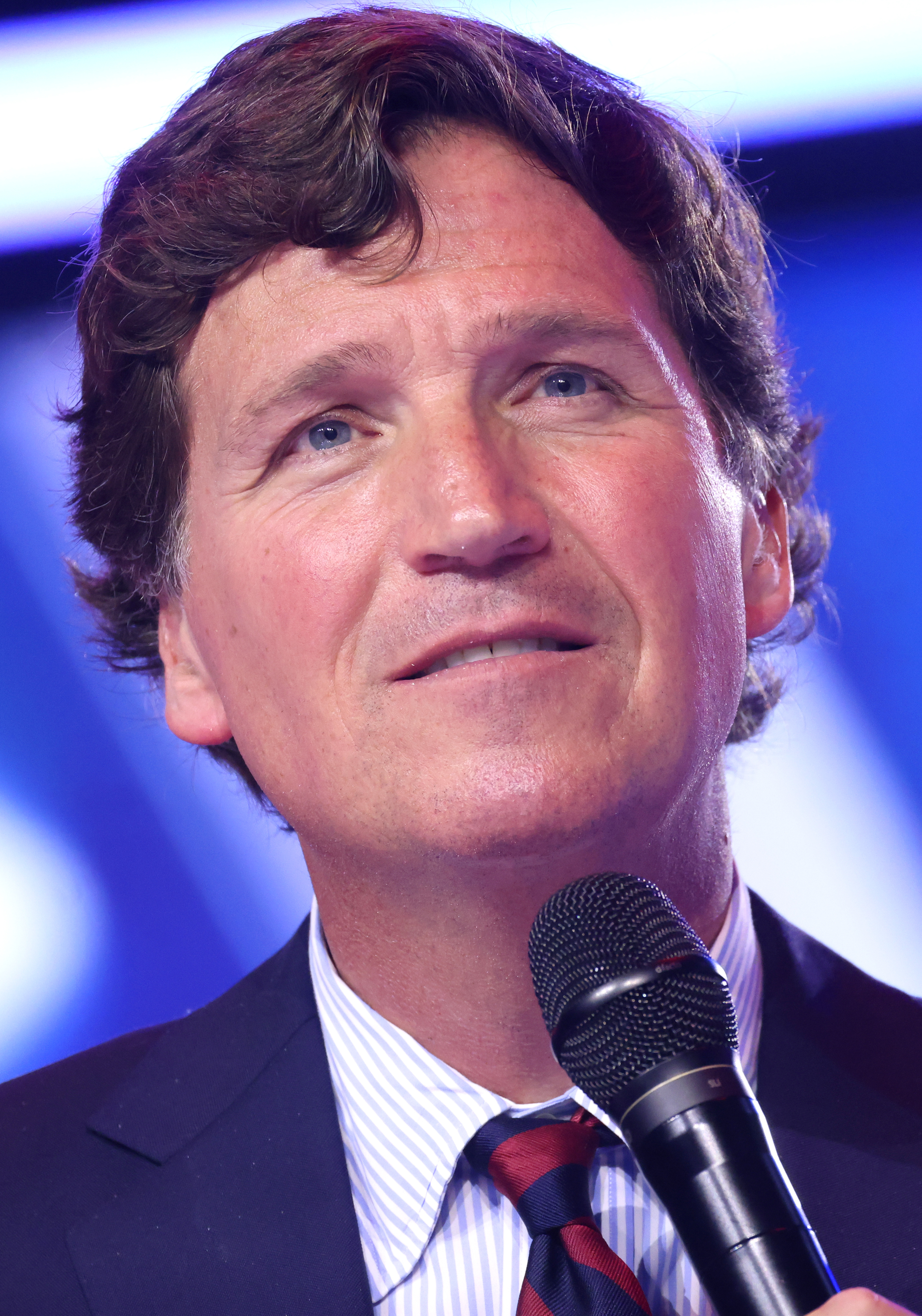
Tucker Carlson 2025 (Wikimedia Commons) Net worth at a glance
Metric Estimate Estimated net worth (2026) $80M – $150M Current company Tucker Carlson Network (TCN) — launched June 2023 X (Twitter) distribution Tucker on X — primary video distribution since 2023 2024 Putin interview views 200M+ on X Last reported Fox salary ~$20M annually (2022) Reported Fox severance (2023) $25M+ (paid out remainder of contract) Co-founded The Daily Caller (2010), Tucker Carlson Wines Education BA History, Trinity College Connecticut (1991) Headquarters Maine and Florida (TCN production) Note: this article is independent editorial research. We are not affiliated with Tucker Carlson, Tucker Carlson Network, or any of his former employers. Net worth ranges are best-effort estimates derived from publicly reported Fox News salary disclosures, reasonable severance and TCN revenue assumptions, and accumulated savings from a long media career; only Tucker and his accountant know the exact figure.
How Tucker Carlson built his net worth
Carlson’s wealth is the product of a 30+ year media career across print, cable news, and now independent platforms. The arc has four phases.
Phase 1: Print journalism and early cable (1991–2008)
Born in San Francisco in May 1969 and raised in California by his father (Richard Warner Carlson, a journalist and US Ambassador to the Seychelles), Tucker Carlson graduated from Trinity College in Connecticut in 1991 with a degree in History. He began his career in print journalism at Policy Review and other publications, then moved to print magazines including The Weekly Standard.
His cable television career began with CNN in 2000 (as co-host of the network’s Crossfire), continued at MSNBC (where he hosted Tucker from 2005-2008), and then to Fox News in 2009. The early cable career provided steady but unspectacular compensation — typical cable-news contributor salaries through the 2000s were in the high six to low seven figures.
Phase 2: The Daily Caller and Fox supporting roles (2010–2016)
In 2010, Carlson co-founded The Daily Caller — a conservative news website — with Neil Patel. The site grew through the 2010s and became a meaningful independent media property in the conservative ecosystem. Carlson sold his remaining stake in The Daily Caller in 2020, with terms not publicly disclosed but plausibly worth $5M-$15M to him personally.
From 2009-2016, Carlson held various Fox News roles including substitute hosting, contributing on weekend shows, and eventually getting his own weekend program. Compensation was meaningful but not at the top tier of network salaries.
Phase 3: Tucker Carlson Tonight at Fox primetime (2016–2023)
In November 2016, Carlson took over the 7 PM ET Fox News slot from Greta Van Susteren, then moved to the coveted 8 PM ET slot in April 2017 after Bill O’Reilly’s departure. Tucker Carlson Tonight consistently became the most-watched program in cable news, regularly reaching 3-4 million nightly viewers and at peak topping all cable news competition.
By 2022, Carlson’s reported Fox News salary was approximately $20 million annually — placing him among the highest-paid cable news anchors ever. Across his roughly seven years as Fox primetime host (late 2016 – April 2023), cumulative Fox News compensation plausibly exceeded $80 million.
Phase 4: Fox termination and Tucker Carlson Network (2023–present)
In April 2023, Fox News terminated Carlson’s contract with no public explanation given. The termination came shortly after Fox’s $787.5 million settlement with Dominion Voting Systems related to election fraud claims. Trade press reports placed Carlson’s reported severance at approximately $25 million or more — Fox paying out the remainder of his contract per typical termination economics for top talent.
In June 2023, Carlson launched Tucker on X — a video show distributed primarily on X (then-Twitter, owned by Elon Musk who had been an outspoken Carlson supporter). He subsequently formalized the operation as Tucker Carlson Network (TCN), launching a subscription tier in late 2023.
The February 2024 interview with Vladimir Putin became a defining cultural moment — reaching more than 200 million views on X within weeks and generating enormous global attention. The interview was widely covered by mainstream media, both critically and otherwise, and dramatically expanded Carlson’s post-Fox audience.
Career timeline
Year Milestone 1969 (May) Born in San Francisco, California 1991 Graduates Trinity College Connecticut, BA History 1991-2000 Print journalism: Policy Review, The Weekly Standard, others 2000-2005 CNN Crossfire co-host 2005-2008 MSNBC’s Tucker show 2009 Joins Fox News as contributor 2010 Co-founds The Daily Caller with Neil Patel 2016 (Nov) Takes over Fox 7 PM ET slot as Tucker Carlson Tonight 2017 (April) Moves to Fox 8 PM ET primetime slot 2020 Sells remaining stake in The Daily Caller 2018-2022 Publishes Ship of Fools (2018) and The Long Slide (2021), both NYT bestsellers 2023 (April) Fox News terminates contract 2023 (June) Launches Tucker on X video show 2023 (late) Formalizes Tucker Carlson Network (TCN) with subscription tier 2024 (Feb) Putin interview reaches 200M+ views on X 2025-2026 Continues TCN operations across X, podcast platforms, and direct subscription Net worth estimate breakdown
Fox News career accumulated savings
Cumulative Fox News compensation across roughly 14 years (2009-2023), with peak years at approximately $20M annually, totals an estimated $80M-$120M gross over the full Fox tenure. After-tax retention plausibly $30M-$50M after federal and state taxes (Carlson primarily based in Florida and Maine — Florida no income tax, Maine modest state tax).
Fox severance payout (April 2023)
Reported severance of $25M+ plausibly added another $15M-$20M after taxes to his post-Fox balance sheet.
The Daily Caller exit (2020)
The 2020 sale of his remaining stake in The Daily Caller plausibly produced after-tax proceeds of $4M-$12M depending on the exact ownership percentage and deal terms.
Tucker Carlson Network (current operating business)
TCN combines subscription revenue, X video monetization, podcast advertising, and live-event income. The business is privately held and revenue is not disclosed. With substantial paid subscribers and high-engagement audiences, annual revenue plausibly $30M-$80M, with Carlson as primary equity holder. Enterprise value plausibly $50M-$150M depending on revenue multiples.
Book royalties
Ship of Fools (2018) and The Long Slide (2021) were both #1 NYT bestsellers. Cumulative royalties plus advances plausibly $3M-$8M.
Tucker Carlson Wines and other ventures
Various smaller ventures including Tucker Carlson Wines plausibly contribute $500K-$2M annually.
Real estate
Carlson owns multiple properties including longtime residences in Maine and Florida. Real estate equity plausibly $5M-$15M.
Investments
Accumulated investments and cash from the substantial Fox-era income compounded over the years plausibly $20M-$40M.
Adding the buckets and applying realistic discounts produces the $80M-$150M range. The wide spread reflects genuine uncertainty about TCN’s exact subscriber count and the ultimate value of his post-Fox business.
Common misconceptions
“He’s worth $300 million already”
Some celebrity-net-worth aggregator sites quote Carlson at figures north of $200M-$300M. Realistic estimates including all revenue lines and reasonable post-tax savings land in the $80M-$150M range. The Fox income was substantial but bounded by the actual contract economics, and TCN is still a relatively new operation.
“His career ended when Fox fired him”
The opposite has been true. The post-Fox Tucker Carlson Network era has expanded his audience well beyond what Fox primetime had reached, with the February 2024 Putin interview alone (200M+ views) reaching more people than entire months of Fox primetime had previously.
“He was paid by Russia for the Putin interview”
Carlson has stated repeatedly that he was not paid by Russia or any Russian entity for the February 2024 Putin interview. The interview was conducted as journalism (debatable framing aside), and Carlson and TCN earned revenue through standard X video monetization plus subscription growth driven by the interview’s audience.
“He owns Fox News”
No. Carlson was a salaried Fox News host from 2009 to April 2023 but never had ownership equity in the network. Fox Corporation is owned primarily by the Murdoch family.
Comparison to similar political commentators
Commentator Estimated Net Worth Profile Tucker Carlson $80M – $150M TCN, X distribution, prior Fox income Ben Shapiro $50M+ Daily Wire equity, podcast, books, films Megyn Kelly $40M – $70M SiriusXM, YouTube, MK Media Bill O’Reilly $80M+ Independent podcast/site, prior Fox career, books Sean Hannity $300M+ Fox primetime since 1996, real estate, decades Glenn Beck $200M+ BlazeTV/Mercury Radio Arts, books, decades Carlson sits in the upper tier of major political commentators. He is comparable to Bill O’Reilly on a personal-wealth basis (both former Fox primetime hosts who built independent operations post-departure), and below Sean Hannity and Glenn Beck primarily because their longer continuous primetime/operating careers have had more time to compound.
Related Profiles
Profiles in the same space — news & political commentary — that readers of this page often explore next:
Frequently asked questions
What is Tucker Carlson’s net worth in 2026?
Combining his accumulated Fox News compensation, the reported $25M+ severance, the 2020 Daily Caller exit, Tucker Carlson Network operating value, book royalties, real estate, and accumulated investments, Tucker Carlson’s net worth is estimated at $80 million to $150 million.
Why was Tucker Carlson fired from Fox News?
Fox News terminated his contract in April 2023 without providing a public explanation. The termination came shortly after Fox’s $787.5 million settlement with Dominion Voting Systems related to election fraud claims. Various theories have been offered but no official Fox explanation exists.
What is Tucker Carlson Network?
Tucker Carlson Network (TCN) is the independent media company Carlson launched in June 2023 after his Fox News termination. It operates across X (where his primary video distribution lives), his own website, podcast platforms, and includes a paid subscription tier.
How much did Tucker Carlson make at Fox News?
His last reported salary was approximately $20 million annually as of 2022. Across his roughly 14-year Fox tenure (2009-2023), cumulative compensation plausibly exceeded $80 million gross.
Did Tucker Carlson really interview Putin?
Yes. In February 2024, Carlson conducted a long-form interview with Russian President Vladimir Putin in Moscow. The interview reached more than 200 million views on X within weeks of release and was widely covered by mainstream media globally.
What was The Daily Caller?
The Daily Caller is the conservative news website Carlson co-founded with Neil Patel in 2010. It became a meaningful independent media property in the conservative ecosystem. Carlson sold his remaining stake in 2020.
How many books has Tucker Carlson written?
Multiple, including Politicians, Partisans, and Parasites (2003), Ship of Fools: How a Selfish Ruling Class Is Bringing America to the Brink of Revolution (2018), and The Long Slide: Thirty Years in American Journalism (2021). The 2018 and 2021 books were both NYT bestsellers.
Where does Tucker Carlson live?
He has long maintained residences in Maine (where he grew up partly) and Florida. The Tucker Carlson Network is produced from these locations rather than from a major media-city headquarters.
Is Tucker Carlson married?
Yes. He has been married to Susan Andrews since 1991. They have four children together.
Did Tucker Carlson go to college?
Yes. He graduated from Trinity College in Hartford, Connecticut in 1991 with a degree in History.
Is Tucker Carlson involved in politics directly?
He has not held elected office and has not formally endorsed running for any political position. His role has been as a commentator and interview-driven journalist rather than as a campaign or party operative, even as his commentary has had clear influence on Republican-aligned politics.
What was the 2026 Trump endorsement reversal?
In 2026, Carlson publicly withdrew his support for Donald Trump and apologized for what he characterized as having previously misled people into supporting him. The reversal was a significant public moment given his previous role as one of the highest-profile Trump advocates in conservative media.
Sources & references
- Wikipedia — Tucker Carlson
- Fox News — Tucker Carlson Tonight archive (2016-2023)
- Tucker Carlson Network — official site (launched June 2023)
- X (formerly Twitter) — Tucker on X distribution (since 2023)
- The New York Times — coverage of April 2023 Fox termination and February 2024 Putin interview
- The Daily Caller — Carlson co-founder profile (2010)
- Trinity College Connecticut — alumni records (BA History, 1991)
Last updated: April 2026. Net worth estimates are based on publicly reported Fox News salary disclosures, reasonable severance and TCN revenue assumptions, and accumulated savings from a long media career. Figures will be revised when new disclosures occur.
-
PSYCHOLOGY | AUTHOR | NET WORTH
Angela Duckworth is one of the most influential psychologists of the past 15 years — the Rosa Lee and Egbert Chang Professor of Psychology at the University of Pennsylvania, a 2013 MacArthur Fellowship recipient (often called the “genius grant”), the author of the international bestseller Grit: The Power of Passion and Perseverance (2016), the founder of Character Lab, and the co-host of the popular No Stupid Questions podcast with Stephen Dubner. As of 2026, Angela Duckworth’s estimated net worth is approximately $5 million to $15 million, derived from book royalties, her Penn academic salary, MacArthur Fellowship, speaking fees, podcast revenue, and selective consulting work.
Her career stands as one of the cleanest examples of how a credentialed academic psychologist can translate rigorous research into accessible bestselling writing — and how a single foundational concept (“grit”) can shape educational policy, organizational psychology, and parenting culture globally.
Key Takeaways
- Angela Duckworth’s 2026 estimated net worth is approximately $5-15 million.
- Her 2016 book Grit: The Power of Passion and Perseverance is an international bestseller.
- She is the Rosa Lee and Egbert Chang Professor of Psychology at the University of Pennsylvania.
- She received the 2013 MacArthur Fellowship (“genius grant”).
- She is the founder of Character Lab, a non-profit advancing the science of character development.
- She co-hosts the popular No Stupid Questions podcast with Freakonomics author Stephen Dubner.

Themed imagery related to Angela Duckworth. Photo by Kampus Production via Pexels. Who Is Angela Duckworth?
Angela Lee Duckworth was born in 1970 and is approximately 55 or 56 years old as of 2026. She is an American academic, psychologist, and popular science author. She earned her Bachelor of Arts in Neurobiology from Harvard University, her Master of Science in Neuroscience from the University of Oxford, and her Ph.D. in Psychology from the University of Pennsylvania — credentials that reflect the unusual breadth of her scholarly background.
What distinguishes Duckworth from many academic psychologists is the combination of rigorous empirical research, foundational theoretical contributions (the concept of “grit” as a measurable trait), and exceptional public communication skill. While many psychology professors publish primarily in academic journals, Duckworth’s work has translated directly into educational policy, classroom practice, organizational psychology, and parenting frameworks used by millions of people worldwide.
Career and Rise to Fame
Duckworth’s pre-academic career included consulting at McKinsey & Company and teaching middle and high school students — experiences that informed her later research interests in why some students with similar abilities achieve dramatically different outcomes. Her teaching observations became the seed of what eventually grew into her grit research program.
She joined the University of Pennsylvania faculty after earning her Ph.D., where she eventually became the Rosa Lee and Egbert Chang Professor of Psychology. Her research has focused primarily on grit (the combination of passion and perseverance) and self-control as predictors of achievement across domains — from West Point cadets to spelling-bee competitors to graduate students.
Her career inflection came in 2013, when she received the MacArthur Fellowship — the prestigious “genius grant” that recognizes exceptional creativity and impact. The MacArthur dramatically expanded her public profile and provided meaningful financial resources for her research and writing.
In 2016, she published Grit: The Power of Passion and Perseverance, which translated her research program into accessible language for general readers. The book became an instant New York Times bestseller, has sold widely globally, and has been translated into more than 30 languages. The book’s central thesis — that long-term passion and perseverance predict achievement more reliably than raw talent — has shaped how educators, parents, organizations, and individuals think about success.
Beyond academic and writing work, Duckworth has built additional ventures:
- Character Lab — She founded Character Lab, a non-profit organization whose mission is to advance the science and practice of character development. The organization works with educators and researchers to translate behavioral science into tools that help young people develop character strengths.
- No Stupid Questions podcast — She co-hosts this popular podcast with Freakonomics author Stephen Dubner, exploring questions ranging from psychology and economics to everyday life choices.
- TED Talks and public lectures — Her TED Talk “Grit: The Power of Passion and Perseverance” has accumulated tens of millions of views.
How Angela Duckworth Makes Money
Duckworth’s income flows through multiple layered streams: her Penn academic salary, MacArthur Fellowship resources, book royalties, speaking fees, podcast revenue, and selective consulting and board engagements.
Book Royalties
Grit has been an international bestseller since 2016, with translations into over 30 languages and continuing strong backlist sales. The book has produced substantial cumulative royalty income across nearly a decade — likely a meaningful seven-figure component of her net worth on its own. International translations have meaningfully extended that revenue.
Speaking Fees
Duckworth has been one of the most-booked academic-author speakers in the personal-development and education-leadership categories. Speaker fees at her level — particularly post-MacArthur — typically range from $40,000 to $80,000+ per keynote, with multiple high-profile engagements per year.
Penn Academic Compensation
Endowed-chair professor compensation at Penn, combined with her seniority and grant-funded research support, has produced substantial cumulative academic compensation across her tenure.
MacArthur Fellowship
The 2013 MacArthur Fellowship included a stipend of $625,000 (paid over five years), a meaningful direct contribution to her financial resources alongside the broader career-acceleration effects of the recognition.
No Stupid Questions Podcast
The popular podcast with Stephen Dubner generates ongoing advertising and sponsorship revenue, contributing to her overall income.
Character Lab and Selective Consulting
Her work at Character Lab is primarily mission-driven (the organization is a non-profit), though her broader profile generates selective consulting and advisory engagements.
Net Worth
Angela Duckworth’s exact net worth has not been publicly reported by mainstream wealth-tracking outlets. Wikipedia and other sources note that the figure is not publicly disclosed, consistent with her broader low-key academic profile.
The realistic 2026 range for Angela Duckworth’s net worth is approximately $5 million to $15 million. That estimate reflects:
- Cumulative royalties from Grit as an international bestseller across nearly a decade
- Multiple years of premium-priced speaking fees, particularly post-MacArthur
- Penn endowed-chair compensation across her tenure
- The MacArthur Fellowship stipend
- Podcast revenue from No Stupid Questions
- Personal investment portfolio compounded over a successful academic career
Duckworth does not appear on any wealth-ranking lists tracking the ultra-wealthy. Her commitment to academic rigor, mission-driven work through Character Lab, and the integrity of her research program has produced what appears to be substantial but measured wealth — consistent with the values articulated throughout her career.
Investments and Business Philosophy
Duckworth’s research and intellectual philosophy is captured in her core thesis: achievement = talent × effort. Her foundational argument is that while raw talent matters, long-term effort applied with consistency over time is the more reliable predictor of high achievement across domains. This thesis, developed across her academic research and articulated for general audiences in Grit, has become foundational vocabulary in modern educational and organizational psychology.
Her career strategy reflects similar values. She has been disciplined about building her platform through rigorous research, peer-reviewed publication, and accessible-but-not-dumbed-down public writing — rather than chasing the typical academic-celebrity moves of constant trend-chasing or controversial commentary. The integrity of staying focused on a clear research program for over two decades is part of why her work has produced lasting impact rather than fading after her peak public moment.
Her work at Character Lab represents the application of her research-philosophy to mission-driven impact. Rather than maximizing personal income through the leverage of her platform, she has built an institutional non-profit vehicle for translating behavioral science into tools that benefit young people directly.
Lifestyle and Spending
Duckworth has been married to Jason Duckworth since 1998, and they have two daughters. Her public lifestyle is characteristically academic and grounded — she is not a fixture in luxury or society coverage and has consistently emphasized family, research, and the responsibilities of using her platform for public good over personal-celebrity status.
Her public personality — warm, intellectually curious, comfortable with uncertainty about her own conclusions — is consistent across her TED Talk, her book, her podcast, and her academic work. The integrity between her public and academic personas is part of why her audience trusts her commentary on grit, achievement, and character.
What Can We Learn from Angela Duckworth?
Duckworth’s career offers some of the cleanest lessons in modern academic psychology and bestselling-author writing:
1. Anchor in rigorous research first. Duckworth’s grit framework emerged from years of peer-reviewed academic research before it became a popular concept. Books built on rigorous research have durability that pure-pop-psychology books cannot match.
2. Single concept beats catalog of concepts. “Grit” — passion plus perseverance over time — is one clear, named, testable concept. Most academic books try to introduce too many ideas; Duckworth’s discipline of focusing the book around one foundational concept has been part of why it has been so impactful.
3. MacArthur recognition compounds. The 2013 MacArthur Fellowship provided both direct financial resources and dramatic career acceleration. Strategic recognition events — when authentic — accelerate the broader trajectory of academic-public careers.
4. Build the institutional layer. Character Lab gives Duckworth’s research a vehicle for scalable, mission-driven impact beyond her personal time. Most academics never build institutional infrastructure around their work; those who do create durable impact.
5. Podcast format extends reach. No Stupid Questions extends Duckworth’s audience and influence beyond what her academic and book writing alone could produce. Cross-format presence — academic, book, podcast — multiplies a research platform’s reach.
6. Family and academic integration is sustainable. Duckworth’s openness about her family, her teaching origin story (with her own children’s school being part of the inspiration for the work), and the integration of her personal life with her research have made her career sustainable rather than burnout-inducing.
Related Profiles
Profiles in the same space — behavioral science & psychology — that readers of this page often explore next:
Frequently Asked Questions
What is Angela Duckworth’s net worth in 2026?
Angela Duckworth’s exact net worth has not been publicly disclosed. The realistic 2026 range — accounting for Grit royalties as an international bestseller, premium-priced speaking fees post-MacArthur, Penn endowed-chair compensation, the MacArthur Fellowship stipend, podcast revenue, and personal investments — is approximately $5 million to $15 million.
What is Grit by Angela Duckworth?
Grit: The Power of Passion and Perseverance, published in 2016, is Angela Duckworth’s bestselling book translating her grit research program into accessible writing for general readers. The book argues that long-term passion and perseverance predict achievement more reliably than raw talent.
Did Angela Duckworth win the MacArthur Fellowship?
Yes. Angela Duckworth received the 2013 MacArthur Fellowship — often called the “genius grant” — recognizing her exceptional creativity and impact in the study of grit and self-control as predictors of achievement.
What is Character Lab?
Character Lab is a non-profit organization founded by Angela Duckworth whose mission is to advance the science and practice of character development. The organization works with educators and researchers to translate behavioral science into tools that help young people develop character strengths.
Where does Angela Duckworth teach?
Angela Duckworth is the Rosa Lee and Egbert Chang Professor of Psychology at the University of Pennsylvania, where she has been on the faculty since earning her Ph.D. there.
What is the Grit Scale?
The Grit Scale is a self-report measurement tool developed by Angela Duckworth and her collaborators to quantify an individual’s level of grit. The scale has been used in numerous research studies on achievement, education, and organizational psychology.
What podcast does Angela Duckworth host?
Angela Duckworth co-hosts the popular No Stupid Questions podcast with Freakonomics author Stephen Dubner. The podcast explores questions ranging from psychology and economics to everyday life choices.
The Angela Duckworth Impact
Angela Duckworth’s $5-15 million estimated net worth in 2026 is the financial result of one of the most influential academic psychology careers of the past 20 years. From her MacArthur Fellowship recognition, to Grit‘s international bestseller status, to the founding of Character Lab, to the popular No Stupid Questions podcast, Duckworth has demonstrated that the most enduring careers in academic psychology combine rigorous research with accessible public communication and mission-driven institutional building.
For aspiring psychologists, popular-science authors, and academic-public bridge-builders, Angela Duckworth’s career stands as one of the most informative blueprints in the modern era — proof that a clear research program, foundational concept, MacArthur-level recognition, institutional vehicle for impact, and cross-format public communication can compound into both substantial wealth and lasting cultural influence on how millions of educators, parents, and individuals think about achievement, character, and the long-term value of effort.
-
Geopolitics · Technology Markets
In the shadowy arena of global technological competition, a silent war is being waged—not with tanks and missiles, but with microchips and export controls. The semiconductor industry has become the new battlefield where nations compete for technological supremacy, with stakes that could reshape the global economic and geopolitical landscape for decades to come.
Key Takeaways- → The global semiconductor industry has become a critical geopolitical battleground, with the U.S. and China engaged in a high-stakes technological chess match
- → U.S. export controls have inadvertently accelerated China’s push for technological self-sufficiency in semiconductor manufacturing
- → China has invested $47.5 billion in semiconductor research and development, signaling a massive national commitment to technological independence
- → Taiwan’s TSMC remains a critical chokepoint in global semiconductor production, producing 90% of the world’s most advanced chips
- → A potential U.S.-China conflict over Taiwan could cost the global economy approximately $10.6 trillion, highlighting the industry’s strategic importance
In the shadowy arena of global technological competition, a silent war is being waged—not with tanks and missiles, but with microchips and export controls. The semiconductor industry has become the new battlefield where nations compete for technological supremacy, with stakes that could reshape the global economic and geopolitical landscape for decades to come.
## The New Technological Cold War
The semiconductor industry has evolved from a mere technological sector to a critical battleground of national security and global economic power. As our previous analysis of semiconductor geopolitics suggested, we are witnessing a profound transformation of global technological competition.
The roots of this conflict trace back to the pandemic-era supply chain disruptions and growing geopolitical tensions between the United States and China. Both nations understand a fundamental truth: whoever controls advanced chip manufacturing will shape the future of artificial intelligence, economic growth, and national security.
## The U.S. Strategy of Containment
In October 2022, the U.S. Bureau of Industry and Security (BIS) implemented unprecedented export controls targeting four critical areas of semiconductor technology: advanced AI processors, semiconductor design, fabrication capabilities, and manufacturing equipment. Companies like NVIDIA were banned from exporting flagship GPUs to China, while firms such as Applied Materials, Lam Research, and KLA Corporation were prohibited from selling sophisticated manufacturing tools.
Jack Burnham, a senior research analyst at the Foundation for Defense of Democracies, noted in a recent report that these controls aim to “lock China out of the global advanced chip-making market.” The strategy involves not just direct restrictions but also pressuring allies like the Netherlands and Japan to align with U.S. technological export policies.
## The Unintended Consequences
Paradoxically, these export controls have potentially accelerated China’s technological development. As explored in our deep-dive into the semiconductor showdown, the restrictions have motivated a massive national effort toward technological self-sufficiency.
Consider these remarkable developments:
1. **Domestic Innovation**: In 2023, Huawei released the Mate 60 Pro smartphone powered by a domestically manufactured 7-nanometer chip, shocking observers who had assumed China was years away from such capabilities.
2. **AI Adaptation**: Chinese firms like DeepSeek have begun developing AI models optimized for locally available processors, demonstrating remarkable software innovation in the face of hardware constraints.
3. **Talent Investment**: China’s Ministry of Education has prioritized semiconductor sciences, with Peking University launching a dedicated School of Integrated Circuits to train up to 600,000 specialists.
## The Financial War Chest
Beijing’s commitment is perhaps most starkly illustrated by its financial investment. In May 2024, China launched a **$47.5 billion semiconductor investment fund**—more than double its previous record initiative in 2014. This massive investment underscores President Xi Jinping’s broader ambition for technological self-reliance.
## The Taiwan Factor
No discussion of semiconductor geopolitics is complete without addressing Taiwan. As our investigation into critical minerals and global supply chains revealed, Taiwan Semiconductor Manufacturing Company (TSMC) remains the global lynchpin of advanced chip production.
TSMC produces an astounding 90% of the world’s most advanced chips, making it a critical chokepoint in global technological supply chains. The geopolitical stakes are enormous—a potential U.S.-China conflict over Taiwan could cost the global economy approximately **$10.6 trillion**, roughly 9.6% of global gross domestic product.
## Global Implications
The semiconductor conflict extends beyond mere technological competition. Countries across Asia, Africa, and parts of Europe may choose to diversify their technological dependencies, potentially fragmenting the global tech ecosystem.
Countries like Russia, Iran, and North Korea stand to benefit from China’s potential willingness to supply restricted technology, further complicating the geopolitical landscape.
## The Path Forward
U.S. policymakers face a complex challenge. Export controls remain one of the few non-military tools to influence technological competition, but their effectiveness is increasingly questionable.
Potential strategies include:
– Tightening enforcement of existing controls
– Deepening multilateral coordination with allies
– Accelerating domestic semiconductor research and development
– Investing in technical workforce development## Conclusion
The semiconductor industry has become more than just a technological sector—it is now a critical arena of global strategic competition. The actions taken in the next few years will likely determine the technological and economic balance of power for decades to come.
## Related Articles
-
Key Takeaways
- Estimated net worth of $5–$12 million as of 2026
- Hosts The Matt Walsh Show on Daily Wire (since 2017) — among Daily Wire’s top podcast properties
- What Is a Woman? documentary (2022) — major Daily Wire production with significant cultural impact
- Author of bestselling children’s book Johnny the Walrus (2021); plus Church of Cowards (2020) and other titles
- Am I Racist? documentary (September 2024) — grossed $12M+ at theatrical box office
- Earlier career as morning radio host in West Virginia and Kentucky markets
Matt Walsh — American conservative political commentator, author, podcast host, host of The Matt Walsh Show on Daily Wire since 2017 (one of the network’s most-listened podcast properties), star and writer of the Daily Wire documentary What Is a Woman? (2022) and the 2024 theatrical documentary Am I Racist? (which grossed more than $12 million at the US box office, an unusual outcome for a politically-themed documentary), and bestselling author of multiple titles including the controversial children’s book Johnny the Walrus (2021) — has built one of the more financially substantial individual creator businesses within the Daily Wire ecosystem. Combining his Daily Wire compensation, book royalties, the documentary box office and licensing proceeds, brand partnerships, and accumulated investments, Matt Walsh’s net worth is estimated at $5 million to $12 million as of 2026.
Walsh’s case is interesting because his commercial success has been tied tightly to specific cultural-controversy projects — particularly What Is a Woman? in 2022 and Am I Racist? in 2024 — rather than to a single long-running content vehicle. The combination of consistent podcast output plus periodic high-profile documentary projects has produced an unusual hybrid career economic model.

Matt Walsh (Wikimedia Commons) Net worth at a glance
Metric Estimate Estimated net worth (2026) $5M – $12M Daily Wire role Host of The Matt Walsh Show since 2017 YouTube subscribers 3M+ (Matt Walsh main channel) Major documentary 1 What Is a Woman? (Daily Wire, 2022) Major documentary 2 Am I Racist? (theatrical, September 2024) — $12M+ box office Bestselling children’s book Johnny the Walrus (DW Books, 2021) — #1 Amazon LGBTQ+ Children’s Books Hometown Maryland (raised); Tennessee (current) Education Did not complete college Note: this article is independent editorial research. We are not affiliated with Matt Walsh or Daily Wire. Net worth ranges are best-effort estimates derived from typical Daily Wire talent compensation, documentary box office data, book sales, and reasonable post-tax savings assumptions; only Matt and his accountant know the exact figure.
How Matt Walsh built his net worth
Walsh’s wealth is the product of a deliberate decade-long build that started in local radio, scaled through blogging, and reached substantial commercial scale through the Daily Wire content and documentary projects. The arc has four phases.
Phase 1: Local radio years (2007–2014)
Born in Maryland in June 1986, Walsh did not complete college and began his career in radio in West Virginia and Kentucky markets. He worked as a morning radio host through the late 2000s and early 2010s, building local broadcasting experience but bounded commercial scale typical of small-market radio.
Phase 2: Blogging and TheBlaze (2014–2017)
In 2014, Walsh began blogging as “The Matt Walsh Blog” — initially independently, then through TheBlaze (Glenn Beck’s media company) starting in 2015. The blog’s combative writing style and consistent output built a meaningful conservative blogosphere following.
Phase 3: Daily Wire era (2017–2022)
In 2017, Walsh joined The Daily Wire as a host and writer. He launched The Matt Walsh Show podcast within the Daily Wire podcast network, and over the subsequent years it scaled into one of the network’s most-listened properties. His Daily Wire compensation as one of the network’s flagship hosts is widely understood to be in the $1-3M annual range, with various performance and equity components on top.
His 2021 children’s book Johnny the Walrus — a deliberately provocative satirical book about gender identity — became a #1 Amazon bestseller in the LGBTQ+ Children’s Books category (a placement Walsh actively promoted as commentary on Amazon’s category-tagging system) and produced meaningful royalty income.
Phase 4: What Is a Woman? and Am I Racist? documentaries (2022–present)
In June 2022, Daily Wire released What Is a Woman? — a Walsh-fronted documentary on transgender ideology and biological sex. The film became one of the most-watched and most-commented Daily Wire productions ever, and its release coincided with a broader cultural inflection point on transgender policy discussions. The documentary was widely streamed within Daily Wire’s subscription base and generated substantial subscription growth for the platform.
In September 2024, the theatrical documentary Am I Racist? — produced by Daily Wire and starring Walsh in an undercover-style format infiltrating diversity-equity-inclusion training events — was released to US theaters by Briarcliff Entertainment. The film grossed more than $12 million at the US theatrical box office, an unusual commercial outcome for a politically-themed documentary and one of the highest-grossing political documentaries in recent years.
Both documentaries provided Walsh with executive producer credit and meaningful equity participation, contributing significantly to his post-2022 wealth scaling.
Career timeline
Year Milestone 1986 (June) Born in Maryland ~2007 Begins radio career in West Virginia, then Kentucky markets 2014 Launches “The Matt Walsh Blog” independently 2015 Joins TheBlaze (Glenn Beck’s media company) as a writer 2017 Joins The Daily Wire; launches The Matt Walsh Show podcast 2020 Publishes Church of Cowards 2021 Publishes Johnny the Walrus; #1 Amazon LGBTQ+ Children’s Books 2022 (June) Daily Wire releases What Is a Woman? documentary 2024 (Sept) Theatrical release of Am I Racist?; grosses $12M+ box office 2025-2026 Continues Matt Walsh Show, books, and Daily Wire production Net worth estimate breakdown
Daily Wire compensation
His Daily Wire host and content compensation across the 2017-2026 era plausibly contributed $10-25 million in cumulative gross income, with peak years at approximately $1-3 million annually plus performance bonuses and equity-equivalent participation in show-related production economics.
Documentary executive producer credit
Both What Is a Woman? (2022) and Am I Racist? (2024) plausibly provided Walsh with meaningful executive producer credit and back-end participation. The 2024 theatrical $12M+ box office for Am I Racist? in particular plausibly contributed $1-3 million in personal proceeds depending on the deal structure.
Book royalties
Johnny the Walrus (2021), Church of Cowards (2020), and his other titles plausibly produced $1-3 million in cumulative royalties.
YouTube ad revenue
3M+ YouTube subscribers across his main channel and Daily Wire-affiliated channels generates plausibly $300K-$700K in additional direct YouTube ad revenue.
Brand partnerships and other income
Various brand partnerships and speaking engagements plausibly contribute $200K-$500K annually.
Real estate
Walsh is based in Tennessee (the broader Daily Wire ecosystem in Nashville). Tennessee has no state income tax, which is favorable for high-income earners. Real estate equity plausibly $1-3 million.
Investments and savings
Accumulated investments plausibly $1-3 million.
Adding the buckets and applying realistic discounts produces the $5M-$12M range.
Common misconceptions
“He’s worth $50 million already”
Some celebrity-net-worth aggregator sites quote Walsh at figures north of $20M-$50M. Realistic estimates including Daily Wire compensation, documentary participation, book royalties, and post-tax savings land in the $5M-$12M range. The wealth is meaningful but bounded by the actual scale of Daily Wire economics and the recent timing of the documentary projects.
“He owns Daily Wire”
Walsh is a salaried Daily Wire host and contributor with various equity-style participation in production projects. He does not own Daily Wire as a company — the network was co-founded by Ben Shapiro and Jeremy Boreing, who retain primary ownership stakes.
“What Is a Woman? made him rich”
The 2022 documentary was a meaningful cultural and Daily Wire-platform success but the direct personal financial impact on Walsh was bounded by his executive producer share and the platform’s distribution model (the film was primarily distributed within Daily Wire’s subscription tier rather than through theatrical or streaming licensing). The 2024 Am I Racist? theatrical release was a larger direct-to-Walsh financial event.
“He’s just a controversial provocateur”
Walsh’s content is intentionally provocative within contemporary cultural debates, but the consistent multi-year output (more than 8 years of Daily Wire podcasting, dozens of episodes per year of The Matt Walsh Show, multiple books, and now multiple documentaries) reflects a sustained content production effort beyond simple provocation.
Comparison to similar Daily Wire and conservative commentators
Commentator Estimated Net Worth Profile Matt Walsh $5M – $12M Daily Wire podcast, documentaries, books Ben Shapiro $50M+ Daily Wire equity, podcast, books, films Jordan Peterson $25M – $70M Books, Daily Wire+, Peterson Academy, speaking Candace Owens $15M – $25M Independent post-Daily Wire, podcast Michael Knowles $5M – $10M Daily Wire podcast, books Andrew Klavan $5M – $10M Daily Wire podcast, novels, films Walsh sits in the lower-middle tier of Daily Wire personalities by personal wealth — comparable to Michael Knowles and Andrew Klavan and meaningfully below Ben Shapiro (whose Daily Wire equity is the differentiating factor). The 2024 theatrical Am I Racist? success may push his trajectory upward in subsequent years.
Related Profiles
Profiles in the same space — news & political commentary — that readers of this page often explore next:
Frequently asked questions
What is Matt Walsh’s net worth in 2026?
Combining his Daily Wire compensation across the 2017-2026 era, executive producer credit and back-end participation in What Is a Woman? and Am I Racist?, book royalties from his catalog, YouTube ad revenue, and accumulated investments, Matt Walsh’s net worth is estimated at $5 million to $12 million.
What is What Is a Woman?
What Is a Woman? is the 2022 Daily Wire documentary fronted by Matt Walsh, which examined transgender ideology and the question of biological sex. The film became one of Daily Wire’s most-discussed productions and contributed to subscription growth for the platform.
What is Am I Racist?
Am I Racist? is the September 2024 theatrical documentary produced by Daily Wire and starring Walsh in an undercover-style format infiltrating diversity-equity-inclusion training events. The film grossed more than $12 million at the US theatrical box office.
What is Johnny the Walrus?
Johnny the Walrus is the 2021 children’s book Walsh authored as a satirical commentary on gender identity. The book reached #1 on Amazon’s LGBTQ+ Children’s Books category — a placement Walsh actively promoted as commentary on category-tagging — and became a meaningful commercial success.
How much does Matt Walsh make at Daily Wire?
Specific contract terms have not been publicly disclosed. As one of Daily Wire’s flagship hosts, his compensation is widely understood to be in the $1-3 million annual range, with various performance bonuses and equity-equivalent participation in production projects.
Where is Matt Walsh from?
He was born and raised in Maryland and now lives in Tennessee, near the broader Daily Wire ecosystem in Nashville. Tennessee has no state income tax.
Did Matt Walsh go to college?
No. He began his career directly in radio after graduating from high school, working in West Virginia and Kentucky markets before transitioning to blogging and then Daily Wire.
Is Matt Walsh married?
Yes. He is married and has six children. He has been generally private about specific personal-life details beyond what appears in his content.
What books has Matt Walsh written?
Multiple books including Church of Cowards: A Wake-Up Call to Complacent Christians (2020), the children’s book Johnny the Walrus (2021), and various other titles. The DW Books imprint has been the primary publisher.
How does Matt Walsh make most of his money?
The largest revenue line is Daily Wire compensation as host of The Matt Walsh Show. Beyond that, executive producer credit on the What Is a Woman? and Am I Racist? documentaries, book royalties, YouTube ad revenue, and various brand partnerships form the rest of the wealth picture.
How long has Matt Walsh been at Daily Wire?
Since 2017 — approximately 9 years as of 2026. He launched The Matt Walsh Show within the Daily Wire podcast network and has been one of the network’s flagship hosts throughout the period.
What is Matt Walsh’s content style?
Confrontational, opinion-driven commentary on cultural and political topics — particularly transgender policy, abortion, religion, parenting, and progressive cultural movements. The deliberately provocative framing is core to the show’s audience appeal and has driven both substantial viewership and consistent controversy across his career.
Did Matt Walsh ever appear on mainstream TV?
He has had limited mainstream TV appearances relative to his Daily Wire-platform reach. The Daily Wire-internal model and his on-camera content focus has been primarily through Daily Wire’s distribution channels rather than via major broadcast network appearances.
What’s the controversy around Johnny the Walrus?
The 2021 children’s book was deliberately positioned as satirical commentary on gender identity discussions. Walsh actively promoted its placement in Amazon’s LGBTQ+ Children’s Books category as commentary on the platform’s category-tagging system. The book generated meaningful sales and substantial cultural debate consistent with the broader contested topics in his content.
Sources & references
- Wikipedia — Matt Walsh (political commentator)
- Daily Wire — The Matt Walsh Show podcast distribution (since 2017)
- Daily Wire — What Is a Woman? documentary (June 2022)
- Briarcliff Entertainment / Daily Wire — Am I Racist? theatrical release (September 2024)
- Box Office Mojo — Am I Racist? theatrical box office data
- DW Books — Matt Walsh book catalog
- TheBlaze — Matt Walsh contributor archive (2015-2017)
Last updated: April 2026. Net worth estimates are based on typical Daily Wire talent compensation, documentary box office data, book sales, and reasonable post-tax savings assumptions. Figures will be revised when new disclosures occur.
-
Key Takeaways
- Estimated net worth of $450–$700 million as of 2026
- Founder of HartBeat Productions — multi-vertical entertainment company valued $650M+ (2022 Abry Partners deal)
- Multiple Netflix specials including Irresponsible (2019), Reality Check (2023), and Acting My Age (2024)
- Major film franchises: Jumanji series, Ride Along, Central Intelligence, Night School, The Upside
- 2024 Mark Twain Prize for American Humor recipient
- Forbes-ranked among highest-paid celebrities multiple years; lifetime gross income exceeds $500M
Kevin Hart — Philadelphia-born stand-up comedian, actor, producer, and entertainment mogul, founder and chairman of HartBeat Productions (the multi-vertical entertainment company he built into a major media business with reported $650M+ valuation following the 2022 Abry Partners growth equity investment), star of multiple major film franchises including Jumanji: Welcome to the Jungle and its sequel, Ride Along, Central Intelligence, Night School, and The Upside, headliner of multiple Netflix stand-up specials including Irresponsible (2019), Reality Check (2023), and Acting My Age (2024), and 2024 recipient of the Mark Twain Prize for American Humor — has built one of the largest individual entertainment-and-media businesses of any contemporary comedian. Combining HartBeat Productions’ enterprise value, accumulated film salary across more than two decades of major studio films, comedy special compensation, sustained arena touring, brand partnerships and equity investments (including notable angel positions across consumer brands), and accumulated investments, Kevin Hart’s net worth is estimated at $450 million to $700 million as of 2026.
Hart’s case is one of the most successful comedian-to-mogul career arcs in modern entertainment. His combination of stand-up dominance, mainstream film franchise leadership, production company ownership, and brand investments places him in a peer group with Tyler Perry and Dwayne Johnson rather than with most of his stand-up contemporaries.
Kevin Hart 2014 (Wikimedia Commons) Net worth at a glance
Metric Estimate Estimated net worth (2026) $450M – $700M Major company HartBeat Productions (founded 2009) HartBeat valuation (2022) $650M+ (Abry Partners growth equity round) Forbes peak earnings year $87.5M (2019, ranked #4 highest-paid celebrities) Major film franchises Jumanji (2017, 2019), Ride Along (2014, 2016), Central Intelligence (2016) Netflix specials Multiple, including Irresponsible (2019), Reality Check (2023), Acting My Age (2024) Mark Twain Prize 2024 Headquarters Los Angeles, California Note: this article is independent editorial research. We are not affiliated with Kevin Hart or HartBeat Productions. Net worth ranges are best-effort estimates derived from publicly reported HartBeat valuation, Forbes-reported celebrity earnings disclosures, film salary norms, and reasonable post-tax savings assumptions; only Kevin and his accountant know the exact figure.
How Kevin Hart built his net worth
Hart’s wealth is the product of nearly three decades of sustained stand-up combined with mainstream Hollywood film leadership and the deliberate buildout of HartBeat Productions into a major operating media business. The arc has four phases.
Phase 1: Philadelphia comedy and Hollywood beginnings (1998–2010)
Born in Philadelphia in July 1979, Hart began stand-up in his late teens, gradually building his career through the Philadelphia comedy scene and then the broader Northeast US comedy circuit. His first major Hollywood breakthrough came in 2001 when Judd Apatow cast him in a recurring role on Undeclared. The 2000s saw incremental film roles including Paper Soldiers (2002), Soul Plane (2004), and various supporting parts.
His first comedy album I’m a Grown Little Man (2009) marked the inflection point of his stand-up career — establishing him as a major touring comedian capable of selling out theaters across the country.
Phase 2: Film stardom and mainstream breakthrough (2011–2017)
Hart’s film career scaled rapidly across 2011-2017 with leading roles in Think Like a Man (2012), Ride Along (2014, with Ice Cube — grossed $134M+ on a $25M budget), Central Intelligence (2016, with Dwayne Johnson — grossed $216M+ globally), Ride Along 2 (2016), and others. The mid-2010s established Hart as one of the most bankable comedy film stars in Hollywood.
His 2015 film Get Hard with Will Ferrell paid him a reported $9 million salary; subsequent films saw fees scale to $10-15M per major project. Cumulative film income across the 2011-2017 period plausibly exceeded $80-130 million gross.
Phase 3: Jumanji era and HartBeat scaling (2017–2022)
Jumanji: Welcome to the Jungle (December 2017, with Dwayne Johnson, Jack Black, and Karen Gillan) was a massive box office hit, grossing $962M worldwide on a $90M budget. The 2019 sequel Jumanji: The Next Level grossed $801M worldwide. The Jumanji franchise alone generated tens of millions in salary and back-end participation for Hart.
In parallel, HartBeat Productions scaled significantly. The company expanded into film and TV production (multiple Netflix specials and series), the Laugh Out Loud digital comedy network, podcast production, and various other entertainment verticals. In August 2022, private equity firm Abry Partners made a major growth equity investment in HartBeat at a reported $650 million valuation — providing Hart with substantial liquidity while he retained meaningful equity in the company.
Phase 4: Continued films, specials, and brand expansion (2022–present)
The post-2022 period has continued Hart’s film output (including Lift on Netflix in 2024, Borderlands in 2024, and various other projects) plus Netflix specials including Reality Check (2023) and Acting My Age (2024). His arena and theater touring has continued throughout, with sold-out shows in major markets globally.
Hart received the Mark Twain Prize for American Humor in 2024 — the major lifetime-achievement award given by the John F. Kennedy Center for the Performing Arts. The recognition is widely seen as a meaningful career milestone.
Career timeline
Year Milestone 1979 (July) Born Kevin Darnell Hart in Philadelphia, Pennsylvania ~1998 Begins stand-up comedy in Philadelphia 2001 Cast in Judd Apatow’s Undeclared on Fox 2009 Releases first comedy album I’m a Grown Little Man 2009 Founds HartBeat Productions 2011 Releases Laugh at My Pain stand-up film (independently distributed) 2014 Stars in Ride Along with Ice Cube ($134M+ box office) 2016 Stars in Central Intelligence with Dwayne Johnson ($216M+ box office) 2017 (Dec) Jumanji: Welcome to the Jungle released ($962M worldwide) 2019 Releases Irresponsible on Netflix; Forbes ranks #4 highest-paid celebrity ($87.5M) 2019 (Sept) Survives serious car accident in Calabasas; lengthy recovery 2019 (Dec) Jumanji: The Next Level released ($801M worldwide) 2022 (Aug) Abry Partners growth equity investment in HartBeat at $650M valuation 2023 Releases Reality Check on Netflix 2024 Releases Acting My Age on Netflix; receives Mark Twain Prize for American Humor 2025-2026 Continues film production, HartBeat operations, and arena touring Net worth estimate breakdown
HartBeat Productions equity (largest single line)
The August 2022 Abry Partners growth equity investment valued HartBeat at $650 million. Hart as founder and chairman retained a substantial equity stake post-deal — plausibly 50-70% depending on the exact deal structure. His personal share of HartBeat enterprise value plausibly $325M-$450M.
Cumulative film salary and back-end participation
Across 2011-2026, Hart has starred in dozens of major studio films with peak salary in the $10-15M range per project plus back-end participation on the biggest hits (Jumanji franchise in particular). Cumulative film income plausibly exceeded $200-350 million gross.
Stand-up touring and specials
Hart has been one of the highest-grossing arena tours in comedy for over a decade. Cumulative touring income across the 2011-2026 era plausibly exceeded $100-200 million gross.
Netflix specials
Multiple major Netflix specials plausibly produced $30-50 million in cumulative special licensing fees and royalties.
Brand partnerships and equity investments
Hart has been notably active as both a brand ambassador (Hyatt, Mountain Dew, BMW, Tommy John, others) and as an equity-holding investor in consumer brands including BodyArmor (sold to Coca-Cola in 2021 in a deal valued at $5.6 billion — Hart’s stake was meaningful) and various others. Brand income plus equity stakes plausibly contribute $50-100 million in cumulative value.
Real estate
Hart owns multiple properties including a notable Calabasas home and other holdings. Real estate equity plausibly $20-40 million.
Investments and liquid savings
Beyond the HartBeat equity, accumulated diversified investments plausibly $40-80 million.
Adding the buckets and applying realistic discounts for taxes, agent commissions, lifestyle, and the substantial portion of post-tax wealth tied up in the relatively-illiquid HartBeat equity produces the $450M-$700M range.
Common misconceptions
“He’s a billionaire”
Some celebrity-net-worth aggregator sites quote Hart at $1B+. The HartBeat valuation is real and substantial but Hart’s personal share post-Abry-Partners-deal is bounded by the equity dilution. Realistic estimates including all assets and reasonable post-tax retention land in the $450M-$700M range. He is firmly in the upper nine-figure range but not yet a confirmed billionaire by Forbes standards.
“Jumanji made him rich”
Jumanji was a major franchise and produced significant income for Hart, but it was one of many major films across his career. The cumulative wealth comes from dozens of films, the touring, the specials, HartBeat, and brand investments — not from any single project.
“He doesn’t really do stand-up anymore”
Hart continues to tour stand-up and release new specials regularly. The 2023 Reality Check and 2024 Acting My Age Netflix specials demonstrate ongoing engagement with the core stand-up career alongside his expansion into films, production, and brand businesses.
“His career was over after the 2019 car accident”
The September 2019 Calabasas car accident was serious — Hart suffered major back injuries and required extensive rehabilitation. He has been clear in interviews that the recovery was difficult. However, the post-accident career has actually expanded substantially, including the 2022 HartBeat liquidity event and the Mark Twain Prize.
Comparison to similar comedy moguls
Comedian Estimated Net Worth Profile Kevin Hart $450M – $700M HartBeat Productions, films, comedy, brands Tyler Perry $1B+ Tyler Perry Studios, films, books Dwayne Johnson $800M+ Films, Teremana, Project Rock, XFL Adam Sandler $450M+ Happy Madison Productions, Netflix deals Eddie Murphy $200M+ Decades of film, Netflix specials return Jerry Seinfeld $1B+ Seinfeld syndication, comedy specials, cars Hart sits at the upper tier of contemporary comedy moguls. He is comparable to Adam Sandler on a personal-wealth basis (both have substantial production company equity plus film salary) and trails Tyler Perry and Jerry Seinfeld primarily because their wealth-creation arcs have had more time to compound at the top.
Related Profiles
Profiles in the same space — comedy & late-night — that readers of this page often explore next:
Frequently asked questions
What is Kevin Hart’s net worth in 2026?
Combining his HartBeat Productions equity (the largest single line, valued at $650M+ in 2022), cumulative film salary across more than two decades of major studio films, stand-up touring, Netflix specials, brand partnerships and equity investments (including the BodyArmor stake sold to Coca-Cola in 2021), and accumulated investments, Kevin Hart’s net worth is estimated at $450 million to $700 million.
What is HartBeat Productions?
HartBeat Productions is the entertainment company Kevin Hart founded in 2009 (originally as HartBeat Digital). The company has expanded into film and TV production, the Laugh Out Loud digital comedy network, podcast production, and various other entertainment verticals. In August 2022, Abry Partners made a major growth equity investment at a reported $650 million valuation.
How much did Kevin Hart make from Jumanji?
The exact figures have not been disclosed but are widely understood to include both upfront fees in the $10-15M range per film plus back-end participation on the franchise’s substantial box office success ($962M for the first film and $801M for the sequel). Cumulative Jumanji-related compensation plausibly exceeded $40-60 million across both films.
Did Kevin Hart really own part of BodyArmor?
Yes. He was an early equity investor and brand ambassador for BodyArmor, the sports drink brand. Coca-Cola acquired BodyArmor in 2021 in a deal valued at approximately $5.6 billion. Hart’s stake was meaningful and produced significant after-tax proceeds at the acquisition.
Where is Kevin Hart from?
Philadelphia, Pennsylvania, where he was born and where he began his stand-up career. He has been based in the Los Angeles area since the 2000s.
What was Kevin Hart’s car accident?
In September 2019, Hart was injured in a serious car accident in Calabasas, California when his vintage Plymouth Barracuda went off the road. He suffered major back injuries and required extensive rehabilitation. He has been clear in interviews that the recovery shaped his subsequent perspective on his career and life.
Did Kevin Hart receive the Mark Twain Prize?
Yes. He received the 2024 Mark Twain Prize for American Humor — the major lifetime achievement award given by the John F. Kennedy Center for the Performing Arts in Washington, DC. Past recipients have included Conan O’Brien, Dave Chappelle, Tina Fey, Steve Martin, and many other major comedy figures.
How does Kevin Hart make most of his money?
The single largest asset is his equity stake in HartBeat Productions. Beyond that, cumulative film salary, stand-up touring revenue, Netflix specials, and brand investments form the rest of the wealth picture. The combination of operating-company equity plus mainstream film career is unusual among contemporary comedians.
Is Kevin Hart married?
Yes. He has been married to Eniko Parrish since 2016 and they have two children together. He also has two children from his previous marriage to Torrei Hart.
How tall is Kevin Hart?
5 feet 4 inches (163 cm). His height has been a recurring element of his stand-up material across his career.
Sources & references
- Wikipedia — Kevin Hart
- Forbes — Highest-Paid Celebrities lists (multiple years 2015-2024)
- HartBeat Productions — official company site (founded 2009)
- The Wall Street Journal — Abry Partners HartBeat investment (August 2022)
- Coca-Cola Co. — BodyArmor acquisition (November 2021)
- Netflix — Kevin Hart specials catalog
- The John F. Kennedy Center — Mark Twain Prize 2024 announcement
- Box Office Mojo — Jumanji franchise data
Last updated: April 2026. Net worth estimates are based on publicly reported HartBeat valuation, Forbes-reported celebrity earnings, film salary norms, and reasonable post-tax savings assumptions across a 25+ year career. Figures will be revised when new disclosures occur.
-
Key Takeaways
- Estimated net worth of $30–$60 million as of 2026
- Co-host of Flagrant (with Akaash Singh) and The Brilliant Idiots (with Charlamagne Tha God)
- Self-financed and self-released his 2022 special Infamous after Netflix declined; sold directly via his website
- Multiple Netflix specials including Schulz Saves America (2020) and Life (2024)
- Sold-out arena tours globally (UK, Australia, Asia, Middle East)
- Co-founder of Brillstein Entertainment Partners-affiliated 800 Pound Gorilla Records distribution deal
Andrew Schulz — Manhattan-born comedian, actor, podcaster, host of Flagrant with Akaash Singh (one of the largest comedy podcasts globally), co-host of The Brilliant Idiots with Charlamagne Tha God, headliner of multiple Netflix and self-released stand-up specials including the famously self-distributed Infamous (2022), and one of the early architects of the direct-to-consumer comedy distribution model — has built one of the most diversified independent comedy businesses of the 2020s. Combining sustained arena and theater touring globally, multiple Netflix specials, the Flagrant and Brilliant Idiots podcast networks, brand partnerships, the You’re Killing the Sport sports podcast within his network, his self-distribution playbook (Infamous in 2022, ongoing direct sales), and accumulated investments, Andrew Schulz’s net worth is estimated at $30 million to $60 million as of 2026.
Schulz is widely credited with being one of the comedians who proved that successful stand-ups no longer needed the major streaming platforms to monetize at scale. The 2022 Infamous self-release — funded by Schulz personally after Netflix declined to pick it up unedited — generated multi-million-dollar revenue directly through his website without any platform intermediary, becoming one of the case studies cited across the comedy industry as proof of viable alternative distribution.
Andrew Schulz (Wikimedia Commons) Net worth at a glance
Metric Estimate Estimated net worth (2026) $30M – $60M Primary podcasts Flagrant (with Akaash Singh), The Brilliant Idiots (with Charlamagne Tha God) Notable Netflix specials Schulz Saves America (2020), Life (2024) Self-distributed special Infamous (2022) — direct-to-consumer via his website YouTube subscribers 3M+ (main channel) plus large Flagrant channel audience Touring Global arenas and theaters (UK, Australia, Asia, Middle East) Education Bachelor’s in History, University of California, Santa Barbara Headquarters New York City and Los Angeles Note: this article is independent editorial research. We are not affiliated with Andrew Schulz or his production companies. Net worth ranges are best-effort estimates derived from typical comedy touring economics, podcast advertising rates, Netflix licensing benchmarks, and reasonable assumptions about the Infamous self-distribution proceeds; only Andrew and his accountant know the exact figure.
How Andrew Schulz built his net worth
Schulz’s wealth is the product of more than 15 years of stand-up combined with a deliberate strategy to build owned audience and distribution rather than rely on platform-controlled distribution. The arc has four phases.
Phase 1: New York comedy and MTV (2008–2018)
Born in Manhattan in October 1983, Schulz graduated from UC Santa Barbara with a degree in History before moving back to New York to pursue stand-up comedy. He spent the late 2000s and 2010s working the New York club circuit and broke into wider visibility through MTV2’s Guy Code and related franchises (Guy Court, Girl Code) starting in 2011-2012. The MTV work paid bills during the long pre-breakthrough period and built a national television profile.
Phase 2: Podcasts and audience building (2014–2019)
The Brilliant Idiots with Charlamagne Tha God launched in 2014 and quickly built a substantial audience in the Black culture and comedy intersection. Flagrant with Akaash Singh launched later, originally as a smaller-scale podcast that would eventually become his largest single content asset.
The 2018-2019 period saw Schulz building a significant YouTube clip-channel audience — short-form clips of his stand-up bits and crowd-work crowd performances accumulated tens of millions of views across his channels. The clip strategy was deliberate: building a free audience that could be converted to paid touring and special purchases.
Phase 3: Netflix and the Infamous self-release (2020–2022)
His Netflix special Schulz Saves America (December 2020) was a four-episode special-and-commentary hybrid that established him on the platform. He produced his next major special, Infamous, with the intent to release it on Netflix or another major streamer.
However, when streamers reportedly required edits to material Schulz did not want to change, he chose to self-finance the release — paying for the production himself and selling the special directly via his website for approximately $7.99. The release in May 2022 generated multi-million-dollar direct revenue and became a widely-cited case study in modern stand-up distribution. Trade press placed gross sales in the $5M-$10M range, with high margins given the lack of platform fees.
Phase 4: Arena touring and Life Netflix special (2023–present)
Through 2023-2024, Schulz scaled his arena touring globally. Sold-out shows in the UK, Australia, Asia, and the Middle East established him as one of the most internationally-touring American comedians. He returned to Netflix with Life (2024), demonstrating that the Infamous self-release had not burned the bridge with the platform.
The combined revenue lines (touring, podcasts, specials, brand deals, direct merchandise) plausibly generate $15M-$30M in annual gross revenue across his business by 2024-2026.
Career timeline
Year Milestone 1983 (Oct) Born in Manhattan, New York ~2005 Graduates UC Santa Barbara, BA History ~2008 Begins stand-up comedy in New York City 2011-2012 Joins MTV2’s Guy Code franchise 2014 Launches The Brilliant Idiots podcast with Charlamagne Tha God ~2018 Builds significant YouTube clip-channel audience ~2019 Launches Flagrant podcast with Akaash Singh 2020 (Dec) Releases Schulz Saves America on Netflix 2022 (May) Self-releases Infamous via his website 2023 Scales global arena touring (UK, Australia, Asia, Middle East) 2024 Releases Life on Netflix; continues podcast and tour expansion 2025-2026 Continues touring, podcasts, and specials development Net worth estimate breakdown
Touring
At his current scale — selling out arenas in major US markets and headlining international comedy events globally with 60-100 dates per year, ticket prices typically $50-$100 plus VIP packages — annual touring gross is plausibly $10M-$25M, with 50-65% retained after standard tour costs and commissions.
Netflix specials and self-distribution
Cumulative Netflix special compensation across Schulz Saves America (2020) and Life (2024) plausibly $3M-$8M, plus the Infamous self-release which generated estimated $5M-$10M gross with very high margins.
Podcast advertising
Flagrant and The Brilliant Idiots are both top-charting comedy podcasts. Schulz’s share of cumulative annual podcast ad revenue is plausibly $3M-$8M.
YouTube ad revenue and direct sales
3M+ subscribers on his main YouTube channel plus the Flagrant channel and clip channels generates plausibly $1M-$3M per year in direct ad revenue, plus additional direct merchandise and special sales through his website.
Brand partnerships
Major brand partnerships across various consumer categories plausibly contribute $500K-$1.5M per year.
Real estate
Schulz owns property in New York and possibly Los Angeles. Real estate equity plausibly $3M-$8M.
Investments and savings
After several years of multi-million-dollar annual income across multiple lines, accumulated investments plausibly $5M-$12M.
Adding the buckets and applying realistic discounts for taxes (federal plus high New York/California state rates), agent commissions, and production costs produces the $30M-$60M range.
Common misconceptions
“He made $50 million from Infamous alone”
The Infamous self-release was a meaningful financial event but not a $50M+ event. Realistic estimates of the gross direct sales are in the $5M-$10M range — substantial relative to the production budget but not transformative on its own. The strategic value of demonstrating viable alternative distribution was arguably larger than the direct revenue.
“He’s worth $200 million”
Some celebrity-net-worth aggregator sites quote Schulz at figures north of $100M. Realistic estimates including all revenue lines and reasonable savings assumptions land in the $30M-$60M range. The arena touring and podcast businesses are large but bounded.
“He’s banned from Netflix because of Infamous”
The 2024 release of Life on Netflix demonstrated that the relationship was not burned by the 2022 self-distribution. Schulz has been clear in interviews that the Infamous decision was about creative control on that specific project, not about an across-the-board rejection of platform distribution.
“His audience is just bro humor”
The international touring scale (UK, Australia, Asia, Middle East selling out arenas) demonstrates an audience meaningfully broader than any single demographic stereotype. The actual audience spans multiple ethnic, age, and geographic groups in ways that surprised many observers when his global tour data became public.
Comparison to similar comedians
Comedian Estimated Net Worth Profile Andrew Schulz $30M – $60M Flagrant podcast, Netflix, Infamous self-release Tom Segura $25M – $50M YMH Studios, Your Mom’s House, multiple specials Bert Kreischer $20M – $35M Arena touring, Netflix, 2 Bears, The Machine film Theo Von $25M – $40M This Past Weekend, Netflix specials, touring Joe Rogan $200M+ Spotify deal, UFC, decades-long career Tim Dillon $10M – $18M Patreon-led podcast, touring, Netflix special Schulz sits at the upper end of the modern independent comedy bracket, comparable to Tom Segura, Bert Kreischer, and Theo Von. The differentiating factor is the international touring scale and the proven self-distribution playbook with Infamous.
Related Profiles
Profiles in the same space — comedy & late-night — that readers of this page often explore next:
Frequently asked questions
What is Andrew Schulz’s net worth in 2026?
Combining global arena touring, Netflix specials, the Infamous self-release proceeds, his share of Flagrant and The Brilliant Idiots podcast revenue, brand partnerships, and accumulated investments, Andrew Schulz’s net worth is estimated at $30 million to $60 million.
What is Flagrant?
Flagrant is the comedy podcast Schulz co-hosts with Akaash Singh. It has grown into one of the largest comedy podcasts globally and is the largest single content asset within Schulz’s broader business.
Why did Andrew Schulz self-release Infamous?
When streaming platforms reportedly required edits to material he did not want to change, Schulz chose to self-finance the special and sell it directly via his website for approximately $7.99. The May 2022 release generated multi-million-dollar revenue and became a widely-cited case study in modern stand-up distribution.
How many Netflix specials does Andrew Schulz have?
Multiple, including Schulz Saves America (2020) and Life (2024). The Infamous special (2022) was self-released rather than distributed through Netflix.
What other podcasts does Andrew Schulz host?
Beyond Flagrant with Akaash Singh, he co-hosts The Brilliant Idiots with Charlamagne Tha God (since 2014). His network has also included sports-focused content like You’re Killing the Sport.
Where did Andrew Schulz go to college?
The University of California, Santa Barbara, where he earned a Bachelor’s degree in History.
Where does Andrew Schulz live?
He splits time between New York City (his hometown and primary base) and Los Angeles. He has been particularly visible as a New York City comedian throughout his career.
Is Andrew Schulz married?
Yes. He married Emma Turner in 2024 after several years of dating. They have a daughter together, born in 2024.
How big is Andrew Schulz’s international tour?
He has sold out arenas in major markets across the UK, Australia, Asia, the Middle East, and continental Europe. The international touring scale is among the largest of any American stand-up comedian of his generation.
What was Andrew Schulz’s MTV show?
He was a regular on MTV2’s Guy Code franchise (and related shows including Guy Court and Girl Code) starting in 2011-2012, which gave him his first major national television visibility.
Why is Andrew Schulz known for crowd work?
His ability to construct funny material in real time from audience interactions has been a core component of his stand-up identity for years. The crowd-work clips are heavily distributed on social media and YouTube and have driven much of the audience growth that translates into ticket sales for his arena tours.
Has Andrew Schulz acted in any films?
He has had supporting roles in films including You People (2023, Netflix) opposite Jonah Hill and Lauren London. Acting work has been complementary to the comedy career rather than a primary income line.
What does Andrew Schulz’s tour look like?
His tours typically include 60-100 dates per year across major arenas in the US and internationally, with average ticket prices in the $50-$100 range plus VIP and meet-and-greet packages. The international portion has been particularly notable for an American comedian — sold-out shows in countries where US comedy historically had limited reach.
How does Andrew Schulz make most of his money?
His largest revenue lines are arena touring, the Flagrant podcast network, his Netflix specials, and the Infamous self-release proceeds, in roughly that order. Brand partnerships and YouTube ad revenue contribute meaningfully but are smaller relative to the touring and podcast businesses.
Did Andrew Schulz play basketball in college?
He has been open about being a basketball fan and former player but his college career at UC Santa Barbara was academic rather than athletic. He pivoted to stand-up comedy after college rather than pursuing any athletic path.
How long has Andrew Schulz been doing stand-up?
Approximately 18 years as of 2026, having started shortly after college around 2008. The breakthrough commercial era began around 2018-2020 alongside the broader independent comedy boom and his deliberate YouTube clip-channel strategy.
Sources & references
- Wikipedia — Andrew Schulz
- Netflix — Andrew Schulz specials catalog
- Andrew Schulz — official website (Infamous self-release archive, May 2022)
- Apple Podcasts — Flagrant and The Brilliant Idiots chart history
- The New York Times — coverage of Infamous self-distribution as industry case study
- MTV2 — Guy Code franchise archive (2011-2018)
Last updated: April 2026. Net worth estimates are based on publicly visible touring data, podcast advertising economics, Netflix licensing benchmarks, and reasonable estimates of the Infamous self-distribution proceeds. Figures will be revised when new disclosures occur.
-
EXECUTIVE COACHING | AUTHOR | NET WORTH
Marshall Goldsmith is widely regarded as one of the most influential executive leadership coaches in the world — the author of What Got You Here Won’t Get You There (2007), the coach who has worked with CEOs from over 200 companies globally, the pioneer of 360-degree feedback in executive development, and a long-running fixture at the top of the Thinkers50 list of most-influential management thinkers. He is also the founder of the 100 Coaches program, in which he has selected and developed 100 top executive coaches and leadership thinkers worldwide. As of 2026, Marshall Goldsmith’s estimated net worth is approximately $25 million to $75 million, derived from decades of premium-priced executive coaching engagements, multiple bestselling books, premium speaking fees, the 100 Coaches program economics, and his personal investments.
His career stands as one of the cleanest examples of how an executive coach can build a multi-decade career operating at the absolute top of the global coaching market — and how a single foundational book can transform an already-successful coaching practice into a global thought-leadership platform.
Key Takeaways
- Marshall Goldsmith’s 2026 estimated net worth is approximately $25 million to $75 million.
- His book What Got You Here Won’t Get You There (2007) is one of the most-cited executive-coaching books of the past 20 years.
- He has worked with CEOs from over 200 companies as an executive leadership coach.
- He is widely recognized as the pioneer of 360-degree feedback in executive development.
- He has been ranked among the top 50 management thinkers in the world (Thinkers50).
- He earned his PhD from UCLA Anderson School of Management.
Who Is Marshall Goldsmith?
Marshall Goldsmith was born on March 20, 1949, making him 76 years old as of 2026. He is an American executive leadership coach, author, and academic. He earned his undergraduate degree from Rose-Hulman Institute of Technology, his MBA from Indiana University Kelley School of Business, and his PhD from UCLA Anderson School of Management.
What distinguishes Goldsmith from many executive coaches is the combination of his rigorous academic background, his decades of coaching the absolute top tier of global CEOs, and his pioneering contribution to 360-degree feedback methodology — which has become foundational vocabulary in modern executive development. Where many executive coaches operate with smaller client bases, Goldsmith has worked with CEOs from over 200 companies across his career — an unusual scale of top-tier executive coaching engagement.
Career Timeline
Marshall Goldsmith’s career has unfolded across several distinct phases:
Academic Training Phase (1970s)
Goldsmith pursued his academic training across multiple institutions — engineering at Rose-Hulman, MBA at Indiana University Kelley, and PhD at UCLA Anderson. The academic background gave him institutional credibility and frameworks that would later inform his executive coaching practice.
Early Coaching Career (1980s-1990s)
Goldsmith began his executive coaching career in the 1980s, focusing on senior executives at major corporations. During this period, he developed and refined the 360-degree feedback methodology that would become central to his coaching approach. The method involves gathering feedback on an executive from peers, direct reports, and superiors — providing a comprehensive view of leadership effectiveness that conventional top-down evaluation cannot match.
Top-Tier CEO Coaching Practice (1990s-2000s)
Through the 1990s and 2000s, Goldsmith built one of the most prestigious executive coaching practices globally. He has worked with CEOs from over 200 companies, including major Fortune 500 leaders, ranking him among the most accomplished executive coaches of his era. His coaching engagements typically operate at premium fee structures — including outcome-based engagements where his fees are contingent on documented behavior change.
What Got You Here Won’t Get You There Publication (2007)
Goldsmith’s career-defining book came with the 2007 publication of What Got You Here Won’t Get You There: How Successful People Become Even More Successful. The book translated his executive-coaching observations into a popular framework focused on the behavioral patterns that hold back already-successful executives from reaching the next level. The book became a New York Times bestseller, has remained continuously in print since 2007, and is widely considered one of the most-cited executive-coaching books of the past 20 years.
Multiple Subsequent Bestsellers (2009-Present)
Goldsmith followed up with multiple additional major books:
- MOJO: How to Get It, How to Keep It, How to Get It Back If You Lose It (2009) — Framework for sustained personal effectiveness
- Triggers: Creating Behavior That Lasts—Becoming the Person You Want to Be (2015) — Framework for sustained behavior change
- The Earned Life: Lose Regret, Choose Fulfillment (2022) — His most recent major book on living a life of meaning and accomplishment
100 Coaches Program (Late 2010s-Present)
Goldsmith founded the 100 Coaches program — selecting and developing 100 top executive coaches and leadership thinkers worldwide who would become his successors and extend his methodology. The program operates as both succession planning for his coaching practice and as an institutional vehicle for the broader executive-coaching ecosystem.
The 360-Degree Feedback Methodology
One of Goldsmith’s most consequential intellectual contributions is the popularization of 360-degree feedback in executive development. Key features:
Multi-Source Feedback
The methodology gathers feedback on an executive from multiple sources — peers, direct reports, superiors, and other stakeholders — rather than relying solely on top-down evaluation from supervisors.
Comprehensive Leadership View
The combination of multiple perspectives provides a comprehensive view of leadership effectiveness that conventional evaluation methods cannot match. Executives often discover that their self-perception differs significantly from how others actually experience them.
Outcome-Based Coaching
Goldsmith pioneered the practice of outcome-based executive coaching engagements — where his fees are contingent on documented behavior change measured through follow-up 360-degree feedback. The structure aligns coach incentives with client outcomes in ways that conventional fee-for-service coaching cannot.
“Stakeholder-Centered Coaching”
The broader Goldsmith methodology — which he calls Stakeholder-Centered Coaching — has been licensed and taught to thousands of executive coaches globally. Coaches certified in the methodology practice it with their own clients, extending Goldsmith’s reach far beyond his personal coaching capacity.
How Marshall Goldsmith Makes Money
Goldsmith’s wealth flows through several layered streams accumulated over more than 40 years: premium-priced executive coaching engagements, book royalties, premium speaking fees, the 100 Coaches program economics, certified-coach licensing through Stakeholder-Centered Coaching, and his personal investments.
Premium Executive Coaching Fees
The dominant historical contributor to Goldsmith’s wealth is his premium-priced executive coaching practice. Top-tier CEO coaching engagements at his level typically operate at six-figure-per-engagement fees, with outcome-based structures that can produce substantially higher fees when documented results are achieved. Across hundreds of CEO engagements over more than 30 years, the cumulative coaching income is enormous — likely in the multi-tens-of-millions range.
Book Royalties
Multiple bestsellers across his catalog produce substantial cumulative royalty income. What Got You Here Won’t Get You There alone has been continuously in print since 2007 with strong backlist demand. Combined with MOJO, Triggers, The Earned Life, and his other titles, his book royalties have produced multi-million-dollar cumulative income.
Premium Speaking Fees
Goldsmith is one of the most-booked executive-leadership keynote speakers globally. Speaker fees at his level — particularly for major Fortune 500 corporate engagements and global leadership conferences — typically range from $75,000 to $150,000+ per major engagement.
Stakeholder-Centered Coaching Licensing
The methodology has been licensed and taught to thousands of executive coaches globally through the Stakeholder-Centered Coaching certification program. Licensing and training revenue from this program has produced ongoing institutional income.
100 Coaches Program
The 100 Coaches program — selecting and developing 100 top executive coaches worldwide — generates institutional benefits and represents both succession planning and ongoing brand-extension infrastructure for Goldsmith’s broader practice.
Personal Investment Portfolio
His personal investment portfolio compounded across more than 40 years of premium-fee coaching income represents another significant component of his wealth.
Net Worth Estimate
Marshall Goldsmith’s exact net worth has not been publicly disclosed by mainstream wealth-tracking outlets. He has been notably private about specific personal financial figures, consistent with his executive-coaching profile.
The realistic 2026 range for Marshall Goldsmith’s net worth is approximately $25 million to $75 million. That estimate reflects:
- More than 30 years of premium-priced executive coaching across CEOs from 200+ companies
- Cumulative royalties from multiple major bestselling books
- Multi-decade premium-priced speaking fees at the highest end of the executive-leadership keynote market
- Stakeholder-Centered Coaching certification and licensing revenue
- 100 Coaches program institutional benefits
- Personal investment portfolio compounded over decades of high earnings
Goldsmith does not appear on any wealth-ranking lists tracking the ultra-wealthy, but his wealth profile is consistent with what one would expect from someone widely regarded as the most accomplished executive coach of his era — operating at premium fee structures across more than 30 years of top-tier CEO engagements.
Common Misconceptions About Marshall Goldsmith’s Wealth
Several common misconceptions appear in discussions of Goldsmith’s wealth:
Misconception 1: Executive coaches don’t accumulate substantial wealth. The popular perception is that executive coaching is a service-business with limited wealth-accumulation potential. Goldsmith’s career demonstrates that top-tier executive coaches operating at premium fee structures across decades can accumulate substantial wealth comparable to many corporate executives.
Misconception 2: His wealth is purely from books. While book royalties are meaningful, the dominant component of Goldsmith’s wealth is the cumulative coaching fee income from more than 30 years of CEO engagements. Books amplified his coaching practice but did not replace it as the primary income source.
Misconception 3: All executive coaching engagements are similar. Goldsmith’s pioneering of outcome-based fee structures — where his payment depends on documented behavior change — represents an unusual coaching engagement model that aligns incentives in ways that conventional fee-for-service coaching cannot. This structure is part of why his fees command premium pricing.
Misconception 4: He’s a billionaire from one bestseller. While What Got You Here Won’t Get You There has been substantially commercially successful, the realistic estimate places Goldsmith in the $25-75 million range — meaningful eight-figure to low-nine-figure wealth that reflects cumulative income across many streams rather than single-bestseller windfall.
Investment and Career Philosophy
Goldsmith’s intellectual philosophy is built around behavior change as the foundation of leadership development. His core insight — articulated across his books and coaching practice — is that successful executives often plateau because the very behaviors that produced their success become obstacles to further growth. The discipline of identifying these “what got you here won’t get you there” patterns and systematically changing them is the central work of his executive coaching.
His career strategy has been notably principled. The pioneering of outcome-based coaching engagements — where his fees depend on documented behavior change — reflects his commitment to genuine client outcomes rather than fee maximization. The discipline of structuring his practice around verifiable results has built the trust that produces premium fee structures across decades.
His writing approach reflects similar discipline. Each of his major books focuses on a specific named framework — “What Got You Here,” “MOJO,” “Triggers,” “The Earned Life” — that captures a core coaching insight in reproducible, teachable form. The discipline of building books around clear named concepts has produced more durable intellectual property than topic-driven business writing typically achieves.
Lifestyle and Personal Life
Marshall Goldsmith lives in Nashville, Tennessee with his wife Lyda Goldsmith. They have two children, Kelly and Bryan Goldsmith. He describes himself as a “philosophical Buddhist” — reflecting an unusual integration of contemplative practice with his executive-coaching work.
His public lifestyle is grounded for someone of his commercial scale. He is not a fixture in luxury or status coverage and his content emphasis is overwhelmingly on the substance of executive coaching, leadership development, and the broader work of helping accomplished people change their behavior.
What Can We Learn from Marshall Goldsmith?
Goldsmith’s career offers some of the cleanest lessons in modern executive coaching and bestselling-author entrepreneurship:
1. Outcome-based fees create alignment. Goldsmith’s outcome-based coaching engagement structure — where his fees depend on documented behavior change — is one of the most underrated business-model innovations in modern professional services. The structure aligns coach and client incentives in ways that conventional fee-for-service coaching cannot.
2. Method licensing scales beyond personal time. Stakeholder-Centered Coaching certification has extended Goldsmith’s methodology to thousands of coaches globally — far beyond what his personal coaching capacity could reach. Methodology licensing is one of the most underrated wealth-building structures available to credentialed methodology developers.
3. Single foundational book can fuel a coaching practice for decades. What Got You Here Won’t Get You There has been continuously in print since 2007. The book has not just produced royalty income — it has been the primary marketing vehicle for Goldsmith’s coaching practice for nearly two decades.
4. 100 Coaches is succession planning done well. The program’s deliberate selection and development of 100 successor coaches and thinkers represents one of the more thoughtful approaches to legacy-building in modern professional services. Most executive coaches don’t think strategically about succession; Goldsmith built it into a structured program.
5. CEO coaching is the highest-tier professional services category. Goldsmith’s career demonstrates that top-tier CEO coaching can operate at fees and scale comparable to other elite professional services. The discipline of staying focused on the absolute top of the executive market — rather than diluting into broader coaching — is what enables this kind of pricing.
6. Books with named frameworks compound across decades. Each of Goldsmith’s major books focuses on a specific named framework. The compounding intellectual property from multiple named-framework books across decades is what produces durable thought-leadership influence.
Related Profiles
Profiles in the same space — self-help & personal development — that readers of this page often explore next:
Frequently Asked Questions
What is Marshall Goldsmith’s net worth in 2026?
Marshall Goldsmith’s exact net worth has not been publicly disclosed. The realistic 2026 range — accounting for more than 30 years of premium-priced executive coaching across CEOs from 200+ companies, cumulative royalties from multiple major bestsellers, multi-decade premium-priced speaking fees, Stakeholder-Centered Coaching licensing, the 100 Coaches program, and personal investments — is approximately $25 million to $75 million.
What is What Got You Here Won’t Get You There?
What Got You Here Won’t Get You There: How Successful People Become Even More Successful, published in 2007, is Marshall Goldsmith’s bestselling book on executive behavior change. It is widely considered one of the most-cited executive-coaching books of the past 20 years.
What is the 100 Coaches program?
The 100 Coaches program is the initiative Marshall Goldsmith founded to select and develop 100 top executive coaches and leadership thinkers worldwide. The program operates as both succession planning for his coaching practice and as an institutional vehicle for extending his methodology globally.
What books has Marshall Goldsmith written?
Marshall Goldsmith’s major books include What Got You Here Won’t Get You There (2007), MOJO: How to Get It, How to Keep It, How to Get It Back If You Lose It (2009), Triggers: Creating Behavior That Lasts (2015), and The Earned Life: Lose Regret, Choose Fulfillment (2022).
How many CEOs has Marshall Goldsmith coached?
Marshall Goldsmith has worked with CEOs from over 200 companies as an executive leadership coach across his career — an unusual scale of top-tier executive coaching engagement.
What is Stakeholder-Centered Coaching?
Stakeholder-Centered Coaching is Marshall Goldsmith’s executive-coaching methodology — combining 360-degree feedback with structured behavior-change processes and outcome-based engagement structures. The methodology has been licensed and taught to thousands of certified coaches globally.
Did Marshall Goldsmith pioneer 360-degree feedback?
Yes. Marshall Goldsmith is widely recognized as a pioneer of 360-degree feedback in executive development — gathering feedback on an executive from peers, direct reports, and superiors rather than relying solely on top-down evaluation.
Where did Marshall Goldsmith go to school?
Marshall Goldsmith earned his undergraduate degree from Rose-Hulman Institute of Technology, his MBA from Indiana University Kelley School of Business, and his PhD from UCLA Anderson School of Management.
Where does Marshall Goldsmith live?
Marshall Goldsmith lives in Nashville, Tennessee with his wife Lyda Goldsmith. They have two children, Kelly and Bryan Goldsmith.
How much does Marshall Goldsmith charge for coaching?
Marshall Goldsmith’s executive coaching engagements typically operate at premium six-figure-per-engagement fees, with outcome-based structures that can produce substantially higher fees when documented results are achieved. Specific fees are not publicly disclosed but are widely regarded as among the highest in the executive-coaching market.
Sources and References
Information for this profile was drawn from publicly available sources including:
- Wikipedia: Marshall Goldsmith article
- Public coverage of Marshall Goldsmith’s executive coaching practice
- Thinkers50 management thinker rankings
- 100 Coaches program public materials
- Goldsmith’s book catalog and publisher materials
Net worth estimates are based on industry-standard methodology for valuing premium-priced executive coaching practices combined with bestselling-author royalties, premium speaking fees, methodology licensing, and personal investments. Specific personal financial details are private and the figures presented are good-faith estimates rather than confirmed disclosures.
The Marshall Goldsmith Impact
Marshall Goldsmith’s $25-75 million estimated net worth in 2026 is the financial result of one of the most distinguished executive coaching careers of the past 40 years. From pioneering 360-degree feedback in executive development to coaching CEOs from over 200 companies, to publishing multiple bestselling books anchored by What Got You Here Won’t Get You There, to founding the 100 Coaches program for succession-building, Goldsmith has demonstrated that combining rigorous academic credentials with outcome-based engagement structures and disciplined named-framework writing can compound into both meaningful wealth and lasting influence on how the modern executive-coaching profession operates.
For aspiring executive coaches, leadership thinkers, and consultants thinking about premium-fee professional-services structures, Marshall Goldsmith’s career stands as one of the most informative blueprints in modern professional services — proof that outcome-based fee structures, methodology licensing, named-framework book publishing, and structured succession-planning can compound across 40 years into a multi-tens-of-millions-dollar career and a defining role in shaping how the most accomplished executives in the world approach their own behavior change.
-
Geopolitics · Global Trade
In the shadowy landscape of global power dynamics, a new battleground has emerged—one where minerals, not missiles, are the primary weapons of strategic competition. As we navigate the complex terrain of 2026, the United States is orchestrating a bold geopolitical maneuver that could fundamentally reshape the global critical minerals supply chain, challenging China’s long-standing dominance and rewriting the rules of international trade.
[Full article content]
Key Takeaways- → The US is creating a critical minerals trade bloc to challenge China’s global supply chain monopoly
- → 55 countries are participating in the new trade initiative, signaling a massive global realignment
- → The trade bloc aims to establish price floors and coordinated tariffs to protect domestic manufacturers
- → Developing countries may gain new leverage in negotiating mineral processing and value chain integration
- → The initiative represents a strategic response to China’s historical control of critical mineral supply chains
## Related Articles
-
Tom Bilyeu — co-founder and former CEO of Quest Nutrition (sold to The Simply Good Foods Company in August 2019 for approximately $1 billion), founder and host of the Impact Theory podcast, and CEO of Impact Theory the media company — is one of the rare figures in the creator economy whose wealth was built by a real consumer-products operating exit before he ever became a podcast personality. Combining his Quest co-founder proceeds, the ongoing Impact Theory media business, and a multi-year run of public-markets investing through his “Investing for the Apocalypse” framework, Tom Bilyeu’s net worth is estimated at $300 million to $500 million as of 2026.
The high end of that range is driven entirely by the Quest Nutrition exit. Public estimates put Bilyeu’s personal share of the $1 billion sale in the $200M–$400M range after taxes and three-way founder split with Mike Osborn and Ron Penna. Without that exit, Bilyeu would be a successful podcaster and self-help author worth $20M–$40M like his peers. With it, he is in a different league.

Photo by Towfiqu barbhuiya (Pexels) Net worth at a glance
Metric Estimate Estimated net worth (2026) $300M – $500M Quest Nutrition sale price (Aug 2019) ~$1 billion Quest Nutrition acquirer The Simply Good Foods Company (Atkins parent) Co-founders Mike Osborn, Ron Penna, Tom Bilyeu Quest peak annual revenue ~$500M Current company Impact Theory (media + content) Impact Theory podcast launched 2016 YouTube subscribers 5M+ (Impact Theory channel) Headquarters Los Angeles, California Note: this article is independent editorial research. We are not affiliated with Tom Bilyeu, Impact Theory, or any of his portfolio companies. Net worth ranges are best-effort estimates derived from publicly disclosed M&A data, equity-split assumptions, and reasonable post-exit asset assumptions; only Tom and his immediate family know the exact figure.
How Tom Bilyeu built his net worth
Bilyeu’s wealth has two distinct chapters that almost no one in the modern creator economy has actually combined: a real consumer-products operating exit, and a major personal-brand media business. The arc has three phases.
Phase 1: Pre-Quest tech failure (2002–2010)
Bilyeu was born in Tacoma, Washington in 1976 and graduated from the University of Southern California with a degree in film. Through the 2000s, he and Mike Osborn ran a small B2B technology services company that — by Bilyeu’s own account in many interviews — never reached the kind of scale they wanted. He spent years sleeping on a cheap mattress on the floor of a small office, working long hours, and feeling unfulfilled despite eventually generating low-seven-figure revenue. The story he tells is of choosing financial security over meaning, and finding both unsatisfying.
Phase 2: Quest Nutrition (2010–2019)
In 2010, Bilyeu, Osborn, and Ron Penna co-founded Quest Nutrition. Penna’s wife had developed serious health issues and they had been experimenting with a low-carb, high-protein bar formulation that didn’t taste like the cardboard-textured products that dominated the protein bar category at the time. The original Quest Bar — high protein, low net carbs, palatable enough to eat regularly — became a sleeper hit in the bodybuilding and fitness communities, then crossed over into mainstream health food.
Quest’s growth trajectory was remarkable:
- 2010: founded; first products sold through bodybuilding.com
- 2014: ranked #2 on the Inc. 500 list of fastest-growing private companies in the United States, with reported three-year growth of 57,000%+
- 2015–2016: expanded into mainstream retail (Target, Costco, Walmart), launched additional product lines (chips, cookies, peanut butter cups)
- 2017–2018: revenue plateaued and the business faced operational challenges; Bilyeu had already stepped back from day-to-day operations to focus on Impact Theory
- August 2019: VMG Partners and other investors agreed to sell Quest to The Simply Good Foods Company (the publicly traded parent of Atkins Nutritionals) for approximately $1 billion in cash
The exact founder-stake economics at exit have not been individually disclosed. By the late stages, the founders had taken outside investment from VMG Partners and held diluted positions, but as the original equity holders they retained meaningful ownership. Bilyeu’s personal proceeds are widely estimated in the $200M–$400M range after taxes. He has spoken publicly in multiple interviews about the magnitude of the exit being “life-changing” and “Tom never has to work again” type money, which is consistent with a nine-figure outcome.
Phase 3: Impact Theory (2016–present)
Bilyeu founded Impact Theory in 2016 — a year before stepping back from Quest operations — explicitly because he had decided that running a CPG company was not how he wanted to spend the rest of his career. His thesis was that culture was more powerful than commerce, and that the highest-leverage thing he could do post-Quest was build a media company that promotes empowering ideas to a generation of young people.
The Impact Theory podcast, launched in 2016, became one of the larger interview podcasts in the personal-development category, with a YouTube channel that has grown to 5M+ subscribers. Guests have included Jordan Peterson, David Goggins, Jocko Willink, Naval Ravikant, Andrew Huberman, and dozens of others. Bilyeu has also produced solo “Impact Theory University” content — long-form lectures and frameworks — that monetizes through his courses and membership.
Impact Theory has expanded beyond podcasting into:
- Impact Theory University — paid online courses on mindset, business, and high performance
- Impact Theory NFT projects — including the Founders Key NFT collection in 2021–2022 (which had mixed financial outcomes during the broader NFT downturn)
- Impact Theory comics and IP — Bilyeu has invested heavily in original IP creation, including a comics imprint and animation development
- Brand partnerships and ad sales on the podcast and YouTube channels
Impact Theory is privately held and Bilyeu has not disclosed revenue. Based on the size of the audience and the number of monetization layers, the company plausibly generates $10M–$30M in annual revenue, with Bilyeu reinvesting much of the cash flow into the IP and creative projects rather than extracting it as personal income.
Career timeline
Year Milestone 1976 Born in Tacoma, Washington 1990s Graduates from University of Southern California, BA in film 2002–2010 Co-runs B2B technology services company with Mike Osborn 2010 Co-founds Quest Nutrition with Mike Osborn and Ron Penna; serves as President 2014 Quest ranked #2 on Inc. 500 fastest-growing private companies list 2015–2016 Quest expands into Costco, Target, Walmart, mass retail 2016 Founds Impact Theory; launches Impact Theory podcast and YouTube channel 2017 Steps back from day-to-day Quest operations to focus on Impact Theory full-time 2019 (Aug) Quest Nutrition sold to The Simply Good Foods Company for ~$1 billion 2020–2022 Impact Theory expands into IP creation, NFTs (Founders Key collection), original animation projects 2023–2024 Becomes a major commentator on AI, crypto, and macroeconomic trends; “Investing for the Apocalypse” framework 2025–2026 Continues hosting Impact Theory; expands long-form content franchise; deepens public market investing thesis Net worth estimate breakdown
Quest Nutrition exit proceeds
The August 2019 sale to The Simply Good Foods Company was for approximately $1 billion in cash. Founders had taken outside investment from VMG Partners by that point, so the three founders did not split the entire $1B equally. After dilution, taxes (long-term capital gains on the federal level plus California state tax), and the three-way founder split, Bilyeu’s individual after-tax proceeds are widely estimated at $200M–$400M. The wide spread reflects unknowns about the exact pre-money cap table at exit.
Impact Theory equity
Impact Theory is privately held by Bilyeu and his wife Lisa. While the company is asset-light and not yet a venture-style growth business, its enterprise value to a strategic acquirer (someone like a podcast network, a media holding company, or a coaching platform) is plausibly $30M–$80M based on revenue multiples in the 3-5x range for a media business with this audience footprint and IP portfolio.
Liquid investments and public markets
Post-exit, Bilyeu has been openly active as a public-markets investor and has discussed his portfolio extensively on his show. He has held meaningful positions in technology stocks, gold-related assets, crypto (Bitcoin, Ethereum), and various inflation-hedging instruments under the “Investing for the Apocalypse” framework he’s developed. A reasonable estimate for liquid investments is $80M–$150M, depending on how aggressively or conservatively the post-Quest proceeds have been deployed.
Real estate
Bilyeu owns property in the Los Angeles area, including a Hollywood Hills home that has been featured in his content. Real estate equity is plausibly $5M–$15M.
Adding these buckets and applying realistic discounts produces the $300M–$500M range. The lower end assumes higher dilution at the Quest exit, more conservative public-markets positioning, and modest Impact Theory enterprise value; the upper end assumes the founder share of Quest was closer to the higher figures circulated in trade press and that public-markets returns since 2019 have been favorable.
The Quest Nutrition founder economics, in detail
Understanding the wealth creation event requires understanding what actually happened in Quest’s cap table.
Quest was bootstrapped in its earliest years and the three founders held the entire equity. As the business scaled into mass retail and required working capital, they took on growth equity from VMG Partners (a consumer products-focused private equity firm). VMG’s investment is reported in trade press to have been a meaningful minority stake, with the founders retaining majority ownership but ceding board governance and strategic control to a degree.
By the time of the 2019 sale to Simply Good Foods, the cap table included VMG, the three founders, and various employee equity grants. A reasonable estimate is that the founders collectively held 50%–70% of the equity at exit, with VMG holding the remainder of the institutional capital and employees holding a small allocation. Splitting the founder portion roughly equally three ways and applying federal long-term capital gains plus California taxes (combined effective rate ~33% for the highest brackets in 2019) yields a per-founder after-tax outcome in the $150M–$300M range.
This is consistent with Bilyeu’s own framing of the outcome as “generational wealth” and “the freedom to never have to work for money again.”
Common misconceptions
“He sold Quest for $1 billion personally”
The $1 billion was the enterprise value of Quest paid by Simply Good Foods. It was split among the three co-founders, VMG Partners (who had invested growth equity), and a smaller employee equity pool. Bilyeu’s personal pre-tax share was a meaningful fraction of the total but not the whole thing.
“He’s worth $1 billion”
Some celebrity-net-worth aggregator sites quote Bilyeu at $1B+. That figure does not reconcile with the Quest cap-table math. Even at the most aggressive assumptions about founder share retention and public-markets gains since 2019, his net worth is unlikely to have crossed the billion-dollar threshold yet. He is firmly in the upper nine-figure range.
“Impact Theory is the main business”
Impact Theory is Bilyeu’s full-time occupation and his cultural legacy project, but it is not the source of most of his wealth. Quest is. Impact Theory generates real revenue and would itself be a successful media business for someone starting from scratch, but it is meaningfully smaller than the Quest exit in financial terms.
“He got rich from NFTs”
Bilyeu was a vocal proponent of NFTs in 2021–2022 and Impact Theory launched the Founders Key NFT collection. The collection had real initial sales but, like most NFT projects, has since traded at a fraction of its original mint price. NFTs were not a meaningful net contributor to his wealth and may have been a small drag.
Comparison to similar entrepreneur-podcasters
Creator Estimated Net Worth Profile Tom Bilyeu $300M – $500M Quest Nutrition exit ($1B), Impact Theory media Tim Ferriss $100M+ Books, podcast, early-stage angel investing (Uber, Shopify) Lewis Howes $15M – $25M School of Greatness podcast, books, events Mark Cuban $5.7B+ Broadcast.com sale, Mavericks, Shark Tank, Cost Plus Drugs Patrick Bet-David $200M+ PHP Agency exit, Valuetainment media Andrew Schulz $30M – $50M Standup, Flagrant podcast, comedy specials Bilyeu sits in a small group of creator-entrepreneurs whose media business sits on top of a real prior operating exit. He is most directly comparable to Patrick Bet-David, who similarly cashed out an insurance/financial-services business before building Valuetainment.
Related Profiles
Profiles in the same space — long-form podcasting — that readers of this page often explore next:
Frequently asked questions
What is Tom Bilyeu’s net worth in 2026?
Combining his Quest Nutrition exit proceeds (sale to Simply Good Foods for ~$1B in August 2019), the value of his Impact Theory media business, and his post-exit investment portfolio, Tom Bilyeu’s net worth is estimated at $300 million to $500 million.
How much did Tom Bilyeu make from Quest Nutrition?
The total sale price was approximately $1 billion. After dilution from outside investors (notably VMG Partners), the three-way founder split, and taxes, Bilyeu’s individual after-tax proceeds are estimated at $200 million to $400 million. The exact figure has not been individually disclosed.
Who acquired Quest Nutrition?
The Simply Good Foods Company — the publicly traded parent of Atkins Nutritionals — acquired Quest in August 2019 for approximately $1 billion in cash.
Who co-founded Quest Nutrition with Tom Bilyeu?
Mike Osborn (Bilyeu’s longtime business partner) and Ron Penna. Penna’s wife developed serious health issues, which inspired the original product formulation.
What is Impact Theory?
Impact Theory is the media company Tom Bilyeu founded in 2016, anchored by the Impact Theory podcast and YouTube channel. The company has since expanded into online courses, IP creation (comics, animation), NFTs, and brand partnerships.
How big is the Impact Theory podcast?
The Impact Theory YouTube channel has more than 5 million subscribers, and the podcast has been a top-charting personal development show since 2017. Guests have included Jordan Peterson, David Goggins, Andrew Huberman, Naval Ravikant, and many others.
Does Tom Bilyeu still work at Quest?
No. He stepped back from day-to-day Quest operations in 2017 to focus full-time on Impact Theory and was no longer in an operating role by the time the company was sold to Simply Good Foods in August 2019.
Where does Tom Bilyeu live?
Los Angeles, California. He has been based in the LA area for his entire entrepreneurial career.
What is “Investing for the Apocalypse”?
It is the framework Bilyeu has been articulating on his show for several years — a portfolio approach designed to perform well across multiple macroeconomic scenarios including high inflation, deflation, and currency debasement. It blends technology equity exposure, gold and other hard assets, crypto (Bitcoin and Ethereum), and various hedges. It is investment commentary, not personalized financial advice.
Is Tom Bilyeu a billionaire?
Not based on publicly available information. He is firmly in the upper nine-figure range and Forbes has not yet listed him on its billionaires ranking. Whether he eventually crosses the threshold depends on Impact Theory’s trajectory and the performance of his post-exit investment portfolio.
Sources & references
- Wikipedia — Quest Nutrition
- The Simply Good Foods Company — Form 8-K filing on Quest acquisition (August 2019)
- Inc. 500 — 2014 list, ranked Quest Nutrition #2 fastest-growing private company
- VMG Partners — portfolio disclosures regarding Quest investment
- Yur Exit — Quest Nutrition $1B exit case study
- Impact Theory — impacttheory.com
- How I Invest Podcast — From Broke & Sleeping on the Floor to a $1 Billion Exit with Tom Bilyeu
- Noah Kagan — Tom Bilyeu Net Worth & Income Breakdown
Last updated: April 2026. Net worth estimates are based on publicly disclosed M&A data, reasonable cap-table assumptions, and post-exit asset patterns. Figures will be revised when new disclosures occur.
-
PRODUCTIVITY | FAMILY FINANCE | NET WORTH
Jordan Page is one of the most-watched family-finance and productivity creators of the past decade — a Utah-based mother of 8 children who built Fun Cheap or Free, the budgeting, frugal-living, and productivity blog and YouTube channel that has grown into a multi-arm digital business including Budget Boot Camp, Productivity Boot Camp, and The Page Company. As of 2026, Jordan Page’s estimated net worth is approximately $1 million to $5 million, with YouTubers.me citing her in this range, derived from her courses and digital products, YouTube ad revenue, brand partnerships, and her broader Page Company business.
Her career stands as one of the cleanest examples of how a family-life blogger can convert authentic experience with high-volume household management into a multi-million-dollar productivity-and-budgeting business serving an underserved audience of busy parents.
Key Takeaways
- Jordan Page’s 2026 estimated net worth is approximately $1-5 million, per YouTubers.me.
- She is the founder of Fun Cheap or Free, her budgeting, frugal-living, and productivity blog and YouTube channel.
- She is a mother of 8 children and lives in Utah.
- She runs Budget Boot Camp and Productivity Boot Camp, her flagship online courses.
- The Page Company is her broader business entity, operating multiple digital products and content properties.
- She has been an active creator in the family-finance and productivity space for over 10 years.

Themed imagery related to Jordan Page. Photo by Kampus Production via Pexels. Who Is Jordan Page?
Jordan Page is an American budgeting, frugal-living, and productivity content creator and entrepreneur. She is the founder of Fun Cheap or Free, the long-running blog and YouTube channel covering family finance, productivity systems, and large-family management strategies. She is based in Utah, where she lives with her husband and their 8 children.
What distinguishes Page from many family-and-productivity creators is the authenticity that comes from actually managing a household of 10. While many productivity creators offer abstract frameworks for organizing your life, Page’s content emerges directly from the daily realities of feeding, scheduling, budgeting, and managing a large family. The credibility of teaching from genuine experience has built her an unusually loyal audience among busy parents, large-family households, and budget-conscious families.
Career and Rise to Fame
Page launched Fun Cheap or Free as a frugal-living blog in the early 2010s, originally focused on her own family’s experiences with budgeting, meal planning, and household management on a tight budget. The blog grew rapidly through a combination of authentic family-life content, practical budgeting frameworks, and the visual appeal of the family-life Instagram era.
Through the mid- and late-2010s, the brand expanded into YouTube and Instagram, with Page’s content focus broadening from pure budgeting into a wider productivity-and-family-systems framework. Her core content topics now include:
- Budgeting and family finance — Her foundational topic, including specific budget frameworks, frugal-living tactics, and money-saving strategies for families
- Productivity and family systems — Time management, scheduling, household-routine systems, and frameworks for managing high-volume household demands
- Family life with 8 children — The day-to-day realities of managing a large family
- Faith and values — Her Mormon (Latter-day Saints) faith is openly part of her public profile
The pivotal business development came with the launch of her flagship online courses:
- Budget Boot Camp — Her structured online budgeting course, designed to help families establish disciplined budget systems
- Productivity Boot Camp — Her structured online productivity course, focusing on time management and household-system design
These courses operate at meaningful price points and have generated substantial recurring revenue across multiple years. The broader business has been organized under The Page Company, which operates her courses, content, and various other digital products.
How Jordan Page Makes Money
Page’s income flows through multiple layered streams: Budget Boot Camp and Productivity Boot Camp course revenue, brand partnerships, YouTube ad revenue, blog advertising, and selective other ventures.
Budget Boot Camp and Productivity Boot Camp Courses
The dominant component of Jordan Page’s net worth is the recurring revenue from her flagship online courses. With multi-year sustained sales and meaningful per-customer pricing, these courses generate significant recurring annual revenue that powers the broader Page Company business.
Brand Partnerships
Page has long-running brand partnerships with various family-life, financial-services, and household-product brands. Top-tier creator partnerships at her audience scale typically command meaningful five-figure sponsorship payments per major integration.
YouTube Ad Revenue
Her Jordan Page, FunCheapOrFree YouTube channel monetizes through AdSense and channel-wide sponsorships. Family and productivity content typically commands moderate CPMs but with substantial volume across her audience.
Blog Advertising
The Fun Cheap or Free blog generates ongoing display advertising and affiliate income from product recommendations and content monetization.
Affiliate and Partnership Revenue
Page recommends a wide range of household products, financial-services tools, and family-life-aligned products through affiliate partnerships, generating additional ongoing revenue.
Net Worth
YouTubers.me cites Jordan Page’s net worth in the range of $1 million to $5 million. The estimate reflects her successful YouTube channel, brand partnerships, course revenue, and broader business activities.
The realistic 2026 range for Jordan Page’s net worth is approximately $1 million to $5 million, with the upper end of that range likely most accurate when factoring in:
- Multi-year recurring revenue from Budget Boot Camp and Productivity Boot Camp
- Long-running brand partnership income across her career
- YouTube and blog advertising revenue across the Fun Cheap or Free channel’s lifetime
- Affiliate revenue from product recommendations
- Personal investments and Utah real estate holdings
Page does not appear on any wealth-ranking lists tracking the ultra-wealthy. Her commitment to authentic family-life-focused content has produced what appears to be substantial but disciplined wealth — consistent with a creator-entrepreneur who has prioritized family and audience trust over maximum revenue extraction.
Investments and Business Philosophy
Page’s content philosophy is built around authentic family-life experience as the foundation of credibility. Her core insight is that the best budgeting, productivity, and family-management content comes from someone actually living the realities — not from theoretical frameworks divorced from daily practice. The credibility of teaching from a 10-person household has been the foundation of her brand.
Her business philosophy reflects similar discipline. The Page Company has been deliberately focused on family-and-productivity content rather than chasing every adjacent business opportunity. The discipline of staying within a clear domain — and serving an underserved audience of busy parents and large families — has compounded her audience trust dramatically.
Her course strategy reflects similar focus. Rather than launching dozens of small products, Page has built two flagship courses (Budget Boot Camp and Productivity Boot Camp) that anchor the broader business. Focused-product strategies often outperform sprawling product-line strategies, particularly in the personal-development and family-finance categories.
Lifestyle and Spending
Page lives in Utah with her husband and their 8 children. Her public lifestyle is openly family-focused — featuring her children, family activities, faith practices, and the daily realities of large-family life prominently in her content. She is not a fixture in luxury or status coverage and her content emphasis is overwhelmingly on family, faith, and the operational realities of running a large household.
Her cultural and faith identity as a Mormon (Latter-day Saints) Utah mother is openly part of her public profile, and that identity has been part of why her audience particularly resonates with large-family and faith-aligned audiences.
What Can We Learn from Jordan Page?
Page’s career offers some of the cleanest lessons in modern family-and-productivity creator entrepreneurship:
1. Authentic experience is the foundation. Page’s family-finance and productivity content works because she actually lives it. The credibility of managing a 10-person household teaches frameworks that no theoretical productivity content can match.
2. Underserved audiences create opportunity. Most productivity content is aimed at single professionals or small families. Page’s focus on busy parents and large families serves an audience that mainstream productivity content largely ignores. Underserved-audience focus creates durable competitive advantages.
3. Two flagship courses can power a business. Budget Boot Camp and Productivity Boot Camp anchor the entire Page Company business. Most creators dilute their efforts across many small products; two well-designed flagship courses can produce more recurring revenue than dozens of mid-tier products.
4. Faith and values are brand assets. Page’s open faith identity is integral to her brand. The willingness to bring authentic faith into a public business, rather than scrubbing it for broader appeal, builds deeper trust with audiences who share those values.
5. Long horizons compound. Fun Cheap or Free has been operating for over a decade. The compounding audience trust and brand equity built across that long horizon dwarfs what shorter-tenure family-finance creators can produce.
6. Family is integrated, not separated. Page’s children, husband, and family routines are openly part of her brand. The integration of family life with creator business is what makes her career sustainable rather than burnout-inducing.
Related Profiles
Profiles in the same space — personal finance creators — that readers of this page often explore next:
Frequently Asked Questions
What is Jordan Page’s net worth in 2026?
Jordan Page’s net worth is estimated at approximately $1 million to $5 million by YouTubers.me as of 2026. The estimate reflects her successful YouTube channel, brand partnerships, course revenue from Budget Boot Camp and Productivity Boot Camp, and broader Page Company business.
What is Fun Cheap or Free?
Fun Cheap or Free is the long-running blog and YouTube channel founded by Jordan Page, covering budgeting, frugal living, productivity systems, and large-family management strategies. It is one of the most-watched family-finance and productivity creator brands in the United States.
How many kids does Jordan Page have?
Jordan Page is a mother of 8 children. Her family life is openly central to her content and brand identity, and her experience managing a large household informs her productivity and budgeting frameworks.
What is Budget Boot Camp?
Budget Boot Camp is Jordan Page’s flagship online budgeting course, designed to help families establish disciplined budget systems. It is one of two flagship courses (along with Productivity Boot Camp) that anchor The Page Company business.
What is Productivity Boot Camp?
Productivity Boot Camp is Jordan Page’s flagship online productivity course, focusing on time management, household-system design, and the operational frameworks she uses to manage her own large family.
What is The Page Company?
The Page Company is the business entity that operates Jordan Page’s various digital products, courses, blog, YouTube channel, and broader content business.
Where does Jordan Page live?
Jordan Page lives in Utah with her husband and their 8 children. Her Utah location and her Mormon (Latter-day Saints) faith identity are openly part of her public profile.
The Jordan Page Impact
Jordan Page’s $1-5 million estimated net worth in 2026 is the financial result of one of the most authentic and audience-aligned family-finance creator careers of the past decade. From a frugal-living blog in the early 2010s to The Page Company’s multi-arm digital business spanning Budget Boot Camp, Productivity Boot Camp, the Fun Cheap or Free blog and YouTube channel, and a deeply engaged audience of busy parents and large families, Page has demonstrated that authentic family-life experience combined with focused course building and underserved-audience service can compound into a meaningful creator-economy business.
For aspiring family-finance creators, productivity content makers serving parent audiences, and creator-entrepreneurs thinking about flagship-course strategies, Jordan Page’s career stands as one of the most informative blueprints in the modern era — proof that authentic family-life experience, focused course strategies, and disciplined long-horizon brand-building can compound into both meaningful wealth and lasting community impact for an audience the rest of the productivity-content world largely ignores.