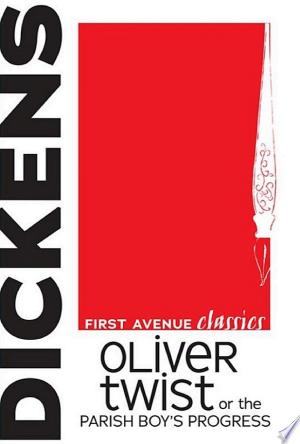
Oliver Twist: or, the Parish Boy’s Progress

3.75

-
+

Specs

Categories: ,

Description

Raised in a workhouse for orphans, Oliver Twist never knew his mother, who died just after he was born, and he has no idea who his father could be. He escapes the workhouse and runs away to London, where he discovers the city’s seedy underbelly that teems with pickpockets and beggars. While making friends and enemies in high and low places, Oliver tries to avoid a life of destitution and crime in the corrupt city. English author Charles Dickens’ rags-to-riches story champions the poor and examines social morals. This is an unabridged version of the novel, first published in 1838.

  • Author: Charles Dickens
  • Publisher: First Avenue Editions ™
  • Published: 2015-01-01
  • Pages: 566
  • ISBN-13: 9781467787611

Additional information

Author

Charles Dickens

Reviews

There are no reviews yet.

Be the first to review “Oliver Twist: or, the Parish Boy’s Progress”

Your email address will not be published. Required fields are marked *

Summary

What the internet says

Aggregated insights from reviews and discussions across the web.

Overall reception: Mixed reception

Oliver Twist receives generally positive reception as a foundational work of English literature, with readers praising Dickens's social commentary and memorable characters. Reviewers consistently highlight the novel's powerful critique of Victorian society's treatment of the poor and orphaned, noting how Dickens exposes hypocrisy in charitable institutions and class structures. The story's impact extends beyond its titular character, with many noting that Oliver himself serves more as a vehicle for broader societal criticism than as a fully developed protagonist. Modern readers appreciate the historical significance and dark, gritty realism of London's underworld, though some struggle with Dickens's verbose prose style and lengthy sentences. A recurring concern across reviews is the problematic portrayal of Fagin, repeatedly referred to as 'the Jew' throughout the text, which readers recognize as evidence of anti-Semitic attitudes that have aged poorly. Despite this and other dated elements, the novel's themes of inequality, child welfare, and social justice remain relevant, making it a recommended entry point into Dickens's body of work.

Reviewers note significant differences between popular adaptations (particularly the musical) and the source material, emphasizing that the novel is far darker and more brutal than sanitized versions suggest. The murder of Nancy and the fates of Bill Sikes and Fagin are cited as particularly grim moments that showcase Dickens's unflinching examination of violence and moral corruption. While some readers find the coincidence-heavy plot and overly neat conclusion frustrating by modern standards, most acknowledge the book's satirical wit and ironic humor as enduring strengths. The supporting cast, particularly Fagin and the Artful Dodger, receive more praise than the angelic but one-dimensional Oliver, with Fagin described as a complex mix of nurture and malevolence despite the offensive ethnic stereotyping.

What readers loved

  • Powerful social commentary exposing Victorian society's hypocrisy toward the poor and orphaned
  • Memorable, complex villains like Fagin and the Artful Dodger who stand out as fascinating character creations
  • Dickens's sharp wit, irony, and satirical humor throughout despite grave subject matter
  • Dark, realistic portrayal of London's criminal underworld that doesn't romanticize poverty
  • Effective use of one boy's story to represent broader systemic issues affecting all impoverished children
  • Timeless themes about inequality, child welfare, and social justice that remain relevant today
  • Accessible introduction to Dickens's work and classic literature for new readers

Common critiques

  • Extremely problematic and repetitive use of 'the Jew' to refer to Fagin, reflecting anti-Semitic attitudes that have aged very poorly
  • Oliver himself is an angelic, one-dimensional character who lacks personality and barely appears in the second half
  • Verbose, meandering prose with excessively long sentences that can feel bloated and burdensome to modern readers
  • Heavy reliance on coincidences to drive the plot forward, with an unrealistically neat and tidy conclusion
  • Polarized morality with most characters being either wholly 'good' or 'bad' rather than nuanced

Based on reviews from

  • Goodreads - Oliver Twist Reviews
  • Goodreads - Anthony Bellaleigh Review
  • Bibliofreak.net Review
  • Roof Beam Reader Review
Last updated May 18, 2026 Summary based on publicly available reviews. May not reflect every reader's experience.