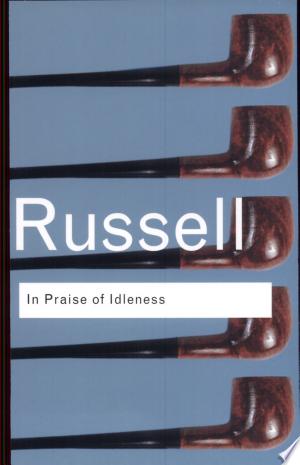
Bertrand Russell's 'In Praise of Idleness and Other Essays' receives generally positive reception online, with readers praising its thought-provoking arguments about work, leisure, and society. The collection, particularly the title essay advocating for a four-hour workday, resonates strongly with modern readers who find its 1932 arguments remarkably relevant to contemporary discussions about work-life balance and overwork culture. Reviewers on Goodreads give it an average of 3.7-4.4 out of 5 stars across different editions, with many calling it essential reading that challenges conventional attitudes toward labor and productivity.
However, reception is not uniformly positive. Some readers, particularly those reviewing on Amazon, criticize Russell's social and political commentary as naive, arguing that his upper-class background limited his understanding of economic realities and the practical necessities of work. Critics note that while Russell excels as a philosopher, his socialist prescriptions and assumptions about how society could function with minimal work hours lack practical grounding. Several reviewers point out inconsistencies in his arguments, such as advocating for socialist homogeneity while simultaneously bemoaning conformity in modern society.
Despite these criticisms, most readers find value in the collection's accessible writing style and its ability to stimulate critical thinking about fundamental assumptions regarding work, leisure, and civilization. The essays beyond the title piece receive mixed attention, with some finding them dated or overly focused on 1930s political movements, though Russell's observations on fascism, communism, and women's unpaid labor are noted as prescient.

Reviews
There are no reviews yet.