Why Is Singapore So Successful? Key Factors Behind Its Economic Triumph

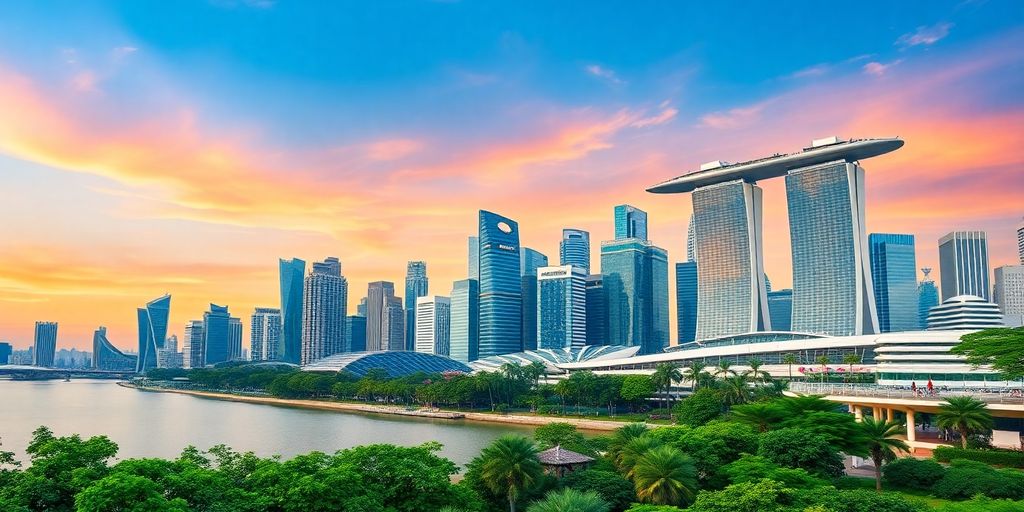
A city-state with no natural resources, no hinterland, and a founding generation that expected failure — yet Singapore has become one of the wealthiest, most competitive, and best-governed societies in human history.
When Singapore separated from Malaysia in 1965, Lee Kuan Yew wept on television. The city had no water, no land, no army, and an economy dependent on a British military base soon to be withdrawn. Sixty years later, Singapore’s GDP per capita exceeds $90,000 — higher than the United States, higher than Switzerland, higher than every European nation. It ranks first in the world for economic freedom, first for infrastructure quality, and consistently top-three for the absence of corruption. This is not luck. It is the product of deliberate, often ruthless, policy design applied with unusual consistency across six decades.
- → Singapore’s location at the Strait of Malacca — the world’s busiest shipping lane — gave it a structural advantage, but location alone explains nothing: geography is table stakes, policy is the differentiator
- → The Central Provident Fund (CPF) replaced welfare dependency with mandatory personal asset accumulation — housing, healthcare, and retirement funded from individual savings accounts, not state redistribution
- → A 90.9% homeownership rate — achieved through public housing sold to citizens, not rented — turned a generation of migrants into a nation of asset owners within two decades
- → Government spending at 15.5% of GDP delivers world-class outcomes in health, education, and infrastructure — comparable or superior to Western welfare states spending 40–50% of GDP
- → Meritocracy, low corruption, and long-term policy planning created an environment where both multinationals and local entrepreneurs could build with confidence — the political stability dividend is real and measurable
Location Is the Starting Point, Not the Explanation
Singapore sits at the Strait of Malacca, through which roughly 40% of global trade passes — but geography alone explains nothing. Dozens of nations occupy strategic locations without translating that advantage into sustained prosperity. What Singapore did differently was recognise its position as a foundation to build on, not a destiny to rely on. Lee Kuan Yew and his colleagues understood that a small island state with no natural resources had only one asset worth developing: the quality of its institutions and its people.
The port was developed with consistent long-term investment into one of the world’s busiest and most efficient maritime hubs. Singapore’s port handles over 37 million TEUs annually, ranking among the top two container ports globally. But the port is merely the most visible expression of a broader institutional commitment: build the infrastructure, keep it world-class, and commerce will follow.
“We have nothing. We have to make the best of what we have and we have to be better than the rest, otherwise nobody will come to us.” — Lee Kuan Yew, 1965. The urgency of that founding moment shaped every policy decision that followed.
The Economic Model: Low Taxes, High Discipline, Open Markets
Singapore’s economic model rests on three pillars that most governments acknowledge in theory but few maintain in practice: fiscal discipline, competitive taxation, and genuine openness to foreign capital and talent. The corporate tax rate is a flat 17%. The top personal income tax rate is 24%, and most workers pay far less. There is no capital gains tax. GST stands at 9% — lower than most European VAT rates. Total government revenue amounts to approximately 15.1% of GDP.
This is not austerity. Singapore invests heavily in infrastructure, education, and research. The difference is efficiency: government spending is concentrated on genuine public goods — defence, law enforcement, transport infrastructure, and education — rather than distributed across a sprawling apparatus of universal entitlements. The result is a state that delivers more, costs less, and creates fewer distortions in the economy.
Singapore’s openness to foreign direct investment is equally deliberate. Nearly 6,000 US companies operate in Singapore, along with comparable numbers from Europe and Asia. The city-state has consistently positioned itself as the most reliable jurisdiction in Southeast Asia for contract enforcement, intellectual property protection, and regulatory predictability. These are not accidents — they are the product of sustained institutional investment in the rule of law.
The CPF: The Most Elegant Social Policy of the 20th Century
The Central Provident Fund (CPF) is Singapore’s answer to the fundamental tension in social policy: how do you provide security without creating dependency? The solution is mandatory personal asset accumulation. Every working Singaporean contributes 20% of their salary to CPF. Their employer adds 17%. That 37% of gross wages flows into individual accounts — not a collective pool — and it stays yours.
CPF contributions are allocated across three accounts. The Ordinary Account funds housing, education, and insurance — it is the mechanism behind Singapore’s extraordinary homeownership rate, allowing citizens to use their savings to build equity from their first paycheck. The Special Account is reserved for retirement, earning a minimum guaranteed return of around 4% per annum. The MediSave Account covers healthcare costs, incentivising cost-consciousness in medical spending rather than the open-ended consumption that drives healthcare inflation in Western systems.
In most Western welfare states, social security contributions disappear into a collective pool — benefits are determined by political negotiation decades later. In Singapore, every dollar you contribute belongs to you, earns interest in your name, and can be directed toward housing, healthcare, or retirement according to your own priorities. If you die, the balance passes to your nominees. The CPF combines the compulsion of a welfare state with the ownership logic of a market economy.
Housing: Turning Migrants Into Asset Owners
Singapore’s Housing Development Board (HDB) is the most successful public housing programme in history — not because it provides rental units, but because it sells homes to citizens. Approximately 87% of Singapore’s resident population lives in HDB flats. But unlike European social housing, these are not rentals managed by government corporations: they are sold on 99-year leases at subsidised prices, financed through CPF withdrawals.
The mechanism is elegant. The government owns roughly 90% of Singapore’s land, acquired through compulsory purchase legislation at independence. It transfers land to HDB at below-market prices. HDB builds standardised apartments and sells them to citizens at subsidised rates. Citizens fund the purchase through their CPF Ordinary Account — meaning their monthly “mortgage payments” come from mandatory savings rather than take-home pay. From their first year of employment, Singaporeans are building housing equity rather than enriching landlords or housing corporations.
The result: a 90.9% homeownership rate, one of the highest in the world, achieved in a country with some of the most expensive land on earth. The contrast with European housing markets — where young workers cannot buy, cannot escape the rental trap, and cannot build the personal wealth that homeownership generates — is striking and instructive. For an analysis of how this model could be applied to the Netherlands, see our From Polder to Powerhouse deep dive.
Political Stability and Meritocracy: The Governance Dividend
Singapore consistently ranks in the top three of Transparency International’s Corruption Perceptions Index, and the effect on economic outcomes is not incidental — it is central. When businesses know that contracts will be enforced, that regulators cannot be bribed, and that government decisions reflect policy logic rather than rent-seeking, investment follows. The cost of corruption is not just the direct theft; it is the uncertainty it injects into every commercial decision.
Singapore’s governance model is also distinguished by its long time horizon. Policies are designed not for the electoral cycle but for generational outcomes. The CPF system was built in the 1950s with a retirement horizon of 40 years. The HDB programme set construction targets a decade in advance. GIC and Temasek Holdings — Singapore’s two sovereign wealth funds — manage national reserves estimated at over $1 trillion combined, generating returns that contributed $23.5 billion to the FY2024 budget. This is governance as stewardship rather than governance as redistribution.
“Singapore’s constitution requires the government to balance its budget over each term of office. Deficits are constitutionally limited. Reserves accumulated by previous governments cannot be drawn down without the President’s approval — a structural safeguard against populist spending that no European democracy possesses.”
Education, Talent, and the Open Workforce
Singapore’s education system consistently tops global PISA rankings, but the more important fact is what happens after graduation: the country actively imports talent it cannot produce domestically. Open immigration policies, a transparent work visa system, and an English-speaking environment make Singapore the default regional base for executives, engineers, and entrepreneurs across Asia.
This is not without tension — Singaporeans regularly debate the balance between local employment and foreign talent. But the structural commitment is clear: a city-state of 5.9 million cannot restrict itself to domestic human capital and expect to remain globally competitive. The result is a workforce that combines rigorous local education with consistent infusions of international perspective and skill — a combination that drives both corporate performance and entrepreneurial activity.
The government reinforces this with substantial investment in lifelong learning. Skills Future, launched in 2015, provides every Singaporean aged 25 and above with a credit to spend on approved training courses. The logic is pragmatic: in a rapidly changing economy, the most dangerous workforce is one whose skills are frozen at graduation.
Innovation, Smart Nation, and the Next Phase
Singapore’s Smart Nation initiative — launched in 2014 — represents the city-state’s attempt to apply its governance model to the digital economy: identify the strategic priority, commit public resources, set measurable targets, and execute. The results include one of the world’s highest rates of digital payment adoption, a national digital identity system (SingPass) used by virtually every resident, and a rapidly growing financial technology sector that has attracted over 1,600 fintech firms.
Research and development investment has been sustained at roughly 2% of GDP, with the government funding collaborations between universities, research institutes, and industry through bodies like A*STAR. The biomedical sciences cluster — built from scratch over two decades — now includes operations from Pfizer, Novartis, Roche, and dozens of others. This is the pattern: identify a strategic sector, create the conditions, attract the anchors, and let the ecosystem build around them.
Singapore’s success is inseparable from its management of great-power relationships. Deliberately non-aligned, it maintains strong ties with both the United States and China while asserting strategic autonomy. As the global order fragments into competing blocs, Singapore’s ability to remain a trusted node in both Western and Asian supply chains — legally, financially, and commercially — may be its most valuable long-term asset. See our Geopolitics 2026 overview for the broader context.
The Limits: What Singapore Cannot Teach
No analysis of Singapore is complete without acknowledging what its model cannot easily export. The city-state’s political system is authoritarian by Western democratic standards — press freedom is severely restricted, political opposition is systematically disadvantaged, and social controls on behaviour are real and enforced. The CPF and HDB systems required a government capable of making long-term commitments that no electoral cycle could reverse — a form of institutional credibility that democracies find genuinely difficult to replicate.
Singapore is also a city, not a country with a rural hinterland, aging agricultural regions, or the spatial complexity that makes uniform policy difficult to apply. The governance challenge of managing 5.9 million people in 720 square kilometres is categorically different from governing 17 million Dutch citizens or 67 million French ones.
These caveats matter. But they do not negate the core lesson: that the relationship between individuals, the market, and the state can be structured very differently from the Western welfare model — with higher GDP, higher homeownership, lower corruption, and comparable social outcomes — and that the Singaporean version of that relationship produces extraordinary results when the institutional capacity to sustain it exists.
Singapore’s success is not a miracle and it is not a mystery. It is the compound effect of consistent, disciplined choices: fiscal restraint, competitive taxation, mandatory personal savings, mass homeownership through sold public housing, meritocratic governance, zero tolerance for corruption, and sustained openness to capital and talent. None of these choices were painless. All of them required a government willing to prioritise long-term outcomes over short-term political comfort. The question for every other nation is not whether the model works — the evidence is unambiguous. The question is whether the political will to apply it exists.
Sources: Singapore Department of Statistics, Ministry of Finance Budget FY2024, CPF Board Annual Report, Housing Development Board Annual Report, Heritage Foundation Index of Economic Freedom 2025, Fraser Institute Economic Freedom of the World 2025, Transparency International Corruption Perceptions Index 2024, World Bank, OECD.

Responses