Super Contango Then and Now: How a Broken Oil Market Looks Completely Different Five Years On

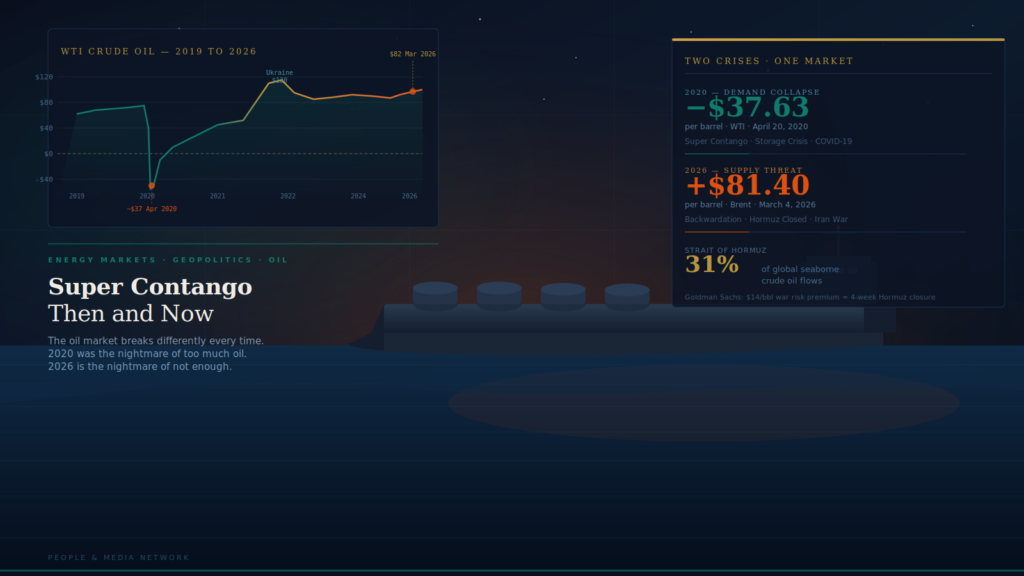
Five years ago, something happened that nobody thought was possible: oil traded at minus $37.63 per barrel. Traders were essentially paying someone to take crude oil off their hands. The concept that explained this surreal moment was called super contango — and it’s worth revisiting now, because the oil market in March 2026 finds itself in a very different kind of crisis, one driven not by a glut of supply but by the terrifying prospect of losing it altogether. This article is part of our Geopolitics 2026 series.
- → In 2020, super contango was driven by a demand collapse — too much oil, nowhere to store it, culminating in WTI trading at −$37.63/bbl on April 20
- → In 2026, the US-Israel strikes on Iran produced the mirror image: a supply threat driving spot prices sharply higher — backwardation, not contango
- → The Strait of Hormuz carries ~31% of global seaborne crude — its effective closure is a Category 5 event for global supply chains
- → Goldman Sachs estimates traders are pricing in a $14/bbl risk premium — equivalent to a full four-week Hormuz closure
- → Both crises share one lesson: oil markets can break in ways most people never imagined — and they are as much a geopolitical instrument as an economic one
What Is Super Contango?
To understand either moment, you first need to understand the basics of oil futures pricing. Normally, futures contracts — agreements to buy or sell oil at a set price on a future date — trade at a slight premium over today’s spot price. This premium covers the cost of storing oil until delivery: think warehouse fees, insurance, and the cost of financing. This is called contango, and it’s considered the natural resting state of many commodity markets.
Super contango is an extreme version of this. It occurs when the spread between the spot price and future prices becomes so enormous — far exceeding normal carrying costs — that it signals a fundamental breakdown in market equilibrium. It usually means one of two things: either the market is drowning in supply with nowhere to put it, or traders are desperately betting that conditions will dramatically improve down the road.
2020: The Pandemic Super Contango — Too Much Oil, Nowhere to Go
In early 2020, everything converged at once in the worst possible way for oil markets. The crude oil glut inherited from the 2010s was exacerbated by demand shattered by COVID-19 lockdowns and oversupply aggravated by a price war between Russia and Saudi Arabia. With the world in lockdown, planes grounded, and factories shuttered, demand collapsed almost overnight. At exactly the same moment, Russia and Saudi Arabia were pumping oil at full capacity to squeeze each other — and everyone else — out of the market.
The WTI futures market steered into a super-contango state, with the futures-spot spread exceeding its 95th percentile as early as March 23, 2020. The steepness of the curve created a seemingly obvious arbitrage opportunity: buy cheap oil now, store it, and sell the futures forward at a profit. The problem? Global oil storage was rapidly filling, exceeding 70% and approaching operating maximum. Tanks were full. Tankers were full. The pipelines were full.
On April 20, 2020, WTI crude traded as low as −$40.32 per barrel. Traders were paying to have oil taken off their hands. It was not a glitch — it was the logical endpoint of a storage system that had run out of room.
With nowhere to put the oil and contract expiration imminent, traders had no choice but to sell at any price — even a deeply negative one — to avoid having thousands of barrels of crude physically delivered to their door. It was a crisis of abundance: too much oil, too little demand, too little storage. The future was priced higher than the present because the market believed conditions would eventually normalize. It was right — but not before the most extreme pricing event in commodity market history.
2026: The Iran War and a Completely Inverted Crisis
Fast forward to February 28, 2026. The world woke up to news that the United States and Israel had launched coordinated air strikes across Iran, targeting nuclear sites, military infrastructure, and — according to President Trump — the regime itself. Trump said on Truth Social that Supreme Leader Ayatollah Ali Khamenei had been killed. Tehran responded with missile attacks targeting multiple Gulf countries, and tanker traffic through the Strait of Hormuz effectively stalled.
Brent futures settled up $3.66, or 4.7%, at $81.40 a barrel on Tuesday — its highest settlement since January 2025. Brent was up 12% since the conflict began on Saturday. The oil market’s reaction was swift and severe — but the mechanics were the polar opposite of 2020. Where 2020 was about oil no one wanted, 2026 is about oil no one can reach.
About 13 million barrels per day of crude oil transited the Strait of Hormuz in 2025, accounting for roughly 31% of global seaborne crude flows. Major economies including China, India, South Korea, Japan, Europe, and the United States all rely on oil shipped through this narrow passage. China alone imports close to 6 million barrels per day through this chokepoint. A sustained closure would create a supply gap that no spare capacity could meaningfully offset.
Iran’s response departed sharply from the largely symbolic retaliation seen during the June 2025 conflict. Missile and drone strikes hit UAE territory — including Jebel Ali port and Abu Dhabi port infrastructure — as well as targets in Saudi Arabia and Bahrain. Goldman Sachs Research estimates that traders are demanding about $14 more for a barrel of oil than before the conflict to compensate for the increase in risks — a premium that roughly corresponds to the effect of a full four-week halt in Hormuz flows.
The Oil Futures Curve Flips
This geopolitical shock does something to oil futures curves that is the mirror image of 2020. Where 2020 produced a steep upward-sloping contango (future prices far above spot), war-driven supply fears tend to produce backwardation — where spot prices surge above future prices, because the immediate need for physical oil overwhelms long-term projections.
In 2026, the dynamic is reversed. A refiner or airline that needs jet fuel today may have to pay a massive premium over the price available six months from now. The market is not worried about storage — it’s worried about the barrels simply not arriving. By end of week, the majority of the market indicated that Brent would settle back into the $70–80 range — implying a spike-and-partial-recovery pattern. This assumption carries significant downside risk if Iranian retaliation escalates further.
Two Crises, Two Extremes of the Same System
The comparison between 2020 and 2026 is a masterclass in how oil markets can break in entirely opposite directions:
| 2020: Super Contango | 2026: War Premium / Backwardation | |
|---|---|---|
| Core driver | Demand collapse + oversupply | Supply disruption threat |
| Spot price direction | Crashed (negative) | Surged (~$82/bbl) |
| Futures curve shape | Steep contango (future >> spot) | Backwardation (spot >> future) |
| Storage | Overflowing, ran out | Adequate, suddenly irrelevant |
| Market fear | Too much oil | Not enough oil |
| Geopolitical trigger | Russia-Saudi price war + COVID | US-Israel strikes on Iran |
| Strait of Hormuz | Fully open | Effectively closed |
| OPEC response | Production cuts | Modest increase (+220k bpd) |
The Macro Ripple Effects
Oil is never just oil. It’s the circulatory system of the global economy. Both crises sent shockwaves far beyond the energy sector. In 2020, the collapse in oil prices was deflationary, feeding into a broader economic freeze — central banks responded with unprecedented stimulus. In 2026, the dynamic is inflationary, and central banks already under pressure from Trump’s tariffs now face a new headache.
Higher energy prices filter through to consumer and producer prices, particularly for economies that rely heavily on Middle East oil imports, leaving central banks scrambling to reassess their interest rate trajectory. Former Treasury Secretary Janet Yellen warned the conflict could hit US economic growth and fuel inflationary pressures, holding the Federal Reserve back from cutting rates. A hypothetical one-month closure of the Strait of Hormuz would create a supply gap that non-OPEC producers — including the United States — simply do not have the spare capacity to offset.
What Traders Are Watching Now
Unlike in June 2025 — when Israel struck Iranian nuclear sites and oil prices spiked briefly before falling back — this time feels structurally different, particularly given the confirmed attacks on tankers in the Strait of Hormuz. Iran had pre-positioned warheads near regional borders in anticipation of this scenario, suggesting the broader escalation was planned rather than improvised. With the leadership structure under sustained attack, Iranian decision-making has shifted from coercive signalling towards existential defence.
Duration — A contained campaign vs. a multi-week operation defines whether $80+ oil becomes structural. Strait of Hormuz — Any sustained closure is a Category 5 event for global supply chains. OPEC+ response — Saudi Arabia and the UAE have spare capacity but are themselves absorbing Iranian missile strikes. China’s positioning — With close to one-fifth of its oil already disrupted by US actions in Venezuela and Iran, Beijing’s response could reshape global energy alliances.
Super contango in 2020 was the nightmare of too much of something the world didn’t want. The oil crisis of 2026 is the nightmare of potentially losing something the world cannot function without. Both are expressions of the same underlying truth: oil markets are exquisitely sensitive to the gap between physical reality and financial expectation. For investors, traders, and policymakers, the lesson of both moments is identical — the oil market is not merely an economic mechanism. It is a geopolitical instrument, a strategic weapon, and, as April 20, 2020 and the opening weeks of March 2026 have both proven, capable of breaking in ways most people never imagined possible.







Responses