Rule of Thumb A Practical Guide to Smarter Decision Making

A rule of thumb is a beautifully simple idea: a practical, easy-to-remember guideline that helps you make quick estimates or decisions. It’s not a strict law but a trusted shortcut born from experience, giving you a good-enough answer without getting bogged down in precise calculations.
What Is a Rule of Thumb and Where Does It Come From?

Think of a rule of thumb as a mental recipe. You don’t need to be a master chef to get a reliable result; you just follow a guideline learned from trial and error. Instead of weighing every ingredient perfectly, you learn that a "pinch" of salt or a "splash" of milk is all you need for a decent outcome.
That’s the essence of a rule of thumb. It's a powerful mental shortcut for making effective decisions on the fly. It trades pinpoint accuracy for speed and simplicity—a trade-off that makes a lot of sense in our busy lives. These shortcuts aren't lazy; they're incredibly efficient.
They’re a brilliant way to avoid "analysis paralysis," that all-too-familiar feeling of being stuck when faced with too much information. A simple rule cuts through the noise and gives you a solid place to start. As we'll see, this approach is useful everywhere, from managing your finances to mastering a new skill.
The Practical Origins of an Idea
The phrase "rule of thumb" has fascinating and very literal roots in craftsmanship and trade. For centuries, before standardised measuring tools were common, artisans relied on their own bodies for quick estimations. A carpenter might use the width of their thumb to approximate an inch, or a brewer might test the temperature of a batch by dipping their thumb in.
This wasn't just a wild guess; it was a calibrated instrument born from years of hands-on work. Their experience gave their "thumb rule" a surprising degree of reliability. It was a mindset deeply embedded in cultures built on making things.
In Dutch culture, for instance, the connection is even more direct. The Dutch word “duim” means both “thumb” and “inch,” a clear echo of a time when personal measurement was central to daily commerce. The first documented use of the English phrase popped up in 1692, when Sir William Hope wrote about doing something "by rule of Thumb, and not by Art," contrasting practical experience with formal theory. This philosophy was vital during Amsterdam's 17th-century Golden Age, where merchants used fast, experience-based heuristics to dominate European trade. You can explore more about these historical roots and the misconceptions surrounding the phrase's origins.
More Than Just a Guess
It’s important to draw a line between a rule of thumb and a wild guess or an unfounded opinion. A true rule of thumb is something more.
- Based on Experience: It comes from repeated observation and real-world results, not just abstract theory.
- Easy to Remember: Its power lies in its simplicity. If you need a manual to use it, it’s not a rule of thumb.
- Widely Applicable: It offers a useful starting point for a common type of problem or situation.
- Approximate, Not Exact: It aims for a "good enough" answer, recognising that absolute precision isn't always the goal.
Ultimately, these rules act as powerful filters for our attention. They help us quickly decide what really matters right now, freeing up mental energy for bigger challenges. This principle is at the heart of many productivity methods and can shift your entire outlook. For instance, asking yourself "will this matter in 5 years?" is a rule of thumb for prioritising what truly deserves your focus.
The Science Behind Our Mental Shortcuts

Ever wondered why our brains cling so tightly to a good rule of thumb? It all comes down to cognitive wiring. Our brains are incredibly powerful, but they run on a finite energy budget. To keep from burning out, they’re constantly looking for ways to simplify the world and avoid getting bogged down by information overload.
This is where mental shortcuts, known in psychology as heuristics, come into play. A rule of thumb is a classic heuristic—a simple, efficient strategy that lets us make judgments and solve problems quickly, even when we don't have all the facts.
Think of it as your brain switching to an 'energy-saving mode'. Instead of performing a full, exhaustive analysis for every single choice, it falls back on these pre-packaged guidelines built from past experience and learned wisdom.
Taming Complexity with Bounded Rationality
The concept of bounded rationality is the key to understanding why we need these shortcuts. In a nutshell, the idea is that our ability to make perfectly rational decisions is limited by the information we have, the time available, and our own mental horsepower. We almost never have a complete picture of any situation.
Because of these limits, chasing a perfect, optimal answer is often impossible or just plain impractical. Our minds aren't wired to find the perfect solution but a good enough one. A rule of thumb helps us land on this 'good enough' decision efficiently, allowing us to act decisively without being paralysed by the endless search for perfection.
A rule of thumb isn’t about being lazy; it's about being smart with your mental energy. It helps you navigate an infinitely complex world with a finite mind by reducing cognitive load and empowering you to act.
This is what frees us from the clutches of analysis paralysis. When faced with a complex choice—like how much to save for retirement or which project to tackle first—a simple rule gives you a clear path forward. It stops you from getting stuck in an endless loop of what-ifs.
Heuristics in Modern Decision Making
In fields like behavioural science and policymaking, the humble "rule of thumb" has evolved into the more formal concept of heuristics. These are seen as simple decision rules that people use when data, time, or mental resources are scarce, and they can perform surprisingly well in complex environments.
For instance, studies show that people across Europe frequently rely on rules like "invest no more than 5–10% of your income in high-risk assets" or "keep an emergency buffer of three to six months’ expenses." These guidelines are powerful because they are easy to remember and teach. In fact, surveys suggest that over 60% of households in the EU use informal mental shortcuts for daily financial decisions rather than complex spreadsheets. For a deeper dive, check out this Cambridge research on decision-making rules.
These mental models are essential tools for getting through everyday life. They aren't foolproof, but they are incredibly effective for managing the constant stream of decisions we all face. The psychology behind why certain ideas are so compelling is a fascinating topic, and if you're curious, you might want to explore some of the best-selling books about psychology for more insights. At the end of the day, these shortcuts are the invisible scaffolding that supports our reasoning, helping us build sound judgments without having to lay every single brick from scratch.
Rules of Thumb in Action Across Different Fields
The real beauty of a rule of thumb is just how versatile it is. Once you start looking, you’ll see these simple guidelines everywhere, quietly steering decisions in fields that seem worlds apart. Think of them as the mental shortcuts that help us jump from theory to action, giving us a solid starting point when things get complicated.
Whether you're trying to wrangle a household budget or fine-tune a creative project, these simple rules help cut through the noise. They have a knack for translating complex, expert knowledge into advice that’s both memorable and easy to act on.
Let's dig into some of the most effective examples out there. Each one has been tested by time and experience, proving its worth as a reliable shortcut. They don't promise perfection, but they almost always deliver clarity and a clear path forward.
Personal Finance and Investing
Money can be an intimidating subject, which is exactly why financial rules of thumb are so popular. They offer simple frameworks for tricky decisions about saving, spending, and investing, making financial planning feel much more approachable.
One of the most famous is the 50/30/20 rule for budgeting. The guideline suggests carving up your after-tax income like this:
- 50% goes towards essential needs—think housing, utilities, and groceries.
- 30% is set aside for wants, like dining out, hobbies, and entertainment.
- 20% is channelled into savings, investments, and smashing debt.
This straightforward structure helps you find a balance between enjoying today and securing your future, all without the headache of tracking every last penny. It’s a classic for a reason.
Another incredibly useful financial heuristic is the Rule of 72. It’s a quick mental calculation to estimate how long an investment will take to double. Just divide 72 by the annual interest rate. For example, an investment earning an 8% annual return will roughly double in nine years (72 ÷ 8 = 9). It’s a simple trick that makes the awesome power of compound interest feel tangible and easy to grasp. These kinds of mental models are invaluable, and you can learn more by studying the principles of Charlie Munger on common sense investing.
Productivity and Project Management
In the world of work, time is always scarce and the pressure is always on. The rules of thumb here are all about wrestling back control of our workload, beating procrastination, and keeping projects from derailing.
A classic principle is Parkinson's Law, which observes that "work expands so as to fill the time available for its completion." While not a law of physics, it’s a painfully accurate rule of thumb about human nature. It’s a great reminder that setting tighter, more ambitious deadlines can force you to be dramatically more focused and efficient. Give yourself a week for a two-hour task, and it will probably take the whole week.
Then there's the brilliant two-minute rule. The idea couldn't be simpler: if a task takes less than two minutes, just do it now. Don't put it off. This stops all those tiny jobs—firing off a quick email, filing a document—from piling up and creating a mountain of mental clutter. It’s a tiny habit that makes a massive difference.
"If you can't explain it in a sentence, you don’t understand it." This rule of thumb is a powerful test for clarity. It forces you to boil complex ideas down to their very essence, making sure you truly grasp a subject before trying to explain it to someone else.
Creativity and Design
You might think rules would stifle creativity, but in the arts, certain guidelines actually help artists, writers, and designers elevate their work. These heuristics aren't about putting creativity in a box; they're about channelling it more effectively.
In writing and editing, the famous advice to "kill your darlings" is a killer rule of thumb. It’s about being ruthless enough to cut the phrases, sentences, or even whole chapters that you personally love but that don’t actually serve the story. It’s a tough but necessary step for staying objective and doing what’s best for the work itself.
For designers, the 60-30-10 rule is a timeless guide for creating a balanced and visually pleasing colour palette.
- 60% of the space is taken by a dominant, primary colour.
- 30% is dedicated to a secondary colour.
- 10% is used for a pop of an accent colour.
This simple formula is a fantastic starting point for achieving visual harmony, stopping a design from feeling either boring or chaotic. It provides a solid foundation that still allows for endless creative expression, ensuring the final result feels polished and professional.
Knowing When to Use a Rule of Thumb (and When to Ditch It)
A rule of thumb is an incredibly useful tool, but like any tool, it’s not right for every job. Knowing how to use one effectively means understanding its limits. Get it wrong, and a helpful shortcut can morph into a dangerous oversimplification, leading you straight to a bad decision. The real art lies in knowing when to lean on one and when to dig deeper.
Think of it like getting directions. A quick, hand-drawn map to a friend's house is perfect for a casual visit. It’s simple, gets the job done, and you don’t need anything more. But you’d never rely on that same sketch to navigate a cross-country flight. For that, you need precise charts, instruments, and detailed data. It’s all about matching the tool to the stakes.
The Best Times to Rely on a Heuristic
Some situations are practically made for a good rule of thumb. These are the moments when you need to move quickly and simplicity is more valuable than getting bogged down in the details. They give you a solid place to start, not a definitive final answer.
You should feel confident pulling out a rule of thumb when:
- Time is tight: When a decision needs to be made now and you don't have the luxury of a deep dive, a rule of thumb offers a reliable, fast framework.
- The stakes are low: If being a little off the mark won't cause a disaster, a heuristic is an efficient way to keep moving. Picking a paint colour or sketching out an early project timeline are perfect examples.
- Information is scarce: When you're staring into a fog of uncertainty with little to no data, a rule of thumb built on years of collective experience is often a much safer bet than a wild guess.
- You just need a starting point: Sometimes the goal isn't the final answer, but just getting the ball rolling. A good heuristic can frame the problem and get you heading in the right direction.
This flowchart can help you decide which kind of rule of thumb might fit your situation, whether you're dealing with finances, productivity, or even a writing project.
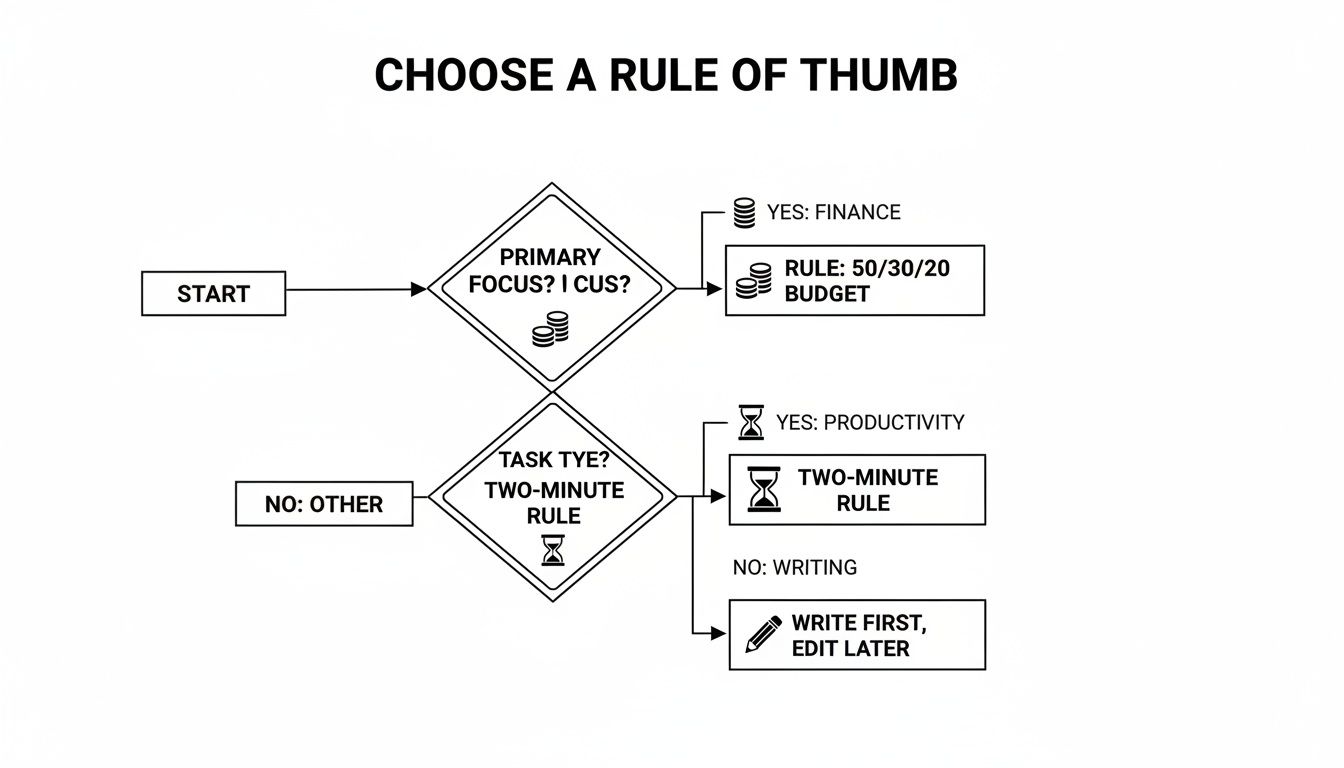
As the chart suggests, the best rule is always the one that matches the context and complexity of your specific challenge.
Red Flags: When a Rule of Thumb Is Not Enough
Knowing when to set a rule of thumb aside is just as important as knowing when to use one. Ignoring the warning signs can be costly, turning a helpful guide into a risky liability. Heuristics are designed for the common and predictable; they can fail spectacularly when things get weird or the stakes get high.
It's time to pause and look for better information when you spot these red flags:
High-stakes decisions are a clear signal to move beyond simple rules. When a choice involves a significant financial investment, a major career move, or a critical health decision, the potential cost of being wrong is just too high to rely on an approximation.
You should also hit the brakes if the situation is highly unusual. Rules of thumb are built on patterns from past experiences. If you're facing a problem that’s fundamentally different from the norm, the old rules might not just be unhelpful—they could be actively misleading.
Finally, if precise data is readily available, for goodness sake, use it. A rule of thumb is a substitute for data, not a superior alternative. If you can get the exact numbers with minimal effort, there’s no reason to settle for an estimate. It’s like guessing the temperature when there's a thermometer right in front of you. Choosing to ignore accessible, accurate information isn't being efficient; it's just being lazy.
How to Create Your Own Effective Rules of Thumb
While it’s smart to learn from the established rules of thumb, the real game-changer is creating your own. When you craft your own heuristics, you’re basically turning your hard-won experience into simple, repeatable guidelines. It’s a way to codify your personal wisdom.
Think of it like building a custom toolkit. Sure, you can borrow someone else's hammer, but there’s nothing like forging one that fits your own hand perfectly. This is how you build true mastery and efficiency, whether you’re tackling professional projects or just trying to form better habits.
The whole journey starts with simple observation. After all, you can’t create a shortcut for a problem you don’t really understand.
Identify a Recurring Problem
First, start looking for patterns in your daily grind. What are the questions you ask yourself over and over again? Where do you constantly get stuck, second-guessing yourself or wasting time in deliberation?
This could be anything. Maybe you struggle with pricing a freelance project, or you can never figure out the best time to schedule deep, focused work.
Let’s imagine a freelance writer who is always agonizing over quotes for new projects. They either undercharge and end up feeling resentful, or they overcharge and watch the potential client walk away. This is the perfect breeding ground for a personal rule of thumb.
Observe and Gather Data
Once you’ve pinpointed the problem, it’s time to play detective. The key here is not to jump straight to a solution. Instead, just track what happens. Be an observer of your own process.
Our writer could start a simple log for every new project quote:
- Project Scope: What was the actual work? (e.g., word count, level of research needed)
- Time Estimate: How long did they think it would take?
- Actual Time: How long did it really take?
- Outcome: Did the client say yes? How did the writer feel about the final pay?
This data-gathering phase is what separates a wild guess from an informed decision. It moves you away from vague feelings and gives you the concrete evidence needed to build a solid rule.
Formulate a Simple Guideline
After a few weeks of this, a pattern will almost certainly appear. The writer might discover that projects consistently take about 25% longer than they first guessed, especially when heavy research is involved.
With this insight, they can finally create a simple, memorable rule:
For any new project, calculate the estimated time, add 25% for the unexpected stuff, then multiply by the hourly rate. That’s the price.
This works because it’s easy to remember and it directly attacks the core problem of underestimation. Most importantly, it’s based on their own real-world data, making it a practical guide, not an unbreakable law.
Test and Refine Your Rule
A new rule of thumb is really just a hypothesis. The final—and ongoing—step is to put it to the test in low-stakes situations and see how it holds up. Our writer can use this new formula on the next few small projects and watch the results.
Does the pricing feel more accurate? Are clients still accepting the quotes? They might find that the 25% buffer is spot-on for blog posts but needs to be bumped up to 35% for dense, technical white papers.
This constant process of testing and refining is what turns a decent guess into a reliable, battle-tested heuristic that truly works for you.
Common Questions About Rules of Thumb
Once you start thinking about using rules of thumb, a few practical questions always pop up. It's smart to ask them. Knowing the answers helps you draw a clear line between a clever shortcut and just being careless.
Let's tackle some of the most common queries. Getting these details right is what makes using heuristics an art, not just a science.
Are Rules of Thumb the Same as Biases?
Not quite, but they're definitely related. Think of it like this: a rule of thumb is a mental shortcut you choose to use to make a decision faster. A cognitive bias, on the other hand, is more like an unconscious glitch in your thinking that systematically skews your judgement.
The two can overlap. Relying too heavily on a rule of thumb can absolutely lead to a biased decision. But the rule itself is just a tool. The real difference is awareness. You consciously decide to apply a rule of thumb, while a bias often operates in the background without you even noticing. A well-designed heuristic can even be a great way to push back against a bias you know you have.
How Can a Team Effectively Use Them?
In a team environment, rules of thumb are fantastic for creating a shared language and speeding up decisions. When you establish simple, agreed-upon guidelines, you can align everyone's approach without getting bogged down in rigid procedures for every little thing.
For this to work, a team has to:
- Agree on them collectively: Everyone needs to buy into the rule and understand why it exists.
- Write them down: Make them visible and easy to find. This stops confusion before it starts.
- Review them regularly: Every so often, check in. Are these rules still helping? Do they need an update?
A great team rule of thumb could be, "No meeting runs longer than 45 minutes," or "Always budget 20% of the timeline for unexpected problems." These simple guides create efficiency and make sure everyone is on the same page.
How Do I Know if a Rule Is Outdated?
A rule of thumb has a shelf life. It becomes outdated the moment the world it was designed for changes in a big way. A guideline that worked perfectly for film photography, for example, is pretty useless when you're shooting with a digital camera.
To see if a rule is past its prime, ask a few critical questions. Is the result you're getting consistently different from what the rule predicts? Has the technology or the context moved on? Are the experts in your field now recommending something totally different?
The best way to keep your rules of thumb sharp and reliable is to constantly test them against new information and, most importantly, your own results.
At People & Media B.V., we're all about turning hard-won experience into practical wisdom. Our platform is packed with courses, articles, and podcasts designed to help you build a powerful toolkit of mental models. Start exploring our content and sharpen your decision-making skills today.


Responses