Mulholland Drive Movie Explained Unlocking Lynch’s Masterpiece

To truly get your head around Mulholland Drive, you have to grasp its fundamental structure. Think of it this way: the first two hours are an elaborate, idealised dream, and the final 30 minutes are the grim reality that spawned it. This isn't just a film with a clever twist; it’s a story built entirely from a character's desperate fantasy that slowly unravels into a tragic truth. The key is realising you're seeing almost everything through one person's fractured psyche.
The Dream Versus Reality Explained
David Lynch's masterpiece operates on two completely different planes of existence. Figuring out how to separate them is the first step toward unlocking its secrets.
For most of its runtime, the film follows the bright-eyed, endlessly optimistic Betty Elms as she arrives in Hollywood, ready to take the town by storm. This entire storyline is a wish-fulfilment fantasy cooked up by the real protagonist, Diane Selwyn. In reality, Diane is a failed actress, utterly consumed by jealousy, guilt, and a devastating heartbreak.
Then, in the final act, Lynch shatters the illusion. We're violently thrown into Diane's bleak world, where her career has gone nowhere, her lover Camilla has left her for a successful director, and—in a fit of despair—she has just hired a hitman to kill Camilla. Every confusing, surreal, or too-good-to-be-true moment in Betty’s world is just a distorted reflection of Diane’s real-life pain. The dream is her mind’s last-ditch effort to rewrite her own story into something beautiful before the guilt completely takes over. For a deeper dive into the kind of creative mind that can build such a world, you can read more about David Lynch on consciousness, creativity, and the brain.
Mapping the Two Worlds
Understanding this duality is everything. The characters, the places, and the bizarre events in the dream are all just repurposed fragments from Diane's actual life, twisted to fit the narrative she so desperately wants.
- Betty Elms: She is the talented, kind, and wildly successful actress Diane wishes she could be. Her pure innocence is the polar opposite of Diane's jaded despair.
- Rita: The helpless, amnesiac brunette is a version of Camilla Rhodes, but stripped of all her power and agency. In the dream, she needs Betty, completely flipping the power dynamic of their real, painful relationship.
- Adam Kesher: The film director, who is systematically humiliated and controlled by shadowy figures in the dream, is, in reality, the very man who "stole" Camilla from Diane. The dream is Diane's revenge fantasy, turning his real-world success into an absolute nightmare.
Lynch's 2001 masterpiece found a dedicated audience in the Netherlands, grossing €300,263 at the box office. While not a blockbuster number, it shows its strong appeal within the arthouse cinema market. You can dig into more details about Mulholland Drive's international performance on Box Office Mojo.
To really see these connections side-by-side, let's break down the key elements from each side of the narrative divide.
Dream vs Reality Character and Event Comparison
This table clearly contrasts the people and events from Diane's dream world with their grim counterparts in her real life. Notice how nearly every element in the dream is a direct, often reversed, reflection of something real and painful.
| Element | Dream Version (Betty's World) | Real Version (Diane's World) |
|---|---|---|
| Protagonist | Betty Elms: talented, hopeful, kind, and successful. | Diane Selwyn: failed, bitter, jealous, and desperate. |
| Camilla Rhodes | Rita: amnesiac, helpless, and dependent on Betty for protection. | Camilla Rhodes: successful actress, confident, and manipulative. In a relationship with Adam. |
| Adam Kesher | Arrogant director whose life is ruined by mysterious forces. He loses control of his film and his wife cheats on him. | Successful director who is engaged to Camilla and casts her in his new film over Diane. |
| The Relationship | A pure, loving, and passionate romance between Betty and Rita. | A toxic, abusive affair between Diane and Camilla, with Diane in the submissive role. |
| The Audition | Betty delivers a stunning, powerful audition that blows everyone away, proving her immense talent. | Diane gives a lacklustre audition for a small part in Adam's film, a favour arranged by Camilla. |
| Coco | The friendly landlady at Betty's aunt's apartment. | Adam Kesher's mother, who looks at Diane with pity and disapproval at the dinner party. |
| The Hitman | An incompetent, clumsy hitman who botches a simple job. | A cool, professional hitman Diane hires to murder Camilla. |
| The Blue Box | A mysterious object that, when opened, seems to cause the dream world to collapse. | A symbolic object. The blue key from the hitman signals the "job is done" and triggers Diane's final descent into guilt. |
Seeing it laid out like this makes the twisted logic of the dream much clearer. Everything from the hitman's comical failure to Betty's star-making audition is Diane's subconscious attempt to fix what went wrong, to punish those who hurt her, and to imagine a life where she was the hero, not the villain.
Reconstructing The Film's Chronological Timeline
David Lynch throws you a puzzle with Mulholland Drive. The pieces are everywhere, and the timeline is deliberately shattered. To really get a handle on what’s happening, you have to do something counterintuitive: ignore the order Lynch shows you and piece the story together chronologically. When you do, the surreal mystery transforms into a devastatingly clear psychological drama about cause and effect.
The real story doesn’t start with Betty. It starts with Diane Selwyn, a hopeful but struggling actress who moved to Hollywood after winning a jitterbug contest. She quickly falls into a toxic, one-sided affair with the charismatic and successful actress, Camilla Rhodes. This relationship is the real-world anchor for everything that follows.
Diane's career flatlines while Camilla's skyrockets. Camilla throws Diane a few small parts in her films, but the power dynamic is painfully skewed. The final, brutal blow comes when Camilla ends their affair and announces her engagement to director Adam Kesher at a party high up on Mulholland Drive. This is the exact moment Diane’s world completely shatters.
The Point Of No Return
Crushed by jealousy and professional failure, Diane makes a decision that seals her fate. She goes to a diner called Winkie's and hires a hitman to murder Camilla. He shows her a blue key, telling her it will appear in her apartment once the job is done. This act is the last irreversible event in the real world before the film dives headfirst into Diane's subconscious.
Overwhelmed by guilt and unable to face what she’s done, Diane falls asleep. And this is where the first two hours of the film actually begin. Her mind cooks up an elaborate dream—a wish-fulfilment fantasy designed as a desperate escape from her horrifying reality.
The timeline below shows this stark divide between the long dream sequence and the short, brutal reality that created it.
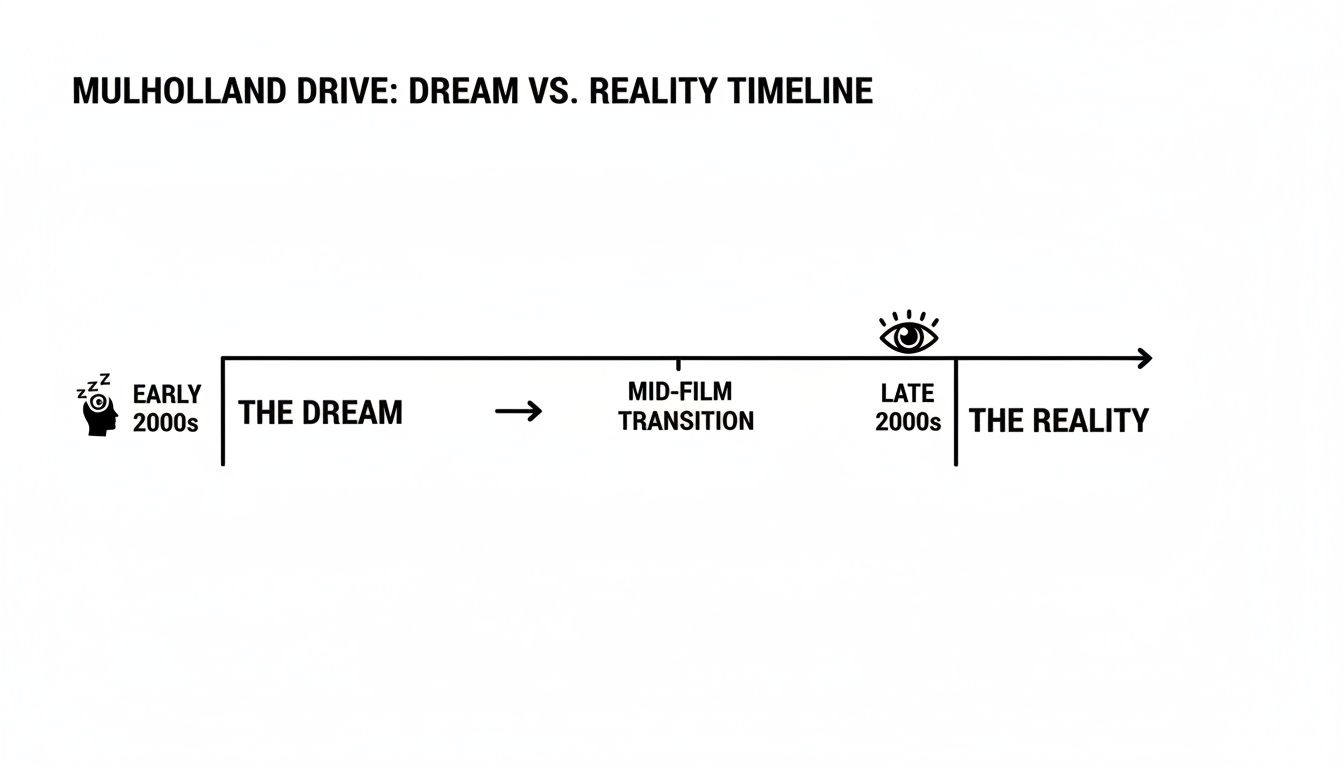
This structure reveals that almost the entire film is a psychological fabrication, triggered by a single, tragic string of real-world events.
How Reality Fuels The Dream
Every bizarre, surreal moment in "Betty's" world is a twisted reflection of Diane’s real life. Her dream is a frantic attempt to rewrite her own story into something she can live with.
- Diane’s Failure Becomes Betty’s Success: In the dream, Diane becomes the bubbly, talented Betty Elms, who absolutely nails her audition and is clearly destined for stardom. This is the polar opposite of Diane's own failed acting career.
- Camilla’s Power Is Erased: The real Camilla, who controlled and abandoned Diane, becomes the helpless, amnesiac "Rita." In this fantasy, Rita is completely dependent on Betty, flipping their real-world power dynamic on its head.
- Adam Kesher Is Punished: The director who "stole" Camilla from her is systematically humiliated in the dream. He loses control of his film, his money, and even his wife—a fitting punishment cooked up by Diane’s vengeful subconscious.
By understanding that the dream is a direct consequence of Diane's real-life trauma, the film's structure becomes clear. It's not random; it's a meticulously crafted psychological map of guilt, longing, and regret. The dream is the story Diane wishes were true, and the reality is the nightmare she cannot escape.
Once the blue key shows up, Diane "wakes up," and the fantasy world collapses. The final 30 minutes of the film force both her and the audience to confront the grim truth: the murder, the suffocating guilt, and the inevitable, tragic end. To get a better feel for how stories can be built in such unconventional ways, looking into different narrative structure examples can be a huge help.
By laying out the timeline chronologically, the film becomes less about cracking a code and more about understanding a profoundly human tragedy.
Decoding The Characters And Their Doubles

To really get inside Mulholland Drive, you have to accept a strange truth: almost everyone you meet in the first two hours is a phantom. They are distorted reflections of people from the film's gritty reality. Diane Selwyn’s dream doesn’t just conjure up new people; it recasts the figures from her waking life, twisting them to fit her own desperate psychological needs.
Each double serves a purpose. They are either an idealised version of who Diane wishes she was, or a punished caricature of someone who hurt her. Think of them as mirror images—one side reflecting a painful truth, the other a desperate fantasy. This idea of duality is the engine driving the whole story. For a fascinating look into this kind of storytelling, you can explore the twin tales of Castor and Pollux. By looking closely at these doubles, we can start to piece together the emotional logic of Diane’s subconscious.
Betty Elms And Diane Selwyn
The most important pairing is, of course, the protagonist herself. Betty Elms is everything Diane Selwyn isn't: talented, kind, brimming with optimism, and seemingly destined for stardom. Betty is the walking, talking embodiment of Diane’s shattered hopes—the person she so desperately wanted to be.
Where Diane is a failed actress whose talent is shaky at best, Betty walks into an audition and delivers a performance that leaves industry veterans speechless. She’s pure, uncorrupted ambition, a world away from Diane's bitter jealousy. In short, Betty is the hero of the story Diane tells herself at night, a flawless alter ego built to erase the reality of her own failures.
Rita And Camilla Rhodes
Just as Betty is the idealised Diane, "Rita" is the idealised version of her lover and tormentor, Camilla Rhodes. In the real world, Camilla is a confident, successful, and ultimately cruel actress who holds all the power. She's the one who discards Diane for the director, Adam Kesher.
But in the dream? Camilla is transformed into Rita—a helpless, terrified amnesiac with no memory, no power, and no identity. This is pure psychological revenge. By stripping Camilla of her confidence and agency, Diane's dream makes her completely dependent on Betty. It flips their real-world dynamic on its head, finally allowing Diane (as Betty) to be the protector and caretaker she always wished she could be.
The dream serves as a stage where Diane can enact her deepest desires. She becomes the star, her lover becomes the damsel in distress, and those who hurt her are systematically punished. It's a psychological defence mechanism of the highest order.
Adam Kesher And The Supporting Cast
The dream's logic of revenge doesn't stop with Camilla. It extends to the supporting cast, most notably the director Adam Kesher. In reality, he's successful and "steals" Camilla. In the dream, he’s a man whose life is being systematically and absurdly destroyed by shadowy forces he can't control.
- Professional Humiliation: Bizarre mobster-types hijack his film, forcing him to cast an actress he despises. His creative vision is rendered worthless.
- Personal Ruin: He comes home to find his wife cheating on him with the pool boy, gets thrown out of his own house, and discovers his bank accounts are frozen. He's left completely powerless.
This dream-world punishment is Diane’s way of neutralising the man who took Camilla from her. Other characters get similar treatment. Coco, Adam's mother who pities Diane at the party, becomes Betty's kind, supportive landlady. The real-life cold, professional hitman becomes a comically incompetent fool in the dream. Every character is a piece of Diane’s reality, reassembled to build a safer, more satisfying world for her to inhabit.
This intricate web of characters is part of what makes the film's production story so interesting. It started as a rejected TV pilot, but was later expanded into a feature film after receiving $7 million from StudioCanal. That funding allowed Lynch to add 18 new pages to the script, which fleshed out Diane's tragic real-world arc and transformed the entire story into the masterpiece we know today. You can learn more about its fascinating production and box office numbers at The Numbers.
Unlocking The Film's Key Symbols And Motifs
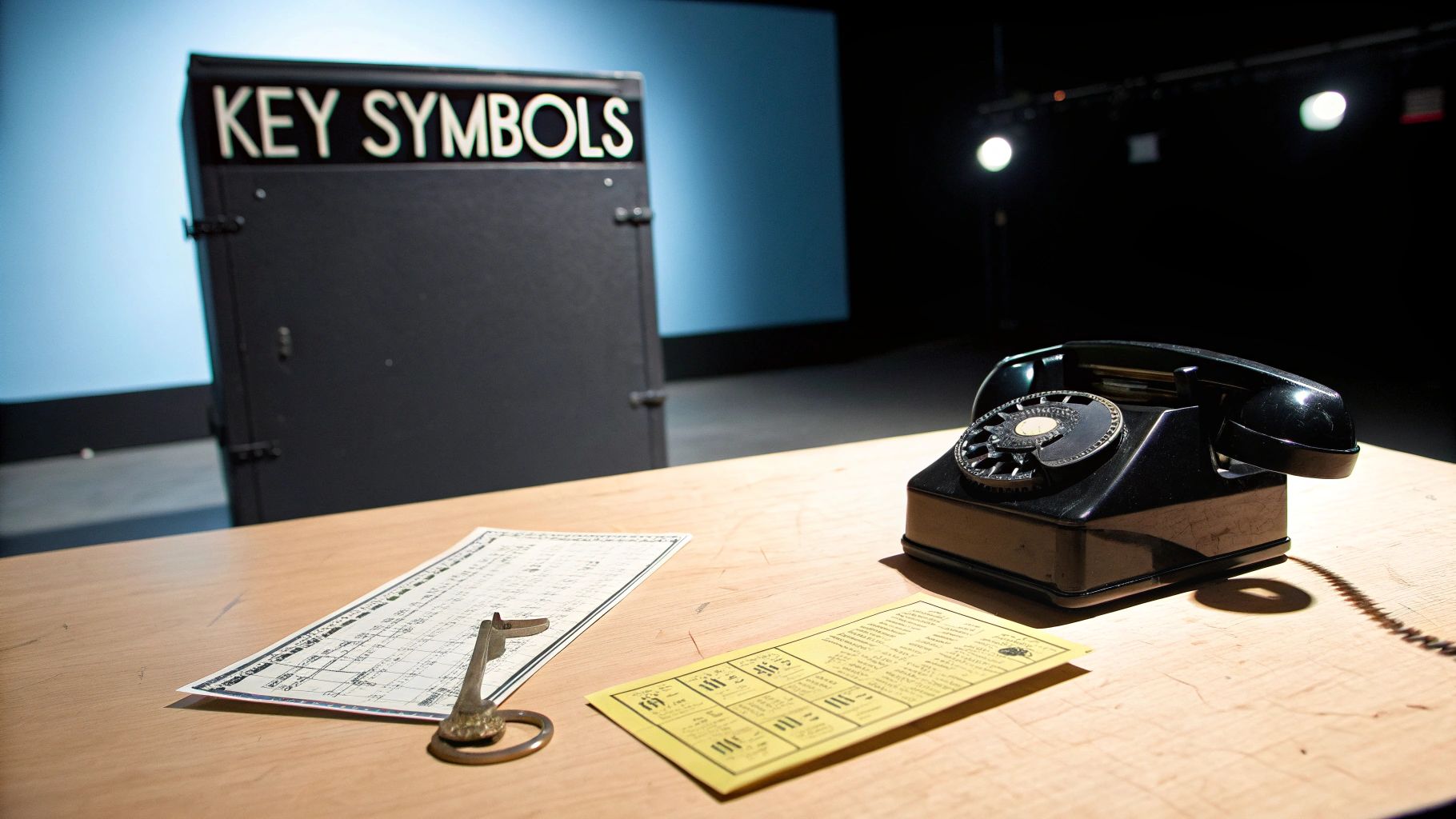
David Lynch doesn't just tell stories; he paints with a rich and recurring visual language. To really get a handle on Mulholland Drive, you have to learn to read its symbols. These objects and places aren't just random quirks. They're the anchors tethering Diane's surreal dream to her devastating reality, each holding a specific piece of the psychological puzzle.
Think of these motifs as a kind of shorthand for Diane's trauma. They pop up again and again, their meanings shifting slightly between the dream and the real world, but always pointing back to the core themes of guilt, illusion, and consequence. By decoding these key symbols, we can move beyond just the plot and start to understand the film's emotional heart.
The Blue Box And The Blue Key
The most crucial symbols in the entire film are, without a doubt, the enigmatic blue box and its matching key. Together, they represent the exact moment Diane's dream world shatters and the horrific reality she's been running from finally crashes through.
In the dream sequence, the box is this mysterious object Betty and Rita find in Rita’s purse. It becomes a puzzle they feel compelled to solve, thinking it holds the secret to Rita's identity. But its true meaning is far more sinister and is rooted firmly in the real world.
The blue key is the signal from the hitman that the murder of Camilla Rhodes has been carried out. It is the physical proof of Diane's guilt, the final, irreversible action that triggers her complete psychological collapse. The box, therefore, represents the locked-away trauma of the murder contract itself.
When Betty uses the key to open the box in the dream, it doesn't reveal an answer—it causes the entire dream world to implode. This act symbolises Diane’s subconscious finally "unlocking" the repressed memory of what she has done. The fantasy can no longer hold, and she is forced to wake up and face the music.
Club Silencio The Heart Of The Illusion
The sequence at Club Silencio is perhaps the most direct explanation of the film's entire thesis. This is the thematic core of Mulholland Drive, a surreal theatre where the nature of illusion is laid bare for all to see. The magician on stage repeats the phrase, "No hay banda"—"There is no band. It is all a recording. It is all an illusion."
This isn't just some strange performance; it's a direct message to both Diane and the audience. Lynch is flat-out telling us that everything we've seen so far—Betty's supposed talent, her pure love for Rita, the entire Hollywood fantasy—is a fabrication. It's just a pre-recorded tape playing inside Diane's head.
Rebekah Del Rio's powerful, a cappella performance of "Llorando" ("Crying") drives this point home. She sings with such raw, genuine emotion, yet halfway through, she collapses. The beautiful, heartbreaking music continues without her, revealing it was a recording all along. This moment forces Diane to confront the artificial nature of her own emotional escape, causing her to shake uncontrollably as her carefully constructed fantasy begins to crumble.
Recurring Signs Of Guilt
Beyond the major set pieces, Lynch peppers the film with smaller, recurring motifs that act as constant, nagging reminders of Diane's impending doom and suffocating guilt.
- The Ringing Telephone: In both the dream and reality, the phone is a source of pure dread. It represents a call from the real world trying to break through the fantasy, often signalling a connection to Camilla or the consequences of Diane's actions.
- The Red Lampshade: That vibrant red lampshade is a visual alarm bell. It’s most prominent in the background during tense or significant moments, acting as a symbol of passion, danger, and the violent act that sits at the very centre of the story.
- Winkie's Diner: This location serves as a critical bridge between the dream and reality. It’s where Diane hires the hitman in real life, and in the dream, it becomes the site of a terrifying scene where a man confronts the literal monster born from his anxieties—a perfect metaphor for Diane’s own guilt.
Each of these symbols works to deepen the film's psychological landscape, transforming it from a confusing mystery into a coherent and tragic exploration of a mind in its final, agonising moments.
Exploring The Core Themes Of The Film
Once you get past the winding plot and dreamlike visuals, you start to see what Mulholland Drive is really about. To understand why this film has haunted audiences for decades, we need to look beyond the timeline and dig into the powerful ideas churning just beneath the surface. Through Diane Selwyn’s story, David Lynch gives us a raw look at ambition, identity, and the devastating cost of a dream that never comes true.
These powerful ideas are a huge reason the film still has such a grip on our culture. In the Netherlands, for example, Mulholland Drive’s popularity went way beyond its initial box office run, becoming a permanent fixture in cultural conversations. You can see this in the high ratings on platforms popular with Dutch film lovers, which often beat the global averages. While some international user scores settled around 3.5/4 stars, Dutch fanbases were frequently awarding it closer to 4.4/5 stars, proving its lasting local impact. You can dive deeper into the film's varied international reception on mulholland-drive.com.
By unpacking these core themes, we can see the Mulholland Drive movie explained not just as a puzzle, but as a profound and devastating tragedy.
The Corrosive Hollywood Dream
At its core, the film is a brutal takedown of the Hollywood fantasy. It paints the industry not as a magical place where talent shines, but as a cruel, soulless machine that chews up hopeful artists and spits them out. Diane Selwyn is the ultimate casualty of this broken promise.
She arrives in L.A. brimming with hope, only to crash against a system built on backroom deals, nepotism, and the cold, hard math of power. Her dream wasn't just about fame; it was about being seen, about being validated. When the industry shuts her out, it’s not just rejecting her talent—it’s erasing her very existence, which sends her spiralling. The entire dream sequence is her last, desperate attempt to live out the fantasy Hollywood sold her but never delivered.
Duality And Fractured Identity
Identity in Mulholland Drive is never a sure thing. It’s fluid, broken, and often something we build ourselves. The central mystery isn’t just "who is Rita?" but "who is anyone, really?" The characters are constantly splitting into doubles, showing the huge gap between who they are inside and the faces they show the world.
- Betty/Diane: This is the clearest example. Betty is the pure, talented ideal Diane wishes she were, while Diane is the bitter, failed reality. They are two halves of one person—one representing what could have been, the other embodying despair.
- Rita/Camilla: Camilla splitting into the helpless, amnesiac Rita shows how we reshape people in our minds to fit our own needs. Diane can’t handle the real, powerful Camilla who rejected her, so her mind cooks up a version she can protect, control, and love.
This theme hits on a deep truth: when reality becomes too painful, the mind can shatter identity as a defence, creating alternate selves to escape a truth it just can't bear.
Lynch suggests our dreams aren't just random nonsense but a stage where we try on different versions of ourselves. Diane's dream is her final audition for an identity she can live with, but like any illusion, it can't last.
The Unescapable Nature Of Guilt
When all is said and done, Mulholland Drive is a ghost story, and the ghost is guilt. The entire, sprawling dream can be seen as an elaborate sprint away from one unforgivable act: hiring a hitman to kill Camilla. Every bizarre character and tangled subplot is just noise, a psychological smokescreen designed to drown out the quiet, nagging voice of her conscience.
Those menacing figures—the grimy creature behind Winkie's, the cryptic Cowboy—aren't just random bits of surrealism. They’re physical manifestations of Diane's self-hatred and her terror of being found out. They are the cracks in her perfect fantasy, where the awful truth keeps seeping through. The film's horrifying final moments drive home the point that no dream, no matter how detailed, can shield you from what you've done. Guilt is the one monster you can never outrun, and sooner or later, it will demand its price.
Unpacking Mulholland Drive’s Lingering Questions
Even after you’ve pieced together Diane’s dream and her tragic reality, Mulholland Drive leaves you with a few moments so surreal they demand a second look. This is a film that’s meant to be talked about, and certain questions always seem to float to the surface.
To get to the bottom of these, we’ve leaned on a wide range of reliable research sources and critical interpretations. Let's tackle some of the most common points of confusion and put the final pieces of Diane Selwyn's psychological puzzle into place.
Who Are the Elderly Couple?
That smiling, almost painfully cheerful elderly couple bookending the film? They’re one of Lynch’s most unsettling creations. We first meet them wishing Betty well on her journey to Hollywood, but they return as terrifying, miniature phantoms who seem to chase Diane to her death.
These aren't real people, but powerful symbols of a dream curdled into a nightmare. They represent the pure, naive optimism of the "Hollywood dream" itself, likely born from a jitterbug contest Diane won early in her life—a contest they probably judged. Their reappearance at the end is the crushing weight of that failed dream made manifest. Their happy faces become a grotesque mask, mocking Diane with the very hope she’s lost and pushing her over the brink.
What Is the Monster Behind Winkie's?
That horrifying figure behind the diner is the raw, physical embodiment of Diane’s guilt. In the dream sequence, one man tells his friend about a nightmare he had—a nightmare about a terrible face in that exact spot. When they investigate, his premonition comes true with heart-stopping results.
This whole scene is a direct metaphor for Diane's own buried horror.
Just like the man in the diner, Diane is haunted by a terrible truth she is desperately trying to keep hidden: the fact she hired a hitman to kill Camilla. The monster is the festering reality of what she’s done. It’s the face of her own guilt, a horror that exists whether she confronts it or not.
If you enjoy peeling back the layers of cinematic storytelling, our complete film analysis collection is the perfect next stop.
Why Does the Film End That Way?
The film's final moments are a chaotic, guilt-ridden spiral. After waking from her elaborate dream, Diane is assaulted by flashes of her crime and the figures that populate her subconscious. The return of the Cowboy and the shrunken elderly couple signals the complete and utter collapse of her mind.
Trapped by the consequences of her actions, Diane runs to her bedroom, grabs a pistol, and takes her own life. The final, ethereal shot of a smiling Betty floating over the city isn’t just a memory; it’s the death of the dream itself. And that last, echoing word—"Silencio"—confirms it. The show is over. The illusion is gone.
At People & Media B.V., we’re passionate about exploring complex ideas through clear and compelling storytelling. Find more insights that bridge creativity, culture, and personal growth on our platform.



Responses