Growth Mindset vs Fixed Mindset: growth mindset vs fixed mindset

At the heart of the growth mindset vs fixed mindset discussion is a simple but powerful distinction. A fixed mindset operates on the belief that your intelligence and talents are innate, static traits you’re born with. In contrast, a growth mindset sees them as qualities that can be nurtured and developed through sheer dedication and hard work. This single belief profoundly shapes how you handle everything from challenges and setbacks to your greatest successes.
Understanding the Core Concepts of Mindset

These concepts were brought to the forefront by Stanford University psychologist Carol Dweck. Her groundbreaking research showed that our quiet, underlying beliefs about our own capabilities have an enormous impact on nearly every part of our lives. These beliefs act like an invisible filter, directing our behaviour, fuelling our motivation, and ultimately, determining what we achieve.
Think of it as having one of two operating systems for your brain. One system is convinced your core attributes are set in stone. The other believes they are malleable, ready to be strengthened over time. This isn’t just a minor attitude tweak; it creates two completely different psychological worlds.
The Fixed Mindset Explained
Someone operating primarily from a fixed mindset believes their basic qualities, like smarts or artistic talent, are inherent and unchangeable. This perspective often creates an intense pressure to look smart and talented at all costs, which naturally leads to a fear of failure and a tendency to sidestep challenges.
From this viewpoint, effort is actually a bad sign. The internal logic goes something like this: “If I was truly good at this, I wouldn’t have to try so hard.” As a result, any setback is taken as proof of a permanent limitation, quickly leading to discouragement and the urge to give up.
“In a fixed mindset, students believe their basic abilities, their intelligence, their talents, are just fixed traits. They have a certain amount and that’s that, and then their goal becomes to look smart all the time and never look dumb.” – Carol S. Dweck
The Growth Mindset Explained
On the flip side, a person with a growth mindset believes that their most fundamental abilities can be cultivated through persistence and effort. This doesn’t mean denying that people have different natural aptitudes or starting points; it simply holds that everyone can grow and develop through application and experience. For a deeper dive, you can explore more articles on developing a resilient mindset.
This belief system builds a genuine love for learning and a resilience that is absolutely essential for great accomplishment.
- Challenges become opportunities: Instead of being seen as threats, difficulties are viewed as chances to learn something new and get better.
- Effort is the path to mastery: Hard work is understood as the necessary ingredient for improving at anything worthwhile.
- Feedback is fuel: Criticism isn’t taken personally but is seen as valuable information that points the way toward growth.
The table below breaks down the key differences between these two powerful perspectives.
| Aspect | Fixed Mindset Belief | Growth Mindset Belief |
|---|---|---|
| Abilities | Talents and intelligence are static and innate. | Skills can be developed through effort and learning. |
| Challenges | Avoided to prevent failure and looking incompetent. | Embraced as opportunities for growth and improvement. |
| Effort | Seen as a sign of weakness or lack of talent. | Viewed as the essential path to mastery and skill building. |
| Feedback | Taken personally; often ignored or met with defensiveness. | Welcomed as a valuable source of information for learning. |
How Your Beliefs Shape Your Brain and Behaviour
Your mindset is much more than just a passing attitude. Think of it as the operating system for your brain, a powerful lens that actively shapes your neurological reality. Groundbreaking research from Stanford psychologist Carol Dweck has shown that what you believe about your own abilities creates distinct patterns in your brain, dictating how you respond to everything from a minor mistake to a major life setback.
A fixed mindset, for instance, can trigger a very real fear of failure. When you believe your intelligence is set in stone, any challenge feels like a high-stakes test of your inherent worth. The brain goes on the defensive, prioritising the protection of your ego—that sense of being ‘smart’ or ‘talented’—above all else. This often leads to avoiding difficult tasks altogether.
On the flip side, a growth mindset frames challenges as essential opportunities to learn. It understands that effort and strategic struggle aren’t signs of weakness; they’re the very processes that build new, stronger neural connections. The brain actually becomes wired to seek out and engage with difficulty, seeing it as the raw material for getting better.
The Science Behind Mindset and Learning
Brain activity studies give us a clear window into this difference. When someone with a fixed mindset makes a mistake, their brain shows a brief spike of distress and not much else. They tend to disengage quickly, almost as if to avoid confronting the ‘proof’ of their limitation. Their focus is purely on the negative outcome—the failure itself.
In stark contrast, the brains of people with a growth mindset light up with sustained activity when they get something wrong. They pay closer attention, engage in self-correction, and actively process the error to learn from it. This neurological engagement is what actually builds new skills and deepens understanding over time.
“Mistakes are not a sign of intellectual weakness. For a brain with a growth mindset, they are the triggers for learning, sparking the very connections that make us smarter over time.”
This distinction gets to the heart of the growth mindset vs fixed mindset debate: one perspective shuts down the learning process when things get tough, while the other kicks it into high gear.
Praise Effort, Not Just Innate Talent
How do we end up with one mindset over the other? It often comes down to the kind of praise we hear, especially when we’re young. Praising innate talent—”You’re so smart!”—can accidentally foster a fixed mindset by linking success to a quality you can’t change. The unspoken message is that if you’re truly smart, success should come easily.
Praising the process, however—the effort, the strategy, the persistence—cultivates a growth mindset. Comments like, “You worked so hard on that problem and found a brilliant new way to solve it,” teach that success is a result of actions you can control. This approach builds resilience and a genuine willingness to tackle even harder problems in the future. To dive deeper into this connection, check out our guide on unlocking the power of mental resilience in everyday life.
The impact of these beliefs isn’t just personal; it’s measurable on a national scale. Take the Netherlands, for example. The 2018 PISA report revealed the country ranked 51st out of 77 nations in growth mindset scores. This data showed that over 50% of Dutch students believe their intelligence is a fixed trait, a belief that correlates with a higher fear of failure and lower motivation, especially in subjects like maths. You can discover more about these findings in the Netherlands on tandfonline.com. It’s a powerful real-world example of how deeply ingrained societal beliefs about intelligence can shape both academic achievement and emotional well-being.
A Detailed Comparison of Mindset Characteristics
Knowing the definition of each mindset is a good start, but the real magic happens when you see how they operate in the real world. The contrast between a growth mindset vs a fixed mindset isn’t just a philosophical debate—it shapes our reactions to challenges, how we take feedback, and even how we feel about the success of others.
Let’s move beyond abstract ideas and get into the nitty-gritty of how these two internal operating systems guide your actions. The differences can be subtle day-to-day, but their cumulative effect on your life and career is massive.
Facing a Difficult Challenge
A tough challenge is often the first real test of your dominant mindset. It’s a fork in the road that sends people down two completely different psychological paths.
Someone operating from a fixed mindset sees a major challenge as a direct threat. Because they believe talent is something you either have or you don’t, the risk of failure feels like a public verdict on their intelligence. Their inner voice might say, “If I can’t do this easily, I’m just not smart enough.” This leads them to avoid the task altogether or give up as soon as it gets hard.
On the other hand, a person with a growth mindset views a challenge as an opportunity. The struggle isn’t a red flag signalling a lack of ability; it’s a necessary part of the learning curve. They think, “This is tough, which means I’m pushing my boundaries and will be better for it.” They lean into the difficulty, understanding that effort is the very thing that forges new skills.
The infographic below really nails this fundamental split.
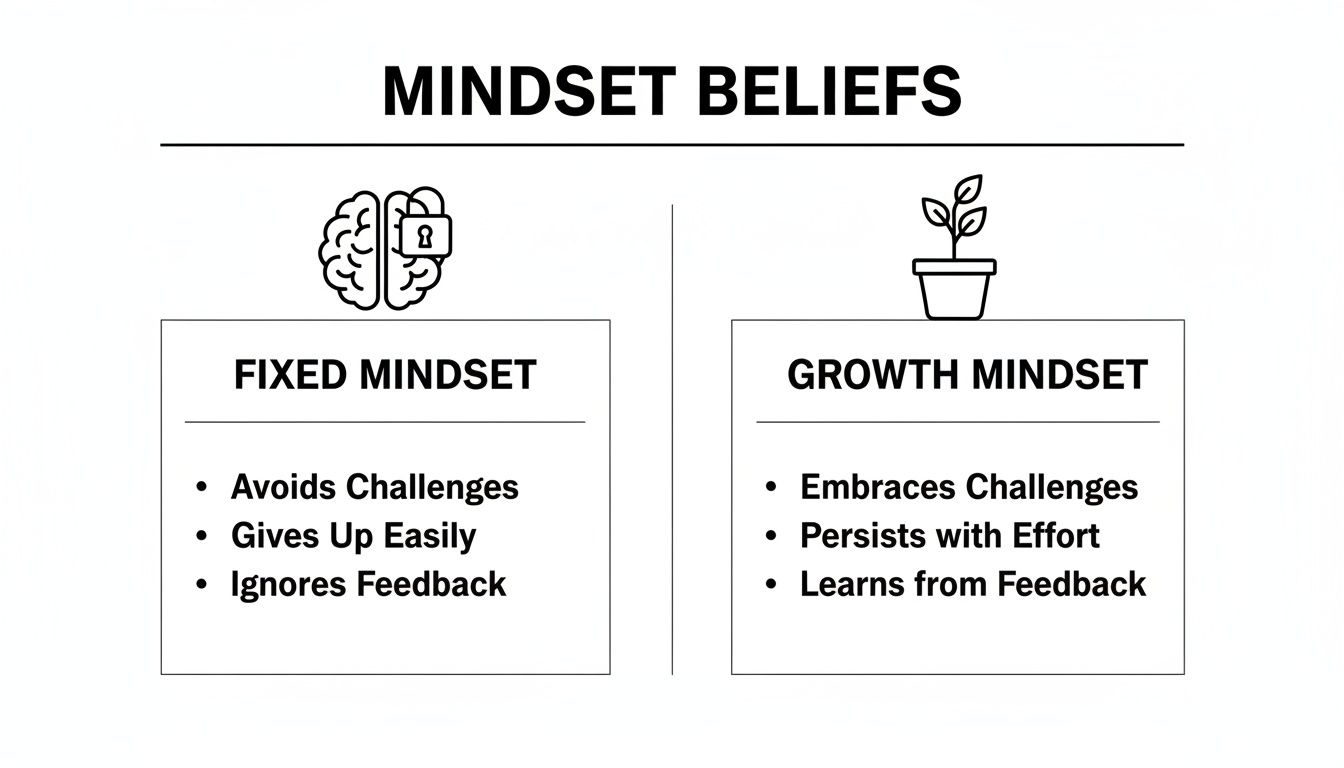
It’s a simple but powerful visual: one mindset sees a dead end, while the other sees a doorway to getting better.
Responding to Effort and Setbacks
How we think about effort is another huge dividing line. The way you react after a setback reveals your deepest beliefs about your own capacity to improve.
A fixed mindset is suspicious of effort. The underlying logic is that if you were truly talented, you wouldn’t need to try so hard. Putting in a lot of work feels like an admission of inadequacy. A setback, then, confirms this deep-seated fear and feels like a final, damning judgement.
In stark contrast, a growth mindset sees effort as the engine of success. Effort is the key that unlocks and builds your abilities. From this perspective, a setback isn’t a verdict—it’s just data. It’s a signal that your current strategy isn’t working and it’s time to try a new one.
The fixed mindset says, “I failed, so I must be a failure.” The growth mindset says, “I failed, so I must learn.” This shift in perspective turns every obstacle into a stepping stone.
Handling Feedback and Criticism
Feedback is one of the most powerful tools for growth, but only if your mindset lets you actually hear it. The difference in reaction is night and day.
- Fixed Mindset Reaction: Constructive criticism often feels personal, like a direct attack on your innate talent. This can trigger defensiveness, making you ignore the advice or just feel defeated. The main goal becomes protecting your ego from what feels like judgement.
- Growth Mindset Reaction: Feedback is actively sought out and treated like a gift. It’s seen as essential information for improving your approach, sharpening your skills, and simply getting better. The focus is on learning and developing, not on proving you were already perfect.
Observing the Success of Others
Finally, how you react to seeing your peers do well is incredibly revealing.
A fixed mindset can trap you in a competitive, zero-sum world where someone else’s win feels like your loss. It can easily breed envy and a sense of being threatened, because if talent is finite, their success must mean there’s less for you.
A growth mindset, however, finds inspiration in the success of others. A colleague’s achievement becomes a source of motivation and a practical lesson in what’s possible. It prompts questions like, “That’s amazing, how did they do that? What can I learn from their journey?”
Growth Mindset vs Fixed Mindset: A Behavioural Comparison
To make these distinctions even clearer, the table below breaks down the typical responses you’ll see from each mindset in common situations. Use it as a quick reference to spot these patterns in yourself and in those around you.
| Scenario | Fixed Mindset Response | Growth Mindset Response |
|---|---|---|
| Encountering a Challenge | Avoids it. Sees it as a risk that could expose a lack of innate talent. | Embraces it. Views it as a valuable opportunity to learn and expand skills. |
| Dealing with a Setback | Gets discouraged easily. Interprets failure as a sign of permanent limitation. | Persists and adapts. Uses failure as a signal to try new strategies and increase effort. |
| Receiving Feedback | Feels defensive. Takes criticism personally and may ignore helpful advice. | Seeks it out. Welcomes feedback as essential information for improvement. |
| Seeing Others Succeed | Feels threatened or jealous. Believes success is limited and compares abilities unfavourably. | Feels inspired. Finds lessons and motivation in the achievements of others. |
Looking at these behaviours side-by-side, it’s easy to see how a growth mindset consistently leads to better outcomes. It’s not about being smarter or more talented from the start; it’s about having a belief system that encourages learning, resilience, and collaboration every step of the way.
Putting Mindset Theory into Practice at Work and Home
Understanding the theory behind the growth mindset vs fixed mindset debate is one thing; seeing how these beliefs actually play out in our daily lives is another entirely. The true power of our mindset only becomes clear when we step away from abstract ideas and look at real, tangible scenarios at work, in school, and within our families.
These everyday situations expose how a fixed mindset can breed friction, anxiety, and stagnation. On the flip side, a growth mindset consistently builds resilience, collaboration, and real progress. Let’s dig into some detailed examples to bring these differences to life.
The Team Project Scenario
Picture a team at an advertising agency, tasked with a tough new client campaign. The first brainstorming session falls flat, producing no standout ideas, and the client’s feedback on the initial proposal is lukewarm at best.
Here’s how the two mindsets might navigate this common workplace hurdle:
- Fixed Mindset Manager: This manager sees the weak start as a direct reflection of the team’s lack of creative talent. They might say, “We just don’t have the right creative minds for this,” getting defensive and pointing fingers at individuals for the failure. Their feedback is rigid and fixated on the outcome, creating a culture of fear where nobody wants to risk suggesting another “bad” idea.
- Growth Mindset Leader: This leader views the initial setback as a totally normal part of the creative journey. They reframe the problem by saying, “Okay, that approach didn’t land. What did we learn from it, and what’s a completely different angle we could try?” Their focus is on the process, praising the effort and encouraging experimentation. They create psychological safety, making it clear that learning from mistakes is the only way to eventually succeed.
The difference is stark. The fixed-mindset approach grinds a project to a halt and leaves the team demoralised. The growth-mindset approach turns a roadblock into a learning opportunity, fuelling innovation and making the team stronger for the next challenge.
The Student Academic Journey
The classroom is a potent environment where mindsets are both revealed and forged. Think about a secondary school student tackling a demanding mathematics course for the first time. The material is far more complex than anything they’ve seen before.
After fumbling the first few assignments, the student’s mindset will set the course for their entire academic path. Research from Dutch secondary schools highlights this perfectly. Studies show that students with a growth mindset, even those with only moderate performance goals, achieve better maths grades and suffer less school-related anxiety. They consistently outperform their fixed-mindset peers who are obsessed with proving the ability they already have. You can dive deeper into these insightful findings on Dutch education at bpspsychub.onlinelibrary.wiley.com.
This illustrates a crucial split in how students see their own intelligence.
A student with a fixed mindset thinks, “I’m just not a maths person.” This belief becomes a self-fulfilling prophecy, causing them to avoid homework, stop asking questions, and tune out. Failure feels like a final verdict on their innate ability.
In contrast, a student with a growth mindset sees the struggle differently. Their internal monologue sounds more like, “This is really difficult, so I need to find new study strategies and ask the teacher for help.” They don’t see difficulty as a sign of their limits, but as a signal that more effort and different tactics are needed. This persistence is what ultimately builds mastery.
Mindsets Within Family Dynamics
Family life provides a constant stream of opportunities for mindsets to clash or connect. Take a child learning to ride a bicycle. They fall, scrape their knee, and get frustrated.
A parent coming from a fixed mindset might try to shield the child from failure by saying, “Maybe this just isn’t your thing. Let’s try something you’re better at.” While the intention might be good, the message is that abilities are fixed and struggle is a sign to quit.
A parent with a growth mindset approaches it from a different angle. They normalise the struggle and praise the process, saying things like, “Every time you fall, your body is learning how to balance better! I’m so proud of you for getting back on and trying again.” This response teaches resilience and frames effort as the direct path to learning something new. The focus shifts from the outcome (riding perfectly) to the valuable process of learning through trial and error.
Actionable Strategies for Cultivating a Growth Mindset

Knowing the difference between a growth mindset vs fixed mindset is one thing, but the real change happens when you start putting that knowledge into practice. Cultivating a growth mindset isn’t some overnight transformation; it’s the sum of small, deliberate shifts you make every day in your thoughts, your words, and your actions. Let’s break down some concrete strategies for individuals, leaders, and educators who are ready to foster this powerful outlook.
The whole journey starts with self-awareness. You have to get good at spotting the fixed mindset’s voice in your own head. It usually shows up when you’re struggling, facing a tough challenge, or feeling like you’ve failed.
It’s that nagging thought that says, “I’m just not good at this,” or “If I was smart, this would be easy.” Catching that thought is the most critical first step. Once you hear it, you can challenge it—treat it as a perspective, not the absolute truth.
Techniques for Personal Mindset Shifts
Changing that internal script takes conscious effort and a few practical tools. When you start reframing your thoughts and the language you use, you can begin to rewire how you automatically respond to difficulty.
- Embrace the Power of “Yet”: This is such a simple word, but its effect is profound. The next time you catch yourself thinking, “I can’t do this,” just tack “yet” onto the end. “I can’t do this yet” completely changes the meaning. It turns a dead end into a temporary spot on a much longer journey.
- Reframe Challenges as Opportunities: Instead of seeing a hard task as a threat that might expose a weakness, try viewing it as a chance to build a new skill. Ask yourself, “What can I learn from this?” or “What new approach can I develop by pushing through this?”
- Focus on Process Over Outcome: After you finish something, change how you evaluate it. Don’t just focus on whether you succeeded or failed. Reflect on the process itself. Acknowledge the effort you invested, the strategies you tried, and what you learned—no matter how it turned out.
Building a habit around this kind of reflection can make a huge difference. Many people find that exploring the power of journaling for mental wellness is a perfect way to track those fixed-mindset triggers and consciously practise a more growth-oriented response.
Strategies for Leaders and Managers
As a leader, you have an incredible opportunity to set the tone for your entire team’s mindset. When you model and encourage a growth mindset, you build a workplace that’s more resilient, innovative, and collaborative.
To do this right, your praise needs to be specific and focused on the process. Instead of a generic, “You’re a natural at sales,” try something like, “I was really impressed with how you didn’t give up after that setback and found a new way to connect with the client.” This reinforces the idea that success comes from strategy and hard work, not just some innate gift.
Creating psychological safety is also non-negotiable. Your team needs to feel safe enough to take risks, admit mistakes, and give honest feedback without worrying about being judged. When a project doesn’t pan out, a growth-oriented leader frames it as a learning opportunity, asking, “What did we learn here that will make our next attempt even stronger?”
By celebrating the learning that comes from failure, leaders signal that experimentation and resilience are valued more than flawless performance. This approach unlocks creativity and encourages continuous improvement.
Nurturing a Growth Mindset in Education
For parents and educators, the words you use with children have the power to shape their fundamental beliefs about their own abilities. The goal is to nurture a love for challenges and a deep sense of resilience from a young age.
This means you have to be intentional with your praise.
- Praise the Process: Zero in on their effort, the strategies they use, and their persistence. “You worked so hard on that puzzle and tried so many different ways to solve it. That’s fantastic!”
- Normalise Struggle: Teach kids that learning is supposed to feel hard sometimes. Frame that struggle not as a sign they aren’t smart, but as the feeling of their brain getting stronger.
- Encourage New Strategies: When a child gets stuck, resist the urge to just give them the answer. Instead, ask questions that get them thinking differently, like, “What’s another way you could try that?” or “What did you learn from the way that didn’t work?”
This approach helps children understand that intelligence isn’t some fixed trait they’re born with. It’s something they can actively grow. Research shows just how important this is. A Dutch empirical study on VET students found that only 47.3% had a strong growth mindset, while 13.9% held a fixed mindset and 38.8% were mixed. The study confirmed that a fixed mindset is linked to avoiding challenges—exactly the behaviour these strategies can help change. You can read more about the research into student mindsets.
Got questions about mindset? You’re not alone. Even after grasping the basics, some nuances can be tricky. Let’s clear up a few of the most common questions that pop up.
Can a Person Really Have Both a Growth and a Fixed Mindset?
Absolutely. In fact, it’s not just possible—it’s how most of us operate. Nobody has a purely fixed or purely growth mindset across the board. We’re all a mix.
Think about it. You might feel totally confident that with enough practice, you could become a fantastic cook (a growth mindset). But when it comes to public speaking, you might tell yourself, “I’m just not cut out for that” (a fixed mindset). This is completely normal.
The real goal isn’t to achieve some perfect, unwavering growth mindset in every corner of your life. It’s about building awareness. The crucial first step is simply noticing which situations or topics trigger that fixed-mindset voice, so you can start to challenge it and consciously choose a different perspective.
Is a Growth Mindset Just About Praising Effort?
This is one of the biggest and most stubborn myths out there. Praising effort alone doesn’t cut it and can sometimes do more harm than good. A true growth mindset isn’t about effort for effort’s sake; it’s about valuing the entire learning process—effort, strategy, focus, and resilience combined.
Simply telling someone, “You tried really hard,” when their approach was clearly failing isn’t helpful. It sends the wrong message: that banging your head against a wall is what matters, not finding a way through it.
A much better, growth-oriented approach links effort to smart strategies and learning. For instance, you could say, “I love how you stuck with that tough problem, and then tried a totally new way to solve it.” This praises the persistence, the pivot, and the learning that came from it.
The focus should always be on strategic learning, not just brute-force work.
How Can I Encourage a Growth Mindset in My Team or Family?
Whether you’re a manager or a parent, the single most effective way to foster a growth mindset is to model it yourself. The way you talk and act sets the tone, creating an environment where people feel safe enough to stumble, learn, and grow.
Here are a few practical ways to do that:
- Share Your Own Struggles: Talk openly about challenges you’ve faced and mistakes you’ve made. Explain what you learned and how you changed your approach. It makes the whole process of learning feel normal, not like a sign of weakness.
- Focus Feedback on the Process: When you give feedback, zero in on specific actions, the strategies someone used, and any progress you can see. Steer clear of language that sounds like you’re judging their natural talent or focusing only on the final score.
- Build Psychological Safety: Make it crystal clear that it’s okay to take risks, ask for help, and even fail. Frame setbacks not as final judgments but as useful information for the next attempt.
- Introduce the Word “Yet”: This little word is a game-changer. When someone says, “I can’t do this,” you can gently reframe it as, “You haven’t figured it out yet.” It turns a dead-end statement into a temporary one.
When you consistently apply these ideas, you build a culture where challenges feel like interesting puzzles, and effort is understood as the path to getting better.
What’s the Danger of a “False Growth Mindset”?
A “false growth mindset” is a shallow take on the whole idea. It often gets boiled down to the simple mantra of “just try harder,” while completely missing the importance of good strategies, having the right resources, and acknowledging real-world barriers. This watered-down version can be genuinely harmful.
It can lead to blaming people for failures when they might lack the support, tools, or opportunities they need to succeed. A real growth mindset isn’t about blind optimism or believing that sheer willpower can overcome any obstacle.
A true growth mindset is a deep commitment to learning. It means recognising that when your effort isn’t getting you anywhere, it’s time to ask for feedback, try a different strategy, or get help. It also means working to create fair environments where everyone has the resources they need to thrive. It’s a nuanced approach that values the entire, messy process of growth, not just the sweat involved.
At People & Media B.V., we believe that understanding concepts like mindset is the first step toward meaningful personal and professional development. Our platform offers a rich ecosystem of courses, articles, and podcasts designed to help you turn these powerful ideas into practical, everyday habits. Continue your learning journey with us and discover the tools you need to grow. Explore our resources today.






Responses