Growth Mindset Fixed Mindset: A Complete Guide to growth mindset fixed mindset

At its core, the difference between a growth mindset and a fixed mindset comes down to a single, powerful belief: can you change your abilities?
A fixed mindset operates on the assumption that your intelligence and talents are static, set in stone from birth. A growth mindset, on the other hand, sees these exact same qualities as dynamic—something you can cultivate through dedication and hard work.
Understanding The Core Difference Between Mindsets
The concept, pioneered by psychologist Carol Dweck, is far more than just "thinking positively." It's a fundamental framework that shapes how we approach everything, from our careers to our relationships. Our underlying beliefs about our own potential have a profound impact on our actions, our resilience, and ultimately, our success.
Think about how two people might approach a difficult new task.
Someone with a fixed mindset might see the struggle as proof of their limitations. Their inner monologue sounds something like, "I'm just not good at this." This thinking often leads them to avoid challenges altogether, protecting their self-image and feeling threatened when others succeed.
But someone with a growth mindset views that same struggle as an opportunity. Their internal dialogue is more like, "This is tough, but I know I can get better with effort and the right strategy." This belief fuels a genuine passion for learning and a resilience that turns setbacks into valuable lessons.
The Two Mindsets In Action
These two perspectives create entirely different psychological worlds. Understanding them is the first step toward consciously choosing which world you want to live in.
- Fixed Mindset Beliefs: People with a fixed mindset believe intelligence is static. They're focused on looking smart, avoiding failure at all costs, and often see effort as a sign of weakness—if you were truly smart, you wouldn't have to try so hard.
- Growth Mindset Beliefs: Those with a growth mindset believe intelligence can be developed. They focus on the process of learning, embrace challenges as chances to improve, and see effort as the only path to mastery.
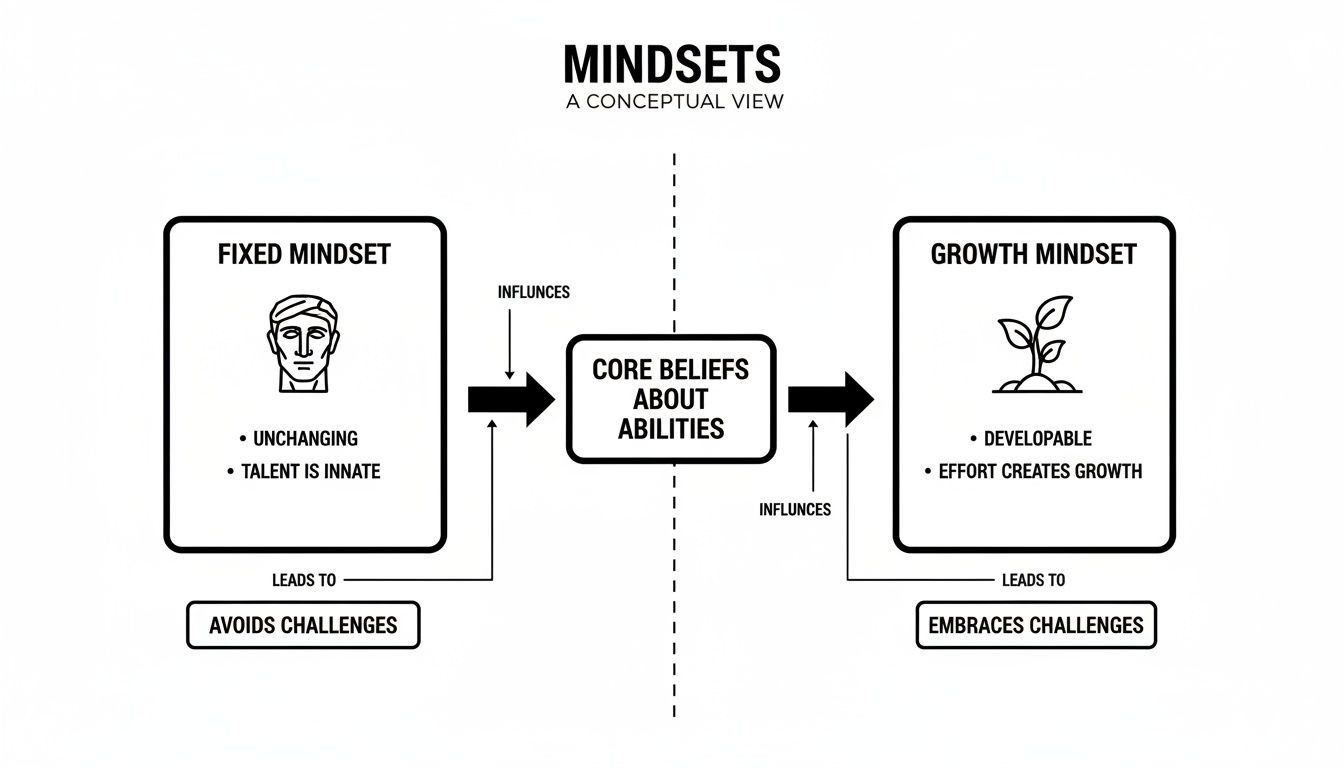
As the diagram shows, one path leads to stagnation, while the other opens the door to continuous development. This simple distinction has massive implications, particularly in how we learn and teach.
Growth Mindset vs Fixed Mindset At A Glance
To make the contrast even clearer, here’s a simple breakdown of how these two mindsets play out in our daily beliefs and behaviours.
| Attribute | Fixed Mindset Belief | Growth Mindset Belief |
|---|---|---|
| Abilities | Are innate and unchangeable. You're either good at something or you're not. | Can be developed through dedication and effort. |
| Challenges | Are risks to be avoided. Failure reveals your lack of ability. | Are opportunities to learn and grow. |
| Effort | Is a sign of weakness. If you were smart, it would be easy. | Is the essential path to mastering new skills. |
| Feedback | Is taken personally and seen as criticism of your core abilities. | Is welcomed as valuable information for improvement. |
| Setbacks | Are discouraging and often lead to giving up. They confirm your limits. | Are learning experiences that motivate you to try new strategies. |
| Success of Others | Is threatening and feels like a personal comparison. | Is inspiring and seen as a source of lessons and motivation. |
This table isn't about judging one mindset as "bad" and the other as "good." We all drift between both. The key is recognising which mindset is driving our actions and consciously choosing the one that serves our long-term growth.
A person's mindset is the view they adopt for themselves. It profoundly affects the way they lead their life, determining whether they become the person they want to be and accomplish the things they value.
This core belief system isn't just academic theory; it directly influences how we process information and learn from our experiences. To dig deeper into the cognitive foundations of learning, it's worth exploring the core tenets of Adult Learning Theory Principles. You'll find they align perfectly with the growth mindset's emphasis on experience, relevance, and problem-solving as the real drivers of development.
Ultimately, understanding the growth mindset vs fixed mindset distinction provides a practical roadmap for unlocking human potential.
The Science Behind How Your Mindset Shapes Your Brain
The difference between a growth and a fixed mindset isn’t just about having a positive attitude; it’s something you can see in the physical and chemical workings of your brain. It's a fascinating area of science that shows how our beliefs about our own abilities can literally rewire our neural architecture.
At the very heart of this is neuroplasticity—the brain's incredible capacity to reorganise itself by forging new neural connections all through our lives. Don't think of your brain as a fixed object. Instead, picture it as a dynamic, living network of pathways that get stronger the more you use them and weaker when you don't.
Taking on a growth mindset is a bit like putting your brain on a consistent workout schedule. Every time you lean into a challenge, push through a difficult patch, or really learn from a mistake, you're physically reinforcing the neural pathways for that skill. Over time, they become more efficient and easier to access.

Your Brain on Mistakes
Modern research gives us compelling proof of this process. Brain activity studies show that people with a growth mindset have a far more intense reaction when they make a mistake. Their brains light up, showing they are actively processing the error and figuring out what went wrong.
On the other hand, someone with a fixed mindset often shows very little brain activity after a mistake. They tend to disengage, effectively slamming the door on the learning process because they see the error as a final judgement on their ability, not as a clue for how to improve.
This neurological contrast makes one thing crystal clear: a growth mindset doesn't stop you from making mistakes; it turns them into fuel for your brain's development.
How Beliefs Trigger Different Brain Responses
The influence of your mindset goes beyond just learning—it directly impacts your motivation and how resilient you are. This happens because our beliefs can set off different chemical reactions in the brain, especially when it comes to stress and reward.
- Fixed Mindset Response: When you're up against a tough task, the thought "I can't do this" can trigger a threat response. Your brain releases cortisol, the main stress hormone, which can actually cloud your thinking and make it harder to find creative solutions.
- Growth Mindset Response: Believing "I can learn to do this" frames that same task as a positive challenge. This shift in perspective can stimulate the release of dopamine, a neurotransmitter tied to motivation, focus, and reward, making you much more likely to stick with it. To get a better handle on these processes, it’s worth exploring the role of dopamine and motivation in how we build our habits and drive.
The brain is like a muscle. When you learn new things, tiny connections in the brain actually multiply and get stronger. The more you challenge your mind to learn, the more your brain cells grow.
This interplay between hormones and neurology is foundational to our overall well-being. You can find out more about how our mindset affects our physical health in our article exploring the links between the brain and our stress levels.
Mindset as a Protective Factor
This science has powerful, real-world applications, especially during tough life transitions. For example, in the Netherlands, the move from primary to secondary school can be a massive source of stress for young teenagers.
A recent study involving 426 Dutch students aged 11-14 confirmed that those with a stronger growth mindset had remarkable protection against school burnout. This was true even after factoring in academic performance, gender, and socio-economic background, proving that mindset is a powerful shield for building resilience.
Ultimately, the science is undeniable. The conversation about growth mindset vs fixed mindset is really a conversation about brain biology. Your beliefs are far from fleeting thoughts; they are the architects of your brain's very structure, directly shaping your ability to learn, adapt, and truly thrive in whatever situation you find yourself in.
How To Recognize Your Own Mindset In Daily Life
Your mindset isn't some abstract theory; it's the running commentary inside your head, shaping your actions and reactions every single day. The real key to shifting from a fixed mindset to a growth mindset is learning to tune into this inner dialogue. It’s about becoming a curious observer of your own thoughts, especially when you’re up against a challenge, a setback, or someone's criticism.
Most of us are completely unaware of this internal voice until we make a conscious effort to listen. It usually shows up in the subtle words we use and our gut emotional reactions. Spotting these patterns is the first, most crucial step toward making any real change.

This process of self-observation is incredibly powerful. A great way to start is by exploring techniques for self-reflection, like those in our guide on unlocking mental wellness through the power of journaling. Getting your thoughts down on paper makes them tangible and so much easier to analyse.
Spotting The Fixed Mindset Triggers
Certain situations are practically guaranteed to activate a fixed mindset. When you learn to spot these triggers in your own life, you give yourself the power to consciously choose a different, more constructive response.
Pay close attention to what your mind tells you when you face:
- A tough challenge: Does your brain immediately jump to, "I can't do this" or "I'm just not smart enough for this"?
- Constructive criticism: Do you get defensive, hurt, or even angry, as if your core abilities are under attack?
- Someone else's success: Do you feel a sting of jealousy or insecurity, instantly comparing their win to your own perceived limits?
- A major setback: Is your first instinct to just give up, concluding that this failure proves you don't have what it takes?
These are all classic tells of a fixed mindset grabbing the controls. It frames every event as a final verdict on your talent and worth, not as a simple data point on a much longer journey of learning and improvement.
A fixed mindset is that nagging voice telling you effort is useless if you aren't a "natural." It insists failure is a permanent brand, not a temporary state.
Recognising this voice is like flipping a light switch in a dark room. All of a sudden, you can see the mental habits that have been holding you back.
The Language Of A Fixed Mindset
Your inner monologue often falls back on specific, limiting phrases. Listening for these is one of the most practical ways to catch yourself when you've slipped into a fixed mindset.
This kind of self-talk is defined by its absolute, all-or-nothing statements. It leaves zero room for growth or change.
Here are a few common examples to listen for:
- "I'm just not a creative person."
- "I'll never be good at public speaking."
- "This is too hard; I should just quit."
- "I failed, so I'm clearly not cut out for this."
- "Some people are born leaders, and I'm not one of them."
Every one of these statements treats a current skill level as a final, unchangeable trait. This kind of thinking slams the door on development and makes putting in the effort seem completely pointless.
Reframing Your Thoughts With A Growth Mindset
Once you can hear that fixed-mindset narrative, you can start to actively challenge and reframe it. A growth mindset speaks a different language—one of possibility, learning, and process. It focuses on what can be done, not on what is supposedly set in stone.
The goal isn't to pretend something isn't difficult. It's to reinterpret what that difficulty actually means.
Here’s how you can reframe those earlier statements into growth-oriented alternatives:
- Fixed: "I'm just not a creative person."
- Growth Reframe: "Creativity is a skill, and I can build it with practice."
- Fixed: "I'll never be good at public speaking."
- Growth Reframe: "Public speaking feels daunting right now. What’s a small first step I can take to improve?"
- Fixed: "This is too hard; I should just quit."
- Growth Reframe: "This is tough, which means my brain is learning. What's another strategy I can try?"
- Fixed: "I failed, so I must not be cut out for this."
- Growth Reframe: "Okay, that attempt didn't work out. What did I learn from this that I can use next time?"
This simple act of rewiring your internal monologue is a game-changer. It shifts your perspective from one of judgment to one of action, opening up new paths for progress and making you more resilient when you hit those inevitable bumps in the road. The journey from a fixed mindset to a growth mindset isn't a one-time fix; it's a daily practice of awareness and intentional choice.
Practical Strategies for Cultivating a Growth Mindset
Knowing what a fixed mindset sounds like is the first step. But actually living with a growth mindset? That’s an ongoing practice. It’s about building new mental habits, replacing those automatic, limiting beliefs with conscious, empowering ones.
These aren't quick fixes. Think of them as practical tools to rewire your approach to challenges, effort, and feedback. By weaving them into your daily life, you start building the mental resilience needed for real, continuous growth. You begin to understand that your potential isn't some fixed destination, but a path you create with every single step you take.
Harness the Simple Power of "Yet"
One of the most profound shifts you can make comes down to a single, three-letter word: yet. It might seem small, but adding it to your internal dialogue is incredibly powerful. It reframes a statement of permanent limitation into one of temporary status. It turns a dead end into an open road.
When you catch yourself thinking, "I can't do this," just tack "yet" onto the end. "I can't do this… yet." This small tweak acknowledges the current struggle without accepting it as a final verdict. It implies that with more time, a different strategy, or a bit more effort, the outcome can—and will—change.
A high school in Chicago famously replaced the grade "Fail" with "Not Yet." This small change in language completely transformed how students saw their learning, turning a final judgement into just another part of their educational journey.
This isn't about ignoring reality. It's about framing it in a way that sparks action instead of resignation. Try it with any skill-based frustration:
- "I'm not a good public speaker… yet."
- "I don't understand this financial report… yet."
- "I haven't figured out how to solve this problem… yet."
This reframing is a cornerstone of building mental fortitude. For anyone looking to dig deeper into strengthening their inner resolve, exploring the power of mental resilience in everyday life offers some fantastic, complementary insights.
Praise the Process, Not Just the Outcome
Our society loves to reward results: the A on the test, the closed deal, the finished project. And while outcomes are important, a growth mindset places enormous value on the process—the messy, difficult journey it took to get there. Praising effort, strategy, and persistence reinforces the very behaviours that lead to growth, no matter the immediate result.
When you or someone on your team achieves something, try shifting the focus of your praise. Instead of saying, "You're so smart!" or "You're a natural at this," which credits innate talent (a very fixed-mindset trait), get specific about the actions they took.
Examples of Process-Focused Praise:
- "I was really impressed with the different strategies you tried to solve that problem."
- "Your dedication to practising that presentation really paid off in your delivery."
- "The way you incorporated feedback from the last draft made this version so much stronger."
This approach has a profound effect. It teaches your brain—and the brains of those around you—that the real victory lies in the hard work and smart strategies used along the way. It makes people far more willing to take on tough challenges in the future, because they know the effort itself is what truly counts.
Actively Seek Feedback and Learn From It
In a fixed mindset, feedback feels personal. It’s a judgment on your core abilities, so it’s natural to get defensive. But with a growth mindset, feedback is a gift. It's just valuable data that can help you learn and get better, faster.
Make it a habit to go looking for constructive criticism. Don't just wait for your annual review; ask for it directly. This signals to yourself and to others that your goal isn’t to be perfect, but simply to improve.
Here are a few ways to put this into practice:
- Be Specific in Your Request: Don't ask, "What did you think?" Instead, try, "What's one thing I could have done differently to make that report clearer?" or "Where was my argument weakest in that presentation?"
- Listen Without Defensiveness: Your only job in that moment is to understand. Just listen. Don't formulate a rebuttal in your head. You can decide what to do with the information later.
- Show Gratitude: Thank the person for their time and their honesty, even if the feedback stings a little. This makes it far more likely they'll be candid with you again.
By treating criticism as a collaborative tool for growth, you turn every interaction into a chance to learn.
Action Plan For Developing A Growth Mindset
To make this all a bit more tangible, here's a table to help you catch fixed-mindset triggers in the moment and reframe them. Think of it as a cheat sheet for building this new mental muscle.
| Fixed Mindset Trigger | Growth Mindset Reframe | Practical Exercise |
|---|---|---|
| "I'm not good at this." | "What am I missing? What can I learn?" | Identify one small, specific skill you can practise to improve. |
| "This is too hard. I give up." | "This will take more time and effort. I'll try a new strategy." | Take a 15-minute break, then come back and try a different approach to the problem. |
| "I'm afraid of making a mistake." | "Mistakes are how I learn and get better." | Deliberately take on a small task you're not perfect at and focus on learning from the process. |
| "Their success makes me feel like a failure." | "I can learn from their success. What did they do that I can try?" | Ask the person for one piece of advice on how they achieved their result. |
| "I'll stick with what I know." | "This challenge will help me grow." | Say "yes" to one new opportunity this week that pushes you slightly out of your comfort zone. |
Using a simple framework like this helps you interrupt old patterns and consciously choose a more empowering response. It’s not about flipping a switch overnight, but about making small, consistent choices that, over time, fundamentally change how you see yourself and the world around you. This is how you turn theory into a lifelong practice.
Applying Mindset Principles To Build Stronger Teams
A growth mindset is so much more than a personal development tool. It’s the very bedrock of resilient, innovative, and high-performing teams. When an entire team starts to believe that their abilities can be developed, the whole culture shifts—moving away from proving talent to improving together.
This shift creates an environment where challenges aren’t seen as threats. Instead, they become shared opportunities for the entire team to grow.
For leaders, nurturing this collective mindset is one of their most vital responsibilities. It all starts with understanding that the language they use, the behaviours they model, and the systems they implement can either encourage a team to embrace challenges or push them toward a defensive, fixed mindset.

Cultivating Psychological Safety
The foundation for a team-wide growth mindset is psychological safety. This is the shared belief that people can take risks—like voicing a half-baked idea, asking a "silly" question, or admitting a mistake—without facing punishment or humiliation.
Without this safety net, a fixed mindset culture will almost certainly take hold. Team members will be more focused on looking smart than on actually learning. They’ll hide their errors, hesitate to innovate, and avoid the very vulnerability that sparks breakthroughs.
Leaders can actively build this kind of safety by:
- Modelling vulnerability: Be the first to admit your own mistakes and what you learned from them.
- Encouraging questions: Frame difficult problems as complex puzzles that need everyone's input to solve.
- Responding productively: When someone points out a problem or admits an error, thank them for their honesty and immediately pivot the conversation to solutions, not blame.
Shifting Feedback From Judgement To Development
Feedback is one of the most powerful levers for shaping a team’s mindset. In a fixed-mindset environment, feedback feels like a final verdict on someone's natural ability. In a growth-mindset culture, however, it’s just seen as crucial information for development.
The language managers use here is everything. Praising outcomes alone ("Great result!") can accidentally reinforce a fixed mindset. The key is to focus on the process, the effort, and the strategies that led to that result.
"A leader's role is not to have all the answers but to create an environment where the best ideas can emerge. This happens when failure is treated as a data point, not a disaster."
For instance, instead of saying, "You're a natural salesperson," you could try, "The way you researched the client's needs before that call was incredibly effective." This shines a light on a specific, learnable behaviour rather than some innate talent. It sends a powerful message: success comes from deliberate actions that anyone can adopt. This distinction between a growth mindset and a fixed mindset is critical for any team's long-term development.
Embracing The Complexity of Mindsets
It's also crucial for leaders to remember that people rarely fit into neat little boxes. Most of us are complex, holding a growth mindset in one area (like a technical skill) while clinging to a fixed mindset in another (like public speaking). Understanding this nuance helps you avoid a clumsy, one-size-fits-all approach.
Recent research really brings this complexity to light. A study of Dutch secondary school students found that most individuals have a blend of mindsets, rather than being purely fixed or growth-oriented. The study identified four distinct profiles—three of which were growth-oriented but varied in how they approached performance goals.
Crucially, all three of the growth-profile groups consistently achieved higher grades than the fixed-mindset group. You can learn more about how mixed mindsets impact achievement and engagement.
This insight is incredibly valuable for managers. It shows that the goal isn't to force everyone into a single mould. It's about understanding individual mindset triggers and helping team members apply growth principles more broadly in their work.
When you start celebrating intelligent risks and framing setbacks as learning opportunities, you create a dynamic where continuous improvement becomes the default. This is how you build a team that doesn't just perform, but truly thrives.
Frequently Asked Questions About Mindset
When you start digging into the worlds of growth vs fixed mindset, some really good questions naturally pop up. Let's tackle a few of the most common ones to sharpen your understanding and help you put these ideas to work.
Can You Have A Growth Mindset In One Area And A Fixed Mindset In Another?
Absolutely, and this is one of the most important things to get your head around. Mindset isn’t some universal switch that's either on or off; it changes depending on the context.
You might feel completely confident in your career, believing you can learn any skill to get ahead—that’s a growth mindset. But at the same time, you could have a total fixed mindset about your artistic side, telling yourself, "I'm just not a creative person."
Spotting these different "mindset zones" is the first real step. It shows you where you naturally lean into challenges and where you tend to back away. The real work is then consciously applying those growth principles to the areas where a fixed mindset is holding you back.
Is A Growth Mindset The Same As Just Trying Harder?
Not at all, and this is a crucial difference. A growth mindset isn't about blindly throwing more effort at a problem. Effort is definitely part of the equation, but it’s about smart effort. It’s about pairing hard work with better strategies, actively looking for feedback, and actually learning from what goes wrong.
Someone can try incredibly hard and still be stuck in a fixed mindset. Think about someone using the same failed approach over and over again. That's persistence, sure, but it isn't the adaptive learning that really defines a growth mindset. True growth comes from adjusting what you do based on what you’re learning.
A growth mindset is not just about effort. You also need to learn skills that let you use your brain in a smarter way. In other words, you have to learn how to learn.
How Long Does It Take To Develop A Growth Mindset?
There's no finish line here. Developing a growth mindset is a continuous practice, a lot like staying physically fit. It’s not a destination you arrive at one day. Because it involves rewiring some deeply ingrained thought patterns, there's no set timeline.
The good news is you can start seeing small shifts in how you think and react almost as soon as you start paying attention and reframing your thoughts.
Making it your automatic response, especially when you're under pressure? That's a lifelong journey. The key is consistency, not perfection. Every single time you choose a growth-oriented response instead of a fixed one, you’re making that new way of thinking a little bit stronger.
Can Praising Talent Be Harmful?
Yes, it really can. It often unintentionally encourages a fixed mindset. When we praise someone for being "so smart" or "a natural," we're giving credit to some innate quality they can't control.
This can make them terrified of tackling challenges where they might not look so smart anymore, because it threatens that label.
Instead, praise the process. Celebrate their hard work, the clever strategies they came up with, their persistence when things got tough, or how they used feedback to improve. This reinforces the idea that success comes from things they can actually control—and that's the very heart of a growth mindset.
At People & Media B.V., we believe that understanding concepts like the growth mindset is just the beginning. Our ecosystem of courses, articles, and podcasts is designed to help you turn these powerful ideas into daily practice. Explore our curated content to continue your journey of lifelong learning. Find out more at https://www.peopleandmedia.com.



Responses