Focussing or Focusing A Clear Guide to the Correct Spelling

Ever typed a word, paused, and felt that little pang of doubt? The whole focussing or focusing debate is a perfect example. It's one of those spellings that can make even a confident writer hesitate.
Let's clear this up once and for all. The overwhelmingly preferred spelling today is focusing, with a single 's'. This is the standard in both American and, increasingly, British English, making it the safest and most professional choice for pretty much any audience.
So, What's the Deal With the Two Spellings?
While both spellings have popped up over the years, one has clearly won out. The double 's' in 'focussing' is an older British variant, but its usage has dropped off significantly.
Think of it as a quiet linguistic update. While 'focussing' isn't technically wrong in a historical sense, it can look dated or even like a typo to most modern readers. Today, almost every major style guide on both sides of the Atlantic—from the Associated Press Stylebook to the Oxford English Dictionary—defaults to 'focusing'.
Choosing 'focusing' aligns your writing with current international standards. Whether you're drafting an email, a report, or a blog post, this small choice helps ensure your message comes across as sharp, clear, and professional.
So why does this confusion exist in the first place? It all comes down to a simple English spelling rule and where the emphasis falls in the word. We'll dig into that next and give you the confidence to get it right every time, without a second thought.
Why Does This Spelling Confusion Exist?
The whole focussing or focusing debate boils down to a classic, and often forgotten, English spelling rule. It's all about where you put the emphasis—the stress—when you say a word. Think of it like a spotlight on a stage; some syllables get the full beam, while others stay in the shadows.
The rule of thumb is pretty simple: when a verb ends in a single vowel followed by a single consonant, you double that final consonant for suffixes like '-ing' or '-ed' only if the final syllable is stressed. It's a pattern we all use instinctively, even if we don't know the formal rule.
For instance, take the word 'commit'. When you say it out loud, the stress is clearly on the second syllable: com-MIT. That stress is the trigger. It tells us to double the 't', giving us 'committed' and 'committing'.
The Role of Syllable Stress
Now, let's apply that same logic to 'focus'. Say it out loud. The emphasis naturally lands on the first syllable: FO-cus. The second part, '-cus', is unstressed and trails off.
Because the stress isn't on that final syllable, the rule says we shouldn't double the final 's'. This is the grammatical bedrock for why focusing is the globally accepted standard. It follows the exact same pattern as countless other English words:
- EN-ter becomes entering (not enterring)
- VI-sit becomes visiting (not visitting)
- O-pen becomes opening (not openning)
So, the single 's' isn't just a random preference; it’s the logical outcome of a consistent spelling principle. This little flowchart breaks it down perfectly.
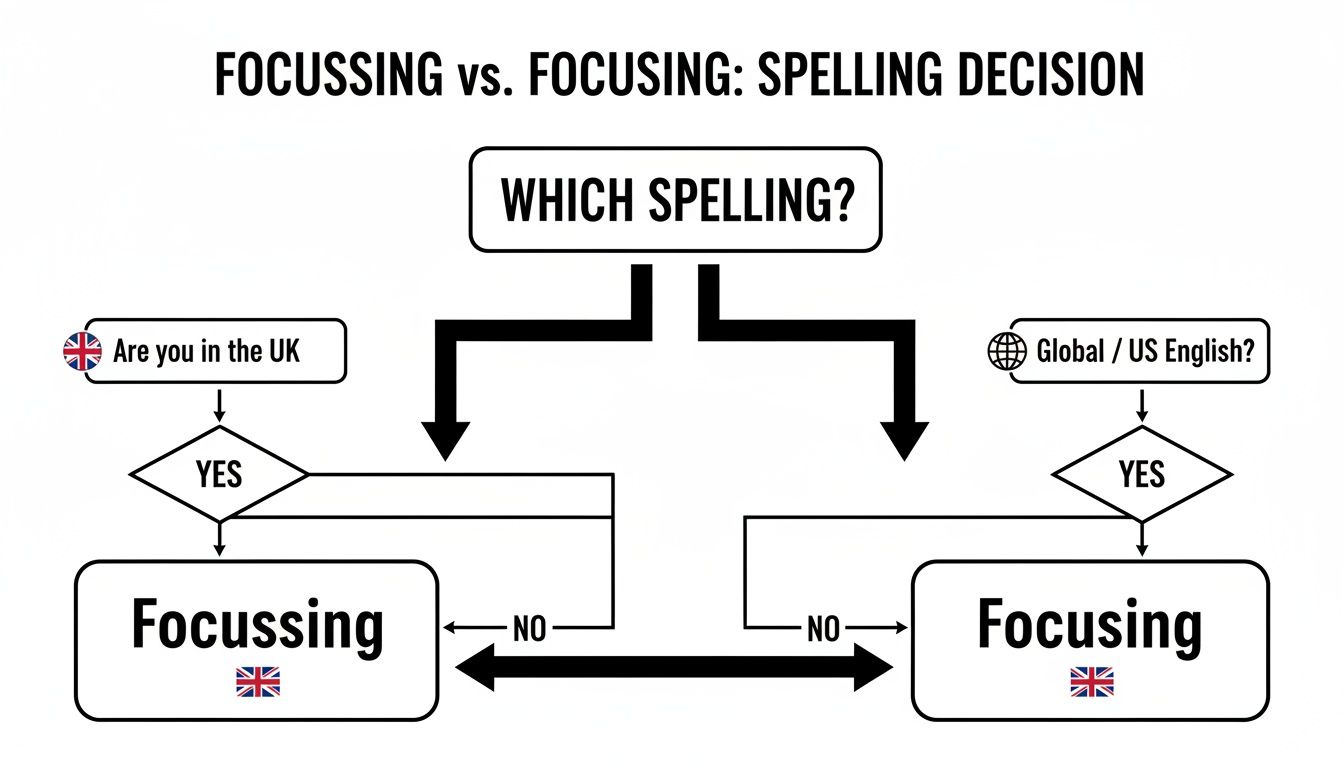
As the chart shows, 'focusing' works for a global audience. 'Focussing', on the other hand, is really just a regional quirk, mostly tied to older British English conventions. Once you get the hang of the syllable stress rule, the choice becomes clear, and you can spell it right every time.
A Tale of Two Englishes: US vs. UK Spelling
At its heart, the focussing or focusing debate is really a story about geography. In American English, the rule is simple and absolute: focusing, with one 's', is the only way to go. There’s no room for discussion; that’s just how it’s done.
Across the pond, British English has traditionally been a bit more relaxed. For many years, 'focussing' was a perfectly fine alternative, living happily alongside its single-'s' cousin. You can still spot it in older books or see it used by writers who lean towards more traditional British conventions.
The Modern Shift in British English
But times have changed. Today, even major British style guides—like those from The Guardian and The Times—now recommend focusing. This isn't just a minor preference; it signals a wider trend towards simplicity and global consistency in the English language.
This shift mirrors what’s happened with other spellings where the American form has gained global momentum. Take 'organise'—it’s still correct in British English, but you’ll increasingly see 'organize' in international business and online media because it’s simpler and more widely understood.
In our connected world, clarity often wins out over regional tradition. Sticking with 'focusing' makes sure your writing is instantly understood by the biggest possible audience, from London to Los Angeles, without making anyone pause for even a second.
At the end of the day, using 'focusing' is the safest and most professional bet. It aligns your work with modern standards and avoids any chance of being flagged for a spelling mistake. Getting a handle on these nuances, like the differences between US and UK English, can be a challenge. It’s where understanding the stages of copyediting and proofreading becomes invaluable, helping writers ensure their final work is polished and consistent for any audience. This is particularly crucial when dealing with multiple languages; if you're curious, you can learn more about how to translate your WordPress content using modern tools in our guide.
Beyond Grammar: The Importance of True Focus
Alright, now that we’ve sorted out the whole focussing vs. focusing debate, let's get to what really matters. What does it actually mean to focus in a world that seems designed to shatter our attention? In an age of endless notifications and constant digital chatter, the ability to consciously direct your attention has become a genuine superpower.

This isn't just about ticking more items off your to-do list. It’s a massive shift towards reclaiming your mental clarity and well-being. By taking control of our digital environments, we turn the vague idea of 'focus' into a real, hands-on strategy for growing both personally and professionally.
A Growing Trend Towards Digital Mindfulness
You can feel a change in the air. More and more people are actively pushing back against the attention economy. They’re silencing notifications, setting firm boundaries with social media, and carving out quiet spaces for deep work and meaningful thought.
This isn’t about becoming a luddite; it’s about choosing where your energy goes instead of letting an algorithm decide for you.
This gut feeling is backed by hard data. A recent study shows just how serious people are about regaining control over their digital lives.
The DDMA Barometer 2025 reveals that 35% of the Dutch population is actively working to reduce digital media use. On top of that, 44% are turning off their devices more often and 33% are disabling notifications just to reclaim their attention.
This isn't happening by accident. People are realising that a focused mind doesn't just appear out of nowhere—it has to be cultivated.
From Vague Concept to Actionable Skill
At the end of the day, focusing is a skill, and like any skill, it needs practice. It’s about more than just shutting out distractions; it's about training your brain to stick with one thing, even when it gets tough or boring. Every time you do, you're strengthening your attention span.
Learning to manage your attention is one of the most valuable investments you can possibly make. If you’re looking for practical ways to build this crucial ability, you might be interested in our guide on focus, the rare skill you can actually learn. By taking small, consistent steps, you can move from a state of constant distraction to one of intentional, powerful focus.
Putting It Into Practice: Focussing vs. Focusing
Knowing the rules is one thing, but seeing how a word works in the real world is what really makes it stick. Let's move from the theory behind focussing or focusing to seeing how the correct spelling looks in everyday sentences.
This is where the rubber meets the road. The single-'s' spelling, focusing, is what you'll see almost everywhere, from the boardroom to your personal life.
- In a business setting: "Our marketing team is focusing all its efforts on the upcoming product launch."
- For personal growth: "She is focusing on her breathing to manage feelings of anxiety."
- In project management: "For this sprint, we are focusing on resolving critical bugs before adding new features."
So, When Might You See Focussing?
While 'focusing' has firmly taken over, you might still stumble upon the double-'s' version. 'Focussing' tends to pop up in older British texts or when you're reading a direct quote from a bygone era. It's not a mistake in that context, just a fossil of an older spelling convention.
Imagine reading a classic novel, where you might see a sentence like: "He found himself focussing intently on the ticking clock, the sound filling the silent room."
Recognising this helps you understand you're looking at a historical variant, not a typo.
Ultimately, getting these small details right is what separates good writing from great writing. If you're keen to sharpen your skills even further, it’s worth digging into other frequently misused words that often trip people up. And for those looking to bring their creative process into the modern age, check out our guide to the best AI tools for writing.
Sorting Out the Spelling of Focus
Let's clear up some of the most common questions that pop up around the whole focussing vs. focusing debate. This should put any final confusion to rest.
Is Focussing Incorrect?
Technically, no. ‘Focussing’ isn't an outright error, but it's definitely an old-fashioned and increasingly rare spelling. It once had a place in British English, but it's been almost entirely replaced by ‘focusing’ to keep things consistent on a global scale.
Using the double-‘s’ version today often looks like a simple typo, even if it has historical roots.
Why Does My Spell Checker Flag Focussing?
Most modern spell-check software, whether you've set it to US or UK English, is programmed to see ‘focusing’ as the correct, standard spelling. Since ‘focussing’ is so uncommon now, these tools usually flag it as a mistake to help writers maintain clarity and modern conventions.
The bottom line is pretty simple: While ‘focussing’ has a history, ‘focusing’ is the universally accepted spelling for any kind of modern communication. Sticking with the single-‘s’ version makes sure your writing comes across as clear, professional, and easy for any audience to read.
Does This Also Apply to Focused vs Focussed?
Yes, it's the exact same story here. ‘Focused’ (with one ‘s’) is the standard and preferred spelling all over the world for the past tense and adjective form.
Just like its ‘-ing’ cousin, ‘focussed’ is an older British variant you might still bump into in historical texts or very old documents. For any writing you're doing today, ‘focused’ is the right choice. The safest and most professional bet is to stick with the single-‘s’ spelling for all forms—focusing, focused.




Responses