Unlocking Your Potential Beyond a Fixed Growth Mindset

At its core, the difference between a fixed and a growth mindset boils down to one fundamental belief: where does ability come from?
Someone with a fixed mindset operates on the assumption that things like intelligence and talent are static, inborn traits. You've either got it, or you don't. In contrast, someone with a growth mindset believes these abilities are malleable—they can be developed and strengthened through dedication, strategy, and good old-fashioned hard work. This single distinction dramatically shapes how you see the world and your place in it, influencing how you handle everything from challenges and effort to feedback and setbacks.
Understanding The Fixed Versus Growth Mindset
Let’s make this real. Imagine two people picking up a guitar for the first time, both struggling to nail a tricky chord.
The person with a fixed mindset hits that wall and immediately thinks, “I’m just not musical. I don’t have the talent for this.” The struggle feels like a final verdict on their innate ability, a clear sign that they should stop before they fail any further. To them, having to try so hard is embarrassing; if they were a "natural," it would come easily.
Now, picture the person with a growth mindset facing the exact same chord. Their internal monologue is completely different: “Wow, this is tough. I’ll need to practise this movement until my fingers get it right.” They see the difficulty not as a reflection of their permanent limits, but as an essential, expected part of the learning curve. For them, effort isn't a sign of weakness—it's the very tool that unlocks new skills.
The Core Beliefs That Drive Behaviour
This simple analogy gets to the heart of the matter. The split between these two mindsets isn't just about "thinking positively." It’s about the deep-seated beliefs you hold about your own potential.
- Belief About Intelligence: A fixed mindset views intelligence as a finite resource, something you're given a set amount of at birth. A growth mindset sees it more like a muscle—the more you exercise it, the stronger it gets.
- Response to Challenges: People with a fixed mindset tend to shy away from challenges, terrified that failure will expose what they believe is a permanent lack of talent. Those with a growth mindset actively seek out challenges, seeing them as exciting opportunities to learn and expand their skills.
- View of Effort: The fixed mindset considers effort to be a waste of time or, even worse, proof that you aren't smart enough. The growth mindset sees effort as the non-negotiable path to mastery.
To really dig into the psychology behind this, it's worth exploring Dweck's Mindset Theory, which laid the groundwork for our entire understanding of this concept.
This is all neatly captured in the image below, which visualises the opposing thought patterns that define each mindset.
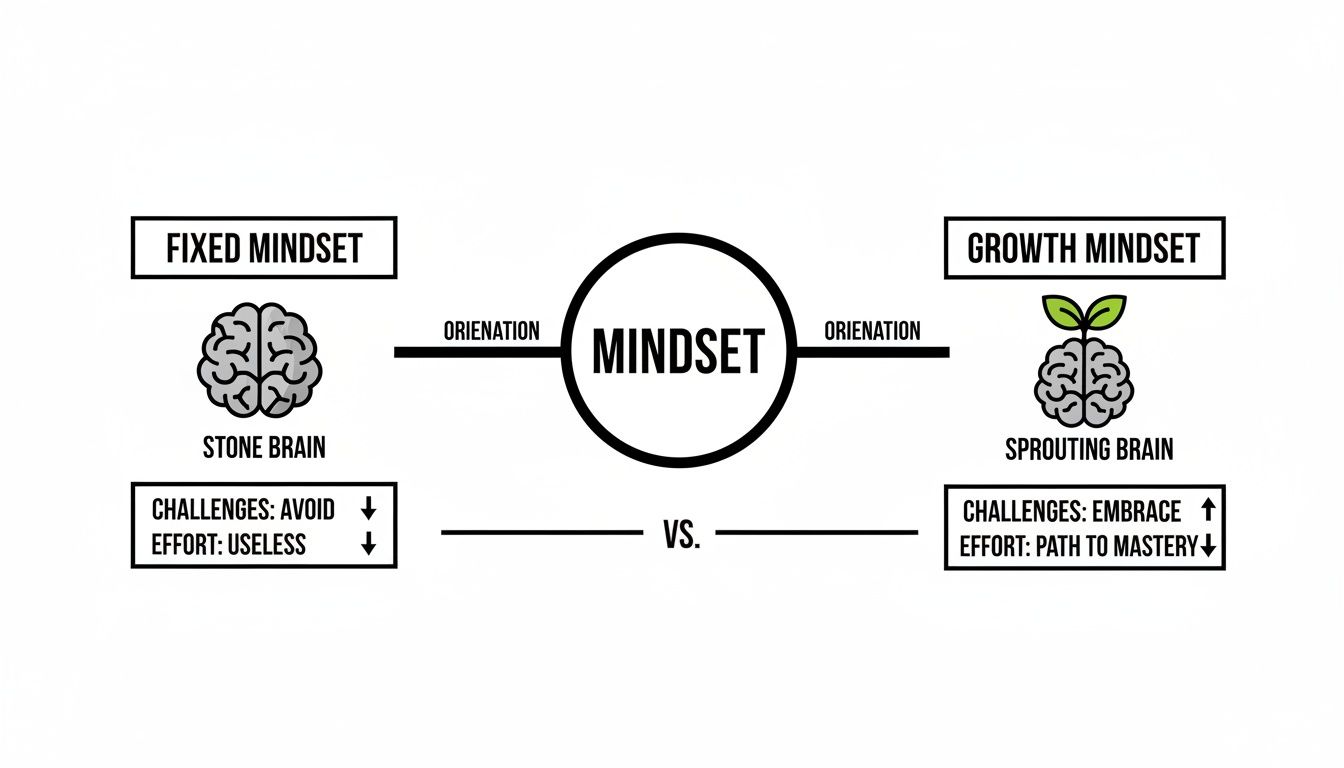
As you can see, one path leads to stagnation by actively avoiding anything difficult, while the other creates a cycle of continuous development by leaning into those very same challenges. Simply recognising which path your own thoughts tend to follow is the first, most powerful step you can take toward meaningful change.
Fixed Mindset vs Growth Mindset At a Glance
To put it all together, this table offers a direct comparison of how each mindset shows up in the real world. Think of it as a cheat sheet for spotting these beliefs in yourself and others.
| Attribute | Fixed Mindset Belief | Growth Mindset Belief |
|---|---|---|
| Skills | "I'm either good at it or I'm not." | "I can learn anything I want to." |
| Challenges | "I avoid challenges to avoid failure." | "Challenges help me grow." |
| Effort | "Effort is pointless if you lack talent." | "Effort is the key to mastery." |
| Feedback | "I take criticism personally." | "Feedback is a source of information." |
| Setbacks | "I give up when I get frustrated." | "Setbacks are wake-up calls to work harder." |
This side-by-side view makes it clear how profoundly your underlying beliefs can shape your actions and, ultimately, your outcomes. While the fixed mindset creates a world full of limitations, the growth mindset opens up a world of possibility.
The Psychological Roots of Your Mindset
Our mindset isn't something we're born with. It’s carefully sculpted over years, often starting in our earliest days. The messages we soak up from parents, teachers, and friends act like a potter's hands, shaping our core beliefs about talent and effort long before we can even put a name to them.
These formative experiences create the internal monologue that ends up defining our entire approach to challenges, often for the rest of our lives.
The language used around our achievements plays a huge part in this. When a child constantly hears praise focused on innate ability—things like, "You're so smart!" or "You're a natural at this"—it can unintentionally plant the seeds of a fixed mindset. This kind of feedback links success directly to an inherent trait, sending the message that talent is what really matters.
On the other hand, praise that centres on the process nurtures a growth mindset. Phrases like, "You worked so incredibly hard on that problem," or "I love the strategy you used to figure that out," send a completely different signal. This feedback highlights effort and persistence as the keys to success, teaching us that our abilities are something we can build.
The Power of Praise and Environment
The difference between these two forms of praise might seem subtle, but its impact is profound. One teaches you that your value comes from a fixed trait you must constantly prove; the other teaches you that your value lies in your capacity to learn and grow.
"Children who were praised for their intelligence, when they hit a failure, they thought that meant they weren't smart. Children praised for the process, when they hit a failure, they thought they just had to try harder or try a different strategy. They were more resilient."
This isn't just about individual praise, either. It extends to our wider environment, especially within the family. Take a recent Dutch study of 129 adolescent-parent pairs, which found a direct link: parents with growth-oriented beliefs tended to raise teens who shared them. But here's the kicker—the study also found that when parents focused too much on school marks and results, it actually held back their child’s mindset development. It reinforced the idea that performance is more important than progress. You can dive deeper into how parental feedback shapes these beliefs in the full study.
From Childhood Messages to Adult Beliefs
These early patterns don't just disappear. They solidify over time, becoming the default lens through which we view our capabilities as adults. The "smart kid" who was always praised for getting easy A's might later shy away from a tough project at work. Why? Because they fear it will expose them as not being as intelligent as everyone thought. They learned that the goal is to look smart, not to get smarter.
In contrast, the person who was encouraged for their effort learns a completely different lesson. They see challenges not as threats to their identity, but as essential parts of the journey. For them, struggling isn't a sign of failure; it’s a sign that they're learning something new and valuable. Understanding these psychological roots is the first step toward consciously choosing the script you want to live by.
How a Fixed Mindset Shows Up in Daily Life
It’s one thing to understand the theory behind a fixed mindset, but it’s another thing entirely to spot it in your own day-to-day life. This is where real self-awareness kicks in.
A fixed mindset rarely announces itself. It’s not a loud declaration but a subtle, convincing whisper that gives you every reason to play it safe and sidestep potential failure. It’s that quiet inner voice shaping how you react at work, in your hobbies, and even within your relationships.
Often, these thought patterns disguise themselves as perfectly logical behaviours. You might turn down a challenging project at work, telling yourself you’re just being realistic about your current workload. But underneath, the fixed mindset is often just shielding you from the risk of not performing perfectly. It prioritises looking competent over actually becoming more competent.
At Work and in Your Career
In a professional setting, a fixed mindset can be a powerful brake on your growth, stalling an otherwise promising career. It usually appears in a few common ways.
- Avoiding Feedback: You feel a rush of defensiveness when a manager offers constructive criticism. Instead of seeing it as helpful, you interpret it as a personal attack on your core abilities.
- Fearing Challenges: When an opportunity comes along that pushes you past your current skills, your first instinct is to find reasons why it’s not the right fit or why someone else would be a better choice.
- Feeling Threatened by Others: A colleague’s success feels less like an inspiration and more like a direct threat. Their achievement seems to highlight a lack in your own static talents, sparking envy or resentment. If this feels familiar, our article on how to stop comparing yourself to others might help you navigate these feelings.
At their core, these reactions are all defence mechanisms. They’re designed to protect a fragile sense of self-worth that has become tangled up with being "naturally" good at something.
In Learning and Personal Hobbies
The influence of a fixed mindset stretches far beyond the office walls. It can quietly sabotage your personal growth and suck the joy out of activities you once loved.
When you believe your abilities are set in stone, every difficult chord on the guitar or failed recipe in the kitchen feels like a final verdict. The journey of learning is overshadowed by the fear of judgement, even if you are the only judge.
Maybe you’ve given up on learning a new language after just a few weeks because you weren't progressing as fast as you’d hoped. The internal script says, "I'm just not good with languages," which slams the door on the possibility of improving through sheer effort.
This mindset transforms the natural struggle of learning into a signal that you should just quit. It pushes you to stick only to the things you’ve already mastered, creating a comfort zone that slowly but surely becomes a cage, walling you off from new skills and experiences.
How Your Mindset Shapes Learning and Resilience
Think of your mindset as the operating system for your brain, quietly running in the background and dictating how you process everything—especially the tough stuff. It’s the invisible link between what you believe about yourself and what you actually achieve. With a growth mindset, challenges aren't roadblocks; they're just data points on your journey to getting better.
This outlook is the bedrock of genuine mental toughness. When you hit a snag, you don't see it as a final verdict on your abilities. Instead, you see it as feedback. This subtle shift is everything when it comes to staying in the game during difficult tasks. If you believe your effort will eventually pay off, you're far more likely to push through the frustration that always comes with learning something new.
For example, imagine a proposal you worked hard on gets rejected. Someone with a fixed mindset might immediately think, "I'm just not good enough." But a person with a growth mindset asks a different question: "Okay, what can I learn from this? How can I make the next one stronger?" It’s a simple switch, but it turns dead ends into launch pads.
The Foundation of Mental Toughness
Resilience isn’t about never falling down. It’s about how quickly and effectively you get back on your feet. A growth mindset is the engine that powers that recovery, giving you the fuel to keep going when the obstacles feel massive.
This kind of mental fortitude is a game-changer in high-pressure places like work or school. A fascinating study of 426 Dutch adolescents, for instance, found a powerful connection between mindset and well-being. The researchers discovered that students with a growth mindset suffered significantly lower levels of school burnout. This was true even after accounting for things like grades and family background, showing how a belief in your own development acts as a shield against stress. You can dive into the full study on how mindset affects student burnout to see the data for yourself.
And this isn't just about school. This protective effect applies to any field where you have to grind to succeed.
A growth mindset allows you to decouple your self-worth from your performance. When an attempt fails, it doesn't mean you are a failure—it simply means your strategy didn't work yet.
Turning Failure into Fuel
This ability to reframe setbacks is probably the most powerful part of having a growth mindset. It completely changes your relationship with failure, turning it from something terrifying into something you can actually learn from.
Just look at these two completely different ways of handling a setback:
- Fixed Mindset Reaction: "I'm just not cut out for this. I should quit before I embarrass myself even more." This response is all about protecting a static, fragile sense of self.
- Growth Mindset Reaction: "Well, that approach didn't work. Let me analyse what went wrong and try a different tactic." This response is driven purely by a desire to make progress.
By welcoming challenges and seeing effort as the path to mastery, you create a powerful positive loop. Every small win builds your confidence, and every failure offers a lesson, making you more capable and resilient for whatever comes next.
Practical Strategies to Cultivate a Growth Mindset
Knowing the difference between a fixed and growth mindset is one thing. Actually shifting your perspective is another entirely. It takes conscious, consistent practice to move the needle.
This isn’t about just thinking more positively; it's about rewiring the deep-seated thought patterns that dictate how you react when things get tough. These strategies are designed to help you build that new mental muscle, one small action at a time. It’s not a personality overhaul. Think of it as making small, deliberate tweaks to your inner voice and daily habits that, over time, create a solid foundation for resilience and a genuine love of learning.
Embrace the Power of Yet
One of the most powerful tools for dismantling a fixed mindset is surprisingly simple: just add the word "yet" to your self-critical thoughts. It’s a tiny word that completely reframes a statement of permanent failure into a temporary state, cracking open the door to future possibility.
- "I can't figure this out" becomes "I can't figure this out yet."
- "I'm not good at public speaking" becomes "I'm not good at public speaking yet."
- "This doesn't make sense" becomes "This doesn't make sense yet."
This small linguistic shift acknowledges the present struggle without accepting it as a final verdict. It implies that with more time, a different strategy, or a bit more effort, success is still on the table. It’s a brilliant way to interrupt that downward spiral of self-defeat before it even begins.
By giving yourself permission to be an amateur, you allow yourself to start and put a premium on all the growth you experience along the way. You can’t beat yourself up over all the things you don’t yet know or can’t do yet.
Focus on Process Over Perfection
A fixed mindset is obsessed with the final outcome—the A+, the promotion, the win. This all-or-nothing focus makes any stumble along the way feel like a catastrophic failure. To build a growth mindset, you have to shift your attention from the result to the process.
Try setting goals based on effort and learning, not just pure achievement. Instead of saying, "I'm going to get that promotion," reframe it: "This quarter, I'm going to ask my manager for feedback twice a month and master one new skill." This approach is powerful for two reasons:
- It Puts You in Control: You can’t always control the outcome, but you can always control your effort and your learning strategy.
- It Celebrates the Journey: Every bit of progress becomes a small win, building momentum and keeping you motivated for the long haul.
For students stuck in the apathy that often comes with a fixed mindset, finding actionable strategies to rebuild motivation can be an absolute game-changer. Similarly, simply documenting your efforts can give you tangible proof that you're moving forward. If you want to dive deeper into this, our guide on unlocking mental wellness through journaling is a great place to start.
And this isn't just wishful thinking; the research backs it up. A six-week growth mindset programme with 14-year-olds in the Netherlands showed that participants felt more engaged and in control in their science classes. Meanwhile, students who didn't get the intervention saw their engagement and skills actually decline. These strategies work because they actively reshape how we see challenges and the effort it takes to overcome them.
Leading Others with a Growth Mindset
Adopting a growth mindset is a powerful personal tool, but its true potential is unlocked when leaders use it to shape their entire environment. A manager, parent, or mentor with this outlook doesn't just improve themselves; they create a space where everyone around them feels genuinely empowered to grow.
This means shifting your focus from judging performance to actively nurturing potential. It's about building a culture of psychological safety, where your team members—or children—feel secure enough to take intelligent risks, ask questions, and, most importantly, make mistakes without fearing blame. It’s about modelling resilience and framing challenges as opportunities for the whole group to learn together.
Fostering a Culture of Learning
For any leader, this starts with communication. The language you use has a direct, tangible impact on the mindsets of your team. It's the simple but profound difference between asking, "Who is responsible for this failure?" and "What can we learn from this setback?"
Effective leaders who cultivate growth do a few key things differently:
- They Praise the Process, Not Just the Person: Instead of saying, "You're a natural at this," they'll say, "I was really impressed with the strategy you used to solve that problem." This small tweak reinforces that effort and smart strategies—not just innate talent—are what lead to success.
- They Frame Feedback as a Tool: Constructive criticism isn't presented as a judgement of someone's ability. Instead, it’s treated as valuable data for improvement. The goal is to inspire growth, not trigger defensiveness.
- They Model Vulnerability: A growth-minded leader is comfortable saying, "I don't have the answer yet, so let's figure it out together." This shows that learning is a continuous journey for everyone, no matter their position in the hierarchy.
When a leader embodies a growth mindset, they give their team permission to be a work in progress. This simple act unlocks creativity and encourages a level of collaboration that a fixed-mindset culture simply cannot sustain.
Practical Steps for Mindset-Driven Leadership
Building this kind of environment requires conscious effort and consistent action. It involves moving beyond simply managing tasks to becoming a true coach who is invested in the development of their people. This is a crucial distinction, as highlighted in discussions about the differences between being a boss versus being truly bossy, where influence often trumps authority. To learn more, explore our article on why workplace labels don't define success.
By celebrating effort, rewarding persistence, and treating setbacks as learning opportunities, you transform your team's relationship with challenges. You steer them away from a culture paralysed by a fixed growth mindset and toward one where continuous improvement is the standard. This shift doesn't just boost morale; it drives innovation and builds a resilient, adaptable team ready for whatever comes next.
Frequently Asked Questions About Mindset
As you start digging into the world of mindsets, a few common questions tend to pop up. Let's tackle them head-on to clear things up and help you see how these ideas play out in the real world.
Can You Have Different Mindsets for Different Skills?
Absolutely. In fact, it's incredibly common. You might have a growth mindset in one part of your life and a fixed one in another, without even realising it.
For instance, you might believe that with enough practice, you could become a fantastic public speaker (that's a growth mindset). But at the same time, you might feel like you're just "not a maths person" and never will be, no matter how hard you try (a classic fixed mindset).
This usually happens because our beliefs are tied to specific past experiences. A string of early struggles with numbers can cement a fixed mindset about mathematics, while getting positive feedback on a presentation can reinforce your belief that you can grow as a speaker. The first step is simply noticing where these different mindsets show up in your life.
How Long Does It Take to Develop a Growth Mindset?
Shifting your mindset isn't like flipping a switch; it's more like building a new habit. There's no magic timeline, because the pace really depends on your own self-awareness and how consistently you put in the work.
It's all about consistency. The process involves consciously catching yourself, reframing challenges as opportunities, and choosing to learn from feedback instead of fearing it. Each time you do this, you're slowly rewiring your brain's go-to responses. These small, daily shifts add up over weeks and months, eventually leading to a profound change in your perspective.
It's less about a finish line and more about a commitment to the journey. The goal isn't to be perfect but to be a little more growth-oriented today than you were yesterday.
Is It Possible to Completely Get Rid of a Fixed Mindset?
Honestly, it's more realistic to think of it as learning to manage your fixed-mindset triggers rather than trying to erase them completely.
Even people who operate from a strong growth mindset most of the time will have moments where those old fixed thoughts creep back in. This often happens when we're under serious stress, facing harsh criticism, or dealing with a major failure. It's human.
The real goal isn't to achieve some "pure" state of growth mindset. It's about getting so good at spotting that fixed-mindset voice that you can acknowledge it without letting it drive your actions. That self-awareness is the true mark of a resilient, growth-oriented person.
At People & Media B.V., we believe in the power of continuous learning to reshape your world. Our curated courses, articles, and events are designed to give you the tools and insights needed to cultivate a resilient growth mindset. Start your journey with us today. Discover our learning platform.





Responses