Your Guide to Fitness Cardio Exercise for Fat Loss and Endurance

Cardio isn't just about getting out of breath. Think of it as training your body's engine—your heart and lungs—to become more powerful, efficient, and resilient for the long haul.
Understanding Your Body’s Engine
Picture your heart as the engine in a high-performance car and your blood vessels as the fuel lines. A finely-tuned engine runs smoothly, sips fuel efficiently, and can handle a cross-country trip without a single hiccup. Cardio is the regular maintenance and performance tuning that gets your body's engine into that kind of shape.
Every session strengthens your heart muscle, which means it can pump more blood with each beat. This isn't just an abstract concept; it has real, tangible effects. Your body gets better at rushing oxygen and nutrients to your muscles while clearing out waste products like lactic acid. It’s a complete upgrade to your entire circulatory system.
The Core of Cardiovascular Health
At its heart, cardio is all about adaptation. When you consistently challenge your body with activities like running, swimming, or cycling, you kickstart a cascade of powerful changes:
- A Stronger Heart: Just like lifting weights builds your biceps, cardio builds your heart muscle. It becomes stronger and more efficient, pumping blood with less effort.
- Improved Oxygen Use: Your body learns to get more bang for its buck, becoming better at extracting and using the oxygen from your blood. This is a classic sign of improving aerobic fitness.
- Increased Endurance: You’ll quickly notice that everyday tasks—from climbing a few flights of stairs to carrying your groceries—become ridiculously easy.
- Better Overall Health: The benefits don't stop there. Regular cardio is a powerhouse for managing weight, lowering blood pressure, and slashing the risk of chronic diseases.
This isn't just important for individual fitness goals; it's a massive public health issue. Here in the Netherlands, for instance, there's a big push for people to stay active, but we're not quite there yet. In 2022, only 44% of Dutch adults managed to hit the national physical activity guidelines of 150 minutes of moderate-intensity exercise per week.
The government has an ambitious target: get 75% of the population to meet these guidelines by 2040. This really underscores just how critical structured cardio is for national well-being. You can dive deeper into these Dutch public health goals and activity levels.
The real point of a cardio routine isn’t just to survive a workout. It’s to build a body that feels more robust, energetic, and capable in everything you do. You’re creating a deep reserve of health and stamina for life.
Choosing the Right Cardio for Your Goals
With a sea of options out there, picking the right kind of cardio can feel a bit overwhelming. The best choice, however, isn't about what's trendy or what someone else is doing—it's about what works for you and your specific goals. Are you trying to build rock-solid endurance, torch fat as efficiently as possible, or just stay active without punishing your joints?
Think of it like choosing a vehicle for a trip. A long, steady cross-country drive calls for a different car than a quick, powerful sprint across town. In the same way, the cardio you choose should be the perfect vehicle to get you to your fitness destination.
Steady-State Cardio for Endurance
Steady-state cardio is the classic approach. Picture a long run at a comfortable pace, a smooth bike ride, or a session on the elliptical where your heart rate stays in a consistent, moderate zone. This is your workhorse for building a powerful aerobic base.
Its real magic lies in improving how efficiently your body uses oxygen and strengthening your heart muscle over the long haul. Because it's less brutal than all-out sprints, it’s far more sustainable for longer workouts and much easier for beginners to stick with week after week.
High-Intensity Interval Training for Efficiency
High-Intensity Interval Training (HIIT) flips the script entirely. It's all about short, explosive bursts of maximum effort followed by brief periods of recovery. Think gut-busting sprints on the track or an assault bike, followed by a slow walk or complete rest. If steady-state is a marathon, HIIT is a series of powerful, back-to-back sprints.
The biggest draw for HIIT is its incredible time efficiency. You can get a massive cardiovascular punch and burn a serious number of calories in a fraction of the time—often just 15-20 minutes. This makes it a game-changer for anyone with a packed schedule. For a powerful HIIT tool, you can learn more about why the Rogue Echo Bike is a cardio equipment must-have.
Low-Impact Cardio for Joint Health
But what if pounding the pavement just isn't in the cards for you? Low-impact cardio is a fantastic solution that protects your joints while still delivering a killer workout. Activities like swimming, cycling, and rowing get your heart rate up without hammering your knees, hips, and ankles.
These options are perfect if you're recovering from an injury, managing joint pain, or simply want to add some variety to your routine without extra wear and tear. They prove that an effective cardio session doesn't have to leave your body feeling beaten up.
The best cardio isn't the one that feels the hardest—it's the one you can actually do consistently and safely. The real key to long-term success is matching the activity to your goals and what your body can handle.
Choosing Your Cardio Modality
To make it even clearer, here's a simple breakdown of how these common cardio types stack up against each other.
| Cardio Type | Intensity Level | Joint Impact | Best For |
|---|---|---|---|
| Running/Jogging | Moderate to High | High | Building endurance, calorie burn |
| HIIT (Sprints) | Very High | High | Time efficiency, metabolic boost |
| Cycling | Low to High | Low | Endurance, leg strength, joint safety |
| Swimming | Low to Moderate | None | Full-body workout, joint protection |
| Elliptical/Rower | Low to Moderate | Low | Low-impact conditioning, recovery |
Ultimately, the best routine often involves a mix of these. You might do a couple of steady-state sessions during the week and sprinkle in one HIIT workout for good measure.
This simple decision tree illustrates how to check if you're meeting the fundamental weekly fitness guidelines.
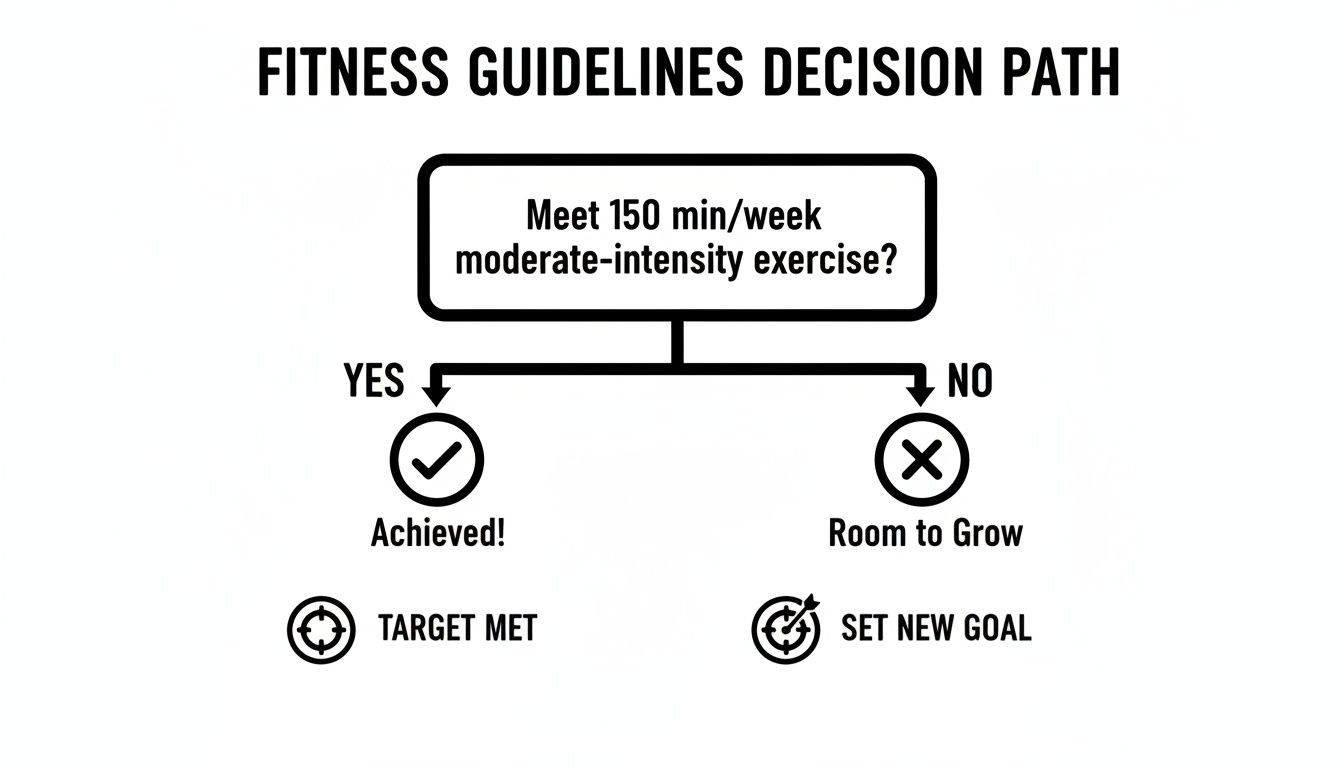
The flowchart highlights a simple but critical benchmark: 150 minutes per week of moderate-intensity activity. Measuring your current routine against this standard is the first step in figuring out if your plan is truly moving you toward your health goals.
How to Personalise Your Cardio Workouts

Generic workout plans get you generic results. If you want to make real progress, you have to stop guessing and start training with a clear purpose. This means personalising your cardio to hit specific goals, whether that’s burning fat, building stamina, or just looking after your heart.
The secret is working at the right intensity. Think of your body like a car with different gears. You wouldn’t drive everywhere in first gear, but you also wouldn’t redline the engine constantly. Smart training is about knowing which "gear"—or heart rate zone—to use and when.
Understanding Your Heart Rate Zones
Heart rate zones are simply ranges based on a percentage of your maximum heart rate (MHR). While a fitness tracker is the easiest way to find yours, you can get a rough estimate of your MHR by using the classic formula: 220 minus your age. Each zone pushes your body in a different way, delivering unique fitness benefits.
-
Zone 2 (60-70% of MHR): This is your foundational gear, perfect for building endurance and burning fat. The effort is steady, and you can comfortably hold a conversation. It’s in this zone that your body gets better at using fat for fuel by building mitochondrial efficiency.
-
Zone 3 (70-80% of MHR): Here, the pace starts to pick up. You can still talk, but you’re limited to short sentences. This is a great zone for boosting your overall cardiovascular fitness and stamina.
-
Zone 4 (80-90% of MHR): Now you're really pushing. Speaking more than a word or two at a time feels difficult. Training here is how you build speed and start to challenge your anaerobic threshold, which is key for getting faster.
Knowing your heart rate zones turns a casual workout into a precision training session. You can strategically shift between zones to target specific outcomes, making every minute of your workout count.
The Talk Test: A Simple Intensity Gauge
Don't have a heart rate monitor? No worries. The "Talk Test" is a surprisingly accurate, no-tech way to figure out how hard you're working. The principle is simple: the harder you work, the harder it is to talk.
If you can sing or chat away easily, you’re in a low-intensity zone. If you can speak in full sentences but with a bit of effort, you're likely in a moderate zone (like Zone 2 or 3). If you can only gasp out a few words at a time, you've hit a high-intensity, vigorous level.
Take cycling in the Netherlands, for example. While a massive 61.3% of the Dutch population cycled weekly in 2019, most of it is casual, low-intensity transport. To turn that daily ride into a real workout, you need to intentionally push the pace until conversation becomes difficult. That’s how you transform everyday movement into a powerful fitness session.
By listening to your body's feedback and pairing it with data from a watch, you can precisely control your workouts. These metrics give you a deeper understanding of how your body is responding to the stress of exercise. You can learn more about this by exploring our article on understanding your unique heart rate variability.
Building Your Weekly Fitness Cardio Plan

Alright, you’ve got the theory down—you know the different kinds of cardio and how to tell if you’re working hard enough. Now for the fun part: putting it all into practice. A solid plan is what turns vague fitness goals into a real, actionable schedule you can follow day by day. It’s your roadmap.
The key is to build a week that actually works for your goal, whether you're just getting off the couch, looking to shed some fat, or have your eyes on a race bib.
Below are three sample plans built for different finish lines. Think of them as starting templates, not rigid rules. Each one lays out the type of workout, how long it should take, and the intensity you're aiming for, using the heart rate zones and Talk Test we just covered. Feel free to tweak them to fit your life and how your body feels.
The Beginner Consistency Plan
If you’re new to this, your number one goal is simple: just show up. This plan is all about building the habit. We’ll focus on a consistent routine of low-impact, moderate-intensity work to create a solid aerobic base without burning you out or causing injury.
The real aim here is to make cardio a sustainable part of your week.
- Monday: 30 minutes of brisk walking or cycling (Zone 2, you can hold a conversation easily).
- Wednesday: 30 minutes on the elliptical or a gentle swim (Zone 2).
- Friday: 35 minutes of brisk walking, maybe find a few small hills (still Zone 2, but the conversation is a bit tougher).
- Active Recovery Days: A gentle walk or some good stretching on your "off" days is perfect.
Notice the focus is on frequency and duration, not gut-busting intensity. You're teaching your body and mind to adapt to regular cardiovascular work.
The best workout plan on earth is the one you actually stick to. For beginners, consistency will always beat intensity. Build the habit first. You can push the boundaries later.
The Fat Loss Optimisation Plan
This plan gets a bit more strategic, bringing in High-Intensity Interval Training (HIIT) to really fire up your metabolism and maximise your calorie burn. We’ll balance those intense days with steady-state cardio to help you recover and keep burning fat efficiently.
Just remember, HIIT is tough on the body, so don't skimp on your rest days. They're crucial.
- Monday: 20-minute HIIT workout (think treadmill sprints: 30 seconds all-out, 60 seconds recovery walk).
- Tuesday: 45 minutes of steady-state cycling or jogging (nice and easy in Zone 2).
- Thursday: 20-minute bodyweight HIIT circuit (jumping jacks, burpees, high knees—anything that gets the heart pounding).
- Saturday: 60-minute long, slow run or a good hike (staying in Zone 2).
This one-two punch of HIIT and steady-state gives you a powerful metabolic advantage while still building that foundational endurance. It's a smart, well-rounded approach to fat loss.
The Endurance 10K Training Plan
Got a race on the calendar? If your goal is to cross that 10K finish line, your training needs to be all about building stamina. That means gradually running for longer and mixing in different types of runs to get you faster and more efficient.
- Tuesday: 30-minute easy run (Zone 2).
- Thursday: 45-minute tempo run (warm up for 10 mins in Zone 2, push to Zone 3 for 25 mins, then cool down for 10 mins in Zone 2).
- Saturday: Long, slow distance run (start at 5km and add about 10% to your distance each week).
- Active Recovery: Hop on a bike or go for a swim on your other days. This kind of cross-training is great for recovery.
This whole structure is built on a non-negotiable fitness principle: progressive overload. It’s the secret sauce to all progress. To keep getting better, you have to gradually ask a little more of your body—whether that means running longer, faster, or more often. Without that gentle but consistent push, your body just adapts and you hit a plateau. This ensures your fitness journey is always moving forward.
How to Fit Cardio Into a Busy Schedule
Let’s be honest, one of the biggest roadblocks to getting fit is the clock. Between work, family, and everything else life throws at you, finding a solid chunk of time for a proper cardio session can feel like a fantasy.
The solution isn't about inventing a 25-hour day. It's about changing how you see a "workout." Forget the all-or-nothing mindset that demands an elusive hour at the gym.
Instead, think smaller. The idea of exercise snacking is a game-changer for anyone with a packed schedule. It’s all about breaking up your activity into short, intense 10-to-15-minute bursts throughout your day. These little efforts really do add up, and their impact on your health is massive.
Weaving Cardio Into Your Day
Your daily routine is already packed with opportunities for a quick cardio blast. The trick is learning to spot them—and then actually doing them.
- Lunch Break Power Walk: Don’t just eat at your desk. Carve out 20 minutes for a brisk walk outside. Not only does it get your heart pumping, but it’ll clear your head for the afternoon ahead.
- Stairway Sprints: If you work or live in a building with stairs, you've got a free gym. A few quick trips up and down is an incredible high-intensity hit that gets your blood moving in minutes.
- The "Commercial Break" Circuit: Kicking back to watch some telly? Use the ad breaks. Bang out a quick circuit of jumping jacks, high knees, or burpees. Just three or four breaks can easily give you 10-15 minutes of solid work.
This approach of slotting in small bursts of activity is especially relevant here in the Netherlands. In 2023, while 56% of the population played sports every week, a large number still didn't quite meet the full Physical Activity Guidelines.
This tells us that lots of people are active but struggle to get the consistent minutes needed for the best health benefits—a gap that exercise snacking is perfectly designed to fill. You can read more on how the Dutch are staying active in these recent RIVM findings.
Your goal is to shift your mindset from "finding time for a workout" to "making my day a workout." Every small bit of movement is a deposit into your health account.
By reframing what actually counts as exercise, you can easily hit—and even blow past—your weekly health targets without having to tear up your entire schedule to do it.
Staying Motivated and Injury-Free
A brilliant cardio plan is worthless if you can’t stick with it. Real, lasting results don’t come from a few heroic workouts; they come from building habits that keep you moving consistently and safely for the long haul.
It all starts with treating your body right. Always kick things off with a dynamic warm-up to get your muscles ready for action, and wrap up with a cool-down to help your body recover. Listening to your body isn't optional—pushing through sharp pain is a one-way ticket to the sidelines. Don't ever ignore the warning signs of overtraining.
Building a Resilient Mindset
Motivation isn't some magical force you find under a rock. It’s something you build, one workout at a time. The psychology of staying committed is every bit as important as the physical work itself.
To keep that fire lit, you need to create a supportive environment for yourself and build a positive feedback loop that makes you want to keep going.
- Track Your Progress: Nothing fuels motivation like seeing how far you’ve come. Use an app or a simple notebook to log your workouts and watch the progress stack up.
- Find Your Soundtrack: The right music can completely transform a workout from a chore into something you genuinely look forward to. You can discover the best playlist for gym music to keep your energy high.
- Set Realistic Goals: Forget about massive, intimidating targets. Aim for small, achievable wins. Hitting these little milestones builds incredible momentum and confidence.
- Celebrate Achievements: When you hit a goal, acknowledge it! Acknowledging your hard work reinforces the habit and makes the whole journey far more enjoyable.
Think of your fitness journey not as a short-term project with an end date, but as a lifelong commitment to your own well-being. Consistency will always beat short-term intensity, every single time.
Frequently Asked Questions About Cardio Exercise
Jumping into the world of cardio can feel a bit overwhelming with all the conflicting advice out there. So, let's cut through the noise and tackle some of the most common questions head-on.
Getting these fundamentals right clears up the confusion and lets you focus on what really moves the needle: showing up and doing the work consistently.
How Much Cardio Should I Do Per Week?
For general health, the standard advice is solid: aim for 150 minutes of moderate-intensity cardio or 75 minutes of vigorous-intensity activity each week. A mix of both works perfectly fine, too.
But here’s the thing—the "ideal" amount is completely tied to your goals. Someone training for a marathon has very different needs than someone who wants to manage their weight or just feel more energetic. The real key is finding a weekly volume that actually fits into your life without leaving you exhausted.
The best amount of cardio is whatever you can do consistently without burning out or getting injured. Start with the 150-minute guideline, listen to your body, and adjust based on what you’re trying to achieve.
Cardio or Weights First in a Workout?
This is the classic gym debate, and the answer is refreshingly simple: it depends on what you're prioritising. If your main goal for the day is to run faster or last longer, do your cardio first while you're still fresh.
On the flip side, if building strength or muscle is your top priority, hit the weights before you hit the treadmill. Tiring yourself out with intense cardio can burn through the glycogen your muscles need for heavy lifting, which can sabotage your strength session. For general fitness, though, the order doesn't matter nearly as much.
What Is the Best Type of Cardio for Fat Loss?
High-Intensity Interval Training (HIIT) gets a lot of hype for burning a ton of calories in a short amount of time, and for good reason. But the best cardio for fat loss will always be the kind you don't dread doing. Both HIIT and steady-state cardio (like a long jog in Zone 2) are fantastic tools in the toolbox.
For most people, a balanced approach is the smartest way to go. Mix in a couple of tough HIIT sessions with longer, less intense workouts. This combination helps you burn maximum calories while also training your body to get better at using fat for fuel—all without running yourself into the ground.
FAQ on Fitness Cardio Exercise
Still have some lingering questions? This table gives you quick, straightforward answers to help you build your cardio plan with confidence.
| Question | Answer |
|---|---|
| Can I do cardio every day? | Yes, but it's wise to vary the intensity. Light activities like walking are fine daily. For more intense cardio, schedule in at least one or two rest days per week to allow your body to recover and prevent burnout. |
| How do I know if my cardio is "moderate" or "vigorous"? | A simple way is the "talk test." During moderate-intensity cardio, you should be able to hold a conversation. During vigorous-intensity cardio, you'll only be able to speak a few words at a time. |
| Does walking count as cardio? | Absolutely! Brisk walking is a fantastic form of low-impact, moderate-intensity cardio. It's accessible, easy on the joints, and a great way to meet your weekly activity goals. |
| How long does it take to see results from cardio? | You'll likely start feeling better—with more energy and better sleep—within a few weeks. Noticeable changes in fitness, endurance, or body composition typically take 4-8 weeks of consistent effort. |
Remember, the goal isn't just to work hard; it's to work smart. Use these answers to refine your approach and make your cardio workouts as effective as possible.
At People & Media B.V., we believe in building a foundation of knowledge to support your growth. Explore our curated courses and articles to deepen your understanding of health and personal development. Continue your learning journey at https://www.peopleandmedia.com.








Responses