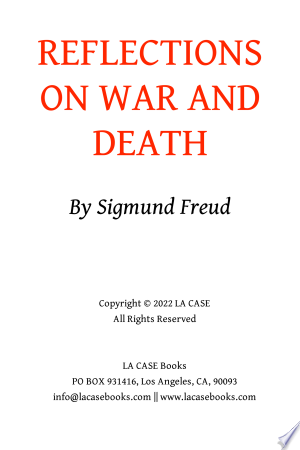
Reflections on War and Death

8.95

-
+

Specs

Categories: ,

Description

Reflections on War and Death is a classic historical psychology study by Sigmund Freud. Thoughts for the Time of War and Death is a set of twin essays written by Sigmund Freud in 1915, six months after the outbreak of World War I. The essays express discontent and disillusionment with human nature and human society in the aftermath of the hostilities; and generated much interest among lay readers of Freud. The first essay addressed the widespread disillusionment brought on by the collapse of the Pax Britannica of the preceding century-what Freud called “the common civilization of peacetime. The second essay addressed what Freud called the peacetime ‘protection racket’ whereby the inevitability of death was expunged from civilized mentality. Building on the second essay of Totem and Taboo, Freud argued that such an attitude left civilians in particular unprepared for the stark horror of industrial-scale death in the Great War. Freud’s account of the centrality of loss in culture has been seen as seminal for his later work, Civilization and its Discontents. Caught in the whirlwind of these war times, without any real information or any perspective upon the great changes that have already occurred or are about to be enacted, lacking all premonition of the future, it is small wonder that we ourselves become confused as to the meaning of impressions which crowd in upon us or of the value of the judgments we are forming. It would seem as though no event had ever destroyed so much of the precious heritage of mankind, confused so many of the clearest intellects or so thoroughly debased what is highest.

  • Author: Sigmund Freud
  • Publisher: LA CASE Books
  • Published: 2012-08
  • Pages: 44

Additional information

Author

Sigmund Freud

Reviews

There are no reviews yet.

Be the first to review “Reflections on War and Death”

Your email address will not be published. Required fields are marked *

Summary

What the internet says

Aggregated insights from reviews and discussions across the web.

Overall reception: Mostly positive

Reflections on War and Death by Sigmund Freud receives generally positive reception as a historically significant and intellectually profound work. Written in 1915, six months after World War I began, the twin essays explore the psychological impact of war on civilization and humanity's relationship with death. Readers appreciate Freud's penetrating analysis of how the war exposed 'cultural hypocrites' who had adopted civilized behavior not from genuine moral development but from social pressure, and his examination of how peacetime society's denial of death left people unprepared for industrial-scale carnage. The work is valued for its timeless insights into human nature, defense mechanisms, and existential anxieties that remain relevant beyond its historical context.

The book maintains a 3.93 average rating on Goodreads with significant reader interest, and continues to be available through multiple formats including Apple Books and Project Gutenberg. Reviewers note that while the essays are relatively short (38 pages in some editions), they offer dense psychological analysis that challenges conventional notions of heroism, sacrifice, and civilization. The work is seen as seminal for Freud's later development, particularly influencing 'Civilization and its Discontents.' Readers find the text somewhat difficult but rewarding, with a reading ease score placing it at 10th-12th grade level, requiring careful engagement with Freud's complex arguments about aggression, violence, and the human instinct for self-preservation.

What readers loved

  • Profound and timeless psychological insights into human nature during war and crisis that remain relevant today
  • Penetrating analysis of 'cultural hypocrites' and how war exposes authentic primitive impulses beneath civilized behavior
  • Challenges conventional thinking about heroism, sacrifice, and the illusions of peacetime civilization
  • Examines the psychological mechanisms of defense and how individuals cope with existential anxieties
  • Historically significant work that influenced Freud's later development, particularly 'Civilization and its Discontents'
  • Accessible length at approximately 38 pages while maintaining intellectual depth
  • Available in multiple free formats through Project Gutenberg and other platforms

Common critiques

  • Somewhat difficult reading level requiring careful engagement with complex psychological arguments
  • Dense philosophical content may be challenging for readers unfamiliar with Freudian theory
  • Historical context from 1915 may feel dated to some modern readers despite timeless themes

Based on reviews from

  • Goodreads
  • Apple Books
  • Project Gutenberg
  • Wikipedia
Last updated May 18, 2026 Summary based on publicly available reviews. May not reflect every reader's experience.