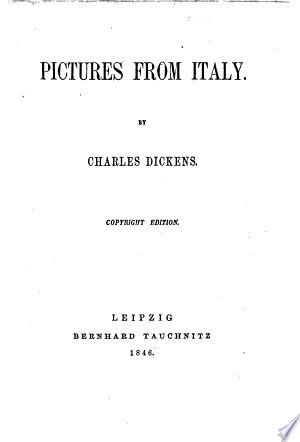
Pictures from Italy

14.95

-
+

Specs

Categories: ,

Description

After MARTIN CHUZZLEWIT was published in 1844, Dickens deliberately took a break from novels to travel in Italy for almost a year. Attracted by the urban desolation, the colourful life of the streets and visible signs of the nation’s richly textured past, rather than by the traditional tourist sites, the result is a thrilling travelogue. It also reveals Dickens’s anxieties and concerns, and should be viewed alongside the masterpieces of his mature works.

  • Author: Charles Dickens
  • Publisher: Castrovilli Giuseppe
  • Published: 1846
  • Pages: 284

Additional information

Author

Charles Dickens

Reviews

There are no reviews yet.

Be the first to review “Pictures from Italy”

Your email address will not be published. Required fields are marked *

Summary

What the internet says

Aggregated insights from reviews and discussions across the web.

Overall reception: Mixed reception

Pictures from Italy by Charles Dickens receives mixed to positive reception as a travelogue that showcases the author's distinctive writing style and vivid observations of 1840s Italy. Readers consistently praise Dickens' descriptive powers and his ability to bring Italian cities, landscapes, and historical sites to life through detailed imagery. The book is valued as a window into both 19th-century Italy—before unification, when it was still divided into separate kingdoms—and into Dickens' own personality and perspectives. However, the work divides readers significantly on one key aspect: Dickens' frequent social and religious commentary, particularly his critical views of the Catholic Church and Italian poverty, which some find insightful while others consider distracting or pretentious.

The travelogue format itself generates varied responses. Some readers appreciate the personal, impressionistic nature of the writing—described as 'like a chaotic magic-lantern show'—with observations jotted down in the moment rather than polished reflections. Others wish Dickens had focused more purely on describing sights and less on injecting his opinions. The book appears to work best for readers already familiar with Dickens' style or those interested in historical travel writing, while disappointing some who expected a straightforward travel guide. The inclusion of beautiful illustrations by various artists, particularly in certain editions, is noted as enhancing the reading experience.

Readers particularly enjoy Dickens' accounts of famous Italian landmarks including St. Peter's Basilica (despite his criticism of it), the Colosseum, Venice's canals, Vesuvius, and theatrical performances in Naples. His observations about the contrast between ancient grandeur and contemporary decay, and his poignant reflections on what would be lost to industrialization, resonate with modern readers. The book is frequently recommended for Dickens completists and those interested in Victorian-era perspectives on Italy, though it's acknowledged as a minor work compared to his major novels.

What readers loved

  • Vivid, detailed descriptions that allow readers to visualize Italian cities, landscapes, and historical monuments through Dickens' careful imagery
  • Provides fascinating historical perspective on Italy in the 1840s before unification, when it was divided into separate kingdoms and states
  • Offers personal insights into Dickens' personality, preferences, and worldview, functioning almost as a form of autobiography
  • Beautiful illustrations in certain editions, particularly artwork by Livia Signorini, enhance the visual experience
  • Entertaining and humorous writing style with Dickens' characteristic wit throughout
  • Poignant observations about the tension between ancient monuments and modern decay, and prescient concerns about industrialization
  • Engaging accounts of specific experiences like visiting the Colosseum, Venice, theatrical performances in Naples, and witnessing Vesuvius

Common critiques

  • Excessive social and religious commentary that many readers find distracting, pretentious, or snobbish, detracting from the travelogue experience
  • Strong anti-Catholic bias with harsh criticism of churches, clergy, and religious practices that can feel judgmental and may be misunderstood
  • Some readers wish for more pure description of sights and less personal opinion and editorial asides
  • Certain editions are highly abridged without clear disclosure, removing significant portions of Dickens' original writing
  • Can feel repetitive or irrelevant in places where commentary extends beyond the point of usefulness

Based on reviews from

  • Goodreads - Pictures from Italy (Penguin Classics)
  • Goodreads - Pictures from Italy (2018 edition)
  • Goodreads - Pictures from Italy (another edition)
  • Amazon - Pictures from Italy
Last updated May 18, 2026 Summary based on publicly available reviews. May not reflect every reader's experience.