Master the past tense read: A Quick Guide

The English verb read is a bit of a shapeshifter. Its past tense form looks identical on the page, but it sounds completely different when you say it out loud. The past tense of read is still spelled r-e-a-d, but the pronunciation flips from /riːd/ (like "reed") to /rɛd/ (like the colour "red").
The Two Sounds of One Word
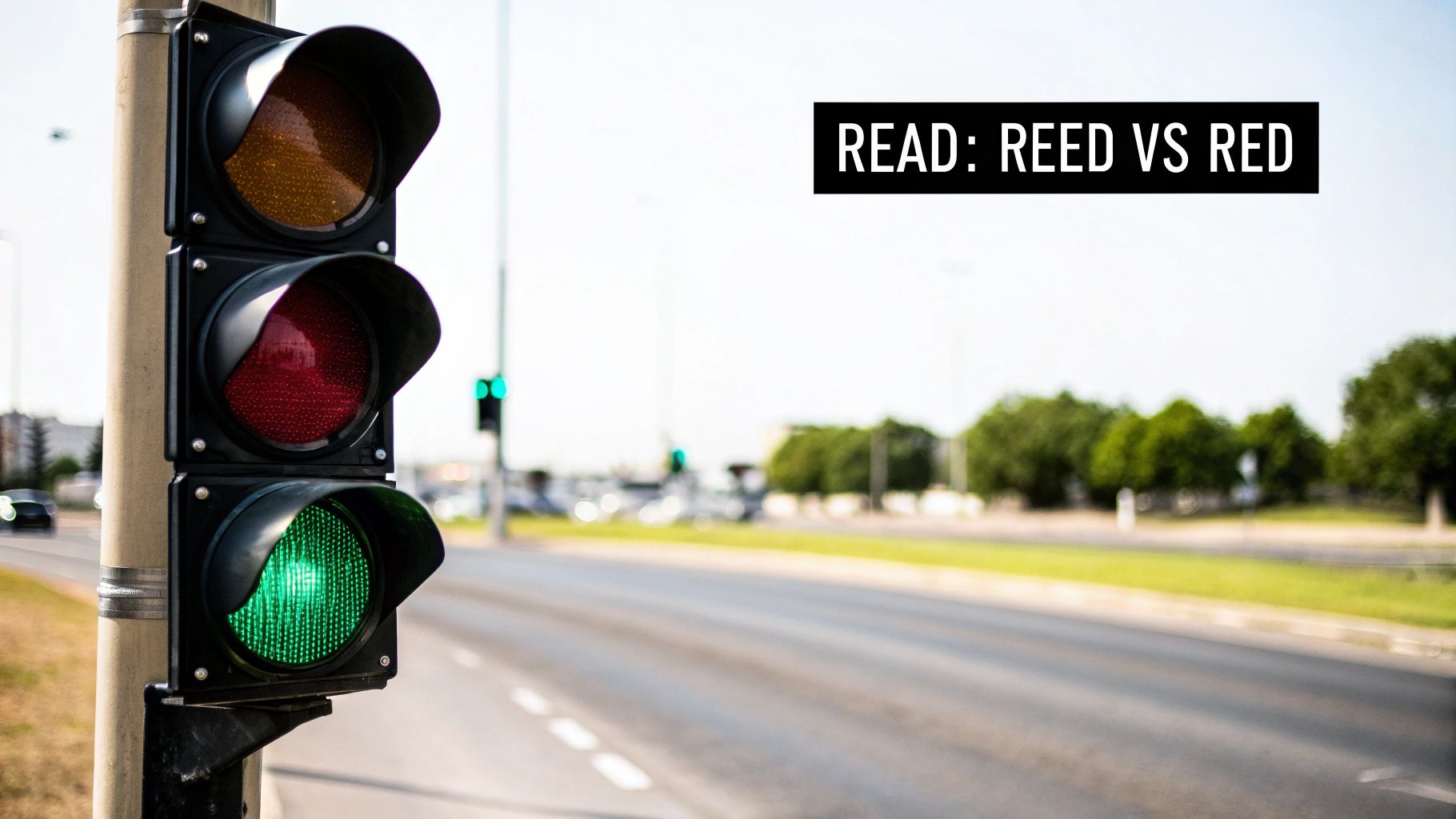
This spelling-sound switch can feel a little tricky at first, but there's a simple way to remember it. Think of the present tense sound, /riːd/, as the "green light" – it's happening now, it's ongoing. The past tense sound, /rɛd/, is the "red light," signalling something that has already stopped or is finished.
This little mental trick helps you instantly know which meaning is intended just from hearing it in a sentence. For instance, "I read every day" uses that long /riːd/ sound. But if you hear, "Yesterday, I read a great book," you'll know it's the short /rɛd/ sound because the action is in the past. It’s a tiny change with a huge impact.
Getting these subtle distinctions right is key for clear communication, even in countries with incredibly high literacy. The Netherlands, for example, has an exceptional adult literacy rate of 99.0%, a place where nuances in language are well understood. You can dig into more global literacy statistics if you're curious.
This diagram shows the switch perfectly:
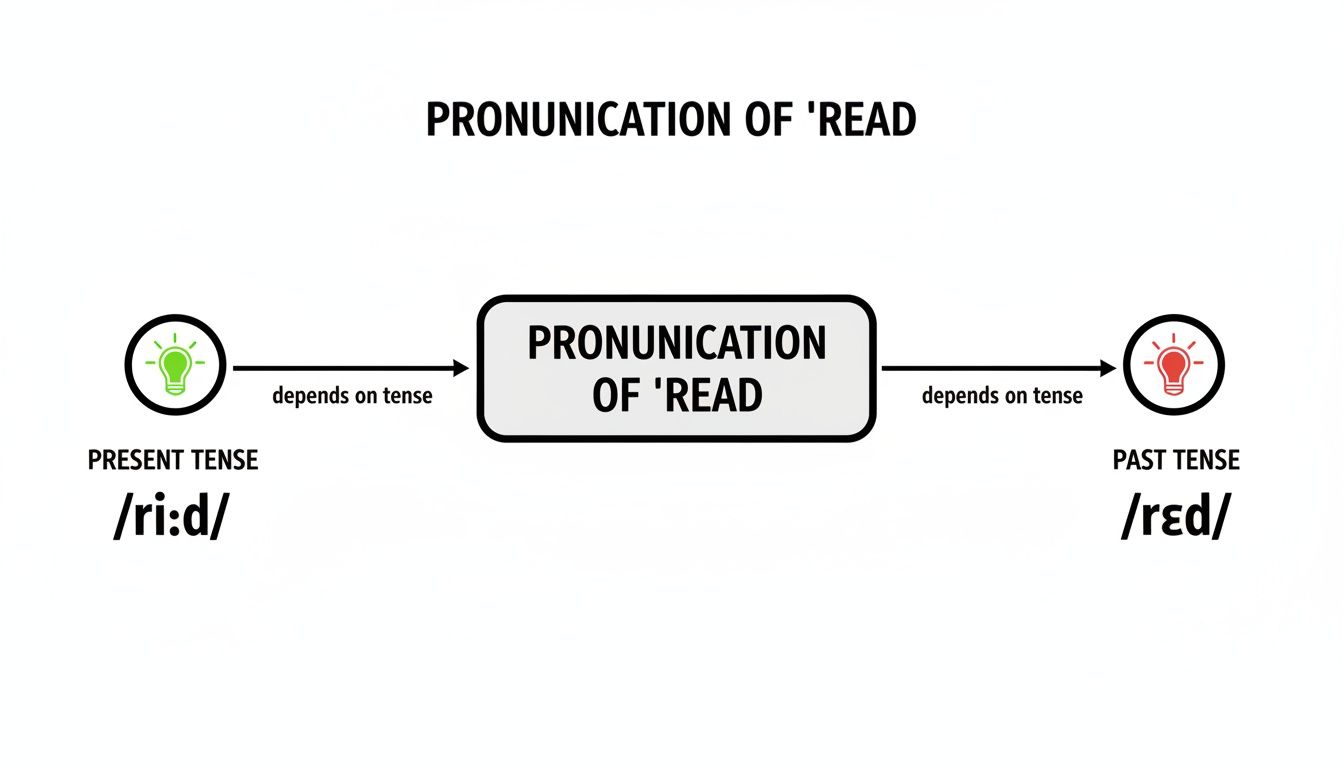
As you can see, the sound transforms from /riːd/ for things happening now to /rɛd/ for events that are over. Getting your head around this is the first real step to mastering this common but sneaky irregular verb.
Pronunciation Guide: Read vs Read
To make this crystal clear, here’s a quick side-by-side comparison. It’s all about what you hear, not what you see.
| Form | Pronunciation (IPA) | Sounds Like | Example Sentence |
|---|---|---|---|
| Present Tense | /riːd/ | "reed" | I need to read this email. |
| Past Tense & Participle | /rɛd/ | "red" | She read the book last week. |
Wrapping your head around this single, crucial sound change is the key. Once you've got it, you'll be using both forms like a native speaker. Now, let's look at how to put this into practice.
How To Use Read for Past Actions
Once you've got the pronunciation switch down, it's time to put the past tense read into practice. The secret is to reserve it for actions that are completely and utterly finished. Think of events with a clear start and a definite end, all locked in the past.
A great way to picture this is like a closed book. When you say, "I read that article," you're talking about an action that's done. You started it, you finished it, and the story of that specific action is now complete.
Spotting Simple Past Tense Signals
Certain "time signal" words are your best friends here. They're clues that tell you the simple past tense is the right move. When you see these in a sentence, they anchor the action firmly in the past, making the /rɛd/ pronunciation the only correct choice.
Keep an eye out for any phrase that pins down a finished time:
- Yesterday: "He read the newspaper yesterday morning."
- Last week/month/year: "They read the instructions last week."
- A specific time ago: "I read her email five minutes ago."
- A specific date or year: "She read War and Peace in 2023."
These phrases act like signposts, confirming that the act of reading is over and done with. Using the past tense form of read here will make your English sound sharp and natural.
The rule is simple: if the action of reading is fully contained within a finished time period, you should always use the past tense pronunciation /rɛd/.
For instance, the sentence "Last night, I read three chapters before bed" is a perfect example. "Last night" tells you the timeframe is closed, so the simple past tense is required. This is a world away from ongoing habits, like "I read (/riːd/) every night," which uses the present tense.
Getting this distinction right is fundamental for clear communication. As we dig into more complex situations, just remember this core rule—finished time, finished action. It's the solid foundation you need to master this tricky irregular verb.
When we talk about the past tense, the word read (pronounced /rɛd/) often comes up. But this little word does more than just describe a completed action. It also pulls double duty as a past participle, and understanding this role is key to unlocking more complex and nuanced ways of speaking English.
Think of the past participle as a team player. It doesn't usually stand on its own. Instead, it partners up with "helper" verbs like have, has, had, was, or were. When they join forces, they build more sophisticated sentence structures that let you express ideas with greater precision.
Building Perfect Tenses
One of the most common places you'll see the past participle read is in the perfect tenses. These tenses are brilliant for connecting a past event to the present moment or to another point in the past. The present perfect, for instance, is all about an action that happened at some unspecified time but still holds relevance right now.
Let's look at the difference:
- Simple Past: "I read that book last year." (This action is done and dusted, locked into a specific time frame.)
- Present Perfect: "I have read that book." (The action is finished, but the experience, the knowledge, or the memory of it is still with me.)
It's a subtle distinction, but a crucial one. Strong reading comprehension skills depend on picking up on these nuances. It's no surprise that countries like the Netherlands, which posted PISA reading scores of 459.243 in 2022, have education systems that focus on these fine points of language. You can dig deeper into these international academic assessments if you're curious.
Key Takeaway: Using "have read" or "has read" is a signal. It tells your listener that a past reading action has a direct connection to what's happening now. It’s not just about what you did, but how it matters today.
Shifting Focus with the Passive Voice
The past participle read is also the magic ingredient for forming the passive voice. This handy structure lets you shift the focus of a sentence. Instead of highlighting the person doing the action, you can put the spotlight on the object that's receiving it. In other words, the thing being read becomes the star of the show.
Check out how the emphasis changes:
- Active Voice: "The teacher read the story to the class." (Here, the focus is squarely on the teacher.)
- Passive Voice: "The story was read aloud to the class." (Now, the story itself is the main subject.)
See how "was read" moves the story front and centre? This is incredibly useful when you don't know who did the reading, or when it's simply less important than the fact that the reading happened.
Common Mistakes to Avoid
Navigating the verb 'read' can feel like walking through a minefield of potential errors, but don't worry—most learners trip over the same few hurdles. Once you recognise these common slip-ups, you can sidestep them before they become bad habits and start using the past tense read with confidence.
The most frequent mistake is purely about sound. It’s so easy to see the letters r-e-a-d and automatically use the present tense /riːd/ pronunciation, even when the sentence is clearly talking about the past. This is a classic trap because our brains love consistency and want to match the same spelling with the same sound every time.
Pronunciation and Tense Confusion
Another common sticking point is mixing up the simple past with the present perfect. While both talk about things that have already happened, they aren't interchangeable. The simple past is for finished actions at a specific time, whereas the present perfect is all about connecting a past action to the here and now.
Here are a few examples of these mistakes in action and how to fix them:
Problem: "Yesterday, I read (/riːd/) the first chapter."
- Solution: "Yesterday, I read (/rɛd/) the first chapter."
- Reason: The word "yesterday" locks the action firmly in the past, which means you need the /rɛd/ sound.
Problem: "I read that book last week, so I understand the story now."
- Solution: "I have read that book, so I understand the story now."
- Reason: The phrase "so I understand now" creates a direct link between the past action and your current knowledge. That connection to the present calls for the present perfect tense.
The golden rule is simple: the spelling of 'read' never changes, but its sound and the words around it do. Just keep an eye out for time clues in the sentence to pick the right form.
This kind of attention to detail is what makes for clear communication. Even in highly literate nations, reading itself can be a challenge. It's quite shocking, but a 2017 report found that 18% of Dutch 15-year-olds struggle with reading comprehension, which just goes to show that mastering the nuances of language is a universal challenge.
Beyond the tricky nature of 'read', getting familiar with other commonly mispronounced words can give your overall clarity a real boost. Along the same lines, you might find our guide on the difference between focussing or focusing helpful.
Practice Exercises to Build Your Confidence
Alright, theory is one thing, but the best way to really get the hang of using the past tense read is to jump in and start using it. These quick exercises are designed to help you lock in what we’ve covered and build that confidence for real-world conversations.
Ready to put your knowledge to the test? Let’s start with a simple fill-in-the-blanks challenge to see how well you can spot the correct form based on context.
Exercise 1: Fill in the Blanks
For each sentence, choose the correct form of the verb "read." Don't forget to look for those little time clues!
- I need to _______ this report before the meeting tomorrow.
- She _______ the entire novel in just two days last weekend.
- Have you ever _______ a book that completely changed your perspective?
- He often _______ the news online to stay updated on current events.
Quick Tip: Keep an eye out for signal words like "tomorrow" or "last weekend," as well as helper verbs like "have." They're your best friends when it comes to picking the right tense for 'read'.
Once you’re comfortable with the mechanics, you can take things a step further. It's not just about grammar; it’s about understanding the meaning. Working to improve comprehension skill will make it much easier to interpret texts where different tenses are in play.
Exercise 2: Pronunciation Check
Now for the tricky part: the sound. For each sentence, decide if "read" should sound like /riːd/ (like reed) or /rɛd/ (like red).
- Yesterday, I read an interesting article. (Pronunciation: _______)
- We will read the instructions together. (Pronunciation: _______)
- The email was read by the entire team an hour ago. (Pronunciation: _______)
Running through drills like these helps build muscle memory, making the correct pronunciation and usage of 'read' feel like second nature. And for any writers out there serious about polishing their skills, checking out some of the best apps for writing in 2026 can give you some fantastic tools to practise and improve.
(Scroll down for the answer key!)
Answering Your Questions About 'Read'
Even after walking through all the rules, a few tricky questions about the past tense read still tend to pop up. This final section is all about tackling those common queries head-on, giving you clear, straightforward answers so you can walk away feeling confident.
Let's clear up any lingering confusion once and for all.
How Do I Know Which Pronunciation to Use?
The secret is all in the context. If the sentence is about a current habit or something happening in the future, you’ll use the long /riːd/ sound. Think of the sentence, "I read (/riːd/) for an hour every night."
But if you spot any time clues that anchor the action in the past—words like "yesterday," "last week," or "an hour ago"—then you need the short /rɛd/ sound. For instance, "She read (/rɛd/) your message" clearly points to a completed action.
The Litmus Test: Just ask yourself, "Is the action finished?" If the answer is yes, then it’s pronounced /rɛd/. If it's happening now, is a general habit, or is set in the future, it's /riːd/.
What’s the Difference Between "I Read" and "I Have Read"?
This is a great question that gets right to the heart of the simple past versus the present perfect tense. While both talk about the past, they do different jobs.
"I read the book" is in the simple past. It describes an action that was finished at a specific point in time. Think of it as a closed chapter: "I read the book last summer." The event is over and done with.
"I have read the book" is in the present perfect. This describes a past action that still has some relevance or connection to the present. The exact timing isn't the point; what matters is the result now—the fact that you now have the knowledge or experience from reading it. If you're looking for more ways to sharpen your skills, check out these excellent alternatives to traditional writing workshops.
Is "Readed" Ever Correct in English?
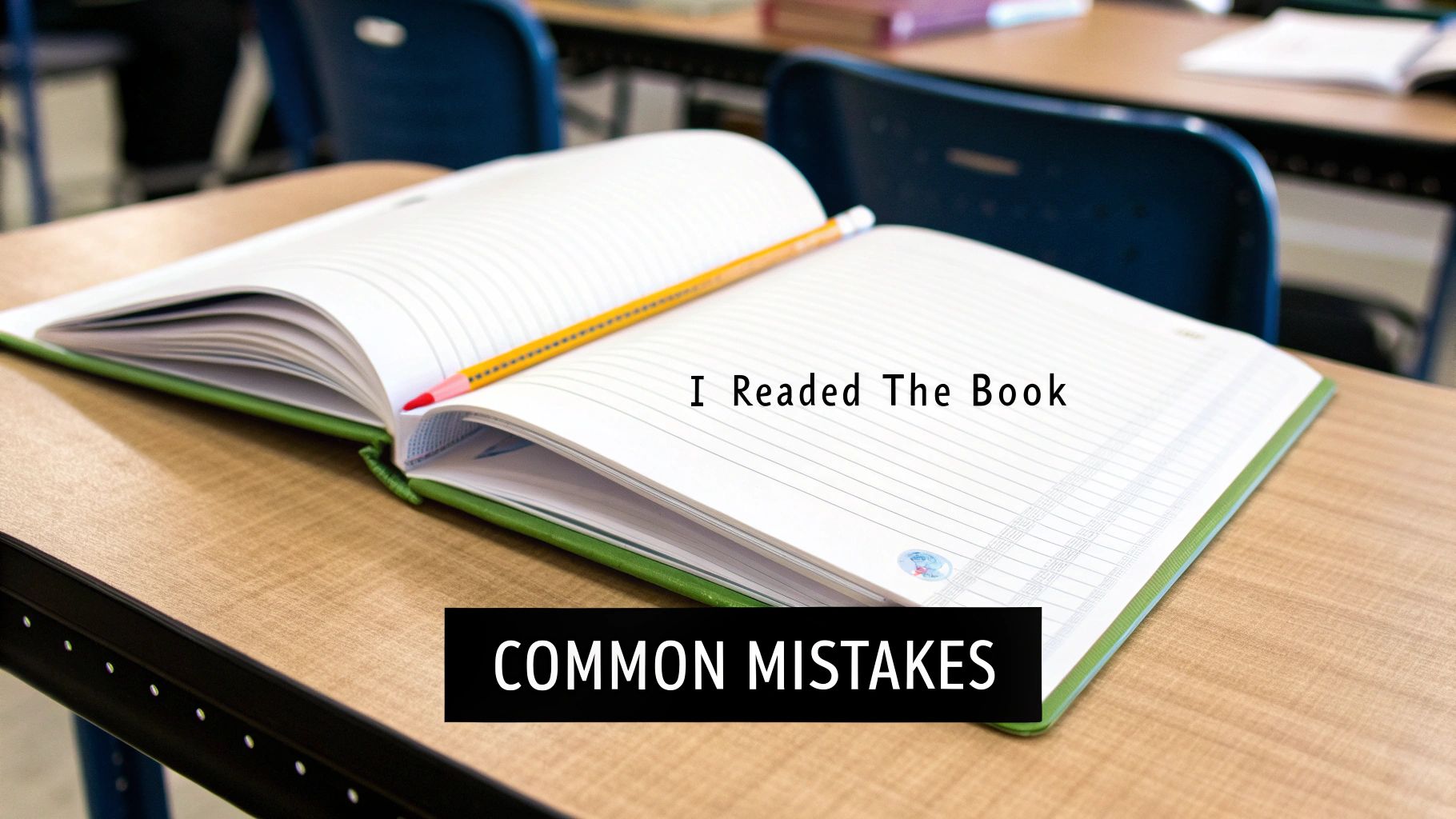
This one’s easy: nope. "Readed" is not a word in standard English and is always incorrect. The verb "read" is irregular, so it breaks the typical rule of just adding "-ed" to make it past tense.
- Correct: He read the email.
- Incorrect: He readed the email.
This is a classic mistake for learners, but the rule is simple to remember. The spelling for the present, simple past, and past participle is always r-e-a-d. The only thing that ever changes is how you say it, and that all comes down to the context.
At People & Media B.V., we believe that mastering the small details of language opens up a world of confident communication and deeper understanding. Explore our platform to find more resources that support your lifelong learning journey. https://www.peopleandmedia.com


Responses