Sap What Is Hana? sap what is hana powering real-time analytics

Let’s get one thing straight: SAP HANA isn't just another database. It’s a complete rethink of how businesses handle their data, built from the ground up for one thing: speed. At its heart, HANA is a high-performance data platform that works its magic by processing enormous amounts of information directly in a computer's main memory (RAM), sidestepping the slow, mechanical hard drives of the past. This in-memory approach is the secret sauce that delivers real-time analytics and transaction processing at a pace traditional databases simply can't touch.
What Is SAP HANA in Simple Terms?
Think of it as the intelligent foundation for your entire business. To really get what that means, let's look at a classic business problem. A retailer using an old-school database probably waits until the end of the day to run its big sales reports. Why? Because pulling all that data from slow disk storage takes forever and would grind the live system—the one processing new sales—to a halt.
SAP HANA flips that script entirely. By keeping all the live, operational data in the computer’s lightning-fast memory, it erases the delay between something happening in the business and your ability to analyse it. A sale happens, and you can see its impact right now.
A Fundamental Shift in Data Processing
Imagine a traditional database is like a huge, sprawling library. The books (your data) are stored on endless shelves (disk drives). To get an answer to a question, a librarian has to find the right book, haul it over to a reading desk, process the information, and then put it back. It’s a reliable system, but it's painfully slow.
SAP HANA, on the other hand, is like having every single book in that library open on one massive, instantly searchable digital table right in front of you. There’s no fetching, no waiting. Analysis and new transactions happen in the same place, at the same time. This simple architectural shift is what lets businesses ask incredibly complex questions of their live data and get answers on the spot.
The screenshot below, taken from SAP's official product page, neatly sums up its role as a modern, all-in-one platform for data management.
This visual shows that SAP HANA is much more than a database; it’s a comprehensive engine designed to handle just about any data workload you can throw at it.
The real game-changer is HANA's ability to run both transactions (like processing an order) and analytics (like forecasting sales) on a single copy of the data. This kills off data redundancy and latency, paving the way for a truly real-time business.
To make sense of how it all works, it’s helpful to break down its core components. The table below summarises the three pillars that define SAP HANA.
SAP HANA Core Characteristics at a Glance
| Characteristic | Simple Explanation | Primary Benefit |
|---|---|---|
| In-Memory | Processes data directly in the computer's RAM, which is thousands of times faster than traditional disk storage. | Drastically accelerates query and transaction speeds, enabling real-time insights. |
| Columnar Store | Organises data in columns instead of rows, which is highly efficient for analytical queries that scan specific data points. | Faster data retrieval and better compression, allowing more data to be stored in memory. |
| Unified Processing | Combines transactional (OLTP) and analytical (OLAP) workloads on one system, eliminating the need for separate systems. | Simplifies IT landscapes and provides instant business intelligence on live operational data. |
These three characteristics—in-memory speed, columnar efficiency, and unified processing—work together to create a platform that’s fundamentally different from what came before it. They are the engine that powers the next generation of business applications.
Understanding the Architecture Behind the Speed
To really get what makes SAP HANA tick, we need to pop the bonnet and look at the engineering that delivers its incredible performance. The platform’s speed isn't some kind of black magic; it's the result of three core architectural pillars working together seamlessly. Each one was designed to smash a specific bottleneck found in old-school database systems.
This quick map shows how HANA's core components—in-memory processing, columnar storage, and unified workload management—all pull together in a single, cohesive platform.
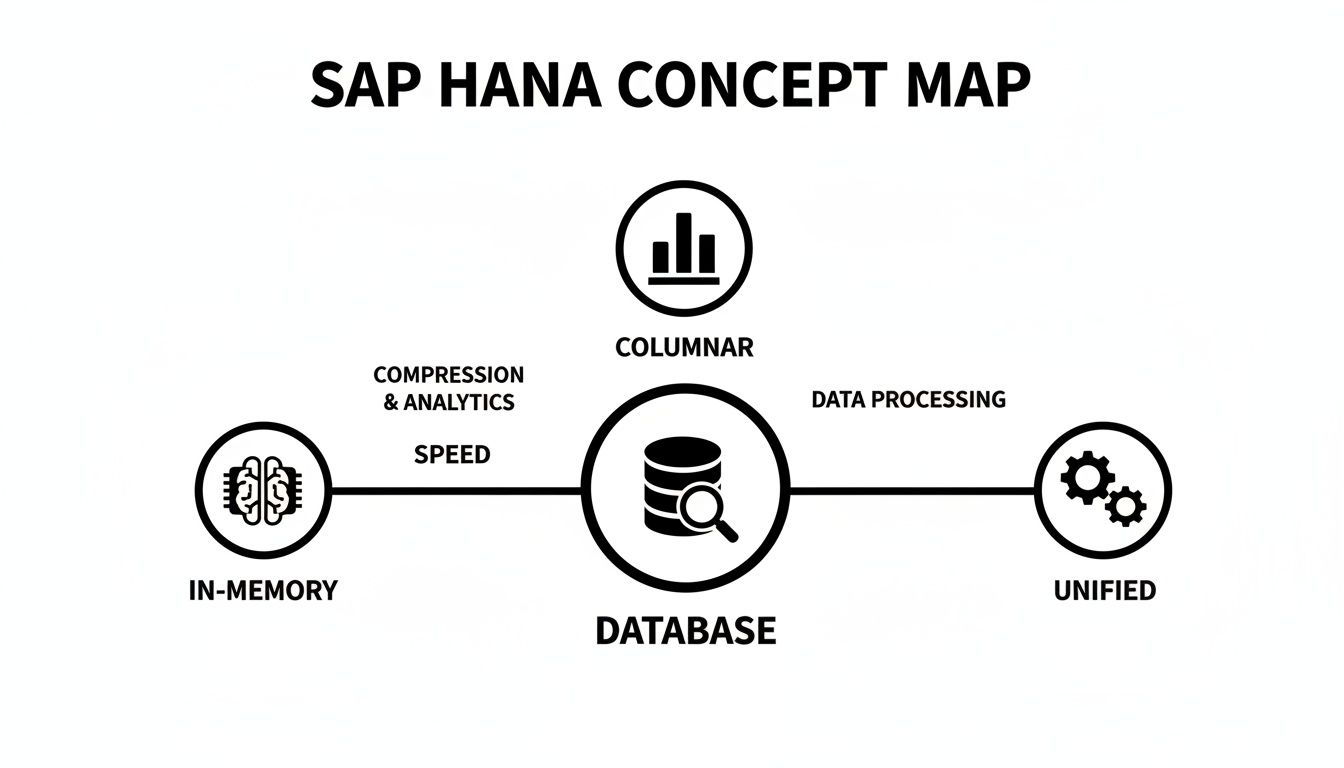
As you can see, these aren't just separate features bolted on. They are deeply interconnected parts of a modern data engine, all built for one purpose: to deliver unprecedented speed and simplicity.
The In-Memory Revolution
The first, and most important, pillar is its in-memory design. For decades, databases stored the bulk of their data on spinning hard disk drives (HDDs) or, more recently, solid-state drives (SSDs). To analyse anything, the system had to find the data on the disk, copy it into the computer’s main memory (RAM), and only then could it start processing. This constant shuffling back and forth creates a massive performance lag.
SAP HANA blows this problem away by keeping the entire operational dataset right in RAM.
Think of it this way: a traditional database is like a chef who has to run down the hall to a massive pantry for every single ingredient. An in-memory database is like a chef who has every ingredient perfectly prepped and organised on the countertop, right in front of them. The jump in efficiency is enormous, enabling data processing speeds that can be thousands of times faster.
Smart Data Organisation with Columnar Storage
The second pillar is the columnar data store. Most databases, especially those built for transactional tasks like recording a sale, store data in rows. A row-based system is like a customer's paper file—it has their name, address, and last purchase all written on one line. To calculate the total sales for Manchester, the system has to read every single customer's complete file just to pull out the city and purchase amount, ignoring all the other irrelevant data. It's incredibly wasteful.
SAP HANA turns this on its head by primarily using a columnar approach, which groups similar data together. Imagine a spreadsheet where all the "City" data is in one column and all the "Sales Amount" data is in another. When you ask for total sales by city, the system only needs to read those two specific columns. This simple change drastically cuts down the amount of data the system has to scan for analytical queries.
This columnar structure doesn't just speed up analytics; it also allows for phenomenal data compression. Because you're storing similar data types together (like a column full of numbers), the compression algorithms can shrink the data's footprint by up to 5-10 times more effectively than in row-based systems.
This efficiency means you can cram way more data into that precious, high-speed RAM, which boosts performance even further and keeps storage costs down.
How In-Memory and Columnar Work Together
These two architectural choices aren't just working in parallel; they amplify each other. The raw speed of in-memory computing makes it possible to run complex calculations on the fly, and the laser-focused efficiency of the columnar store ensures those calculations are done with the absolute minimum amount of data movement.
The combination creates a system that is exceptionally good at two very different jobs:
- Transactional Work (OLTP): Rapidly writing new data, like processing an online order the second it happens.
- Analytical Work (OLAP): Running heavy, complex queries across massive datasets, like forecasting next quarter's demand across all product lines.
By mastering both, SAP HANA gets rid of the need for businesses to run separate, siloed systems for their day-to-day operations and their big-picture analytics. That alone massively simplifies the entire data landscape.
How Key Features Actually Change Your Business
It's one thing to understand SAP HANA's architecture on paper, but it's another thing entirely to see how it reshapes the way a company works. The real magic happens when you connect its technical muscle to long-standing business headaches, turning raw speed into a genuine competitive edge.

The biggest shift? Moving away from batch jobs and after-the-fact reports to live, in-the-moment decision-making. This is what lets an organisation stop reacting to yesterday's problems and start proactively shaping tomorrow's outcomes.
Unifying Transactions and Analytics
For decades, businesses lived with two separate data worlds. First, you had your OLTP (Online Transaction Processing) system, the workhorse handling the daily grind of sales orders, stock updates, and customer data. Then, you had your OLAP (Online Analytical Processing) system—a data warehouse for spotting historical trends and running massive reports.
This separation created an unavoidable time lag. Data had to be pulled from the OLTP system, cleaned up, and loaded into the OLAP system (a process known as ETL). This usually happened overnight, meaning your "business intelligence" was always a day old.
SAP HANA completely bulldozes the wall between these two worlds, creating a single platform that handles both OLTP and OLAP jobs at the same time.
Think about a retail manager trying to tweak a marketing promotion. On a unified system, every single sale at the till (a transaction) instantly updates the company-wide sales forecast and inventory levels (analytics). The manager sees the impact of their choices right now, not 24 hours later.
This convergence is only possible because of HANA’s in-memory, columnar design. It's fast enough to log new transactions without choking the complex analytical queries running on the exact same data, at the exact same second. This is the core of what people mean when they talk about the "real-time enterprise."
True Real-Time Analytics and Insights
"Real-time" is a term that gets thrown around a lot, but with SAP HANA, it actually means something. Because your analytics are running on live operational data, you can ask—and answer—critical questions as things are happening. This unlocks powerful new capabilities that just weren't feasible before.
- Live Fraud Detection: A bank can analyse a credit card purchase against a customer’s entire history and complex fraud models in milliseconds—before the transaction is even approved.
- Dynamic Supply Chain Optimisation: A logistics firm can reroute trucks on the fly based on live traffic, port congestion, and incoming orders, slashing delays and fuel costs.
- Predictive Maintenance: A manufacturer can monitor sensor data from factory machinery in real-time, letting predictive algorithms flag a potential failure and schedule maintenance before a costly breakdown brings the line to a halt.
These examples show a fundamental shift away from historical reporting ("What happened?") towards predictive and prescriptive analytics ("What will happen, and what should we do about it?").
Secure and Reliable by Design
All that speed would be worthless without security and stability. SAP HANA was built from the ground up with enterprise-grade features to keep your data safe and available.
- Persistence Layer: Even though it's an in-memory database, HANA is fully durable. Every transaction is written to a persistence layer on disk storage. This guarantees that if the power goes out or the system needs a restart, your data can be recovered with zero loss.
- Multi-Tenancy: This feature lets a single HANA system be securely divided to serve multiple independent applications or even different companies (tenants). It’s essential for cloud deployments, ensuring data is completely isolated and secure in a shared environment. It's also a key enabler for building modern applications, including those that integrate intelligent automations. To get a better sense of how this works in today's tech, check out our guide on what AI agents are and their role in technology.
When you put it all together, these features create a platform that isn't just ridiculously fast, but also tough and secure enough to run the most critical parts of your business.
Navigating the SAP HANA Product Ecosystem
If you're new to the SAP world, it’s easy to get tangled in the web of product names. You hear HANA, S/4HANA, BW/4HANA, and they all sound frustratingly similar. But understanding how they fit together is the key to seeing why SAP HANA is such a powerful foundation for modern business.
Think of it this way: SAP HANA is the high-performance engine. It's the source of the raw speed and data-crunching power. The other products, like S/4HANA, are the fully kitted-out vehicles built around that engine, each designed for a very specific job.
SAP S/4HANA: The Intelligent Business Suite
First up is the big one: SAP S/4HANA. This is SAP's flagship Enterprise Resource Planning (ERP) suite. It’s designed to run every core part of a company—from finance and supply chain to manufacturing and HR. The most important thing to know is that S/4HANA was built from the ground up to run only on the SAP HANA database.
This isn't a coincidence. S/4HANA relies on HANA's in-memory speed to give you real-time insights, a simpler data model, and a much cleaner user experience. By getting rid of the performance roadblocks found in older databases, S/4HANA can run complex calculations and pull up analytics right inside the day-to-day operational workflows. This synergy is exactly what drives complex business transformation projects, such as the detailed processes involved with SAP S/4HANA migrations.
SAP BW/4HANA: The Modern Data Warehouse
Next in the lineup is SAP BW/4HANA. While S/4HANA is busy running the company's daily operations, BW/4HANA has a completely different mission. It’s a specialised tool for data warehousing and analytics. Its job is to pull in massive amounts of historical and current data from all over the place—S/4HANA, legacy systems, non-SAP applications—and make sense of it all.
Just like its ERP cousin, BW/4HANA is optimised to run exclusively on the SAP HANA database. This gives it the horsepower to blast through complex analytical queries on huge datasets, supporting the kind of strategic business intelligence that informs long-term planning. It's the go-to solution for deep-dive reporting and understanding trends over time.
The key takeaway is specialisation. S/4HANA runs the business in real-time. BW/4HANA analyses the business's performance over time. Both need the same powerful SAP HANA engine to do their jobs properly.
SAP HANA Cloud: The Platform as a Service
Finally, we have SAP HANA Cloud. This isn't an application like the others; it's a different way of getting the HANA database itself. It’s a fully managed, database-as-a-service (DBaaS) that gives you all the power of HANA without having to buy and manage the servers, storage, and all the other infrastructure yourself.
SAP HANA Cloud is really the future direction for HANA. It offers incredible flexibility, scales up or down as you need it, and makes connecting to other cloud services much easier. It acts as a central hub, bringing data together from countless sources to provide a single place for building new apps or running analytics.
To help tie all this together, here’s a simple breakdown of how these products differ.
Differentiating Key SAP Products on HANA
| Product | Primary Role | Analogy |
|---|---|---|
| SAP S/4HANA | A complete business suite for managing daily operations (ERP). | The entire car, including the body, interior, and electronics. |
| SAP BW/4HANA | A specialised system for data warehousing and advanced analytics. | The car's sophisticated diagnostic and performance-tuning computer. |
| SAP HANA Cloud | The cloud-based deployment of the core database platform. | The high-performance engine, delivered and maintained by a specialist. |
At the end of the day, SAP HANA is the common thread that powers the entire modern SAP landscape. Whether it's driving transactional processes in S/4HANA, fuelling deep analytics in BW/4HANA, or serving as a flexible platform in the cloud, its job is always the same: to deliver the speed and intelligence that businesses need to compete.
Choosing Your Deployment and Migration Path
Deciding to bring SAP HANA into your organisation is a huge strategic move, but figuring out what you want is only half the battle. The how is just as important. Your first major decision is choosing the right deployment model, a choice that will directly shape your costs, control, and agility down the line.
There’s no magic "best" option here. The right path depends entirely on your company's specific needs, technical muscle, and long-term vision. Each route offers a different trade-off between flexibility, management headaches, and upfront investment.
Exploring Your Deployment Options
The way you choose to deploy HANA fundamentally defines your relationship with the technology. It answers the big questions: Who manages the hardware? Who handles the updates? How do we scale when the business grows? Let's break down the main models.
- On-Premise: The classic approach. You own and manage everything—all the hardware, all the infrastructure, right in your own data centre. This gives you maximum control and is often the go-to for organisations with strict data residency rules or serious security concerns, provided they have the in-house IT expertise to run a complex environment.
- Public Cloud (IaaS): With this model, you run SAP HANA on infrastructure from a major cloud vendor like AWS, Azure, or Google Cloud. Known as Infrastructure-as-a-Service, it shifts all the hardware management to the provider. The big wins here are greater scalability and a pay-as-you-go cost structure.
- Hybrid Model: A best-of-both-worlds approach that combines on-premise and cloud deployments. It lets you keep sensitive data on-site while using the cloud for things like development, testing, or less critical workloads. It's all about finding that perfect balance of control and flexibility.
- SAP HANA Cloud (DBaaS): This is the fully managed, Database-as-a-Service offering directly from SAP. It takes nearly all the infrastructure management off your plate, freeing up your team to focus purely on building applications and pulling insights from your data. It’s the simplest and most agile way to get your hands on HANA's power.
When you're mapping out your HANA deployment, especially in the cloud, picking the right infrastructure is everything. To make sure your choice lines up with both your technical and business goals, it’s vital to understand how to choose a cloud provider.
Migration as a Business Transformation
It’s easy to look at a move to SAP S/4HANA and see a simple technical upgrade. That’s a common and costly mistake. A successful migration isn't just an IT project; it's a full-scale business transformation. It's your chance to redesign clunky old processes, simplify how you operate, and truly cash in on the real-time capabilities that HANA opens up.
Thinking strategically from the start is the only way to get the full return on your investment. Before a single line of code gets written, your business goals have to be perfectly aligned with the technical possibilities.
A migration to S/4HANA is not about lifting and shifting old processes onto a faster platform. It’s about reimagining how your business can operate when the limitations of old technology are removed.
Recent research shows that the global push to S/4HANA is still going strong, even as companies navigate the complexities involved. This just goes to show how much value businesses see in making the switch. You can check out more insights on S/4HANA migration trends and challenges. The journey takes careful planning, solid support from the top, and a clear vision for what your company will look like on the other side. It can also be a good moment to review your data practices. For more information, you might be interested in our article on how server-side tracking works and its benefits.
Seeing SAP HANA In Action Across Industries
Tech specs are one thing, but the real test of any platform is its impact on the ground. To truly get what SAP HANA is all about, you need to see how it changes the game for businesses you probably interact with every day. Its power to crunch live data isn't just a feature—it's a massive competitive edge across dozens of sectors.

From the shop floor to the production line, everyone needs instant information. This is where SAP HANA’s speed and all-in-one processing model stop being theory and start driving real business results. It lets companies get more responsive, more efficient, and far better at predicting what’s next.
Retail: Dynamic Pricing and Smarter Supply Chains
Think about a big retail chain. In the old days, figuring out what was selling—let alone adjusting prices or restocking shelves—was a sluggish, overnight job. By the time you had the report, the moment was gone.
With SAP HANA, that whole story is flipped on its head. As soon as an item is scanned at the till, the system is already analysing sales speed, local demand patterns, and even what competitors are charging, all in real time. This unlocks some incredible possibilities:
- Dynamic Pricing: Imagine digital shelf labels that automatically adjust prices to jump on a sudden trend or clear out stock that isn't moving.
- Instant Replenishment: The moment a popular product hits a critical low, an order is fired off to the warehouse. No more empty shelves or missed sales.
You’re no longer just reacting to yesterday's news. Every single sale becomes an immediate, actionable piece of intelligence.
Manufacturing: From Reactive Repairs to Predictive Maintenance
In heavy manufacturing, nothing is more expensive than unplanned downtime. When a critical piece of equipment suddenly fails, the entire production line can grind to a halt, costing a fortune in lost output and emergency repairs.
Now, picture a factory using SAP HANA. They fit their most important machines with sensors that stream constant data—temperature, vibration, pressure—straight into the HANA platform. Advanced analytics running on that live data can spot tiny, almost invisible patterns that signal a machine is about to fail.
That’s the magic of predictive maintenance. Instead of waiting for something to break, you schedule the fix during planned downtime. Costly interruptions are stopped before they can even happen.
This is a huge reason why so many companies are moving to the cloud. In fact, SAP adoption continues to climb across Europe as businesses make the switch, showing a growing trust in these powerful platforms. You can dig into this trend in recent reports covering SAP's growing adoption in Europe.
Financial Services: Real-Time Fraud Detection
For banks and financial institutions, speed is security. Catching fraud after the fact is one thing, but stopping it dead in its tracks is the real goal.
SAP HANA’s in-memory engine gives a bank the power to analyse a transaction the very instant it happens. In just milliseconds, the system can check that transaction against the customer’s entire history, their current location, and complex fraud-detection models. If anything looks off, the transaction is blocked before any money moves.
This capability turns a massive data challenge into a rock-solid security measure—a critical skill for anyone working in data today. If you're curious about this field, have a look at our guide on exploring the complete roadmap to becoming a data analyst.
Got Questions About SAP HANA?
Even after getting the basics down, you're bound to have some specific questions pop up when digging into a platform as deep as SAP HANA. Let's clear up some of the most common ones that people ask when they're getting started.
Is SAP HANA Just Another Database?
Not even close. While it’s built around a ridiculously powerful in-memory database, SAP HANA is a full-blown data platform. It packs in advanced analytics engines, application development tools, and data virtualisation services all in one place.
Think of it less like a storage cabinet for data and more like a complete workshop for building and running the next generation of applications.
Can I Run SAP S/4HANA Without SAP HANA?
That’s a firm no. SAP S/4HANA is the modern business suite from SAP, and it was architected from the ground up to take advantage of the unique in-memory speed and real-time power of the SAP HANA database.
The two are designed to work as a single, symbiotic unit; S/4HANA simply won't run without HANA underneath it. The application is built to squeeze every last drop of performance out of the database’s unique architecture.
What's the Biggest Difference Between SAP HANA and a Database Like Oracle?
The single biggest game-changer is its ‘in-memory first’ architecture. Traditional databases like Oracle are disk-based, which means they have to pull data from much slower storage drives. SAP HANA, on the other hand, keeps the most critical data loaded directly in super-fast RAM.
This design choice, combined with its columnar data structure, is what allows it to tear through complex analytics and transactions at the same time—at speeds that disk-based systems can only dream of. It effectively removes the biggest bottleneck that has plagued database performance for decades.
What this means for you is that you can run heavy analytical queries right on your live transactional data without grinding the system to a halt. That’s something that's often completely impractical on older, disk-centric platforms.
Is SAP HANA Only for Massive Companies?
It might have started that way, but things have changed. With the rise of cloud offerings, particularly SAP HANA Cloud, its power is now within reach for businesses of all sizes through flexible, subscription-based models.
This shift has really democratised access to high-performance computing. You no longer need a massive upfront investment in hardware and infrastructure, allowing smaller and mid-sized companies to get the same real-time capabilities that used to be reserved for global corporations. The focus has moved from owning the gear to simply accessing the service.




Responses