IPv6 vs IPv4 A Practical Guide to the Future of the Internet

At its heart, the whole IPv6 vs IPv4 debate boils down to a single, critical problem: we've run out of road. IPv4's address pool of roughly 4.3 billion is completely exhausted. This makes IPv6—with its practically infinite supply of addresses—the only way forward for the internet, especially with the explosion of IoT devices connecting every day.
Understanding the Internet's Essential Upgrade
The move from Internet Protocol version 4 (IPv4) to Internet Protocol version 6 (IPv6) isn't just some minor technical refresh. It's a fundamental evolution needed to keep the lights on for global connectivity. For decades, IPv4 was the workhorse of the internet, faithfully routing our data. But its creators back in the early 1980s could never have imagined the sheer number of devices we’d have online today—from phones and laptops to smart fridges and industrial sensors.
This incredible growth completely tapped out the available IPv4 addresses. To get around this, network engineers got creative with workarounds like Network Address Translation (NAT), which lets a whole private network of devices hide behind a single public IP address. While NAT has kept things afloat, it adds complexity and gets in the way of true end-to-end communication, a real headache for many modern applications. If you're curious about how your home network gear juggles these connections, you might find our guide on the differences between a modem or router useful.
Why the Shift to IPv6 Matters
The switch to IPv6 is about more than just getting more addresses; it’s about building a better foundation for the internet's future. Yes, the massive address space is the headline feature, but the improvements run much deeper. IPv6 was designed from the ground up with efficiency, security, and scalability baked right in.
Here are the key drivers behind this essential upgrade:
- Fuelling the Internet of Things (IoT): With billions of IoT devices coming online, every single one needs its own unique IP address. IPv6 delivers, providing more than enough addresses to connect every gadget we can dream of directly to the internet.
- Bringing Back End-to-End Connectivity: By making NAT obsolete, IPv6 simplifies network design. It allows devices to talk directly to each other, which can seriously improve the performance and reliability of things like VoIP calls and online gaming.
- Security and Efficiency by Design: IPv6 isn't just an update; it's a redesign. It includes features like mandatory IPsec for stronger security and a streamlined packet header that cuts down on processing overhead for routers, making traffic flow more smoothly.
The move to IPv6 is less about replacing an old system and more about building a scalable, secure, and more efficient internet capable of supporting the next generation of technology and global communication demands.
To give you a clearer picture, I've put together a quick table that breaks down the most significant distinctions in the IPv6 vs IPv4 comparison.
Key Differences IPv4 vs IPv6 at a Glance
This table offers a side-by-side summary of the fundamental distinctions between the two internet protocols, serving as a handy reference.
| Feature | IPv4 | IPv6 |
|---|---|---|
| Address Space | 32-bit (approx. 4.3 billion addresses) | 128-bit (approx. 340 undecillion addresses) |
| Address Notation | Dotted-decimal (e.g., 192.168.1.1) | Hexadecimal (e.g., 2001:0db8:85a3::8a2e) |
| Header Size | 20-60 bytes (variable length) | 40 bytes (fixed length) |
| NAT Requirement | Often required due to address scarcity | Not required; enables end-to-end connectivity |
| Configuration | Manual or via DHCP | Stateless Address Autoconfiguration (SLAAC) & DHCPv6 |
| Security | Optional (IPsec as an add-on) | Integrated (IPsec is a mandatory component) |
As you can see, IPv6 isn't just a bigger version of IPv4; it's a smarter, more robust protocol designed for the demands of the modern internet.
Comparing Address Space and Architecture

The most glaring difference when you put IPv6 and IPv4 side-by-side is the sheer scale of their address spaces. It’s not just an upgrade; it’s a complete re-imagining of what’s possible.
IPv4 runs on a 32-bit system, which gives us about 4.3 billion unique addresses. That sounded like a lot in the 1980s, but it's now completely exhausted. IPv6, on the other hand, uses a 128-bit system. The number it produces is so vast it’s hard to wrap your head around.
To put it in perspective, we’re talking about 340 undecillion addresses. That's 340 followed by 36 zeroes. If the entire IPv4 address space was the size of a single A4 sheet of paper, the IPv6 space would be a stack of paper reaching our sun. This isn’t just about having more room; it fundamentally changes how we design and manage networks.
This architectural leap takes us from a world of scarcity to one of abundance. The biggest casualty of this shift? Network Address Translation (NAT). NAT was a clever but clunky workaround for IPv4's limitations, allowing many devices on a private network to share one public IP. It worked, but it also added complexity and broke the internet's original promise of true end-to-end communication.
Understanding IPv6 Address Notation
Getting away from IPv4's familiar dotted-decimal format can feel a bit jarring at first. IPv6 uses hexadecimal notation, which looks intimidating but is actually quite logical once you get the hang of it. An IPv6 address is made up of eight groups of four hexadecimal digits, separated by colons.
A full, unabridged IPv6 address might look like this:2001:0db8:85a3:0000:0000:8a2e:0370:7334
That’s a mouthful. Thankfully, the designers built in two simple rules to make these addresses more manageable for humans:
- Leading zeros can be dropped: The group
0db8becomesdb8, and0370is the same as370. - One consecutive block of zeros can be replaced with a double colon (::): This is a huge space-saver.
Applying those rules, our example address shrinks down to a much cleaner version:2001:db8:85a3::8a2e:370:7334
This streamlined notation makes day-to-day work with IPv6 addresses far more practical for network teams.
The Real-World Impact of Abundant Addresses
The freedom that comes with IPv6’s massive address pool is a game-changer. We finally have enough unique, globally routable addresses for every conceivable device on the planet, unlocking a whole new level of internet capability.
This is absolutely critical for the Internet of Things (IoT). For a country like the Netherlands, for instance, slow IPv6 adoption can actively hold back IoT innovation, since these interconnected devices depend on a massive pool of unique addresses to function properly. This not only drives up the cost of scarce IPv4 addresses but can also tarnish a nation’s image as a forward-thinking tech hub.
The core architectural benefit of IPv6 isn't just about having more addresses; it's about restoring the internet's original principle of direct, end-to-end connectivity for every device, which simplifies networks and enables new innovations.
This direct connectivity model means your smart thermostat, your car, and your factory sensors can all have their own public IP addresses without complex network gymnastics. It simplifies development, opens up new security possibilities, and cuts down latency for real-time applications.
To truly appreciate the elegant solution IPv6 provides, it helps to understand the old problems. Digging into the details of IPv4 addressing and subnetting really highlights the complexities it was designed to solve. Ultimately, this vast new architecture paves the way for a more direct, efficient, and interconnected digital world.
Diving into Protocol Efficiency and Header Design
When you look past the enormous address space, the IPv6 vs IPv4 debate reveals deep-seated differences in their fundamental architecture. It's all about how data packets are built and handled, and these design choices have a massive impact on network speed, router performance, and how well the protocol can evolve.
At first glance, the IPv6 header seems larger—a fixed 40 bytes compared to IPv4's variable 20-60 bytes. But here's the twist: its streamlined design is actually one of its biggest strengths. Routers can process these fixed-length headers much faster and more predictably because they don't have to waste time checking for variable options like they do with IPv4. This small change massively reduces the strain on network hardware, paving the way for quicker packet forwarding.
How IPv6 Speeds Up Packet Processing
IPv6 gets its efficiency by fundamentally rethinking what a packet header needs to do. Several fields that were mandatory in IPv4 have either been completely removed or moved into optional "Extension Headers." This declutters the main header, leaving only the bare essentials for routing.
One of the most significant changes is getting rid of the header checksum. In the IPv4 world, every single router that touches a packet has to recalculate this checksum to verify the header's integrity. This made sense back when networks were less reliable, but modern link layers like Ethernet already handle their own error-checking.
By ditching this redundant step, IPv6 frees up precious router CPU cycles. What this means is that on a packet-by-packet basis, routers simply do less work. The result? Lower latency and better throughput, especially in the high-traffic core of the internet.
The streamlined IPv6 header is a perfect example of learning from the past. By axing legacy fields like the header checksum and shifting non-essential options out of the way, IPv6 lets routers get on with their main job: forwarding packets as fast as possible.
Another game-changing improvement is the elimination of packet fragmentation by routers. With IPv4, if a packet is too big for a certain part of the network, an intermediate router can slice it into smaller pieces. IPv6 pushes this job back to the sender, which is now responsible for figuring out the right packet size before it even sends the data. This simplifies router logic and cuts their workload even further.
The Flexibility of Extension Headers
Instead of trying to cram every conceivable feature into one rigid header like IPv4 does, IPv6 introduces a much smarter, modular system called Extension Headers. Think of these as optional add-ons that sit between the main IPv6 header and the actual data, providing extra functionality only when it's needed.
This design is incredibly flexible. It means IPv6 can easily support new features and protocols down the line without needing a complete overhaul of the core standard. The base header stays lean and fast, while specialised functions can be bolted on as required.
A few common Extension Headers include:
- Hop-by-Hop Options: For information that every router along the path needs to look at.
- Routing Header: Lets you specify a particular path for the packet to follow.
- Fragment Header: Used by the source device to manage packet fragmentation.
- Authentication Header (AH) and Encapsulating Security Payload (ESP): These are core components of IPsec, providing authentication and encryption.
This modular system is a world away from IPv4's clunky "Options" field, which is limited in size and rarely used in the real world because it gums up packet processing. The extension header system makes IPv6 far more adaptable and ready for the future.
Built-in Protocol Smarts
The improvements in the IPv6 vs IPv4 comparison don't stop at the header. IPv6 bakes crucial features directly into the protocol—things that were either tacked on or totally missing in IPv4. This leads to much better network management and security right out of the box.
Stateless Address Autoconfiguration (SLAAC) is a prime example of this simplified management. With SLAAC, devices can automatically generate their own unique IPv6 address just by listening to router advertisements on the network. This cuts down the reliance on centralised DHCP servers, making network setup simpler and reducing the administrative burden. If you've ever configured a device to wake up over a network, you'll know how much easier automated configuration makes life. You can learn more about related networking features in our guide to understanding Wake-on-LAN.
On top of that, support for IPsec (Internet Protocol Security) is a mandatory part of IPv6. While IPsec was eventually bolted onto IPv4 as an afterthought, its native integration in IPv6 means that powerful tools for authentication and encryption are available by default. This provides a standardised, more secure foundation for all network communication from the ground up.
How IPv6 Impacts Performance and Security
When people pit IPv6 against IPv4, one of the first questions is always about speed. Is the new protocol faster? The answer isn't a simple yes or no. IPv6 isn't inherently faster in terms of raw bandwidth, but its design choices clean up the clutter of IPv4, allowing networks to run more efficiently and securely.
The performance gains come from smart architectural decisions, not just turning up a dial. Understanding these subtle but powerful changes helps network teams see the real-world benefits of making the switch.
Unlocking Performance by Removing Roadblocks
One of the biggest performance boosts in IPv6 is the elimination of Network Address Translation (NAT). In the IPv4 world, NAT is a clever but clumsy fix that lets multiple devices share a single public IP. The problem is, this process adds complexity and, more importantly, latency.
Every single packet passing through a NAT device has to be inspected, its header rewritten, and its state tracked in a table. This eats up processing power and adds milliseconds of delay. IPv6, with its practically limitless pool of addresses, gives every device its own unique public address, bringing back the internet's original promise of true end-to-end connectivity.
This direct connection is a game-changer for anything where low latency is non-negotiable:
- Online Gaming: Less lag means a much more responsive and fair experience for players.
- VoIP and Video Conferencing: Cutting out NAT-related delays leads to clearer calls with fewer jitters and dropouts.
- Peer-to-Peer Applications: Direct device-to-device communication becomes simpler and faster without a middleman slowing things down.
On top of that, the streamlined IPv6 header helps routers push packets along more quickly. By dropping unnecessary fields like the header checksum, IPv6 reduces the computational burden on network hardware. This translates to faster packet forwarding across the internet's core infrastructure.
The performance edge of IPv6 isn't about raw speed; it's about efficiency. By removing legacy bottlenecks like NAT and optimising packet headers, IPv6 creates a smoother, more direct path for data. That translates to lower latency and a better user experience.
A Stronger Security Foundation by Design
Security is another area where the IPv6 vs IPv4 comparison reveals a clear step forward. You can certainly secure an IPv4 network, but many of its security features were bolted on as afterthoughts. IPv6, on the other hand, was built from the ground up with security as a core principle.
The most critical security feature is the mandatory integration of Internet Protocol Security (IPsec). IPsec is a suite of protocols that delivers robust authentication, data integrity, and confidentiality. It’s the tool that ensures data packets are actually from the claimed sender and haven't been messed with along the way.
While IPsec also exists for IPv4, its implementation is optional and often inconsistent. In IPv6, support for IPsec is a fundamental part of the protocol. This creates a standardised and universally available security framework, making it far easier for organisations to roll out strong, end-to-end encryption for their network traffic.
Practical Security Considerations
Despite these built-in advantages, IPv6 isn't a magic wand for all security woes. A secure network still comes down to proper configuration, smart management, and a vigilant eye from network administrators. For small businesses, implementing effective Network Security for Small Business is a perpetual challenge, which makes the built-in security upgrades in IPv6 especially valuable.
The enormous number of IPv6 addresses also changes the security game. Attackers can no longer just scan an entire address block to find vulnerable devices like they could with IPv4. However, that same vastness means that network monitoring and security hygiene are more critical than ever, as a misconfigured device can be much harder to spot.
Ultimately, IPv6 provides superior security tools, but their effectiveness still hinges on skilled implementation and solid best practices.
Examining Global Adoption and Transition Challenges
While IPv6 is technically the superior protocol, its global rollout has been more of a slow, uneven marathon than a sprint. This sluggish pace is caught in a classic "chicken-and-egg" standoff between Internet Service Providers (ISPs), content networks, and businesses. Nobody wants to fully commit until everyone else does, creating a powerful inertia that's tough to break.
This hesitation gets worse when you factor in the high cost and sheer complexity of upgrading legacy infrastructure. For many organisations, the immediate pain of training staff, buying new hardware, and overhauling networks just doesn't seem worth the long-term gain, especially when IPv4 workarounds like NAT are still doing the job. The result? A messy patchwork of adoption where some regions and industries are leaping ahead, while others are still dragging their feet.
The Uneven Global Adoption Landscape
The switch from IPv4 to IPv6 isn't happening uniformly across the globe. Different countries are moving at wildly different speeds, pushed along by a mix of government policies, market pressures, and just how urgently they need to escape IPv4 address exhaustion. For anyone planning network strategy, understanding these real-world adoption patterns is absolutely key.
This chart from Google paints a clear picture of this varied adoption, showing the percentage of users hitting their services over IPv6.
The data tells a simple story: nations with proactive governments and major ISPs leading the charge have much higher adoption rates. Everyone else is still in the early innings. This gap creates a complex environment where networks have to support both protocols, adding yet another layer of operational headaches.
Analysing Regional Adoption Disparities
A closer look at specific regions reveals the economic and strategic gears turning behind the scenes. In the Netherlands, for instance, client-side IPv6 adoption has lingered around a modest 33-47% as of mid-2024. That's a long way behind global leaders like Belgium (58%) and Germany (75%). These numbers show that while global adoption is pushing past 50% in many places, about a third of Dutch visitors are still using the new protocol, causing the country to fall behind. You can find more on the state of modern internet standards in the Netherlands on sidn.nl.
The slow transition isn't just a technical issue; it's a business one. The market for renting or purchasing scarce IPv4 addresses has become a multi-billion dollar industry, creating a financial disincentive for organisations to abandon the old protocol.
This creates a frustrating cycle. As long as legacy systems are mission-critical, organisations are stuck running dual-stack environments, which drives up complexity and even energy consumption. Running parallel processing paths for both IPv4 and IPv6 is simply less efficient than a streamlined, single-protocol network. This operational burden can sometimes lead to unexpected problems, so it's smart to be prepared. For those managing critical infrastructure, it's worth reading up on developing backup plans for network outages to get ahead of such events. Ultimately, breaking free from these hurdles will require a coordinated push from the entire internet ecosystem.
Making the Jump: Practical Strategies for the IPv6 Transition
Moving from an IPv4-only world to one where IPv6 is king isn't like flipping a switch. It’s more of a carefully planned journey, one that leans heavily on several coexistence strategies. These mechanisms are what allow networks to migrate gradually without dropping service, letting both protocols run side-by-side for as long as needed.
Getting a handle on these core strategies is essential for any organisation plotting its move. The big three are Dual-Stack, Tunnelling, and Translation. Each has its place, and knowing which one to use is key to navigating the ongoing IPv6 vs IPv4 evolution.
The decision tree below gives you a clear roadmap for picking the right strategy based on where your network is today and where you want it to go.
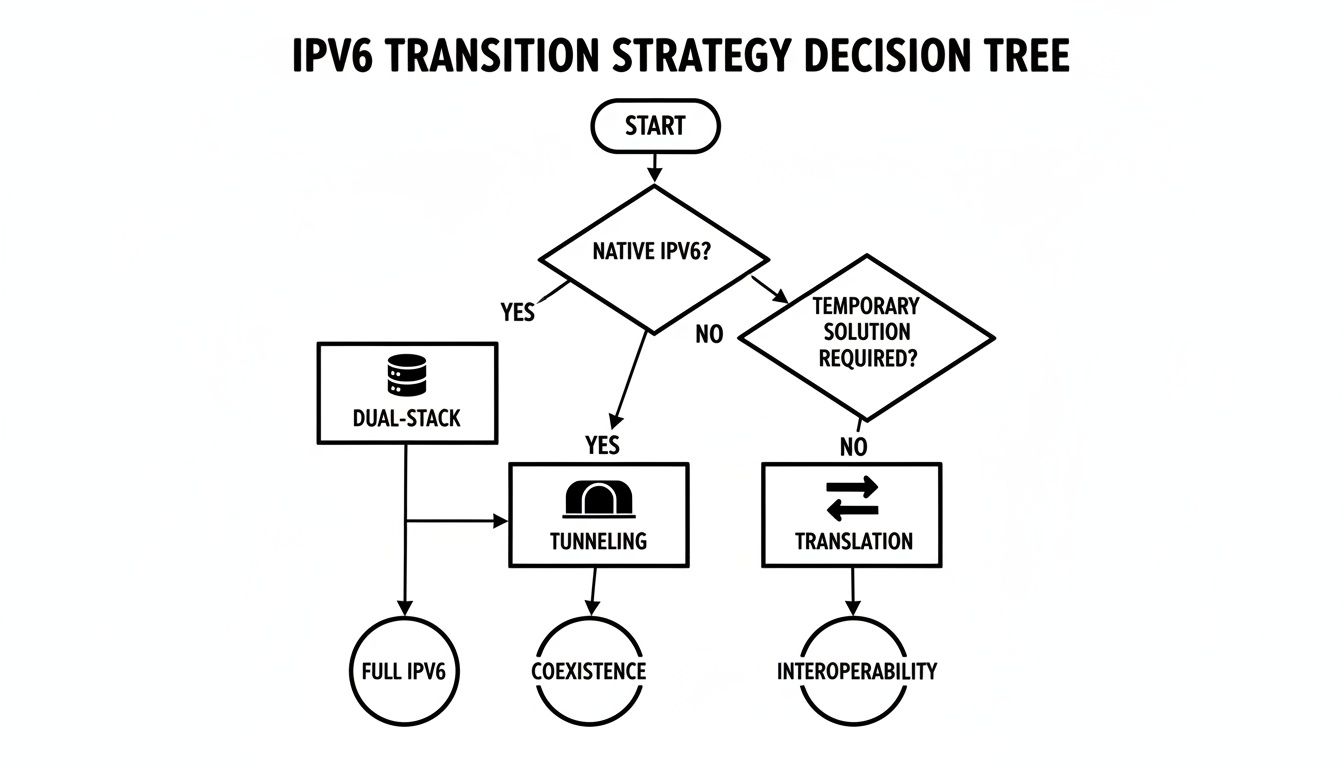
This visual guide really helps simplify the decision-making process. It shows that the path to full IPv6 adoption is a phased approach, not some abrupt, all-or-nothing changeover.
Dual-Stack Implementation
By far the most common and straightforward approach is Dual-Stack. In this setup, your network interfaces—on devices, servers, and routers—get configured with both an IPv4 and an IPv6 address. This lets them talk natively to both IPv4 and IPv6 networks without any clunky translation in the middle.
A dual-stack device will naturally prefer IPv6 when talking to another IPv6-enabled destination, only falling back to IPv4 when it has to. This makes it the perfect strategy for a gradual, low-risk migration. The trade-off? You're now managing two separate network stacks and routing tables, which can add complexity and eat up more resources on your network gear.
Dual-Stack is the workhorse of the IPv6 transition. It gives you maximum compatibility by letting systems speak both languages fluently. This ensures a smooth user experience while the internet slowly shifts its centre of gravity over to IPv6.
Bridging Networks with Tunnelling
Tunnelling is a clever technique used to link up isolated IPv6 networks across an infrastructure that's still only running IPv4. It works by wrapping IPv6 packets inside of IPv4 packets. This creates a kind of virtual "tunnel" for IPv6 traffic to pass right through the older network.
This method is a lifesaver in the early stages of a rollout or for connecting remote offices that are IPv6-ready back to a central, IPv6-enabled corporate network over the plain old IPv4 internet. While it gets the job done, tunnelling can add latency and complexity. It's best seen as a temporary bridge, not a permanent fix.
Enabling Communication Through Translation
The third key strategy is Translation, and the most common tool for the job is NAT64. Think of NAT64 as a gateway service that translates packet headers between IPv6 and IPv4. This is what allows IPv6-only clients to talk to IPv4-only servers.
This is absolutely essential in situations where a device has no IPv4 address but still needs to get to legacy content on the IPv4 internet. Many mobile networks, for example, are now deploying IPv6-only to devices and use NAT64 to maintain access to the rest of the web. It's powerful, but translation is complex and can sometimes break applications that have IP addresses hardcoded into them, making it a solution for specific use cases rather than a one-size-fits-all strategy.
Common Questions About IPv6
As we navigate the shift from IPv4, a few key questions always seem to pop up. Let's clear the air on some of the most common points of confusion for network professionals and curious internet users alike.
Is IPv6 Actually Faster Than IPv4?
Not in the way you might think. IPv6 doesn’t offer more raw bandwidth, but it often delivers a snappier, more efficient connection. The secret lies in its ability to eliminate Network Address Translation (NAT), a clunky workaround IPv4 relies on. NAT forces routers to constantly rewrite packet headers, which adds processing overhead and noticeable latency.
With its vast address space, IPv6 makes true end-to-end connectivity possible again. Every device gets a direct, unique address. This streamlined path can dramatically cut down on lag, which makes a world of difference for real-time applications like gaming, streaming, and video calls.
Why Has Full IPv6 Adoption Taken So Long?
The sluggish rollout is a classic case of the "chicken-and-egg" problem. For years, Internet Service Providers (ISPs), content platforms, and businesses were all waiting for each other to make the first big move. This created a powerful inertia that was difficult to overcome.
On top of that, the cost and sheer complexity of upgrading legacy hardware and retraining entire teams presented a massive hurdle. Since IPv4 workarounds and dual-stack environments still get the job done, many organisations have simply kicked the can down the road, delaying a full migration. This hybrid approach, however, adds its own complexity and can even lead to higher energy consumption.
The gradual pace of IPv6 adoption isn't just a technical challenge; it's an economic one. As long as legacy systems remain critical, the internet will exist in a complex hybrid state, delaying the full efficiency and security benefits of a native IPv6 environment.
Do I Need to Do Anything as a Home User?
For the most part, no. The transition is designed to be completely invisible to you. Modern operating systems—whether it’s Windows, macOS, or Linux—along with the router in your home, have supported IPv6 for years now.
Your ISP is the one managing the switchover behind the scenes. Your devices are already programmed to automatically use IPv6 whenever it’s available, so you can keep browsing, streaming, and working without ever noticing the underlying protocol has changed.
At People & Media B.V., we believe in making complex topics accessible to fuel your curiosity and growth. Explore our diverse collection of courses, articles, and podcasts to continue your learning journey. Discover more at https://www.peopleandmedia.com.



Responses