Growth Mindset and Fixed Mindset Unlocking Your Potential

Think about your abilities for a moment. Are they carved in stone, or are they more like a muscle you can build over time? This simple question gets to the heart of the difference between a growth mindset and a fixed mindset. One sees challenges as a threat to some innate, unchangeable talent, while the other sees them as the very things that make you stronger.
How Your Mindset Colours Your World
Your mindset is the invisible force shaping your reality. It's the collection of beliefs you hold about yourself that dictates how you interpret experiences, bounce back from setbacks, and chase your goals. This whole idea, brought to the forefront by psychologist Carol Dweck, splits these beliefs into two powerful camps that influence everything from your career path to your personal relationships.
Getting a handle on this distinction is the first step toward realising your true potential. These mindsets aren't just abstract psychological ideas; they are the operating system you run your life on.
The Two Core Beliefs
At its core, the difference between a growth mindset and a fixed mindset boils down to how you view intelligence and skill. A fixed mindset works from the belief that qualities like talent and intellect are static. You're born with a certain amount, and that's that.
In sharp contrast, a growth mindset is built on the belief that your basic abilities can be developed through dedication and hard work. This perspective doesn't pretend everyone starts at the same place, but it frames potential as something that can be grown and cultivated, not just discovered.
"A growth mindset means you recognise that what you know now is just a tiny percentage of what you could know. It means that you have the superpower to transform yourself into a much better and more powerful version of yourself."
This map offers a fantastic visual breakdown of the two mindsets.
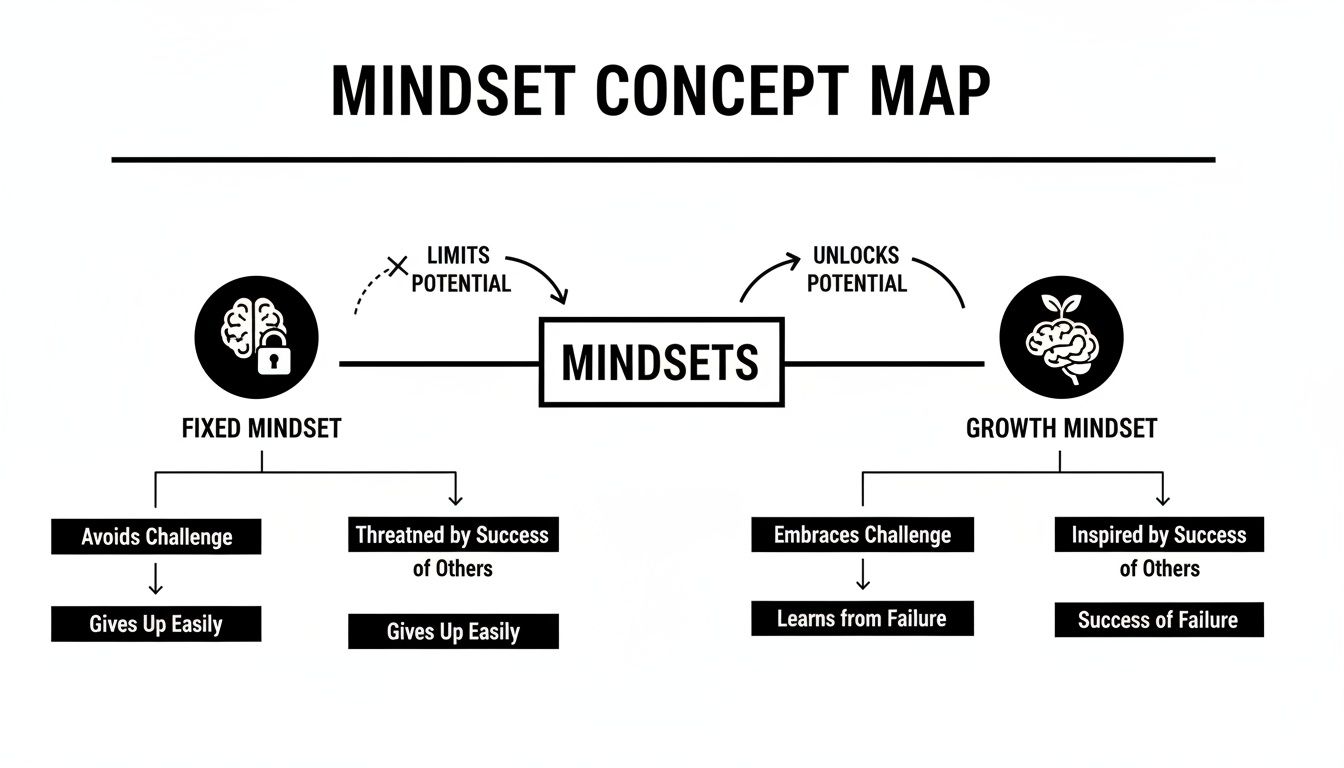
As you can see, the fixed mindset (the locked brain) leads to avoiding challenges and feeling stuck. The growth mindset (the sprouting brain), on the other hand, fosters resilience and achievement.
To make this even clearer, here's a quick side-by-side comparison.
Growth Mindset vs Fixed Mindset at a Glance
| Attribute | Fixed Mindset Belief | Growth Mindset Belief |
|---|---|---|
| Intelligence & Talent | Are static, innate traits. "You either have it or you don't." | Can be developed through effort and learning. "I can get better at this." |
| Challenges | Should be avoided to prevent failure and looking bad. | Should be embraced as opportunities to grow and learn. |
| Effort | Is a sign of weakness. If you were smart, you wouldn't need it. | Is the path to mastery and getting smarter. |
| Feedback & Criticism | Is taken personally and seen as an attack on ability. | Is valuable information for improvement and is welcomed. |
| Success of Others | Is seen as a threat or a reason to feel inadequate. | Is a source of inspiration and learning. |
This table neatly summarises how these opposing beliefs create vastly different outcomes in how we approach life's hurdles.
Why This Distinction Is So Crucial
The real-world impact of these beliefs is massive, especially in education. Take a study from the Netherlands, where over 50% of secondary school students were found to hold a fixed mindset, believing their intelligence is something they can't change. This often creates a deep fear of failure and makes them shy away from tough subjects, which can seriously stunt their academic progress. You can dive into the full findings of this study on Dutch mathematics classrooms if you're interested.
This internal dialogue plays out in subtle but powerful ways every day:
- When you face a challenge: Do you embrace it as a chance to learn, or do you back away for fear of looking incompetent?
- When you get feedback: Is it a gift that helps you improve, or is it a personal attack on your inherent abilities?
- When you think about effort: Is it the path to getting good at something, or is it just something people need when they lack natural talent?
By understanding the key differences between a growth mindset and a fixed mindset, you can start to spot your own thought patterns. From there, you can consciously choose a perspective that supports continuous improvement and a more fulfilling life.
Recognizing the Fixed Mindset Trap in Daily Life
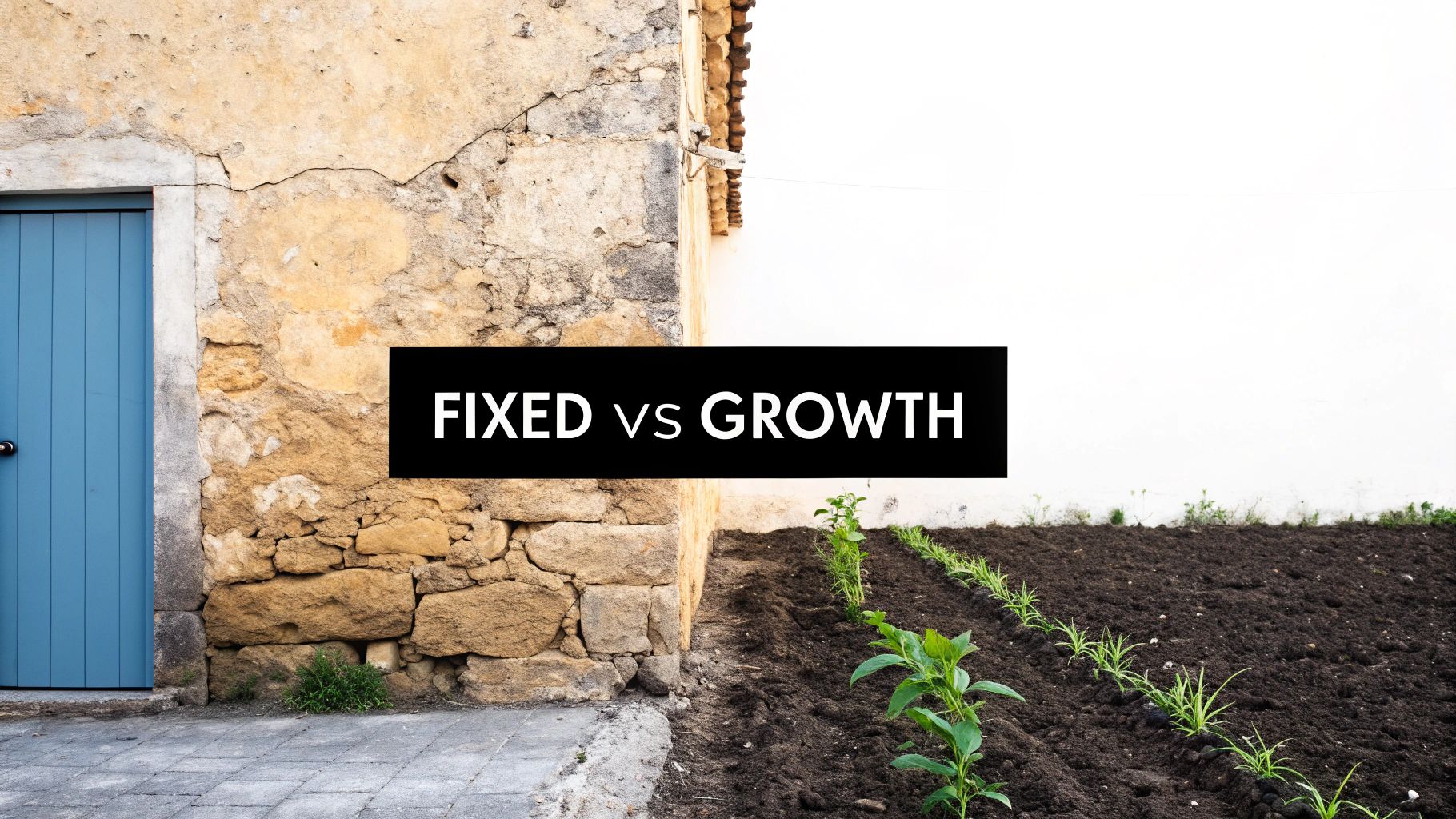
The fixed mindset works like an invisible fence. It subtly hems you in, limiting your potential before you even realise what's happening. It’s that quiet inner voice that whispers cautions, cooks up excuses, and ultimately holds you back from the very experiences that make you grow.
To break free, you first have to get good at spotting this limiting belief system in your everyday thoughts and actions. It often disguises itself as being "realistic" or "sensible," but its real job is to keep you safely inside your comfort zone, far from the risk of failure.
The Internal Monologue of a Fixed Mindset
Picture a software developer who’s a master of one coding language. They consistently sidestep projects that would force them to learn a new one. Their justification might be a lack of time, but the thought running underneath is often, "I'm good at what I know, and I might look like a fool trying to learn something new." This fear of looking incompetent is a classic sign of the fixed mindset trap.
Or think about a manager who dismisses constructive feedback from their team. On the surface, they might project confidence, but internally, they hear that feedback as a direct attack on their innate leadership skills. A fixed mindset tells them, "If I were a good leader, my team wouldn't have these suggestions."
A fixed mindset turns every situation into a test of your innate abilities. Success means you're smart or talented, while failure means you're not. This high-stakes perspective makes it difficult to embrace challenges.
These thought patterns are everywhere, woven into all areas of our lives. They're the background noise reinforcing the dangerous idea that our talents are set in stone.
Common Fixed Mindset Red Flags
Simply recognising these thought patterns is the first step towards changing them. A growth mindset and fixed mindset produce very different internal scripts. Here are some tell-tale signs that a fixed mindset might be steering your behaviour:
Avoiding Challenges: You stick to what you know you can ace, turning down opportunities that seem too difficult. The fear isn't just about failing the task; it's about the failure proving you lack talent.
Giving Up Easily: The moment you hit a hurdle, your immediate reaction is to feel defeated. The thought "If this is hard, it must mean I'm not good enough" takes over, making it feel pointless to keep trying.
Seeing Effort as a Negative: You believe that if you were a natural at something, you wouldn't have to try so hard. Effort becomes a sign of weakness rather than the path to mastery.
Ignoring Useful Feedback: Constructive criticism feels like a personal attack. Instead of seeing it as valuable data for improvement, you get defensive because it challenges your perceived competence.
Feeling Threatened by Others' Success: When a colleague or friend achieves something great, it can spark feelings of inadequacy or envy. Instead of feeling inspired, you compare yourself unfavourably. If that hits close to home, our guide on how to stop comparing yourself to others and find your own path might help.
By becoming aware of this internal monologue, you can start to question it. Each time you spot one of these thoughts, you have an opportunity to challenge that invisible fence and choose a different perspective—one that opens the door to learning and real improvement.
Unlocking Your Potential with a Growth Mindset
What if every challenge was an opportunity? What if every mistake was just a lesson in disguise? This is the core idea behind the growth mindset. It’s a powerful shift away from feeling stuck, moving the focus from constantly trying to prove how smart you are to actively getting smarter.
Think of your brain like a muscle. Someone with a fixed mindset believes that muscle has a set strength—you’re either strong or you’re not, and that’s that. A growth mindset, on the other hand, sees the brain as something that gets stronger with every single workout, every tough problem you wrestle with, and every new skill you practise.
This perspective completely changes your relationship with effort. It’s no longer a sign that you lack some kind of natural talent. Instead, effort becomes the direct path to mastery—the very process that builds new connections in your brain and expands what you’re capable of.
Reframing Your Approach to Challenges
The way you look at life’s hurdles is fundamentally different depending on whether you have a growth mindset and fixed mindset. A growth-oriented view doesn’t just put up with challenges; it actively seeks them out as the essential fuel for development. It transforms feedback from something to fear into valuable guidance that lights up the path forward.
When you see challenges as opportunities to get better, your potential is no longer defined by what you can do today, but by your willingness to learn tomorrow. Setbacks aren't verdicts on your talent; they are just data points on the journey to improvement.
This approach is the real engine for lifelong learning and genuine personal achievement. To help the next generation reach their full potential, it's vital to foster a growth mindset in children from an early age.
Effort as the Pathway to Mastery
The growth mindset gives a whole new meaning to hard work. In a fixed view, needing to put in a lot of effort can feel like a weakness—proof that you're not a "natural." But from a growth perspective, effort is the very thing that activates and builds your ability.
This principle is already showing promising results in education. For instance, some Dutch secondary schools running growth mindset programmes in their maths classes have seen some exciting shifts. Researchers noticed teachers praising effort over innate talent and tweaking tasks to encourage students to seek out challenges. The early results? Students in these classes engaged more deeply with the material and stuck with difficult problems for longer.
Learning From Setbacks and Feedback
Mistakes and criticism are often where the fixed mindset’s defences go up the highest. A single failure can feel like a final, damning judgement. A growth mindset flips this script completely, viewing setbacks and feedback as indispensable parts of the learning process.
- Mistakes as Lessons: Instead of being a dead end, a mistake becomes a signpost, showing you exactly what to work on next.
- Feedback as a Gift: Criticism is no longer a personal attack. It's a roadmap for improvement, offered by someone who can see a path you might have missed.
- Resilience as a Skill: Bouncing back from failure isn't just a trait you’re born with; it’s a skill that gets stronger every time you choose to try again after a setback.
By embracing this perspective, you build real resilience and turn every experience—good or bad—into a stepping stone. This mental shift doesn't mean you’ll never feel frustrated or disappointed. It just means you understand those feelings are part of the journey, not the final destination.
How Each Mindset Plays Out in the Real World

Theory is one thing, but to really get a feel for the power of a growth mindset and fixed mindset, you have to see them in action. The same exact event can set off completely different reactions, behaviours, and outcomes, all depending on the mental filter we use to process it.
Let's look at a few side-by-side scenarios. In each one, two people face the same challenge, but their internal scripts—one fixed, one growth-oriented—send them down wildly different roads. These examples make the whole concept tangible, showing how your mindset is a direct line to your resilience and success.
The Workplace Project
Picture two colleagues, Alex and Ben. They’ve both been tapped to lead a tough new project that demands skills neither of them has mastered yet. The stakes are high, and the deadline is looming.
Fixed Mindset Alex: A wave of dread washes over Alex. The inner voice kicks in: "They're going to find out I'm not right for this. If I was a real leader, I'd already know how to handle it." Alex avoids asking questions, terrified of looking incompetent, and defaults to old methods that don’t quite fit the new challenge. When the team pipes up with suggestions, Alex gets defensive. The first roadblock feels like a nail in the coffin—proof of failure.
Growth Mindset Ben: Ben sees the same project and thinks, "What a massive opportunity!" The internal monologue is totally different: "This is a great chance to learn something new and really stretch myself. I don't have all the answers yet, but I can figure it out." Ben immediately starts scheduling meetings to pick the brains of seasoned colleagues, openly admits what he doesn’t know, and rallies the team to experiment. Early hurdles aren't disasters; they're just valuable feedback to help adjust the strategy.
The outcome is almost inevitable. Alex’s team disengages, and the project hits a wall. Ben’s team feels empowered, collaborates like a well-oiled machine, and makes real progress, learning a ton in the process.
Receiving Creative Feedback
Now, let’s imagine two artists, Clara and David. They both submit their work to a critic they admire and get back feedback that’s constructive but also highlights several big areas for improvement.
A fixed mindset turns feedback into a verdict on your talent. A growth mindset sees it as guidance to help you refine your craft.
Clara, working from a fixed mindset, is crushed. She takes the criticism personally, thinking, "I guess I just don't have what it takes." She feels embarrassed, shoves the artwork in a closet, and becomes hesitant to create anything new, fearing the same judgement.
David, on the other hand, operates with a growth mindset. Sure, he feels that initial sting of disappointment, but he quickly reframes it. His thought process is, "This is brilliant. I have a clear roadmap of what to work on next." He grabs a notebook, jots down the key points, thanks the critic for their insight, and feels a new surge of energy to get back to the studio and try out the suggestions.
For Clara, the feedback was a dead end. For David, it was a launchpad.
Tackling a Learning Challenge
Finally, let's look at two students, Eva and Finn, who enrol in a notoriously difficult online course on data analytics—a subject they both find intimidating.
Eva’s fixed mindset whispers that she’s “just not a numbers person.” When the first module proves challenging, she takes it as confirmation. She quits, convinced her initial assessment was right. Her ego is safe, but she's lost the chance to grow.
Finn’s growth mindset acknowledges the difficulty but tells a different story. He thinks, “This is new and complex, so it’s supposed to feel hard at first. My brain is literally building new connections.” He goes looking for extra videos, joins an online study group, and isn't afraid to post what he thinks are "silly" questions in the course forum.
Finn pushes through that initial wall of frustration. With persistence and effort, the concepts start to click. He doesn't just pass the course; he walks away with a valuable new skill and the quiet confidence that comes from conquering something truly difficult.
These stories all point to a simple truth: what you believe about your abilities becomes a self-fulfilling prophecy.
Actionable Strategies to Build Your Gworth Mindset
Knowing the difference between a growth and a fixed mindset is a great first step, but real change only happens when you put that knowledge into action. Think of it like training a muscle: building a growth mindset takes consistent, deliberate practice. The brilliant news is that you can actively rewire your own thought patterns, turning that nagging inner critic into a genuinely supportive inner coach.
This section is a practical toolkit filled with evidence-backed exercises to get you started today. These aren’t just abstract theories; they’re simple, repeatable actions designed to forge new mental habits. By consciously using these strategies, you can shift your entire perspective from proving yourself to improving yourself.
Embrace the Power of "Yet"
One of the most profound—and simplest—tools in your mindset toolkit is a tiny, three-letter word: "yet". Adding it to the end of a self-limiting statement can completely change its meaning. It transforms a dead-end declaration into a progress report, instantly opening the door to future development.
This isn’t just a semantic trick. It’s a mental cue that acknowledges where you are right now without accepting it as a permanent state. It shifts your brain from a state of failure to a state of learning.
- "I can't solve this coding problem" becomes "I can't solve this coding problem… yet."
- "I'm not a good public speaker" turns into "I'm not a good public speaker… yet."
- "I don't understand these analytics" changes to "I don't understand these analytics… yet."
This small adjustment builds a bridge between your present abilities and your future potential, making the whole journey feel much more manageable.
Challenge Your Fixed Mindset Voice
We all have it. That distinct voice that tells you to give up when things get hard, to duck challenges where you might fail, and to feel a sting of envy at someone else's success. The first step to quietening this fixed mindset voice is to separate it from yourself.
Try giving it a name—like "the Judge" or "the Critic". This creates a bit of distance, helping you realise that its commentary isn't the absolute truth. When you notice this voice creeping in, don't just ignore it; engage with it from a growth perspective. Acknowledge what it's saying, then talk back with evidence of growth, effort, and possibility.
Teaching this skill to young people is invaluable. For parents and educators looking for more ideas, this practical guide on how to build a growth mindset in children is a fantastic resource. Over time, this internal dialogue strengthens your growth-oriented beliefs and loosens the grip of the fixed mindset.
Reframing Your Inner Monologue
The thoughts running through your head directly shape the actions you take. Actively translating your fixed mindset thoughts into growth-oriented alternatives is a core practice for change. This isn't about forced, toxic positivity. It's about realistic optimism grounded in the belief that effort genuinely leads to improvement.
The examples below can help you start reframing your internal script. Think of it as consciously choosing a more empowering narrative.
Reframing Your Inner Monologue
| Fixed Mindset Thought | Growth Mindset Reframe |
|---|---|
| "I failed. I'm not good at this." | "This approach didn't work. What can I learn from this to try next?" |
| "I'll look stupid if I ask a question." | "Asking questions is how I learn and get better." |
| "This is too hard. I want to give up." | "This is challenging, which means my brain is growing. I'll take a break and come back with a fresh perspective." |
| "She's so talented. I'll never be at that level." | "I admire her skills. What can I learn from her process and effort?" |
| "I'm just not a 'maths person'." | "Maths is a skill I can develop with practice, just like any other." |
This deliberate reframing is a powerful exercise in building what we call mental resilience, which is a key ingredient of a strong growth mindset. To go a bit deeper on this, you might find our article on unlocking the power of mental resilience in everyday life interesting.
Seek Out Challenges and Value Effort
Where a fixed mindset runs from difficulty, a growth mindset actively seeks it out. It understands that challenges are where the real learning happens. Instead of sticking to what’s easy and comfortable, make a conscious choice to step just outside your comfort zone.
A Dutch university study found that combining mindset interventions with neuroscience courses led to a significant shift toward growth-oriented beliefs. Students began replacing thoughts like "I'm not smart enough" with empowering ones like "Effort builds ability," which boosted their engagement in learning. You can discover more insights about these findings and how they support the core theory.
Start celebrating the process, not just the final result. Praise yourself and others for the effort, the strategy, and the persistence put into a task. This reinforces the idea that hard work is the path to mastery, not a sign that you're failing.
Putting Your Growth Mindset into Practice

Shifting from a fixed to a growth mindset isn't like flipping a switch. It’s not a final destination you arrive at, but an ongoing practice—a conscious choice you make every day when you're up against a challenge, a setback, or even the success of others. It’s about seeing your whole life as a kind of laboratory for learning and development.
The real difference between a growth mindset and fixed mindset boils down to this choice. Do you see your abilities as set in stone, or do you truly believe in your capacity to grow? Choosing growth means stepping forward with curiosity, convinced that your potential is something to be cultivated, not just proven.
Your Call to Action for Lifelong Growth
Embracing a growth mindset is an active process. It means you have to consciously rewrite your internal narrative, moving away from judgement and towards genuine curiosity. The goal isn't to silence that fixed-mindset voice forever; it’s a perfectly normal human response, after all. The trick is to recognise it, thank it for trying to keep you safe, and then deliberately choose a more empowering path forward.
True growth begins when you stop seeing effort as a sign of weakness and start seeing it as the path to mastery. Every challenge becomes an opportunity, and every mistake a lesson.
To get started today, simply begin noticing your thoughts without judgement. Observing that internal monologue is a powerful first step. Tools like journaling can offer incredible insights into your own mindset patterns. To dig deeper into this, you can explore our guide on unlocking mental wellness through the power of journaling.
Fostering Your Mindset Every Day
This shift is reinforced by small, consistent actions that build momentum over time. Here are a few practical ways to keep your growth mindset active and thriving:
Embrace Imperfection: Give yourself permission to be a beginner. It’s impossible to be an expert at something you’ve never done. Celebrate the courage it takes just to start, not the perfection of the final result.
Persist Through Setbacks: When you hit a wall, reframe it. Instead of automatically thinking, "I failed," try asking, "What did I learn from this?" This simple switch turns every obstacle into fuel for your next attempt.
Seek Inspiring Examples: Look at the success of others not as a threat, but as proof of what’s possible. Study their journey, the effort they put in, and their strategies. Use it all as a source of inspiration and learning.
Ultimately, your mindset is your most powerful tool for navigating the world. By choosing growth, you're not just aiming for success; you're committing to a more resilient, engaging, and fulfilling life. Your potential isn't fixed—it's just waiting to be realised.
A Few Common Questions
Diving into the world of growth and fixed mindsets always sparks a bit of curiosity. Once you start noticing these patterns in your own thinking, questions naturally pop up about the finer points—like how they show up in different parts of life or how to help the people you care about make the shift.
Let's tackle some of the most common questions. Think of this as a quick-reference guide to help sharpen your understanding and start putting these ideas to work.
Can You Have a Growth Mindset in One Area and a Fixed One in Another?
Yes, absolutely. In fact, it’s incredibly common to have a mix of mindsets depending on the context. This really highlights how our beliefs are moulded by our unique experiences and the feedback we’ve received over the years.
For instance, you might have a solid growth mindset about your career, fully believing you can pick up new skills and climb the ladder through sheer effort. But at the same time, you could have a stubbornly fixed mindset about a creative hobby, telling yourself, "I'm just not an artistic person."
Simply spotting where you apply each mindset is a huge first step. It gives you the chance to consciously question fixed beliefs in one area by borrowing the successful, growth-oriented approach you’re already using somewhere else.
It's not about being one or the other; it's about being aware of which mindset you are bringing to each challenge. This awareness gives you the power to choose growth.
By mapping out these different mindset "zones" in your life, you can start applying growth principles more consistently and unlock potential where you thought there was none.
How Can Parents and Teachers Nurture a Growth Mindset in Children?
The words we use around children have a massive impact on the mindset they end up adopting. The real key is to shift the focus from praising talent to celebrating the process of learning itself. This helps kids build resilience and actually start to enjoy a good challenge.
Here are a few practical ways to do this:
- Praise the Process, Not the Person: Instead of saying, "You're so clever!" when a child nails a problem, try something like, "I love how you kept trying different ways to solve that until you got it." This reinforces effort and persistence, not a static trait.
- Frame Mistakes as Lessons: Treat slip-ups as a normal, even valuable, part of the journey. You could say, "That's an interesting mistake! What can it teach us for next time?"
- Embrace the Word 'Yet': When a child says, "I can't do this," just gently add the word "…yet." It's a tiny addition, but it completely reframes a dead-end statement into one of progress.
Don't forget that modelling a growth mindset yourself is maybe the most powerful tool of all. Sharing your own struggles and how you work through them shows this perspective in action.
Is It Possible to Permanently Switch to a Growth Mindset?
The aim isn't to completely wipe out fixed-mindset thoughts—they’re a natural response to fear or a tough challenge. The real goal is to build a stronger, more dominant growth mindset that you can call on intentionally. It’s an ongoing practice, a bit like keeping up with your physical fitness.
Think of it as becoming fluent in a new language. At first, you have to consciously translate your old fixed-mindset script into a growth-oriented one. But with time and consistent practice, that new way of thinking becomes your default. You get faster at catching those fixed-mindset triggers and better at responding with a view that fuels learning and grit. Lasting change comes from that steady, conscious effort.
At People & Media B.V., we believe that curiosity is the engine of personal growth. Our platform offers a rich ecosystem of blogs, courses, and podcasts designed to help you explore timeless ideas and gain practical wisdom. Continue your journey of lifelong learning with us. Discover more at https://www.peopleandmedia.com.
Responses