Your Guide to the Online Marketing Funnel

An online marketing funnel isn't just some abstract marketing theory—it's the strategic journey you intentionally create to guide a complete stranger from their first flicker of curiosity all the way to becoming a loyal, paying customer. Think of it less as a rigid formula and more as a powerful framework for understanding and influencing people by delivering the right message at the right time.
How the Marketing Funnel Guides Your Customers
Consider the marketing funnel your roadmap for building customer relationships. It helps you actually see the path someone takes, starting from the moment they first hear about your brand to the point where they pull out their wallet, and hopefully, stick around for more. Without this structure, your marketing efforts can feel disjointed and random—like shouting into a void and just hoping someone hears you.
This framework is all about segmentation based on where someone is in their journey. Are they just now realising they have a problem you can solve, or are they deep in research, actively comparing your solution against three others? Each mindset requires a completely different conversation, and the funnel gives you the clarity to deliver content that genuinely connects at each step.
The Purpose Behind the Process
At its heart, the purpose of a marketing funnel is to build a predictable, repeatable system for generating leads and sales. Simple as that. By organising everything you do around the customer's decision-making process, you create a strategy that’s cohesive and far more effective. To really nail this, you need to map out the different stages of the customer journey from that initial "hello" to becoming a passionate advocate for your brand.
This structured approach pays off in a few critical ways:
- Improved Targeting: You stop using one-size-fits-all messaging and start creating specific campaigns tailored to the actual questions and needs people have at each stage.
- Enhanced Customer Experience: Your prospects get information that’s actually relevant to them when they need it. This builds trust and removes the friction that makes people click away.
- Efficient Budget Allocation: You can put your money where it will have the biggest impact, instead of wasting your budget on mismatched ads and content.
Getting this strategic alignment right is more important than ever. Here in the Netherlands, for example, the shift toward measurable, outcomes-based strategies is undeniable. Digital ad spend hit a massive €3.59 billion in 2022, and digital advertising now commands a 71% share of the total media mix. This shows a decisive move towards frameworks like the marketing funnel that deliver clear, measurable results. You can dig into more insights on the Dutch digital scene in this 2023 report.
Visualising the Core Funnel Stages
The classic marketing funnel is typically broken down into four primary stages. Each one represents a fundamental shift in your customer's mindset and relationship with your brand.
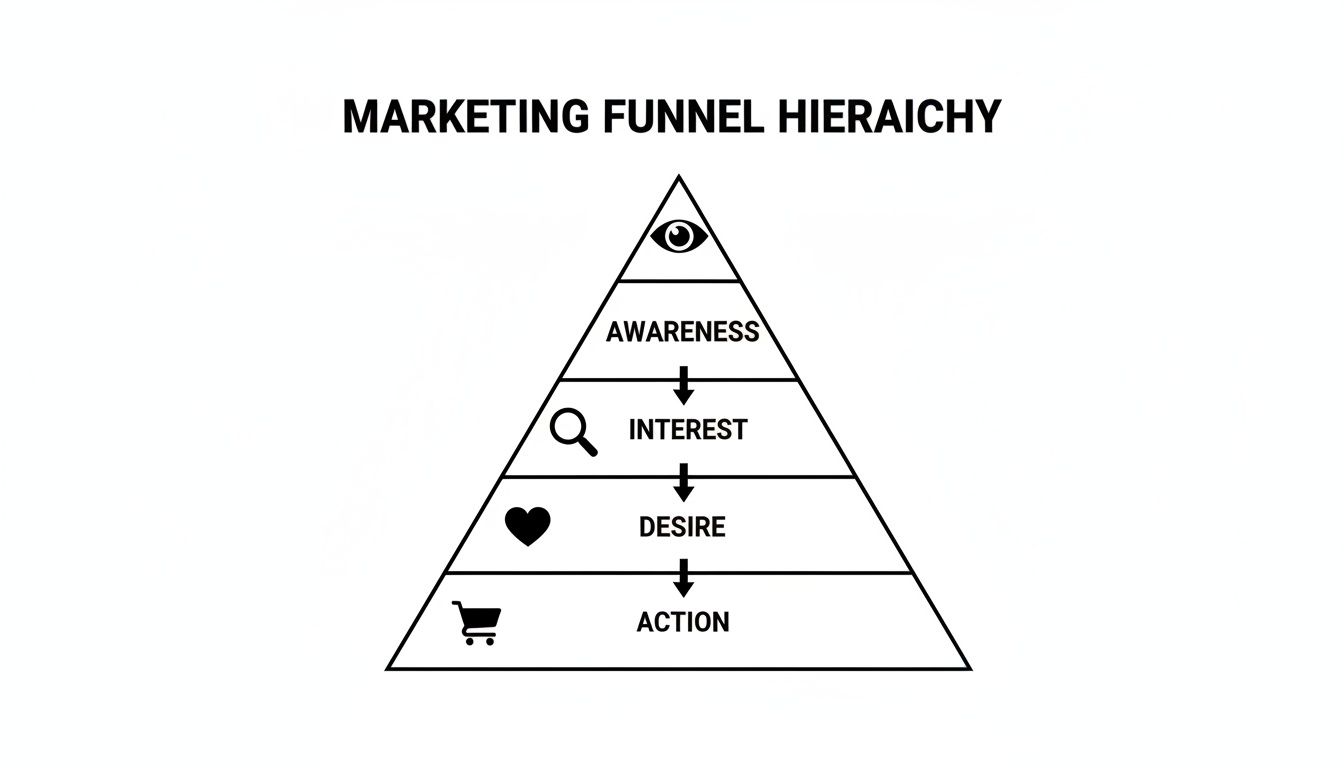
The table below gives a quick snapshot of what each of these core stages is all about.
The Four Core Stages of the Marketing Funnel
| Funnel Stage | Primary Goal | Customer Mindset |
|---|---|---|
| Awareness | Introduce your brand and capture attention | "I have a problem, but I'm not sure what the solution is." |
| Interest | Educate and build a connection | "This looks interesting. I want to learn more about how it works." |
| Desire | Create a preference for your solution | "I believe this specific product is the best choice for me." |
| Action | Motivate the final purchase decision | "I'm ready to buy this now." |
As the funnel visual shows, you start with a wide audience at the top and gradually nurture them into a smaller, more qualified group of people who are ready to take action. Each stage acts as a filter, guiding only the most interested and best-fit individuals forward on the journey.
Attracting Visitors at the Awareness Stage

This is where it all begins. The very top of your marketing funnel is the first handshake, the initial point of contact with a future customer. At this stage, people aren't looking for you or your product. In fact, they probably don't even know you exist.
What they do know is that they have a problem or a question. They're just starting to look for answers, information, or solutions to a challenge they've only recently become aware of. Your job here isn't to sell; it's to help. Think of yourself as a trusted guide, not a pushy salesperson. The entire strategy revolves around providing genuine value upfront to build that first layer of credibility and trust.
Get this right, and you'll make a powerful first impression, positioning your brand as the go-to resource in your space. When they're ready to learn more, your name will already be top of mind.
Understanding The Psychology Of Discovery
Someone in the awareness stage is in pure exploration mode. Their mindset is all about discovery and identifying their problem more clearly. They're typing broad terms into Google, asking general questions on forums, and scrolling through social media feeds to get a better handle on their challenge.
They are curious, but they are absolutely not committed to a solution yet. This is about meeting them exactly where they are. Content that educates, entertains, or inspires will pull them in, but anything that feels like a hard sell will push them away instantly. Your content must match their intent, which, for now, is all about gathering information.
The goal is to become the answer to their initial questions. When you provide clear, valuable information without asking for anything in return, you create a positive initial association with your brand that pays dividends later in the funnel.
Key Channels For Building Awareness
To effectively cast a wide net, you need to show up where your audience is already spending their time. At the top of the funnel, the game is all about visibility and reach. These are the channels that deliver:
- Search Engine Optimisation (SEO): SEO is non-negotiable. It's how you capture people who are actively looking for information related to what you do. By creating content that ranks for their questions, you place your brand directly in their path at the precise moment they need help.
- Content Marketing: This is the fuel for your SEO fire. High-quality blog posts, guides, and articles addressing your audience's pain points are what attract organic traffic and demonstrate your expertise.
- Social Media Marketing: Platforms like LinkedIn, Instagram, or Facebook are perfect for sharing valuable content in bite-sized formats like infographics, short videos, and quick tips. This allows you to reach people who aren't actively searching but are interested in your topics.
- Digital Advertising: Paid ads on Google and social media give you a shortcut to visibility. They let you target specific demographics and interests, introducing your brand to a well-defined audience to accelerate your reach.
Crafting Content That Captures Attention
The content you create for this stage has one job: to attract and educate. It needs to be easy to find and easy to share, focusing entirely on solving problems, not pushing products.
Think about writing blog posts that answer the common "how-to" or "what is" questions in your industry. For instance, a software company shouldn't write "Why Our Software is the Best." Instead, they should tackle "How to Improve Team Productivity." This approach builds trust. As creating high-quality, long-form content becomes more critical, you might want to look into support; you can learn more by discovering the best AI content writers on the block.
Here are a few proven content formats for the awareness stage:
- Blog Posts and Articles: The bread and butter for answering the "who, what, why, and how" questions your audience is asking.
- Infographics: Visually appealing and super shareable, these make complex information easy to digest.
- Short Videos: Quick explainers or tips that are perfect for consumption on social media.
- Guides and Ebooks: In-depth resources you offer for free to cement your authority on a topic.
Ultimately, success at the awareness stage comes down to generosity. When you give immense value away freely, you build brand recognition and create an audience that is ready and willing to move deeper into your funnel.
Nurturing Leads Through Interest and Desire

So, you've grabbed their attention. Great. But now the real work begins. The journey from the top of the funnel to the middle is where casual browsers become serious researchers. They've identified a problem, and now they're actively hunting for the best solution.
Your goal shifts dramatically here. It’s no longer about just being seen; it’s about being understood and, most importantly, trusted. This is your chance to build a real connection by proving you have the expertise to solve their specific challenges. The content you create now has to go deeper, answering the detailed questions that pop up when someone is truly weighing their options.
From Casual Interest to Genuine Desire
The psychological leap in the middle of the funnel is huge. Prospects go from thinking, "I'm just learning about this," to, "I need to find the best tool for this job." They're comparing features, digging through reviews, and looking for any proof that a solution actually delivers what it promises.
This stage is all about building credibility. You have to educate them not just about their problem, but about the nuances of solving it. Your job is to be their guide, anticipating their questions and positioning your offering as the most logical, effective choice.
Think of this middle stage as earning the right to make a sale later. By giving away immense value and showcasing your expertise without a hard sell, you build the trust that’s absolutely critical for the final conversion.
Creating Content That Educates and Persuades
To really nurture these leads, you have to move beyond introductory blog posts. Your content now needs some serious depth to prove your authority. The whole point is to give prospects the detailed information they crave, making them feel confident in their decision-making process.
Often, this means creating more substantial, gated content that requires an email address to access. This little exchange is a powerful signal of high interest and your green light to start a more direct, personalised nurturing sequence. The middle of the online marketing funnel thrives on content that delivers real, tangible value.
Here are some of the most effective content types for this stage:
- In-Depth Webinars: A live or on-demand session lets you dive deep into a topic, show your product in action, and answer questions directly. It’s a powerful way to build a personal connection.
- Detailed Case Studies: Nothing builds trust like social proof. Case studies show potential customers that people just like them have already solved the exact same problems using your solution.
- Email Newsletters and Courses: A well-planned email sequence can guide someone through a learning journey, delivering valuable, bite-sized insights straight to their inbox over several days or weeks.
- White Papers and In-Depth Guides: These are your authority pieces. They provide comprehensive data and analysis on an industry challenge, cementing your status as a thought leader.
- Comparison Sheets: Help them do their homework. Directly comparing your product’s features against competitors helps prospects in the final evaluation stages make a clear, informed choice.
This kind of strategic nurturing is especially powerful in active online markets. Take the behaviour of Dutch online shoppers, for instance. A 2023 CBS survey showed that 78% of people aged 12 and over had bought something online in the last three months, a massive leap from just 46% in 2012. With 27% shopping weekly, this consistent online habit creates the perfect environment for marketers to guide interested users down the funnel. You can read more about these online shopping trends in the Netherlands.
Building an Effective Lead Nurturing Sequence
The moment a prospect downloads a resource or signs up for a webinar, the real nurturing begins. This is usually handled by an automated email sequence designed to build the relationship and gently guide them toward making a decision.
A great nurturing framework doesn't just spam people with sales pitches. It follows a logical path, building on the topic that first caught their interest. For a closer look at the tools that run these sequences, check out our guide comparing Klaviyo vs HubSpot vs ActiveCampaign.
A simple but highly effective nurturing sequence might look like this:
- Immediate Value Delivery: The first email delivers the goods—the ebook, the webinar link—and thanks them for their interest. Keep it simple, clear, and focused on value.
- Problem Agitation and Context: A few days later, send an email that digs deeper into the problem their downloaded resource helps solve. A relevant statistic or a short, relatable story works wonders here.
- Introduce Your Solution: Now you can gently introduce your product or service as a powerful way to solve that specific problem. This isn't a hard pitch; it’s an educational overview of how you help.
- Showcase Social Proof: Follow up with a killer case study or a handful of customer testimonials. This email is all about showing, not just telling, them that you get results.
- Overcome Objections: The final emails can tackle common concerns. Maybe link to an FAQ page or offer a free demo to clear away any last-minute doubts.
By methodically walking prospects through the Interest and Desire stages, you transform a cold lead into a warm, well-informed individual who sees your brand not just as another option, but as the obvious, trusted partner they need.
Driving Conversions at the Action Stage
This is it. The moment of truth. After all the work you’ve put into building awareness and nurturing desire, your potential customer is standing right at the finish line. They know who you are, they trust your brand, and they're seriously thinking about pulling the trigger. The final step is all about making it as easy and compelling as possible for them to say "yes."
The psychology here shifts from education to reassurance and urgency. Down here at the bottom of the funnel, your job is to add that last layer of confidence, quiet any last-minute doubts, and bulldoze every single obstacle standing between them and the sale. This is where a seamless user experience and powerful social proof become your most valuable assets.
Crafting an Irresistible Call to Action
Your Call to Action (CTA) is the single most important element on your conversion page. It's the big, shiny button that tells your prospect exactly what to do next. A weak, generic CTA like "Submit" can kill momentum in an instant, while a strong, benefit-driven one can make a huge difference to your conversion rates.
A killer CTA must be:
- Clear and Concise: Leave no room for confusion. "Get Your Free Ebook Now" is worlds better than just "Download."
- Action-Oriented: Kick things off with a strong verb that gets people clicking. Think "Start," "Join," "Get," or "Claim."
- Visually Prominent: Your CTA button needs to pop. Use a contrasting colour that stands out from the rest of the page and give it plenty of white space to breathe.
The best CTAs create a feeling of low risk and high reward. Instead of "Buy Now," which can sound like a big commitment, try "Add to Basket" or "Start My 30-Day Free Trial." This subtle shift in language lowers the barrier and makes the decision feel much easier.
Leveraging Social Proof to Build Final Trust
When people feel uncertain, they naturally look to what others are doing to guide their own decisions. That’s the core principle of social proof, and it’s incredibly powerful at this stage. You’ve already told them your product is great; now it’s time to let other people prove it for you.
Showcasing genuine feedback from happy customers is one of the most effective ways to dissolve that last bit of hesitation. It provides unbiased, real-world validation that your solution actually delivers on its promises.
Here are the most effective ways to display social proof:
- Customer Testimonials: Feature quotes from satisfied customers. Adding their name, company, and a photo makes them feel much more authentic.
- Case Studies and Success Stories: Link out to a detailed case study showing the tangible results another customer achieved with your help.
- Reviews and Ratings: Display star ratings right where people can see them. Studies have shown that products with reviews have a much higher conversion rate than those without.
- Trust Seals and Logos: If you’ve worked with well-known brands or have industry certifications, show off their logos. It's a simple way to borrow their credibility and apply it to your own brand.
Optimising the Final Steps for a Seamless Experience
Even the most motivated buyer will ditch their cart if the checkout or sign-up process is clunky, confusing, or just too long. Friction is the mortal enemy of conversion. Your goal is to make this final hurdle feel absolutely effortless.
Put yourself in their shoes. Every single field they have to fill out and every click they have to make is a potential reason to give up and leave.
Stick to these best practices to reduce friction:
- Keep Forms Short: Only ask for the information you absolutely need. Every extra field you add is another reason for someone to drop off.
- Offer Multiple Payment Options: People have their preferences. Cater to them by including options like credit cards, PayPal, and other popular digital wallets.
- Ensure Mobile Friendliness: A huge chunk of your users will be on their phones. Your checkout process must be perfectly optimised for a small screen. No pinching and zooming allowed.
- Provide Clear Error Messages: If someone makes a mistake, tell them exactly what’s wrong and how to fix it. A generic "error" message is just frustrating.
By zeroing in on a clear CTA, powerful social proof, and a frictionless experience, you give your prospects that final nudge of confidence they need to take action and complete their journey.
Measuring Success with the Right Funnel Metrics
An online marketing funnel without data is just a collection of hopeful guesses. If you really want to turn your strategy from an art into a science, you have to track the right key performance indicators (KPIs) at each stage. This is how you move past surface-level "vanity metrics" and get a real look at the health of your entire customer journey.
Success isn't about tracking every number under the sun. It's about focusing on the specific metrics that show how well you're guiding people from one stage to the next. By mapping actionable KPIs to each part of your funnel, you can pinpoint exactly where things are working and, more importantly, where they’re breaking down. This data-driven approach lets you make precise tweaks that actually impact your bottom line.
Key Metrics for Each Funnel Stage
To make this practical, let's break down the essential metrics you should be watching at each stage. The table below gives a quick overview, and we'll dive into the details for each section afterwards.
| Funnel Stage | Primary Metric | Supporting Metrics |
|---|---|---|
| Top of Funnel (ToFu) | Reach | Impressions, Website Traffic (New Users), Social Media Engagement |
| Middle of Funnel (MoFu) | Lead Conversion Rate | Email Click-Through Rate (CTR), Lead Magnet Downloads, Time on Page |
| Bottom of Funnel (BoFu) | Conversion Rate | Cost Per Acquisition (CPA), Customer Lifetime Value (CLV), Return on Ad Spend (ROAS) |
This framework helps you stay focused on what truly matters at each step, preventing you from getting lost in a sea of irrelevant data.
Top of Funnel: Awareness Metrics
Right at the top, your goal is maximum visibility. You’re introducing your brand to entirely new audiences, so your metrics need to reflect reach and initial engagement. Forget about sales figures here; that’s not the point yet.
Your focus should be on these core awareness KPIs:
- Impressions: This is simply the total number of times your ad or content was displayed. It's a foundational number for gauging the sheer volume of your reach.
- Reach: This is the one that really counts—it measures the number of unique people who saw your content. This tells you how large of an audience you're actually connecting with.
- Website Traffic: Tracking new, unique visitors from different channels (organic search, social media, paid ads) shows you which ones are best at driving discovery.
Middle of Funnel: Interest and Desire Metrics
Once you've got their attention, the game changes. Now, it's all about nurturing that interest. The metrics in the middle of the funnel measure how engaged your audience is and whether they're willing to take the next step. This is where you see casual visitors start turning into qualified leads.
Look at these key metrics for this stage:
- Lead Magnet Downloads: How many people are actually downloading your ebooks, white papers, or checklists? This is a massive indicator of genuine interest.
- Email Click-Through Rate (CTR): When you send out those nurturing emails, the CTR shows how compelling your content really is and if subscribers are buying into your message.
- Webinar Attendance Rate: For everyone who registers, what percentage actually shows up? A high attendance rate signals a highly motivated and interested audience.
With privacy standards constantly changing, making sure you have reliable data for these crucial metrics is more important than ever. It's worth exploring different measurement technologies to keep your insights accurate. You can learn more about how to capture user data properly in our guide on how server-side tracking works and its benefits.
Bottom of Funnel: Action Metrics
This is where the rubber meets the road. At the bottom of the funnel, your metrics are all about conversions and profitability. These are the numbers that directly tie your marketing efforts to revenue and prove your strategy is working.
The most important metrics at this stage tell a story about efficiency and value. It's not just about how many sales you made, but how much it cost to earn them and what each customer is worth over time.
Get laser-focused on these bottom-line KPIs:
- Conversion Rate: The percentage of visitors who take that final, desired action, whether it's making a purchase or signing up for a trial. This is the ultimate test of your funnel's effectiveness.
- Cost Per Acquisition (CPA): This is the total cost of your marketing divided by the number of new customers you gained. It tells you exactly how much you're spending to get each one.
- Customer Lifetime Value (CLV): This metric predicts the total revenue you can expect from a single customer over their entire relationship with you. A high CLV is a sign of a healthy, sustainable business.
To get the full picture of your profitability across all stages, mastering how to calculate marketing ROI is non-negotiable. A clear dashboard with these metrics will turn your funnel from a hopeful idea into a predictable engine for growth.
Turning Customers into Brand Advocates
Most marketers think the funnel ends with a sale. They couldn’t be more wrong.
The sale isn’t the finish line; it’s the beginning of the most powerful, and often most profitable, stage. When a customer buys from you, they’ve just stepped into a new role with massive potential: the brand advocate. This is where you turn one hard-won conversion into many more.
The logic is simple and has been proven time and again. It’s far cheaper to keep a customer than to find a new one. Delighted customers don’t just come back for more; they become your volunteer marketing army, telling their friends and colleagues about their great experience. This is how you transform a linear funnel into a self-powering flywheel of growth.
Nurturing Post-Purchase Loyalty
The moments immediately after a purchase are a golden opportunity. A generic “thank you” email is a complete waste of this moment. Your focus must shift to creating a memorable post-purchase experience that crushes any buyer's remorse and makes them feel truly valued.
You can do this with a few proven strategies designed to keep the excitement going:
- Personalised Follow-Ups: Go beyond the receipt. Send an email with genuine tips on how to get the most out of their new purchase. This simple act shows you care about their success, not just their money.
- Exclusive Customer Communities: Create a private Facebook group or a dedicated forum. This gives customers a sense of belonging, a place where they can connect, share advice, and feel like insiders.
- Loyalty and Reward Programmes: Give them a real reason to come back. Offer points, exclusive discounts, or early access to new products for repeat business. Tangible incentives work.
When you nail these tactics, you build a foundation of trust and goodwill that keeps customers around long after they’ve clicked “complete purchase.”
The ultimate goal is to make your customers feel so well looked after that they couldn't imagine choosing a competitor. This level of satisfaction is the fertile ground from which brand advocacy grows.
Encouraging Advocacy and Referrals
A happy customer is your single greatest marketing asset, but you can’t always wait for them to act. Often, they just need a little nudge to share how they feel. Your final job is to make it incredibly easy—and rewarding—for them to spread the word.
Start actively encouraging reviews, testimonials, and user-generated content (UGC).
For instance, you could run a simple social media contest asking customers to post photos with your product. Or, a week after delivery, send a follow-up email that links directly to a popular review platform.
When you get that glowing feedback, showcase it everywhere—on your website, in your social posts, and even in your ads. This social proof then feeds directly back into the middle of your funnel, creating a powerful, continuous loop that convinces new prospects and fuels sustainable growth.
Right, you've got the map, but what about the bumps in the road? Every marketer runs into questions when building out their funnel. Let's tackle a few of the most common ones that pop up.
How Long Is a Piece of String? (Or, How Long Is a Customer Journey?)
Honestly, there’s no single answer here. It all comes down to the complexity and cost of what you're selling.
Someone might see a €20 t-shirt on Instagram and buy it during their lunch break. The whole journey takes less than an hour. But what about a business looking at a €5,000 software subscription? They could easily spend months weighing their options, reading reviews, and getting demos. They'll need a lot more convincing and nurturing before they're ready to commit.
What's the Single Biggest Mistake People Make with Funnels?
Easy. Focusing only on the bottom. So many businesses pour their entire budget into "buy now" ads and completely ignore anyone who isn't ready to pull out their credit card this second.
It’s a short-sighted approach that misses the point entirely. You're not building any trust or educating potential customers, which leaves you with a tiny, incredibly expensive pool of people to target.
A healthy online marketing funnel needs a balanced investment across every stage. It's the only way to create a sustainable flow of new leads who actually want to hear from you.
Neglecting the top of the funnel is like trying to harvest crops without planting any seeds. You might get a few lucky sprouts, but you'll never build a sustainable farm.
Can One Piece of Content Work for Multiple Stages?
Absolutely, but it’s all about how you slice and dice it. Think of it as repurposing, not just reusing.
A detailed case study, for instance, is perfect for the middle of the funnel (Desire). But you could pull a killer testimonial from it for a sales page (Action) or chop it into a quick, engaging video summary for a social media post (Awareness).
The trick is to adapt the format and the message to fit the mindset of your audience at each specific stage.
At People & Media B.V., we believe that understanding these core concepts is the first step towards meaningful growth. Explore our curated courses and articles to deepen your knowledge and build strategies that connect with your audience. Start your learning journey with us today.
Responses