Master the Morning: early birds catches the worm for peak productivity

"The early bird catches the worm." We've all heard it. It's more than just a nudge to get out of bed; it's a powerful philosophy for getting ahead by acting with intention and foresight. The core idea is simple: tackle your most important work when your energy and focus are at their absolute peak, long before the chaos of the day has a chance to derail you.
Rethinking the Early Bird Advantage
For generations, this proverb was taken at face value—success was for those who rose with the sun. But its meaning has deepened. Today, it’s less about the time on the clock and more about your state of mind. The modern "early bird" is anyone who proactively carves out their prime moments of clarity and energy to hit their biggest priorities first.
This isn't just time management; it's energy management. By dedicating your sharpest hours to what truly matters, you build momentum that carries you through the rest of the day. Think of it like a chef's mise en place—the meticulous prep work done before the dinner rush. That preparation is what allows for a smooth, efficient, and successful service, no matter how hectic the kitchen gets.
This chart shows how the philosophy has shifted from a simple, time-based rule to a more strategic, state-based one.
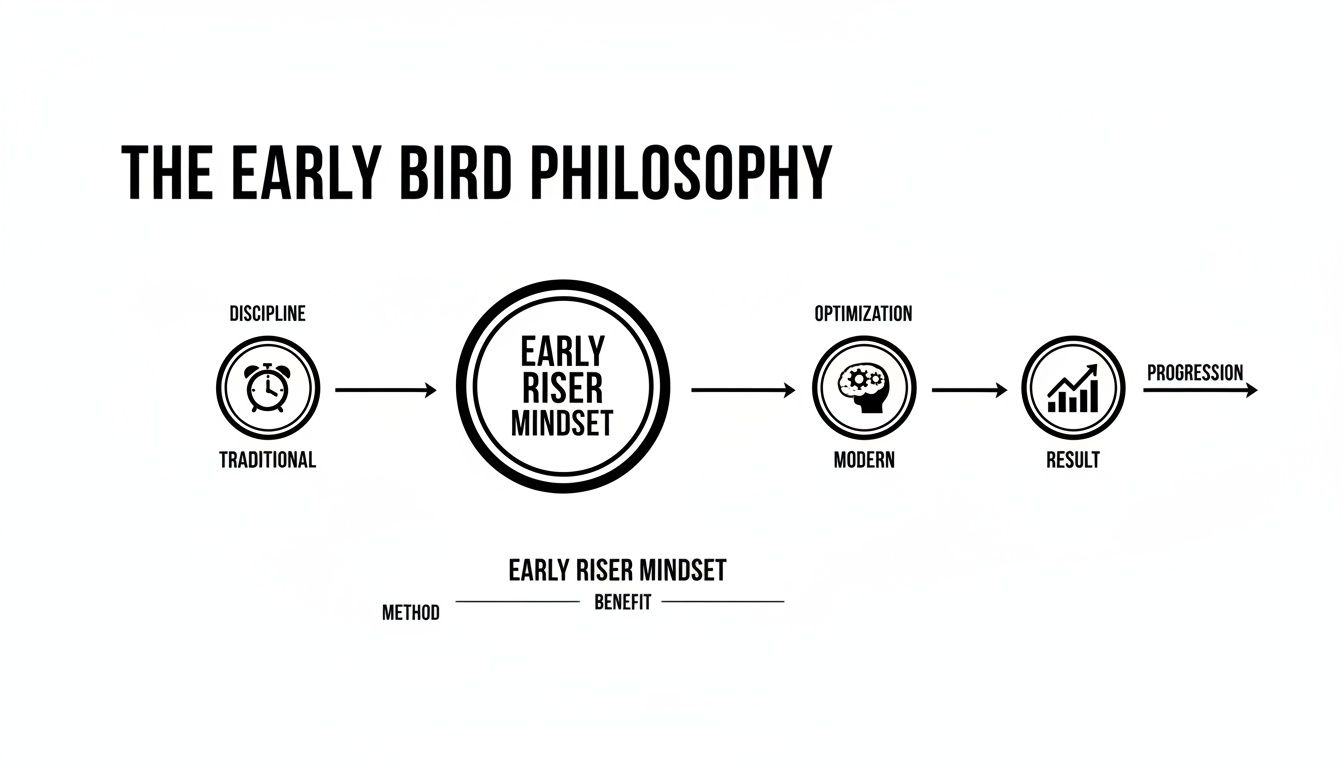
As you can see, the thinking has evolved from the discipline of the alarm clock to the strategic optimisation of the mind, which is what really drives better outcomes.
To help clarify this evolution, let’s compare the old and new interpretations side-by-side.
The Early Bird Philosophy Yesterday and Today
This table breaks down the shift from the traditional saying to its modern application in our lives.
| Traditional Saying | Modern Interpretation | Practical Application |
|---|---|---|
| "Wake up early." | "Start when you're sharpest." | Identify your personal peak performance hours—whether that's 5 AM or 9 PM—and protect that time for deep work. |
| "Be the first to act." | "Act with strategic foresight." | Plan your day the night before. This proactive step ensures you wake up with a clear mission instead of reacting to demands. |
| "Work hard from dawn." | "Work smart on high-impact tasks." | Use your prime energy to tackle the one task that will make the biggest difference, creating a domino effect of productivity. |
This modern, strategic approach empowers you to control your day rather than letting your day control you.
The Power of Proactive Focus
Ultimately, adopting this mindset is about managing your attention, not just your schedule. When you start your day with a clear, high-value goal, you're far less likely to get pulled into the vortex of urgent but unimportant tasks. This proactive stance gives you a profound sense of command over your life.
There are some clear wins that come with this approach:
- Reduced Decision Fatigue: Making your most important choice first thing preserves your mental bandwidth for the rest of the day.
- Increased Momentum: Ticking off a major accomplishment early on creates a powerful psychological boost that fuels everything else.
- Improved Work Quality: Your brain is often at its best after a good night's rest, which leads to sharper insights and more creative solutions.
Mastering this principle is a lesson in intentionality. It's about deciding what worm is worth catching and then setting yourself up for success. If you're looking for practical methods to build this skill, our deep dive on how focus is the rare skill you can actually learn is a great next step. This is how the early bird truly wins in the modern world.
The Dutch Blueprint for Peak Productivity
If you want to see a modern, country-wide take on the "early bird gets the worm" principle, look no further than the Netherlands. Here, the competition isn't about who stays latest at the office; it's about who works most effectively. Dutch work culture is built on a foundation of efficiency and deep focus, proving that real productivity has very little to do with the total hours you spend at a desk.
This national mindset completely flips the traditional idea of a long workday on its head. Instead of rewarding ‘presenteeism’—just being visible at your desk—the culture values concentrated, high-quality effort followed by genuine time off. It's a powerful, real-world lesson in working smarter, not harder.

And this approach gets results. Dutch professionals are among the most productive in Europe, despite consistently working fewer hours. The core idea is brilliantly simple: start the day with clear priorities, knock out your key tasks with intense focus, and then actually finish your day on time to disconnect and recharge.
Efficiency Over Endurance
The Dutch work ethic shows that success is a direct result of the quality and intensity of your work, not the sheer volume of time you put in. In the Netherlands, there's a shared understanding that an eight-hour day rarely contains eight hours of genuinely productive work. By compressing focused effort into a shorter timeframe, they protect their energy and maintain a much higher standard of output.
You can see this philosophy reflected in the country's economic performance. In the Netherlands, being an "early bird" is about how efficiently you work, not how long you stick around. Dutch workers average just 32.1 hours per week, the shortest workweek in the EU. Yet, their labour productivity per hour grew by 1.1% annually between 2013 and 2023, showcasing a model of sustained efficiency. You can dive deeper into this impressive work-life balance in this insightful article from Fortune.com.
The Dutch approach teaches a vital lesson: Peak productivity isn't about outworking everyone; it's about out-focusing them during the moments that matter most.
By internalising this, they not only achieve professional success but also carve out ample space for personal life, rest, and well-being. This balance is the secret ingredient to their sustainable model of high performance.
Applying the Dutch Model
So, how can you bring this blueprint into your own life? It starts with redefining what a "good day" at work actually looks like. Stop measuring your day by the hours you log and start measuring it by the meaningful tasks you complete.
Try adopting these principles for a more Dutch-inspired work style:
- Define Your Priorities First: Before you even think about opening your email, decide on the one or two tasks that will deliver the most value. Make them your mission for the day.
- Time-Block for Deep Work: Schedule uninterrupted sessions for your most important tasks. Treat these blocks like unbreakable appointments with your most important client: yourself.
- Set a Firm Stop Time: Having a clear end to your workday forces you to be more efficient and prevents tasks from expanding to fill whatever time is available.
This isn’t about being lazy; it's about being strategically effective. It’s the ultimate expression of how early birds catches the worm—by concentrating their efforts to achieve more in less time.
Unlocking Your Cognitive Head Start
Let’s be honest, the real magic of an early start has nothing to do with the time on the clock. It’s all about the state of your mind. Waking up properly rested gives you an immediate cognitive advantage—sharper focus, nimbler problem-solving, and a more creative spark right out of the gate. It’s the difference between starting a race with fresh legs and showing up already winded.
This is where the old wisdom of the early bird catches the worm gets a modern, scientific update. Quality rest is the non-negotiable foundation for a productive day, plain and simple. It’s what allows your brain to fire on all cylinders.

The Science of a Clean Mental Slate
Think of your brain as a computer's RAM. After a full night of sleep, that RAM is wiped clean, ready to process complex tasks at lightning speed. But as the day wears on, every email you open, every notification you glance at, and every small decision you make starts to fill it up. This build-up of mental clutter is what psychologists call attention residue—those lingering thoughts from one task that bleed into and slow down your performance on the next.
By tackling your most important work first thing, you’re dedicating your brain's cleanest, fastest processing power to what truly matters. It's a proactive strike against the mental drag that inevitably creeps in, ensuring your best energy goes to your best work.
If we were to rewrite the proverb for the Netherlands, it might be something like, “the well-rested bird finds more worms in less time.” Dutch residents get an average of 8 hours and 5 minutes of sleep a night, a good bit more than many of their European neighbours. This rest advantage, paired with a shorter average workweek, means many Dutch professionals kick off their day with a higher quality of attention, not just an earlier start time.
Your morning mind is your most valuable asset. A well-rested brain is primed for deep work, creative insights, and strategic thinking. Protecting it is not a luxury; it's a core productivity strategy.
Making sleep a priority isn’t about being lazy; it’s about being strategic. When you get enough rest, you’re not just prepping for tomorrow—you’re optimising your cognitive performance to make every single hour more effective.
For those serious about refining their sleep habits, tech-driven solutions can be a game-changer. If that sounds intriguing, you might want to check out our guide on improving your rest to sleep like a rose with Eight Sleep.
Designing Your System for Proactive Success
Knowing that proactive work is a good idea is one thing; building a life that actually supports it is a completely different ball game. To truly live out the “early bird catches the worm” philosophy, you need more than just a shot of willpower in the morning. It takes a well-designed system, both personal and sometimes even societal, that makes a proactive start feel less like a struggle and more like second nature.
Moving from theory to practice is all about designing a framework that consistently stacks the odds in your favour. This isn't about chasing the latest productivity hack. It's about deliberately constructing a routine, environment, and mindset that clears the runway for you to do your best work before the day’s chaos takes hold.
Auditing Your Current Routine
Before you can build something new, you have to get honest about what isn't working. The first step is to audit your current schedule and, just as importantly, your energy levels. For a few days, just observe. Notice when you feel sharp and focused, and when your brain feels like mush. This simple act of paying attention is where real change begins.
A great way to do this is to ask yourself a few key questions at the end of each day. You can learn more about how to structure these reflections by exploring the power of journaling for mental wellness. This practice helps you connect the dots and pinpoint the exact moments where your time and energy are getting hijacked.
Think of this audit as gathering intelligence. It replaces guesswork with genuine self-awareness, showing you exactly where your biggest opportunities for improvement are hiding.
The goal is not to force a rigid, early-morning schedule on yourself. Instead, it's to create a supportive structure that aligns with your natural energy, making proactive work feel less like a chore and more like a strategic advantage.
Getting this shift in perspective right is the key to making it stick for the long haul.
Building Your Proactive Framework
Once you have a clear map of your peak times and biggest distractions, you can start building a personalised framework. This is all about creating structures that fiercely protect your most valuable hours. It's about engineering your day so that proactive work becomes the path of least resistance.
Here are a few practical steps to get you started:
- Time-Block Your Mornings: Carve out the first 90 minutes of your workday for your most important task. Treat this block like an unbreakable appointment with your future self.
- Prepare the Night Before: Do your future self a favour. Lay out everything you need for that morning task—whether it's research notes, your gym clothes, or just a clean desk. This removes friction and kills decision fatigue before it starts.
- Negotiate Flexibility: If your role allows, have a conversation with your employer about adjusting your hours to better align with your peak productivity window. Many are more open to this than you might think.
These small, structural changes add up to a powerful cumulative effect. They put good habits on autopilot, freeing up precious mental energy for the kind of deep work that actually moves the needle. This is what separates fleeting productivity boosts from sustained high performance.
Interestingly, the Dutch have even applied this kind of system-level thinking to their entire society.
Dutch data reveals that being an “early bird” isn’t just about personal discipline; it’s about how a society structures time itself. Starting in the 1980s, the Netherlands began to expand flexible work options, actively encouraging a healthier work-life balance. By 2024, the average work week was just 32.1 hours, yet the country maintained an impressive 82% employment rate—outpacing the UK, US, and France. This shows how systemic support can make proactive, focused work a cultural norm, not just an individual aspiration.
When to Ignore the Early Bird Rule
The idea that the “early bird catches the worm” is a powerful piece of advice, but it’s definitely not a universal law. Forcing yourself into a routine that clashes with your natural rhythm can be a recipe for burnout, not breakthroughs. The simple truth is, not everyone is wired to be a morning person, and fighting that can do a lot more harm than good.
This isn’t just about personal preference; it’s baked into our biology. Each of us has our own unique chronotype—an internal clock that governs when we naturally want to sleep and wake up. Trying to force a natural ‘night owl’ onto a ‘lark’s’ schedule is like putting petrol in a diesel engine. It just won’t run properly.

Beyond Performative Productivity
On top of that, a rigid obsession with being early can feed into a toxic productivity culture. This is where you see presenteeism—the act of being seen at work early or staying late, regardless of actual output—get mistaken for genuine effectiveness. Real productivity isn't about being the first one in the door; it's about doing your best work during your own peak hours.
Pressuring everyone to fit the same mould ignores the incredible diversity of human energy cycles and unfairly penalises those who are sharpest at different times. The focus needs to shift from performative earliness to authentic, results-driven work.
The ultimate goal is not to wake up earlier, but to become more self-aware. The real wisdom of the proverb lies in aligning your most important tasks with your personal windows of peak energy, whenever they may occur.
Find Your Own Peak Time
To make this principle work for you, the first step is to figure out your own rhythm. This takes a bit of honest observation. For a few days, just pay attention to your energy levels without judging them.
- When do you feel most alert and focused? Pinpoint the exact hours when your mind feels sharp and ideas seem to flow without effort.
- When does your energy naturally dip? Recognise when you’re better off handling light administrative tasks or just taking a proper break.
- Are you more creative in the morning or late at night? Your creative and analytical peaks might not even happen at the same time.
Once you’ve identified your personal windows for peak productivity, you can start redesigning your schedule around them. This is the modern, much smarter way to interpret the old rule: work with your nature, not against it. That’s how you get yourself in the best position to catch your own version of the worm.
Your Early Bird Questions Answered
We’ve all heard the phrase, but plenty of myths and misunderstandings surround the whole idea of being an 'early bird'. Let's clear up some of the most common points of confusion and look at how this timeless wisdom actually fits into the realities of modern life.
Must I Wake Up at 5 AM to Succeed?
Not at all. The real principle behind the “early bird catches the worm” isn’t about a specific time on the clock—it’s about proactivity and smart energy management. It simply means doing your most important work when you’re at your cognitive peak.
For some, that might genuinely be 6 AM. For others, it could be 10 AM after a solid workout and a focused breakfast. The goal is to intentionally design your start to align with your personal energy cycles, making sure your best self is working on your biggest priorities.
How Does This Work If I Am a Night Owl?
If you’re a natural night owl, your proverbial 'worm' might just be found long after the sun has set. The core idea is exactly the same: pinpoint your peak productivity hours and fiercely protect them for deep, focused work.
This could mean blocking out 8 PM to 11 PM for a creative project or some strategic planning. In a way, you’re still ‘starting early’—just on the next day’s most critical tasks, while the world around you is winding down. The wisdom is in the proactive mindset, not the time of day.
The question isn't "how early can I start?" but rather "how can I best protect my most energetic and focused hours?" This shift in perspective makes the principle work for everyone, regardless of their chronotype.
Can I Apply This With a Rigid 9-to-5 Job?
Absolutely. Even within a structured schedule, you almost always have control over the first 60 to 90 minutes of your workday. This is your prime 'early bird' window.
Instead of immediately diving into emails or reacting to whatever came in overnight, dedicate that initial block of time to your single most important task for the day. By making real progress on a high-value priority before the interruptions kick in, you build momentum and ensure you're driving your agenda, not just responding to everyone else's.
At People & Media B.V., we believe in turning timeless wisdom into practical strategies for personal and professional growth. Explore our curated courses, podcasts, and articles to continue your learning journey. Discover more at peopleandmedia.com.

Responses