Is The Global Economy Headed For Collapse? Japan, the US, and Europe’s Structural Woes

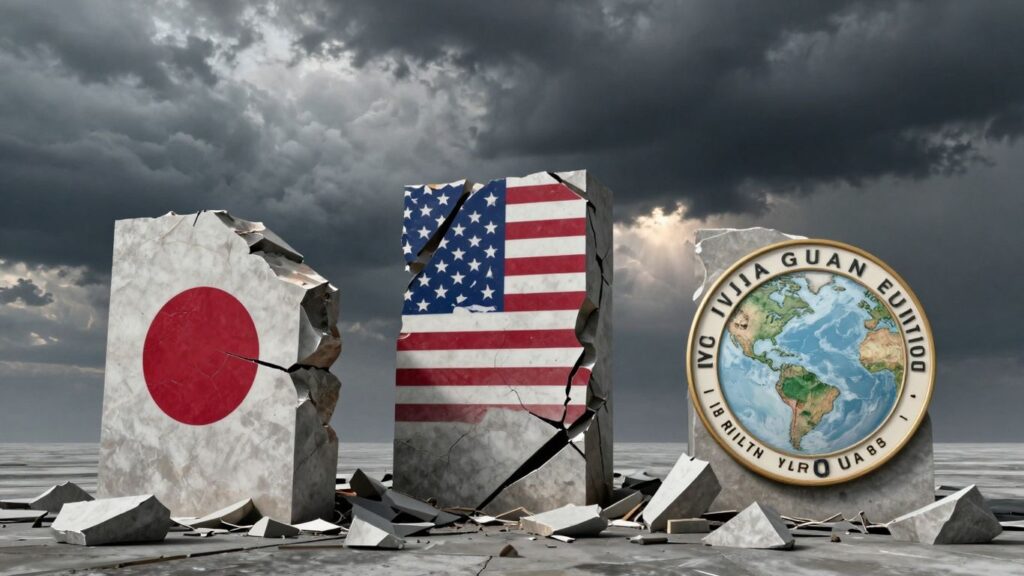
The word “collapse” gets used too freely in economic commentary — every recession becomes a depression, every correction becomes a crash. But the convergence of structural vulnerabilities across the world’s three largest economic blocs in 2026 is unusual enough to warrant serious analysis. Japan carries the world’s highest debt-to-GDP ratio (260%) and has been trapped in low-growth, low-inflation stagnation for three decades despite every monetary experiment known to economics. The United States combines record debt levels with political dysfunction, persistent fiscal deficits, and an interest burden that is the fastest-growing item in the federal budget. Europe is caught between energy price pressure, demographic decline, industrial competitiveness problems, and the fiscal constraints of a currency union without a fiscal union. Are these three crises converging into something systemic — or are they manageable, separate challenges?
- → Japan: 30 years of quantitative easing, negative rates, and fiscal stimulus have produced stability without growth — the “Japanification” scenario is now the baseline fear for Western economies
- → US: $36 trillion in debt with interest payments exceeding $1 trillion annually — not a crisis today, but a structural constraint that limits policy options and will eventually force adjustment
- → Europe: the energy price shock of 2022 permanently raised industrial production costs; German industrial competitiveness — the engine of European growth — faces structural challenges from Chinese competition and high energy prices
- → The contagion risk: these three blocs are deeply financially integrated — a crisis in any one transmits rapidly to the others through trade, financial markets, and currency relationships
- → The policy exhaustion problem: central banks used their most powerful tools in 2008 and 2020 — the next crisis arrives with less monetary ammunition available
Japan: The 30-Year Warning
Japan is the most important economic case study of the 21st century — not because it has collapsed, but because it has not. Since its asset bubble burst in 1989–90, Japan has tried everything that economic orthodoxy recommends for a stagnant economy: fiscal stimulus (running deficits every year since 1993), monetary easing (zero interest rates since 1999, quantitative easing since 2001, negative rates from 2016), structural reform (repeatedly promised, partially delivered), and currency depreciation. The result has been not recovery but managed stagnation: low unemployment, social stability, and essentially zero real GDP growth per capita for three decades.
The “Japanification” scenario — low growth, low inflation, high debt, monetary policy exhaustion — is now the baseline fear for the United States and Europe. The structural parallels are uncomfortable: ageing demographics reducing consumption and labour force growth, corporate zombie companies kept alive by cheap credit rather than forced into productive reallocation, and a political system that cannot deliver the structural reforms needed because the costs fall on constituencies that vote. Japan has shown that a rich, technologically advanced democracy can sustain this condition for decades without dramatic crisis. It has also shown that the exit from this condition, when it comes, involves painful adjustments that have been deferred for a generation.
“Japan did not collapse. It stagnated — and stagnation at high debt levels is not a stable equilibrium, it is a slow compression that eventually forces the adjustment that was avoided for decades.”
Europe’s Industrial Competitiveness Problem
Europe’s economic challenge in 2026 is different in character from Japan’s or America’s but equally structural. The energy price shock triggered by Russia’s invasion of Ukraine in 2022 permanently raised the input costs of European industrial production — particularly in energy-intensive sectors like chemicals, steel, aluminium, and ceramics. German industrial companies, the backbone of European export competitiveness, face Chinese competition in their core markets (electric vehicles, industrial machinery, solar panels) at the same time as their production costs have risen sharply relative to American and Asian competitors.
The Mario Draghi report on European competitiveness (2024) quantified the problem with uncomfortable precision: Europe needs €800 billion annually in additional investment to close its technology and productivity gap with the US and China — investment that cannot come from governments already constrained by fiscal rules, and that private markets have not been providing at sufficient scale. The combination of high energy costs, Chinese industrial competition, and underinvestment in the technologies of the next economic cycle (AI, semiconductors, clean energy) creates a structural competitiveness challenge that no single policy intervention can resolve. See the full context in our Global Economics overview and Macroeconomics series.
Is Systemic Collapse Likely?
The honest answer is: probably not in the near term, but the structural vulnerabilities are real and the policy tools available for the next crisis are more limited than for the last one. Central banks have demonstrated enormous capacity to prevent financial crises from becoming economic depressions — 2008 and 2020 both showed that coordinated monetary intervention can stabilise markets faster than almost anyone predicted. But each intervention leaves a larger debt overhang and less room for the next one. The question is not whether central banks can handle the next crisis — it is whether the fourth or fifth crisis in a sequence can be handled with the same tools when interest rates are already elevated and debt levels are already at records.
The more likely scenario than dramatic collapse is the Japan scenario: managed stagnation, slowly declining living standards relative to rising Asia, periodic financial volatility contained by policy intervention, and a gradual compression of the fiscal and monetary space available for future crises. This is uncomfortable but not catastrophic. The catastrophic scenario — simultaneous fiscal crises in multiple major economies, breakdown of dollar-based financial infrastructure, and geopolitical conflict that disrupts trade — is possible but requires a specific sequence of events that is not inevitable. For investors, the implication is not panic but diversification: across geographies, asset classes, and currencies, with more attention to real assets and less reliance on the assumption that 2010s-style financial asset appreciation will continue indefinitely.
The global economy is not headed for imminent collapse — but it is navigating a convergence of structural vulnerabilities that make the next decade more challenging than the last. Japan’s three-decade stagnation, America’s debt arithmetic, and Europe’s competitiveness crisis are not independent problems: they interact through trade, finance, and geopolitics in ways that amplify each other’s risks. The most likely outcome is not dramatic rupture but slow compression — manageable in the short term, cumulatively significant over a decade. The investor and policy implication is the same: stop assuming that the exceptional conditions of 2010–2020 were normal, and start positioning for a world of lower returns, higher volatility, and more frequent policy interventions.
Responses